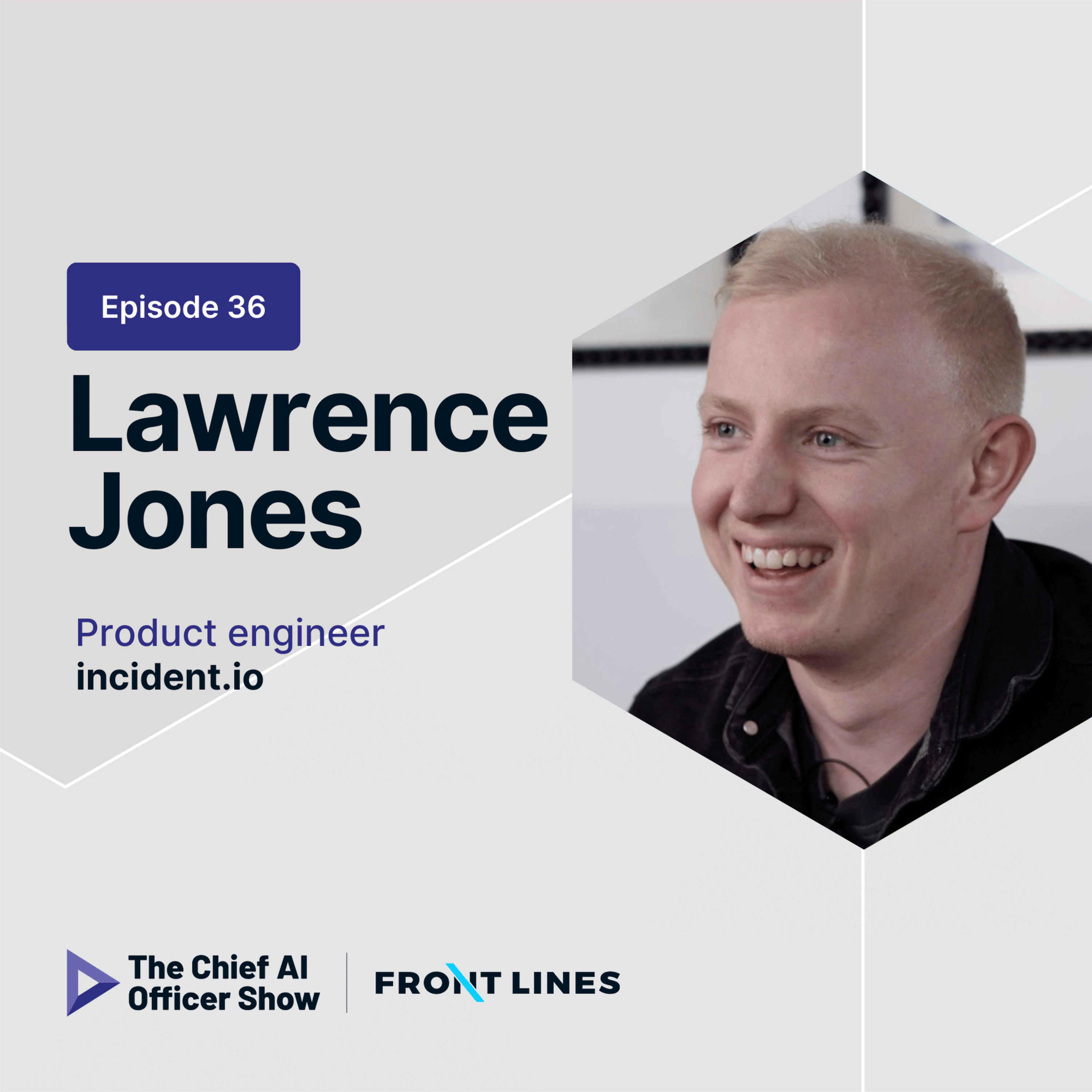
How incident.io built AI agents that draft code fixes within 3 minutes of an alert  episode artwork

EPISODE · Jan 29, 2026 · 44 MIN

How incident.io built AI agents that draft code fixes within 3 minutes of an alert

from The Chief AI Officer Show · host Front Lines

Lawrence Jones, product engineer at incident.io, describes how their AI incident response system evolved from basic log summaries to agents that analyze thousands of GitHub PRs and Slack messages to draft remediation pull requests within three minutes of an alert firing. The system doesn't pursue full automation because the real value lies elsewhere: eliminating the diagnostic work that consumes the first 30-60 minutes of incident response, and filtering out the false positives that wake engineers unnecessarily at 3am.The core architectural decision treats each organization's incident history as a unique immune system rather than fitting generic playbooks. By pre-processing and indexing how a specific company has resolved incidents across dimensions like affected teams, error patterns, and system dependencies, incident.io generates ephemeral runbooks that surface the 3-4 commands that actually worked last time this type of failure occurred. This approach emerged from recognizing that cross-customer meta-models fail because incident response is fundamentally organization-specific: one company's SEV-0 is an airline bankruptcy, another's is a stolen laptop.The engineering challenge centers on building trust with deeply skeptical SRE teams who view AI as non-deterministic chaos in their deterministic infrastructure. Lawrence's team addresses this through custom Go tooling that enables backtest-driven development: they rerun thousands of historical investigations with different model configurations and prompt changes, then use precision-focused scorecards to prove improvements objectively before deploying. This workflow revealed that traditional product engineers struggle with AI's slow evaluation cycles, while the team succeeded by hiring for methodical ownership over velocity.Topics discussed:Balancing precision versus recall in agent outputs to earn trust from SRE teams who are "hardcore AI holdouts"Pre-processing incident artifacts (PRs, Slack threads, transcripts) into queryable indexes that cross-reference team ownership, system dependencies, and historical resolution patternsModel selection strategy: GPT-4.1 for cost-effective daily operations, Claude Sonnet for superior code analysis and agentic planning loopsBacktest infrastructure that reruns thousands of past investigations with modified prompts to objectively validate changes through scorecard comparisonsBuilding ephemeral runbooks by extracting which historical commands and fixes worked for similar incidents, filtered by what the organization learned NOT to do in subsequent incidentsPrioritizing alert noise reduction over autonomous remediation because the false positive problem has clearer ROI and lower riskWhy AI engineering teams fail when staffed with traditional engineers optimized for fast feedback loops rather than tolerance for non-deterministic iterationBuilding entirely custom tooling in Go without vendor frameworks due to early ecosystem constraints and desire for native product integrationThe evaluation problem where only engineers who invested hundreds of hours building a system can predict how prompt changes cascade through multi-step agentic workflows

Episode metadata supplied by the publisher feed · Published Jan 29, 2026

Lawrence Jones, product engineer at incident.io, describes how their AI incident response system evolved from basic log summaries to agents that analyze thousands of GitHub PRs and Slack messages to draft remediation pull requests within three minutes of an alert firing. The system doesn't pursue full automation because the real value lies elsewhere: eliminating the diagnostic work that consumes the first 30-60 minutes of incident response, and filtering out the false positives that wake engineers unnecessarily at 3am.The core architectural decision treats each organization's incident history as a unique immune system rather than fitting generic playbooks. By pre-processing and indexing how a specific company has resolved incidents across dimensions like affected teams, error patterns, and system dependencies, incident.io generates ephemeral runbooks that surface the 3-4 commands that actually worked last time this type of failure occurred. This approach emerged from recognizing that cross-customer meta-models fail because incident response is fundamentally organization-specific: one company's SEV-0 is an airline bankruptcy, another's is a stolen laptop.The engineering challenge centers on building trust with deeply skeptical SRE teams who view AI as non-deterministic chaos in their deterministic infrastructure. Lawrence's team addresses this through custom Go tooling that enables backtest-driven development: they rerun thousands of historical investigations with different model configurations and prompt changes, then use precision-focused scorecards to prove improvements objectively before deploying. This workflow revealed that traditional product engineers struggle with AI's slow evaluation cycles, while the team succeeded by hiring for methodical ownership over velocity.Topics discussed:Balancing precision versus recall in agent outputs to earn trust from SRE teams who are "hardcore AI holdouts"Pre-processing incident artifacts (PRs, Slack threads, transcripts) into queryable indexes that cross-reference team ownership, system dependencies, and historical resolution patternsModel selection strategy: GPT-4.1 for cost-effective daily operations, Claude Sonnet for superior code analysis and agentic planning loopsBacktest infrastructure that reruns thousands of past investigations with modified prompts to objectively validate changes through scorecard comparisonsBuilding ephemeral runbooks by extracting which historical commands and fixes worked for similar incidents, filtered by what the organization learned NOT to do in subsequent incidentsPrioritizing alert noise reduction over autonomous remediation because the false positive problem has clearer ROI and lower riskWhy AI engineering teams fail when staffed with traditional engineers optimized for fast feedback loops rather than tolerance for non-deterministic iterationBuilding entirely custom tooling in Go without vendor frameworks due to early ecosystem constraints and desire for native product integrationThe evaluation problem where only engineers who invested hundreds of hours building a system can predict how prompt changes cascade through multi-step agentic workflows

PodParley-generated summary based on available episode metadata and transcript content.

NOW PLAYING

How incident.io built AI agents that draft code fixes within 3 minutes of an alert

0:00 44:38

No transcript for this episode yet

We transcribe on demand. Request one and we'll notify you when it's ready — usually under 10 minutes.

Frequently Asked Questions

How long is this episode of The Chief AI Officer Show?

This episode is 44 minutes long.

When was this The Chief AI Officer Show episode published?

This episode was published on January 29, 2026.

What is this episode about?

Lawrence Jones, product engineer at incident.io, describes how their AI incident response system evolved from basic log summaries to agents that analyze thousands of GitHub PRs and Slack messages to draft remediation pull requests within three...

Can I download this The Chief AI Officer Show episode?

Yes, you can download this episode by clicking the download button on the episode player, or subscribe to the podcast in your preferred podcast app for automatic downloads.
URL copied to clipboard!