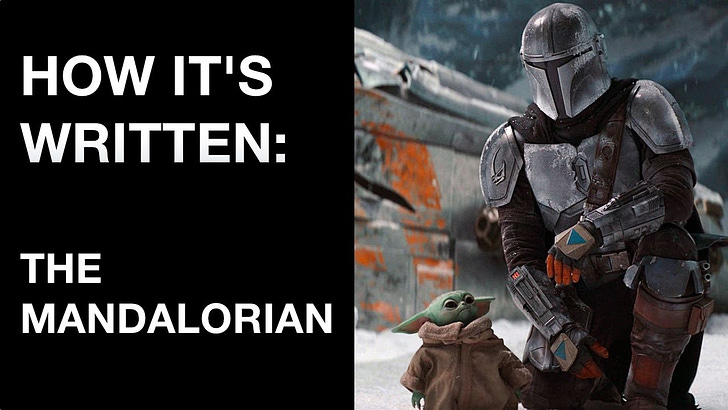
How It's Written: The Mandalorian
from Patrick E. McLean Hosted by Patrick E McLean
This week, I'm trying something a little different. In addition to this essay and podcast, I made a video. It’s part of my ongoing series, “How It’s Written” I’m explaining, in detail, why I think the TV show the Mandalorian is so well-written. And to do that, I delve into the world of the internal story. I think this essay it's more fun as a video, but it totally works as a podcast or an essay. So consume in the form that you find most palatable. Introduction Today on "How It's Written" we're going to dig into the immensely popular Mandalorian, I've seen lots of people commenting on this story, good and bad, but I don't think any of them have really nailed what makes the show so great. But that's not surprising, because that's what a well-crafted story does. It hides its workings so that you are drawn into and through the story, without fully realizing what's being done to you. But I'm going to lay it all out for you. Obviously, if you haven’t seen the whole show, here’s your spoiler alert. Go binge it and come back. The most important thing to realize is that for all it's wonderful action sequences, The Mandalorian is driven by its internal story. And if you don't know what I mean by that, or that all great stories are driven by the internal conflict, stick around. Internal v. External Story So, quick primer. One way to think about an internal story is that it is the story that matters most to the main character. I think this is what William Faulkner meant when he said, “The only thing worth writing about is the human heart in conflict with itself.” Take Rocky, for example. On the outside, Rocky is a movie about a hopeless loser who tries his best who gets a shot, tries his best, and loses. In fact, he gets beat up and loses in front of his girlfriend. But on the inside, it's a triumph. And we triumph with him. Which is why we love Rocky. Could you tell the story of Rocky without the boxing scenes? On one hand, the idea is silly. The boxing is how you show the conflict on the screen. It’s how Rocky demonstrates his passion and sacrifice. When you write a book you can put the reader directly into the mind of your character, but with film or television, you can't. So you have to have some way to symbolize what’s going on in your character’s head. But it can be anything that’s fun to film, boxing, wrestling, bobsledding, hunting a giant shark, a chess game, performing a difficult piano concerto, lightsaber duels, or a gunfight. So here's how the show works Every episode has the same structure. Mando gets a job, Mando does a job. He wants someone from someone, in exchange, they give him a quest, and he completes it in exciting and unexpected action sequences. That's it. That’s pretty much all there is to the external story. It's a formula and I love it. And, unless you're over-intellectualizing it, or trying to score clicks in pointlessly snarky YouTube commentary, you love it too. Because it’s amazingly well done. Because as fans and viewers don't want our expectations subverted. We don't want genre conventions broken. We want all of those things honored and given back to us in a way that makes them fresh and new. We want our expectations fulfilled in a way that we don't see coming, or with such a high emotional charge we just don't care. And I think that is one reason the Mandalorian is so refreshing. It doesn't have any pretensions to being important to the culture. They're just trying to tell an entertaining story. And that’s all that George Lucas was doing when he made the original films. And it’s not a thriller. The whole world isn’t a risk. The Galaxy is not in jeopardy. The kid is. And for me, that makes the stakes more real. Is anything in the universe going to change if Baby Yoda gets snuffed? Probably not. But, to the Mandalorian, it would be Armageddon. And that’s the internal story. Or part of it at least. So we’ve got sixteen chapters across two seasons. And across the loom of these episodes the internal story of the Mandalorian is woven. It’s the story of a traumatized orphan raised to be a violent killing machine who rediscovers his humanity by caring for an orphaned child. And his real change, I think, is from cold indifference - that detachment of the professional not just to love, but something beyond love. I call it selfless love. I’m going to go through this in detail, but my first thought is that it is kind of a small story. It doesn’t feel like two seasons worth of television. So I think any flaws in this show are because they were shucking and jiving, filling episodes. Or what you might see as a flaw or a misstep is the writers intentionally sacrificing the external story to make the internal story stronger. The most glaring one in my mind is in Episode 14 — titled the Tragedy, but what I think of as the Return of Boba Fett. In the standoff, Boba Fett demands that the Mandalorian takes off the jet pack. This means that he doesn’t have it on when the Child is taken by the Dark Troopers. Honestly, this is very, very dumb. Why wouldn’t he have put his jet pack back on? Seems very valuable, not the kind of thing you’d leave lying around? Because, if he had it, he’d just fly up to save the Child either, saving him or dying in the process. And it’s very important for the internal story to have the child taken from him. Because it is in recapturing the child — because the big fight that is to come, is how he will show that he loves the child. These “missteps” sets up a bigger, more satisfying story beats in the end. Find me anything you love and I will find you a misstep. This show isn’t perfect. But nothing is. Work doesn't succeed because it's flawless. It succeeds because its strengths overcome its flaws. And that’s worth knowing if you want to be a maker instead of a critic. This why hatchet job reviews and commentary bother me. Everything has flaws. And it takes no real skill or insight to them. What's harder to explain is why anything is good. In other words, how its strength’s overcome its flaws. In the first episode, there are only two beats in the internal story. 1. Mythrol tries to bribe him to not take him in. And the Mandalorian doesn’t accept. Because, even though he’s not exactly a good guy, he’s a man with a code. Which the show will beat us over the head with for a couple of episodes. This is the way. This is the way. This is the way. Yup, he’s got a way. Because this is a Western and Samurai movie. And Westerns and Samurai movies are the same thing. Because even if you swap out the pistols for swords a showdown is a showdown is a showdown. Yojimbo is a Fistful of Dollars. The Seven Samurai is The Magnificent Seven. And Kurosawa, the guy who made these Samurai epics, was in turn influenced by earlier Westerns. The cycles of influence never end. Until in 1970, Kazuo Koike and Goseki Kojima produce a Japanese comic called Kozure Okami. Which literally translates as "Wolf Taking Along his Child" but which you probably know as Lone Wolf and Cub. It’s a monster manga epic. This is the first volume and there are twelve of these books in the series. As you can see from the fabulous cover art by Frank Miller, we’ve got the cute kid in the baby carriage and everything. So it seems like it’s the same as the Mandalorian, but it’s not. Because of, you guessed it, the internal story. Now I love Lone Wolf and Cub, so don’t take this as a real criticism, but compared to the Mandalorian, The Wolf — Ogami Itto — is kind of an a*****e. Or a real hardass. At the beginning of the story, he has been ordered to commit suicide — his wife is dead and his clan has been betrayed. He is setting off on a path of revenge, but he’s got this little boy. So he lays out a sword and a ball and lets the kid choose. If the kid chooses the ball, he’s going to “send him off to be with his mother.” In other words, kill him. But the kid goes for the sword. So he takes him with him in one of the most satisfying stories of reckless child endangerment I’ve ever read. Bu… This is a public episode. If you would like to discuss this with other subscribers or get access to bonus episodes, visit patrickemclean.substack.com
Embed this episode
No transcript yet.