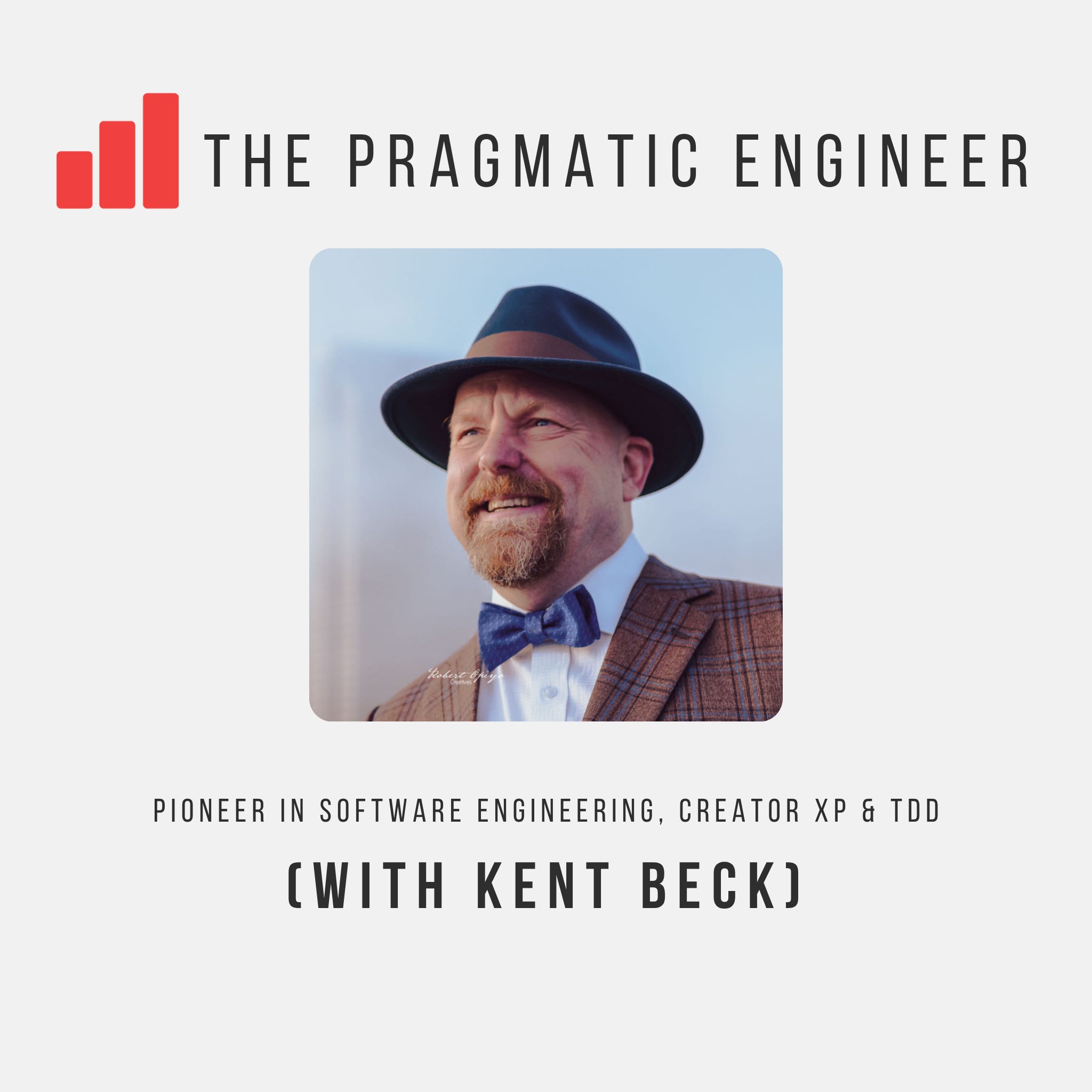
Ken Beck is one of the living legends of the industry. He's greatly shaped the software engineering profession and keeps impacting it even today. But there's not been a podcast episode covering his whole career from start to present, until today. In this conversation we cover, how Ken grew up with computers in the 70s and how he fell in love with Small Talk. The origin of stories behind TDD, Xtreme Programming and the Edge on Manifesto, and while Agile, the word, was a mistake.
Listen to all the stories like how he got fired from Apple, Ken's lost a decade into 2000s, and why he thinks TDD has failed. How he thinks about it and uses AI and will still excites him with coding after 40 plus years, and many more. If you'd like to understand how true legends will shape by the industry and shape software engineering himself, this episode is for you. This episode is longer than most of my podcast episodes, and I do hope that you'll find that it's worth the time to listen to Ken longer than he's ever told his story in one setting before. This episode was presented by Antisys.
If you work with agents, your job is no longer just writing code, it's specifying and testing it. Antisysys is the most effective method of verifying Agent code today. This episode was brought to you by TurboPuffer. A fun fact about TurboPuffer is how they become the search engine for AI agents. It seems like every week they had a new use case from one of the leading AI companies, Ram, Lagora, Harvey, Granola, they're all on TurboPuffer.
Or, as it seems like to say it, they're all puffing. TurboPuffer offers a full set of search tools, VectorSearch, Full-Text Search, Attitude, Filtering, RegEx and more in one API. It's built on object storage as a stole stateful dependency, so it's extremely scalable, reliable, and cheap. But it's also very fast thanks to its intelligent caching layer. One cool thing about TurboPuffer is you can have unlimited search indexes, so it's perfect for multi-cent AI applications.
Build an in-expertentant, data is isolated by default, and you can scale without thinking about it. Here's the best part. TurboPuffer just announced last week that they've dropped their base price from $64 per month to $16 per month, so it has never been a better time to test it out. Head to TurboPuffer.com slash pragmatic. And it's so good to have you in person on the podcast.
Very good. It's great to talk to you again. Yeah, I want to kick off with something really timely. There was this tweet going viral by Dario where he said, I quote, coding is going the way first, and all of software engineering. You had some things to say about it.
Yeah, my response is that that's a statement by someone who doesn't understand software engineering. Coding is part of what you're doing, but it's only a small part of what you're doing. Even if it takes up a fair amount of time, you're building confidence, you're building connections with other people. You're building your own understanding. All those things are happening while you're coding.
And coding's actually a great way to cement understanding. The more you program, the more you understand the domain that you're working in. So to say, well, we're just going to pass all that off to a machine. Well, that's not all there is to it. Interesting, because one thing that is so obvious with LMs is they just go really quickly, right?
Like it used to take us a lot of time to both type it out and also thinking out, but you're saying that there was thinking involved and understanding involved as well in that process, right? So a couple of days ago, I saw a phrase and it really hit me that we're accumulating code faster than we're accumulating trust. And that sense of trust comes from me struggling to understand some domain concept. I get it. I represented in the code.
I write tests that demonstrate that I really did understand it. And now I trust my program. But if we're programming together, that active programming together means that we trust each other more. If we talk to someone, an eventual user, and we demonstrate that we understand their needs, and they tell us, well, I want to button the decision. We're like, well, what problem are you really solving?
And we go back and forth and back and forth. That builds human trust as well. None of that can be automated. None of that occurs if we prompt the, we get the finger guns. You know, the genie goes, yeah, it's all finished boss.
And it's like, well, hang on, finish what's finished. As we're talking about software engineering, you mentioned trust connection, understanding. You didn't mention technologies. You didn't mention programming languages. You didn't mention, wouldn't even mention refactoring.
This is really interesting. You've been doing this for what? 50 plus years now. Do I understand that the human part is the hardest or most important part in software engineering? This is the biggest cosmic practical joke ever.
As young people who, some of whom, like I don't understand humans very well, we were promised, okay, here's this computer. And if you completely understand this computer, you'll be fine. That's all you need to do. So I set out the first part of my career just to become the best programmer that I could be, because that's what it would take to be successful. And then, whoo, sorry, there's this whole human side.
And your ability to affect change in the world is gated by your ability to communicate with, emphasize with empathy, not my natural strong suit, to convince, to communicate with, to soothe, to understand other human beings. And those are exactly the skills that I thought I didn't need to learn. So I was promised just to understand the computer and then just kidding, understand people from a position where I was already 10 years behind. So I'd like to go back to right there to the very beginning, because so many people know you from your books, from a lot of the techniques and the things that you've co-created or made a lot more popular, XP, TDD, a bunch of other just small refactoring and so on.
But going back, how did it all start? How did you have your first contact with computers? I know your father was an electrical engineer? Yeah, so my father started out as an electrical engineer. He was in the Navy in the Korean War as a radio operator.
Came out of that, went to school, got an electrical engineering degree, started working in aerospace as an electrical engineer and then moved to Sunnyvale, Silicon Valley, before it was Silicon Valley. This is before the invention of silicon. Oh, this was before? Yes, before there was, this is when there were still cherry orchards on El Camino. And I was born there about the time, so I was in sixth grade.
He brought home a programmable calculator, which was as big as, not as big as a stable, maybe half the size of the stable. Probably weighed 65 or 70 pounds. Yeah, it was 65 pounds. And it had, it had nixie tubes. Nixie tube is, this is before seven segment LEDs, because LEDs hadn't been invented.
You'd have an incandescent light bulb with 10 filaments in the shape of the numbers. And my first program was a loop that would just count up and down and up and down because the filaments were set one in front of the other. It's 0, 1, 2, 3, 4, 5, 6, 79. So I just wrote a program that would count up and down because I loved watching this go back and forth and back and forth and back for hours. I could just.
That's right. Absolutely. That was the first time I had my hands on any real hardware. Although I did find my dad would bring home books and I was a kind of obsessive factory me kind of kid, I would obsessively read these books and I found one of them lately in a during a move, the a burrows B6700 instruction set manual. And this was a really interesting machine to imprint on early because it has a hardware stack.
It wasn't register based, it was stack based. How they did that with discrete transistors, I will never know, but it's just a really interesting architecture. And that book, I would just read the pages over and over and I understood nothing, but I was just fascinated with this mechanism. So when I got an actual machine and I could play with it and something that resembled assembly language and I could get it to do stuff, I could have an idea in my head and if I understood this mechanism, I could get it to do the stuff in my head, which would spark the next idea. That's what really hooked me is that that creative impulse coupled with knowledge of the machine together, I could create things in the world that I wanted to see.
And this was very early 70s, right? Microsoft 72 maybe? So Microsoft wasn't even founded though, if not in 75. What was it like in terms of how common or uncommon were these machines? How much or little did you even think that they would go anywhere?
Or was it just a fun thing that has just been invented? Probably the first wave of miniaturization was the programmable calculator. So the one that your dad brought home. So no, like handheld calculators. Okay, so the big tabletop calculators was one thing.
But then there were these little calculators. I remember my dad buying an HP 35 for $400, which is, I have no idea how much that would be today, but a lot of money just for this little thing. It'll probably be $2,000. Yeah. So you had to keep the stacking your head of what order do I want to put the operands in and make sure that I stack everything and then you go plus plus plus and that would pop stuff off the stack.
And then the HP 45 came along and it had its own little programming language in it. And that was just like, okay, this is really, really cool. And then microprocessors started to come out and we had the Z80 and the 8,000 and 8,000 and the 6,800 and my dad and I soldered together our first 6,800 based machine. Then we were programming in assembly language, then about became basic, then that's what that's 70s. Yeah.
So that was really, I was spending a lot of time working on that machine. Again, I wouldn't say I understood it at an elite level, but I was fascinated and I, everything I could learn about it made me that much more effective at that creative impulse. Imagination of a thing in the world, execution, there's a thing in the world. And that just has always felt great for me. And then when it came to college, you chose University of Oregon, right?
Well, University of Oregon kind of chose me because none of the other places I had accepted me. No way. Yep. And what did you study there? How did your college years go?
Well, the first year was computer science and... So they already had a computer science? Yes. Yes. We had invented computer science by then.
The first year was CS and I enjoyed it, but I still wasn't a great programmer, but classes, I breezed through. It's always a little bit bored. So before the start of my sophomore year, it was really hot and I was walking through the music building and there were some flyers for signing up for auditions. And I thought, oh, I play guitar. Let me see what I can do.
Next thing I knew, I was a music student. So... Wow. So I started playing guitar when I was eight, kind of the end of the folk boom. Mrs. Card at a summer school class and there was a guitar laying around at our house.
And so I went and again just obsessed. She'd show us something and I'd go home and I'd play it until my fingers bled. Come in the next day and everybody else was kind of where they were before, but I would have mastered some picking patterns, some strumming pattern because I just played it for three, four hours. So I was very into music and in high school, I was in the choir, which was the big deal. We didn't have a lot of sports at our high school, but we certainly had music.
It was kind of natural that I would study music. At the end of the year of music, I missed programming. So I went back to programming, then I went back to music so I could do my senior recital. Then I went back to programming for a master's degree in another year and finished that. And so as I say, I just ended on the wrong year.
Yeah, because I checked. I think it was eight years in total that you spent at Oregon, like University of Oregon. Five years full time and then I had a hard time finishing my master's thesis. What did you have all the time? What was your master's thesis on?
It was a novel query language. Not surprisingly, I did not get along with the authority figures, which is a theme of my career. Yeah, just had a hard time checking off all the boxes and getting the whole thing finished. People said, oh, you're going to be sorry if I was just ready to quit. This is all hoop jumping and has nothing to do with programming and I was making good living as a programmer by then.
Oh, but you're going to regret it if you don't get your degree, if you don't finish, you're so close and it's never helped me one bit as far as I can tell. You completed it. I did complete it. It is important to complete things in that process from vision of thing in the world to careful activity to the thing in the world. There has to be some finishing.
Even if I'm, as the Reverend Jesse Jackson said, I'm a tree shaker, not a jelly maker. And that's definitely me. It's true for your work as well, also for software. Well, I keep switching topics. That's something that'll probably come up as we go through the various things that I've worked on.
What was your first job? It was while you were still finishing your degree the last few years. You started to work as a programmer, right? Correct. So during that graduate student year, a team from Techtronics came down to give a presentation about the programming environment work they were doing.
Techtronics was started out as an electronic test equipment company in Portland, did well in their little niche, but they opened up an industrial lab as lots of companies as that point did to do basic research. And part of that basic research was on programming environments. They came and gave a presentation. I asked them questions they couldn't answer. And so they invited me out to dinner, which led to an interview, which led to a job.
Techtronics was an interesting one because this is where you might war kind of gone, right? Yeah. So Techtronics had invested early in this crazy object-oriented programming language called Small Dog and was trying to make a commercial go of it. And I got there and looked at the research that had been presented down in Oregon and it kind of played itself out. But this small talk thing, wow, that's cool.
So I dove right into that. For those of us who have not touched small talk might have heard of it. What made small talk so such a hitch? What pulled you in? What is a language like?
There's a beautiful paper called The Design Principles Behind Small Talk by Dan Ingalls. And the opening line is, Small Talk is computer support for the creative spirit and everyone, which had two big themes. One was a language of programming, the small talk language, and another was a language of interaction. Overlapping windows, mice, as pointing devices, pains, scroll bars, those were all things that were pioneered out of the user interface. Those things are kind of ordinary today, but Small Talk, the language was built out of a very small number of primitives.
There's really only three primitives in the language, sending a message, assigning a variable, and returning a value. And that's really all that there is. So maybe towards the end, we can talk about my current projects, one of which is to build another new small talk from scratch, just because now that's within reach for anybody. But what I found beautiful was that the language pushed its own mechanisms to the absolute limit. So everything is an object in small talk, including numbers.
You don't call a function that adds two integers. You send a message plus, which is received by an integer and takes another object as a parameter. If that other object happens to be another integer, then you add them together. This leads to interesting things like there are no control structures to find. If the analysis is not part of the language, it's part of the library, because there's a, you send the message, if true, with a closure, to true, and it evaluates the closure, you send the message, if true, to false, with a closure, and it does nothing.
It just returns no. Everything is built out of the same kind of substrate. There's very few special cases in Small Talk, which means that sometimes you have to get clever to understand things like how does, how do, how do conditional work? But also when the time comes for you to build abstractions, you don't have a bunch of special cases getting in your way. It is a different way, think, especially looking at the modern programming languages that have a, the language comes with so many things built in, whether even if we're thinking of like later languages like Kotlin or Swift, or any of them, they have things like control structures and reserved words.
Why would you reserve words? How rude? The programming language should give me as much vocabulary as possible. But I do notice that with Small Talk, the people who have used it just get really passionate about it and love using it. And I understand doing my research that there was a time around that time for a few years where it started to become a lot more popular.
Can you tell me why it got more popular? And then what happened? It seems to have kind of fizzled out. Yeah, longer story, some of which I was not privy to, some of which comes down to business decisions. Objects were, were hopping.
We've been programming with the previous generational languages, Cobalt Fortran C, Algal, Pascal, for a long time. And we were used to the kind of constraints that those provided. And along came these objects and objects were going to change everything. People were really, really excited. But objects were going to make programmers so much more productive that we wouldn't need nearly as many programmers.
And in fact, it's so much easier to program with objects that ordinary people can write their own programs. They don't have to. I've heard this recently. Exactly. But seriously, this was what they were saying.
We're inside of the industry. This was the thing used objects or Small Talk and do more with less programmers, cheaper the works. Yeah. And to a degree, it was true. People would come in.
So, that's what they wanted was a significant step forward as opposed to, I'm going to write a thousand page requirements document and then wait eight years and not get what I want, which was the alternative that we were offering at the time.
So it's not the first time that we're expanding. Because again, if we jump to today, some of the things are happening. People in different domains who have never dreamed of hiring a developer are now building their programs on the same thing as playing out, which is if you look under the hood, if you, which your software engineering had on the look under the hood of that mess, there's lots of corner cases that aren't covered. It's impossible to modify and evolve. So far, this story, what Small Talk and electronic selling machines that come with Small Talk make ever more productive, clearly a pace for itself, that sounds great.
But that and what happened. There were alternatives that were easier to understand. So for example, Small Talk syntax is funky. It's this keyword in fix syntax. Along comes C++, which was originally called C with objects.
And the syntax looks familiar. Even though it's the design philosophy is entirely the opposite of Small Talk. There's lots of mechanisms and they're very complicated. But just the fact that it was approachable, that you could, there was a compiler because we were used to having compilers in Small Talk. There'd be some code you'd edit it.
And now you're running with the new code. There's no compiler in Linkstep. It's of course, it's just sitting right there. And if you're in the middle of, you know, if you could be editing some text and say, this doesn't work the way I want and hit Ctrl C and you get a debugger and go down the stack and you find the code that's not doing what you want and you fix it and you continue on your way. And then you're writing again.
That was, that was that level of, this is intended to be a personal computer. And part of that sense of ownership was that you could see everything and you could change everything. Now it turns out if you have a hundred people working on the same program, you need to put the breaks on. Everybody can't be changing everything in incompatible ways at the same time. That just doesn't work.
But in terms of this is my computer and I feel power because I understand it, I can have more ideas that I can then execute on degrees. Things in the world, it worked great for that. Now while at Textronics, you work with War Konnagem who would later become the developer of the first ever Wiki. He had a huge influence or he helped create design patterns. He also helped with extreme programming.
Can you tell me about what it was like working with him and how you and him started to get into design patterns which back then didn't exist, right? This was something you would have ventilated. We needed to give training classes on small talk and Ward had written some small talk. We knew each other. There were probably 60 people, 80 people in the labs.
So we knew each other by side. I had learned a bunch about small talk working on my own projects. I was working on programming language for prologue because logic programming was also a big deal at that time. So I implemented I think three different virtual machines for prologue including some nice animations showing how prologue's unification mechanism worked. I guess for those of you who don't know prologue is this, the current of language is a very different way of thinking.
No variables as I think. No variables is FBE. Sorry, but it does have some funky stuff. I used it a long time ago. It's fun.
Turns out to be difficult to write big programs in. But it's a good exercise because there aren't control like do this thing, then do this thing, then do this thing. It's more like a theorem pervert. So I was working on that. War to build this example code for the small talk class.
And he said, I just want to run you through this code. So I sat down next to him and he showed me the code for plumbing. Cool plumbing. And I suggested some improvements. We gave the class together.
I met some people who would later become lifelong friends in that class. And then we just kind of fell into a rhythm of, well, I wonder if we can make small talk do this. Because the universe of what it meant for a computer to support programming was just exploding. We had this high resolution screen, which nobody had ever had before. We had this dynamic language, including our own implementation of it.
So we could tweak it if we needed to. And we just didn't know what was even possible. So at first, and Ward was always a much better programmer than I was in terms of low level technique. He also had a gift for design at a higher level and a gift, as you see in the wiki, of picking powerful top level goals and then making something that does that. But I was this 24 year old punk with attitude and he didn't let me touch the keyboard for a while.
I could watch him and then eventually I was like, those parentheses don't balance. You need a period here. And I was actually being useful to him, even though, and I was absorbing watching a master programmer work. But I wasn't really driving stuff. Eventually, though, I started understanding the low level patterns and then building up to the next level and the next level.
And then I would say, why is this called this and not that? And pull out a thesaurus and look it up and find just the right word for things and then continue. And eventually I started making suggestions that he wouldn't understand right away. And so I would take the keyboard for a little while, say, well, I get it, I get it, then you take the keyboard back. Over the course of a few months, we developed both a programming style where the keyboard was going back and forth, where we were talking at multiple levels.
You know, we talk about, here's this code, why isn't it working? Is this the thing we should be working on at all? What programming tools would we need for this to be easy? What should the design be so this whole thing should work well? Should we even be doing this at all philosophically?
We would bounce between all those levels in the active programming. And we had a weekly cadence where Monday morning we'd have a coffee and we talk about the list of things because we would then, out of those conversations, we'd come. I wish we had a thing that did a thing. We would talk about that and then we'd say, okay, well, let's go down and see how far we can get. And over and over Tuesday, Wednesday, we would make a bunch of progress on what we were working on.
Thursday, we'd be giving demos and refining it. And Friday, we'd write a tech report. So there's this whole string of tech reports that we wrote over the course of maybe six or 12 months of really working together intensely. Even if one of those weeks failed, you know, we'd have our coffee Monday, Tuesday, Wednesday, as didn't work, we would know why it didn't work and what it was that we needed in order for that thing to be easy in the future. And that goes into the hopper for the next Monday's coffee.
So we developed a wide range of programming tools and applications, some foundational stuff. So we had a graphics editor called Hot Draw because we had this graphical interface and everybody had been used to text interfaces for so long. But now we had high speed graphics. Oh my goodness, what can we do with this? So we kept making graphical interfaces, but it was hard to make graphical interfaces.
Yeah, I have a photo of early Hot Draw. Yes, absolutely. And this reminds me when I look at Hot Draw, this, you know, like these boxes and arrows, they do remind me later of things like UML and a bunch of just the, no, not the exact ideas, but visualizing. And of course later, I think these days, people don't use UML, but you still, you just go to the whiteboard and you draw out boxes and arrows and how they connect sounds like you did this back in 87 or something like that. Correct. And because we had high performance for the time, graphics primitives, the magic moment
out of Hot Draw was we drew a series of rectangles kind of on top of each other. We selected every other one, we clicked on it, we started to move it back and forth. And you could, and because we could, we could do maybe 10 Hertz animation, it was, it was smooth and you could just see half of the rectangles, you know, kind of moving behind the other hand and it just, this is so hot. We were just really excited about it. Oh, that's why we called it Hot Draw.
That was the name because that was the reaction to being able to see this smooth animation. And before that, writing that kind of smooth animation was a bespoke thing and took a lot of work. And with this, you subclass figure and now you have something that works in this two and a half D world and away you go, those figures though were meant to represent some thing in the interface. It wasn't just a rectangle, it was a processor, it was a generator or it was a whatever. And then you click on it and you get these handles on the figure, which each of which represents some way to manipulate the state, not just of the graphics thing, but again, there was intended to be meaning behind it. So you'd have a handle that would raise and lower the temperature
and another handle that would change the pressure or whatever, whatever domain you were working in. And then you had, it was a boxes and arrows model. So you'd have connections between things and the connections again were intended to be semantic, but would follow the figures around. And actually the words figure handle drawing, a ward came up with those. Mine were something pedestrian, drawing object, drawing handle. I didn't have good words for it. And this was where the sarsasaurus
came in was, ward would think about, okay, this is like figures in a book. We had an analogy, there was a metaphor to what we were doing. But in the computer world, you can have figures and do I understand that you actually had a physical is ours, like a book with words in it, you would actually as a programmer reach for this book with words and open up to find better words all the time. Was this just you doing it or the programmers in general have like people that you knew that they also have the sarsas? We were on the far end of the obsessive scale for this. There were other
people certainly who were fighting for the right words. But this just reminds me of how the programming is just more than just writing code, how you need the scales. For example, if you are well read, you can probably write more expressive programs or if you're not well read, having the sars, of course, you could do it online. But I assume that by opening up the book and looking through and reading a lot of other words, your vocabulary will start to grow. Therefore, making you a better programmer or someone who can write a lot more understandable or maintainable.
Part of the goal of programs is to communicate intent to other human beings and now to models as well, which is a much more open-ended problem. We understand a lot more about how to communicate to other human beings, whether we apply that understanding or not, we don't understand at all how to communicate effectively to models and people are trying out all kinds of things, which is great. That's what you do. Yeah, and then later Ward went on and he got very much involved with design patterns. I can now see with Hobt-Traw how the design patterns in the Gang of Four later, you see boxes and arrows, how I see some resemblance on being able to visualize objects on a monitor.
Yes. All of the pieces were working together for us. The patterns work. I had become interested in Christopher Alexander at the University of Oregon. I couldn't afford the timeless way of building, so I read it standing up in the bookstore over the course of several visits. Ward had also been
exposed to Christopher Alexander in patterns. Alexander wanted buildings with a certain spirit to them. He talks about it in kind of mystical terms, but that's okay. He hypothesized that if people made their own decisions about the design of buildings, that this spirit would exist in a way that didn't, when the architect would say, well, tell me what you need in a building and then I will program myself to dream of your perfect space and then I will tell you I will bring to you the solution. The way he wanted to work was to empower people to make decisions within constraints.
Me designing a house, I am going to have roofs that fall down and walls that don't match and whatever because I don't know. I need constraints, but I know more about my life, so I should be the one making the decisions about family dinners are really important. Also, this is in the domain of architecture, strictly physical buildings. You have a lot of inspiration from this domain, even though software is very much a virtual that's in our head, right, or in the computer. Right. So the patterns are the constraints. You can't just make any decision. You make
particular decisions at particular times based on the constraints that come from the decisions you've already made and that creates constraints for the next decisions that you make. We wanted that for the users of programs, taking this small talk, personal computer ethos to the next level. And so we were consulting on a project that wasn't going well at tectronics. Some programmers were writing software for some test engineers and it wasn't going well. So Ward came up with the initial set of patterns that we would use for designing a user interface. Again, graphical interfaces were
brand new. Nobody knew what to do. There were all kinds of crazy things coming out. In music school, we learned about the evolution of musical notation. And when musical notation first came out before then, it was entirely an oral tradition, then musical notation was invented and some of the most complicated music ever written was written in like 1200 or 1300 right after musical notation because nobody knew what the limits were. And then they settled down, it was like, okay,
four part motet. That's fine. We don't need to have 60 different instruments doing 60 different things all at the same time, just because we can. Well, it was the same kind of way with these user interfaces. Nobody knew how to organize them. So we gave this initial set of patterns that Ward had
come up with. And we talked about here's different Alexander and patterns. And I ran across a copy of notes on the synthesis of form at Powell's books in Portland and devoured that, which is kind of the theoretical underpinning of patterns. We handed the patterns to the test engineers and said, okay, we're just going to start over, use these patterns to break your process down into windows with pains. And we were careful to only allow them to do things that we knew that we could implement. So they
couldn't come up with anything. The pains had to be lists or texts or waveforms. The waveforms were special, but that's okay. We could do that. Each task that you had to do in this testing process would have its own window. And so there was, you know, four or five different patterns. And they
came up with an interface that was eminently implementable. And they felt like they owned it. And then the small talk programmers would look at that and go, okay, well, how do I implement this? How do I implement that? So that was our first foray into patterns. People get really fussed about this
transfer of responsibility. They want to think, I am the designer of interfaces and I worked hard at this and I want to ask you a bunch of questions. And then I want to cogitate on that. And then I'm going to bring you the solution and then you'll thank me and pat me on that. Of course that doesn't happen. Your understanding of somebody else's problem is bounded because you're not in the middle of it.
You don't have the same skin in the game. If you're not semi-conductive test engineer, you don't have as much skin in the game as somebody who is because they're going to have to be using this interface for a long time after you're gone. Yeah, there's also this concept of the flyby architect on teams who, you know, is very senior person has built a lot of stuff and the team is struggling. They call him and they call him or her in. This person comes, does some suggestions.
Seagull. Seagull. Seagull. Because you fly and you make a bunch of noise, you just grab all over everything and then you fly out and you drop skin in the game. Yeah, that's interesting because if we, anyone who's worked in teams of a certain size or certain tenure, you see it happen and it doesn't really matter how highly skilled that person is. There might be a few exceptions,
but generally if you don't have skin in the game, you just make different decisions. And then after a tectronics, you work at Apple. I only realize this about you. How did you get into Apple? This was in 1987's very exciting time from my research. How did you get in there? What did you do there?
So Smalltalk was going up like a rocket at that time. Xerox had developed Smalltalk, it handed it to four, I think, companies to see, can you also implement it or is this something special? So HP, Apple, tectronics and Blanking on the fourth one. HP really didn't do anything with it, but Apple and tectronics ran with it. So Apple had its own implementation of Smalltalk and they wanted to not commercialize it in the sense of selling it, but commercialize it in the sense of having something that this was right after the Mac had come out, something that you could use on a Mac.
And so I knew about that project. I was getting too big for my Brits at tectronics. I learned a lot. There's a thing, there's this kind of compression that happens. When you're growing faster than the organization can recognize that you're growing, but also you're not growing as fast as you think you're growing. And eventually that gap between how people see
you and how you see yourself and then somewhere in between is how you really are. If those gaps get too wide, you just have to move. So I was ready to move on. So I contacted Apple and I worked for about a year on the Smalltalk project, which ended up going nowhere because it really didn't make sense. Smalltalk could work in quite a small memory footprint, but the only developer tools Apple really needed was a C compiler, Pascal compiler. That's what they built their software on. We'll see.
That's what they built their software on. That's what everybody else did. There was a thriving third market for other developer tools, but the Smalltalk wasn't going to do really do anything for anybody. Maybe school kids or something, but it wasn't. It wasn't driving Apple sales. People who bought
Apple computers typically didn't want to do Smalltalk. So we talked about the client of Smalltalk. I'm sensing around this time, it's like as personal computers started spreading, it seems like it just remained the niche, right? No, it was quite strong at that time. It was growing fast. Lots of people
like relative to the previous year were using it. A company had spun out of Xerox called Park Place, which was selling Smalltalk as a big ticket item for developers. This is before there was open source out there. The idea that you could charge money for language implementation was lots of people were doing that kind of thing. This was running out of that same kind of playbook. It was still
doing that. It just didn't make sense for Apple's customer base, correct, and their hardware. Yeah. Also, though, at the same time, a bunch of Xerox people had come to Apple. My friend Larry Teslaer was there. My friend, I mean, bitter enemy. I respect it a lot. Sometimes there are people who
just raised the hair on the back of your neck. Larry Teslaer was one of those. To me, and I don't know if even the feeling was reciprocated. He passed a few years ago. So I never got a chance to talk to him.
But I talked to him. We would check in afterwards. Anyway, he was the head of the Advanced Technology Group at Apple at that time. Alan Kay had moved to Apple and was working on a programming language for kids, another programming language for kids called Playground. Again, Deningles was there.
So a lot of the Xerox folks were at Apple and I heard about Alan Kay's project and thought, that was a dream of mine. The Bike Magazine had an article on Smalltalk. I read about the development of Smalltalk. The project started in like, 71. And it was 1980 before they released anything at all publicly. And just imagining working in that environment just seemed like heaven to me. So I moved to
the Alan Kay's Playground project. Now, I was horribly ineffective. Ended up getting fired from that job. No way. Yeah, sure. As a programmer, you being inefficient, what happens?
I wanted to do my own thing. And this was still, I'm still in this punk mode where I'd listen to somebody else's ideas and go, I don't think so. I have a better idea. And if you're working by yourself, that's okay. But if you're working in a team, that's not okay. So it came to a head,
I was the program chair for the Oopslet Conference, which we probably should have mentioned earlier. There was this conference. And it was the hottest conference. And everybody who was there, and it was growing fast. And I was involved in it, kind of stumbled into it. But I was in 89, I was a program
chair for Oopslet, right? For Oopslet. And I spent a month just reading papers while ignoring my duties to the Playground project. And that was kind of the final straw. Okay, you're not helping us.
So you need to move on. And then the conference happened. And my second child was busy not being born. So I didn't even get to attend the conference. But I'd heard about the Playground project. So I moved to the Playground project and did a little bit to help build this programming
language for kids. That was the next thing beyond object oriented programming. You would call it, today you'd call it reactive programming. So you couldn't send a message, you could only raise some condition that some other object would be waiting on. So it's like PubSub. But that
was the only control mechanism. And then I once asked you about this was around this time CRC cards. What are CRC cards? I know they sent for class responsibly, collaborator cards. But what were they and how did you come up with them? You have these imperative
programs and you have a flowchart which represents accurately if kind of verbosely the control flow in a parrot program. Now we have these objects and you send messages which are polymorphic. So you don't know exactly what code is going to be invoked when you send a message. And people were like, well, how do you even visualize, internalize? For me, I'm a aesthetic sensation. So I can feel
in my body, if I'm looking at some code I can feel in my body, it wants to go this way. It's yeah, which is I don't know if I've met anybody else who describes their experience of programming the same kind of way. But there we go. How do you get a sense of however you internalize this, of what's going on in this program where you can't just say, we execute this line and then we execute that line. Because as soon as we send a message, we don't know what's going to happen. So Ward came
up with the idea to write down on cards, index cards, here's what's going on, because we would talk this way all the time. So, you know, we've got to have a rectangle and it asks the renderer to do the saying and then that goes into the pipeline which the blah, blah, blah, blah, blah, blah. So we would talk with our hands a lot. So he said, well, why don't we write these things down on cards? So a big challenge in object-oriented programming is dividing the responsibilities. Because you're
moving the computation to where the data is saying, well, this object does this and that object does, that is a really critical decision because you want the computation near to the data so that there's less coupling between them. Just a lesson that I think kind of got lost in the noise. That's the fundamental design moving on in designing object-oriented programs and I think I'd stand behind that. So have a data be close to where it's used, where the computation will happen. Backwards. Backwards. Have the computation move to where the data already lives?
I'll have the competition move to where the data is. So like if you have a rich object with a lot of data inside of it, for example, you want the computations to move, there's you want the like objects invoke and just get the data and do whatever computation they need to. If I'm going to operate on stuff that's on the inside of a rectangle like area, do I have height times width scattered all over the universe or do I have an area inside the rectangle that does heighten with? At the limit, now I don't care that the rectangle has height and width. That's hidden from the rest of the world. Like I can represent the rectangle with two corners or I can represent the rectangle
as a top left, a height and a width. So the rest of the world, it doesn't matter as long as they both respond to area. So now I can come up with another representation and another representation and the rest of the world doesn't have to care if I've moved the computation where the data lives. Yes. And that means you can have loose or coupling. Correct. Understood.
It's a good lesson. Yeah. Yeah. And even today because everything that we do is under the hood, almost everything we do as objects or a lot of these object oriented. And I don't think we think about these. Yeah. I see a lot of criticism of programs written in object-oriented languages
that aren't criticisms of object-oriented programming or design. So after Apple, you move to a company called MassBar and the thing that I notice here is unit testing. This was the place where as I understand, you came up with something called SU. While I was at TechTronics, I got interested in testing. At that point, testing was a sociological divide. If you got A's and B's
in computer science school, you got the program and if you got C's, you had to be a tester. So it really was like a status. I'm not going to test. I'm one of these guys. I'm one of those. But I got
interested in how would you automatically test programs? How would you get a sense of confidence in what you were doing? So I tend to be an anxious person and the more complicated my programs were, the more I had to be anxious about, the more experience I had with what kind of bugs could possibly exist, the more anxious I got. I thought there was just some way to kind of quell this without pills. That would be great. I tried out a bunch of different approaches to writing automated tests.
At that point, in addition to this status divide, there was a tool divide. You had testing tools, which would have their own kind of language in some way to connect with the program that was under test. So I tried this and that and the other thing. It was actually after MassBar that I think is all ancient history. So we'd have to go dig through the archaeological layers. I started
consulting and I was going to tell a client that they should write tests. I was going to fly out to Chicago the next day, but I didn't have any way for them to write tests. So out of these five or six experiments that I'd done, I synthesized test case test suite and test result. That was like three classes and 12 methods, but it was a framework where you could write tests that would execute isolated from each other fully automatic and give you a roll up of the results of it. So this was pretty much a unit testing framework for small talk. The first version was written in
small talk. So MassBar was a Silicon Valley startup, venture funded, intended to build an entire new architecture, which was a SIMD, single instruction, multiple data. So we would have a torus of processing elements up to 16,000. So you have 16,000 and they're connected in a toroidal grid. So you could talk to the processing elements left, right, up, down and diagonally. And it looks very
much like the NVIDIA architecture now. But this was way back when, and it was just too early. So three years of that building programming environments for high performance computing. So the intention was to get the kind of performance you get out of a cray at that time, but for a tenth of cost. And they needed a programming environment. So we built a programming environment in small talk.
They did some really cool stuff. You could single step of Fortran program and build a performance profile at the same time. No way. So you built a runtime that allows you to build in small talk to interpret, for example, for program programs and run them. No, we had a standard compiler, an optimizing compiler.
But because we had, we controlled the operating system, we could build really low level probes to collect performance profiling data. So we could get line level profiles for these Fortran programs running on 16,000 processors and great gobs of data. That's awesome. When you're going from not just, like, you're going to lower level, like building infrastructure, that runs programs. But then I want to go back to S unit. So the concept of S unit,
the, the, the, these concept be particular test case, what was it, the test case, test suite, and test result. This really became sticky because then there was JUnit, which you later created with Eric Gama. And there's a whole suite and unit for, I think that was for .NET, XUnit.NET. All of them took over some of these ideas and a lot of modern unit testing frameworks are built on some of these ideas. Why do you think it was so sticky and why do you think it wasn't created beforehand?
So beforehand, because of this social divide between programmers and testers, there was a lot of incentive for the testers to have their own language. This is my tool. I know how to run it. I'm going to run it. And it was very adversarial at that time too. And kind of patronizing, like,
you're a programmer. You can't be trusted to test. You know, you'll just say it works fine. I'm going to be the adult supervision. You know, and sometimes, sometimes the programmers really did act that way. So I, you know, hard to argue with. But I think that encouraged this idea that a testing
tool is its own, its own world, the inspired decision to use the same language to test as you're testing. It was a natural decision because I was in Smalltalk and you should be able to represent anything in Smalltalk. So, you know, and I was just used to, how do I represent this as objects? Sounds like Smalltalk as a language has been early to a lot of things. I sense a lot of innovation coming from Smalltalk because it was one of the first languages that did have objects, but it was a very simple language. So you needed to build a lot of things, which then led to representing a lot of
things, to talking about them design patterns and now also, you know, being able to write your test environment if you're being forced to do so if you wanted to do that. Well, there was an ethos that went along with Smalltalk. So if you didn't like the tools, if you're running the debugger, then the debugger doesn't have some feature that you really need right now. You just pop on the stack, implement the feature that you want, and then get back to whatever it was you were doing. That was just a natural thing because there was never this huge gap. You know,
imagine today I'm using a C compiler and I realized, oh, I wish C had this new feature. We're embarking on a multi-year project to go and like the huge barrier to entry to go to the next level. And in Smalltalk, by design, for example, you pop up menus and then you can see all of the options right there. That's a deliberate pedagogical choice. It says, okay, well, you know about cut and paste, but you don't know the other things that you can do right here. So the menu doesn't just give
you cut and paste, it gives you all the things that you can do as a way to encourage you to learn about them because eventually you're going to see this format item here and I said, well, what is that too? So it was very much part of the Smalltalk, so that the system would teach you as you kept using it. So yeah, it was very natural to build the testing tool in the language. And of course, you have to kind of bastardize the language a bit. Here I've got this class for some test case, and I have a method which is one of the test cases and it starts with TEST, which is kind of magic.
You know, and this is getting squigy. And then when you execute it, you create one of these objects, you send it set up because you don't know, you don't have to build some stuff. And then you send the test TEST something or other, and it executes that one thing. And then you then assuming, well, then regardless, you run the teardown from that. So it's not it looks like the syntax is the same as the language. The representation of the tests, you kind of borrow from the representation of just any
kind of code, and then you interpret it yourself. So it's it's in the language, but it's not really in the language at the same time. But people don't think about that. They just think, I subclass this, I give a method with the annotation of test or with start TEST and then it just starts working. And that's fine. I want to jump to a few years later, from 1996, you start to work on a project
at Chrysler, and this is where you met Martin Fowler. What was this project? I'd actually met Martin Fowler a little bit before that. So as early as the first Oopsle conferences, the question of how do we manage projects with objects differently than we managed projects with the previous generation? The previous generation tools definitely gave you well many fewer options for change. You'd still
have to change code, but it was just a lot harder compared to working with object oriented programs. So what is the methodology? We had we had the structured analysis structure design. What is the methodology for for objects and how should it be different? That was the million dollar question at the original 86 Oopsle. By the time 94, 95 rolled around, we were starting to get a clue
what that would look like. There were, I think, the rational unified process or the things that would go into the rational unified process already existed by that time, which was great, which was involved in that. Grady Booch, Yvar, James Rumbaugh, Yvar Yachobson. So people were coming up with some kinds of answers. Ward had come up with his own answer called episodes written as a pattern language because we were like, you know, I don't have a big bag of tricks up to keep using them over again. And the same just turns out of everybody. So you can find that episodes on Ward's C2 site.
It's really interesting to compare that because I borrowed heavily from that. I borrowed from everything else that I had seen and experienced with that point. I'd been, when did I leave Mass Park 92? So I'd been an independent consultant for four years at that point. And there were a couple of workshops held in Snowbird. I don't know why we picked Snowbird, but somebody else did.
About this methodology question. And I met Martin at the first one of those that I attended. And his introduction was, it's just the classic Martin introduction. He said, I am the only person here I've never heard of. And he was already doing some some great work on analysis patterns.
At the time, which I knew about. So I was excited to meet him. Get to this Chrysler project. The project's important for Y2K, but it's not clear that it's going to be finished in time. Martin was already there as a consultant. I met Ron Jeffries doing small talkies stuff. I don't remember
exactly how we met. But long story short, I came in as lead consultant or something, restarting that project in a very different development style. And for that style, I took everything that I knew that was useful and cranked it up to 11 and discarded all the stuff that I couldn't prove we needed. So that was the value system behind this new style of development. Martin and I would visit their periodically Ron was there full time. I was originally brought in as a performance
consultant, because I knew a lot about small talk performance. And they were using a database called Gemstone, which it was small talk objects, small talk semantics, but coupled with persistence, transactions, indexes, all that data be good stuff. But it wasn't going fast enough. So I said, well, where's the test case that makes sure that I don't break something if I make some changes. And I said, well, actually, it's not computing the right answers yet. And I said, well, then I
can make it go really fast. And then like that answer very much. Anyway, most change I've ever seen over the course of one week, at the end of which everybody was exhausted. They've been working very long hours. I said, send everybody away for two weeks, tell me get some rest. We'll come
back. We'll throw away all the code that we've written so far and we'll restart. And we restarted on this three week, eightens, every three weeks, we would have more test cases specified by Marie, payroll expert would be working. And then we'd start another three week segment and another and another. Now it turns out those 11s that we turned everything to, there were several notches beyond that. But it was just that was the most intensely we could imagine replanting integration,
deployment, refactoring, and so on. The idea is that we went into that was the synthesis of all these experiences that I had. And then this was from from Ward when the two of you started to pair and pass the keyboard and the site on all the different things that you're going to do your experience with tests as a concept that it doesn't need to be the testing team that does it themselves, but you can do it yourself in your own language, which was just new and so all of these ideas just all came together. And then when did you give it a name? It started going well. At first, I was
like, I was excited. I was scared. I was excited. Then it started going really well. So like the project started to go visibly well. Yeah, after my week six weeks. And then I was happy to be
telling my friends about it, this new style of working that we're doing here at Chrysler, this new style of working we're doing here at Chrysler, this new style, kind of old to say that over and over again. So now I'm back with the sasaras trying to figure out what are the words. What are the words? I thought we were really onto something that was going to be big. So I wanted to protect it. Apologies to Grady, who's a good friend now, but I didn't want Grady
Booch to ever say that he was doing this thing. So I had to pick a moniker that was unattractive enough that somebody would try and steal it. And this is about the point at which extreme your your now this punk again. Yeah, well, yeah, I still am. That just is an older punk now. Yeah, but a little bit of some of the nose at the
establishment. Extreme sports were there. I kind of like the analogy with extreme sports because you don't just hop on a snowboard at the top of some avalanche and the first time. No, you have to be supremely prepared. You have to have done all of your research. And then if you have these
outstanding skills, then you accomplish things. Training and all that's right. That seem impossible and are impossible if you haven't done all the prep. So it's accurate. It's edgy. It's
that word extreme and hence extreme programming was was born. That's so that's the extreme part. Extreme we had. I knew that a bunch of people wouldn't like it, but that's okay. I started out calling it development, which I still kind of like because there's more to delivering value with software than programming. But the methodologies extend at that time treated programming as this
clerical task. We'll we'll we'll draw these diagrams and these diagrams and build this thing in the 14 ways to visualize this and then some programming and then we'll draw some more diagrams and I thought programming sitting fingers on keyboard staring a code. That's that's where I do my learning because that's where you can no longer fool yourself that you actually understand. Either you compute the correct value or you don't compute the correct value. So I wanted to elevate that moment of reality meets program and that's where the programming comes from. Now from very early
days, I also called it XP as a way of separating from the downsides of both of those words, extreme and programming. So we can just call it XP and it's more of a generic thing. Not long after that Microsoft released this Windows XP and there's an alternate universe in which I sued them and succeeded and there's another alternate universe in which I sued them and failed and bankrupted myself and my children all started out. So right because this was right around the year late 90s on XP came out. Yes, soon after I think 2000 or 2001 something like that. When did XP,
extreme programming, how we call it, started to become big? Was it as you gave it a name and you started telling people or then there was your book which came out in the year 2000? I remember the first talk about XP I gave. I had some flyers to hand out. So I think it was at an oopsalim on a panel or something like that. I talked to some about XP and afterwards people were
giving me a copy. No, no, the reaction to it was just tugging on my shirt wanting a piece of this thing and I think the XP had exquisite timing in that the dot com, the upside, not the bomb but the the upside of it was just starting to hit. They looked at other methodologies that would say, you know, very carefully prepare to this analysis document, do this design document, then a bunch of coding, then a bunch of testing. They could tell this never going to work in a world that's changing as fast as the internet waves starting to crest, starting to come into this super hyper growth.
On the other hand, we know that this cowboy style of just, you know, you have the Jolt Kola, rest in peace Jolt Kola, cowboy, you have a bunch of programmers, they do incomprehensible stuff. They don't talk to anybody, you just slide pizza under the door and then you get the code out. That's not going to work either. Here's this thing that looks like it's kind of in between the two. There's discipline to it, there's iteration to it, there's transparency to it. You have ways of steering what
goes on, you have ways of tuning the process, you have all these tests to make sure that stuff actually works. You have frequent alignment between people, whether it's business people and technology, people or technology people with each other. Okay, I can see how this could work. And so they could see the internet is exploding and I can use XP to take advantage of that opportunity in a way that I can't. There wasn't really another alternative to it.
Basically, XP was giving you a way to move pretty fast and nimble, but also have a sense of stability, not just going wild, but you have tests there, you have the iterations, the planning, the learning. And then when the TDD come along, because there was a book that you wrote that came out, I think two years later, a test of development by example, and how did it relate to XP? So TDD was an earlier test of development was an earlier rediscovery for me. Remember, I was a kid, I read all these books. I remember one of the books my dad brought home, and I still haven't found a copy of it said, here's how you program this was back in the days of tape to tape. So you'd have an input tape, you know, like time cards, and then you put it through
the payroll program, which would write an output tape, which was like dollars for checks dollars for withholding, et cetera, et cetera. So it was all and then really back in the day, really back in the day, and you'd have these long strings of this and it's actually functional programming, because you can't change the input tape, but operating payroll or operating accounts payable, operating inventory was a process of take these tapes, feed them into this program, take the output of that, feed them into this program and blah, blah, blah, blah, blah, and then you get the manual like actually physically pulling a tape off and moving it over. Yeah. And it's so it said, here's how you write one of these programs is you take an input tape, an actual input tape that you need to process, and you manually type in the output tape, you expect that to generate. You say, okay, well, this number of hours, I should have a record in the output that like this. I see where we're going with this. You're defining the output.
You're before you start on the program. Yeah. So first you need to know what do I expect? How can I validate it? Correct. I read that as a kid. Didn't understand. Diddly squat. But it's back
in the back here someplace. I wrote S unit for the first started using it, gave it to Hal Hilderbrand, one of those smartest programmers. I knew I didn't figure he would need it. He used it. He loved it.
So I knew I was on to something with this, this testing framework. And then I was just kind of farting around and remembered this typing in the output tape first and mapped that onto the testing that I was doing with S unit. And well, if I followed that pattern, I would write the test before I wrote the code. And I can remember laughing out loud because it was such a stupid idea. Why would you write a test that you know is going to fail? You don't even have the classes defined
yet. You don't have the methods defined yet. It's just it's going to fail a bunch of different ways before it could possibly succeed. Cool. Let's try it and see what happens. So I used stack as my
first example. So I have a stack new and I push something and I pop it and I should get the same thing back. Okay. And then I went to program it and okay, well, that's easy to satisfy that. What's the next one? No, you push two things and you get them back in the right order. Okay. And this
end of a dupe pop top is empty and finished. We're seeing tidy. Oh, just gone. Oh, for the first time. Wow. I can't imagine another test case that wouldn't pass. So I'm really I'm finished and I feel great.
I feel finished and I am finished. Wow. Going from this stupid idea. Let's try it. Absolutely. No, I met a comment. Always try your stupid ideas. If you can do it cheaply and
reversibly jumping off a bridge. It's not a reverse. Not talking about that. I'm talking about stuff like this where you're just like, here's a stupid idea. 99 times out of 100, it'll fail. But that one
time you won't have any competition because nobody else is stupid enough to try this idea. Part of this punk attitude, I don't care what you think about this has enabled me to just try lots and lots of stupid ideas. And most of them you don't see, but there'd been a string of them which worked out way better than they would have expected to work out. Well, and then a bunch of other people tried these ideas as well. You know, like I think TDD is a good example where there was a time where shortly after you wrote the book about it as well, it was it was a super popular book. I
remember, I think I had a copy as well back in the late 2000s. People were like doing, you know, group exercises, developers were developing accordingly. Over time, it probably dropped, I would say in 2010s, I saw fewer and fewer people doing it and it almost went out of style completely. And now with agents, the idea is back because turns out it might take more time with all but agents can do that, but it's pretty useful for them to test themselves. It costs tokens in the short run, but it can save them in the long run because one of the classic G mistakes is stuff doesn't work. So how do you how do you pull in the range a little bit? And why
did TDD go out of fashion? I think there's a big part of it is I work on something for a while, and then I switch to something else. Those true patterns, those true J in it, true TDD, true of XP. I just move on to the next thing. So I moved on to the next thing, TDD is out there, and then there were people who used it as a moral cudgel. Like you should be if you're not using
TDD, you're not professional. And that's just such bullshit. People can write very good software with a wide variety of workflows. Now there's advantages and disadvantages to different workflows. The sweet spot of TDD is this combination of discovery and realization. I kind of know where I
want to go. I don't know exactly. I'm going to get there, but I do know the first step. So I take the first step and that teaches me something which lets me take the next step and that teaches me something. If you can just go implement, implement, implement, implement. Fine. There's other workflows
that are fine. If you just want to sit there and go learn, learn, learn, learn, learn, learn, learn, I don't think that works very well, but you certainly don't need TDD. It's when you have this rapid alternation between I do a thing, I learn a thing, I do a thing, I do a thing, I do a thing, I learn a thing. That's where TDD is really powerful. But it's not a moral decision. It's a practical
decision. TensorFlow development is one of Ken's most lasting contributions, how software is written and shipped, and today with a genetic development, it's more important than ever. If you work with agents, your job is no longer writing code. It's specifying and testing it. This is where I need to mention representing sponsor and tisis. Antisis is the most effective method of verifying a
genetic code today. Let me explain how it works. Antisisis runs your whole system in hostile simulation. By doing so, it finds every bug before your users do. And because the simulation is fully deterministic, Antisis doesn't only find bugs, it gives you a perfect reproduction of every issue.
I know this sounds closer to science fiction, but it's actually hardcore engineering under the hood. Jane Street, fly.io and the etcd community ship agent working code with full confidence because they know it's been verified by Antisisis. See more case studies and details? Head to antisisisis.com slash pragmatic. That's antisisis.com slash pragmatic. Ken has spent his career building
the primitives that the rest of us now take for granted. Unit testing, design patterns, refactoring. And building on solid primitives is exactly what our season sponsor, WorkOS, is all about. If you're building an ASAS, especially an AI product, sooner rather than later, you'll need to get around building enterprise features, things like all for apps and agents. WorkOS handles it.
SSO, SCIM, fine grade authorization, builds for how agents actually operate. The fastest growing AI companies and Tropic, OpenAI, Curse, or Perplexity already trust WorkOS to solve these problems. Check out WorkOS.com. And with this, let's get back to Kent and where the Edge on Manifesto came from. I wanted to talk about the one thing that you're also very known for.
I think that's 17 people wrote, but you're the first one listed, the Agile Manifesto. Can you take me back to what happened in Snowbird? What was the industry like and what made all of you come together? There were a bunch of people, remember, we were talking about what is the methodology for objects and kind of this dominant rational unified process, which I say is neither rational nor unified nor processed, but that's a separate. I'm mostly, I did that to tweet people's noses, but that was the adult way to do development.
And there were a bunch of us who, if you talk to Grady, if you talk to Jim and you talk to Yvar, how they would apply, it actually looks a lot like the way that I would develop. But it doesn't matter what you would do. What matters is what the people who read the stuff that you write would do. And it was being used in a very waterfall style, bunch of analysis, bunch of design, bunch of implementation, separate testing, disaster, over and over and over again. So a bunch of us looked at that and in our own ways, in our own sequence of time, said, no, we shouldn't do this. We should do something else. And we started making enough noise
that we started getting attacked by the rational unified process people. Well, you'd want to do that. You want to do my thing and here I'll sell you two or four millions of dollars to help you do it. I can understand why they would attack, but we started realizing, okay, if we're all going in this similar kind of directions, scrum, feature-driven development, we had to come together. We had a meeting in Norway where we got together, gave a presentation. This is towards the end of the time I was living in Europe. I lived
in Switzerland for two years, 97 to 99. So in 99, we blew up to the tip of Norway and took the flute de grouten ferry, which I practiced saying, and I'm sure I still blitured it. It took this ferry down to Bergen and it was light all day, all night bucket list item. Definitely take this if you ever get a chance because the scenery is just absolutely spectacular. But we were meeting and talking about, do we have enough in common that we could actually do stuff together?
The sense of that meeting was, yes, we should do something together, but there's still a lot of friction and there's a lot of divergence. You're talking about people with some healthy egos, stronger fengines, me, not the smallest, the one. So when we got back, Jim Heistmith and Alisterc-Overn convened another meeting at Snowbird, same place that we'd been having these kind of methodology kind of meetings for a while. And so we all went there and other people have told the details of the meeting. I'm not going to be able to recall them precisely enough. So find one of those
recountings of this, but it was not going well. For me personally, I had a nasty sinus infection and I was on some heavy-duty drugs. So I don't really remember much of the meeting in general, but I knew that things weren't going very well because there's all these people and they, I want my stuff in, though I want my stuff in and that contradicts your stuff. So we took a break, we walked out and Martin and Jim, Heistmith, stayed behind. When we came in from the break, there was the basics of the manifesto. You know, that format, we value these things, but we value these things more.
And the four specific items, that was, that was all in place. And then the, and that was just a magic moment that I had nothing to do with. And then we came up with the principles. And I remember the only word in there that's mine is the word daily when it talks about daily interaction with users. I don't think I had another thing in there, but it came time to publish it. What
order the names go? I like alphabetical alphabetical. Absolutely alphabetical. So, so when people say, oh, you're a signatory, I say, no, I'm the first signatory alphabetically. And then what was the impact of the agenda manifesto? Oh, instant, instant people were so excited. Again, we're now the rumblings of the
dot bomb. I'll call them. It was still going up. I think so. It was towards the end, but definitely towards the end. Like, but people were still looking for a like, how do we do this? How do we do
this stuff? How do we all software quickly, cheap reliably? Ever searching for that? With optionality. With optionality. Yeah. Because when things are uncertain, is exactly when options give you the
most value. And we had a story about how you could preserve optionality, all of us in our own separate ways. That was another case. So, XB was the first time I had people tugging on my shirt. JUnit was another one, which was SUnit. I had SUnit. Eric was using, Eric, I was using this new
language Java. We were flying to America. He was going to show me Java. I was going to show him SUnit. So, we developed JUnit testing itself in itself on the flight from Vienna to Washington, and when we landed on the plane, no internet. Two and a half hours of battery, the clock is ticking.
Yeah. No power adapter in the seat. Oh, it was like a horse driven computing. So, we landed and we gave JUnit to Fowler, who was at that Oopsla. And the next day, I hear you have a Java testing framework and I get a copy. So, we made floppy disks, three and a half inch diskets. And we were handing them
out as fast as we could because there was so much demand for it. That was the second time I've been through that kind of a product market fit. Yeah, yeah, exactly product market fit. And then the agile manifesto was the next version of that where people were just really excited about it. Beautiful piece of marketing to have the original signatories. And then if you
want to design it, you can sign it for a while. I think that pulls it off for a while because I've got too many people. But that meant that people felt invested. They were already body-in. They'd already attached their names to this thing. It's interesting, right? How
being invested, being able to contribute or feel your contributing, it can make a difference. It has made a difference. And for agile, for sure. So, one piece of follow-up is that word agile. Part of the argument. Yeah, argument was around what are we going to call this thing. And somebody
suggested agile. I don't remember who, but probably somebody does. And I objected. And what I don't like about it, it didn't like about it then and still don't like about it, is it's not defensible. Nobody's going to say, I'm not agile. Oh, no, I prefer rigid development. I prefer inflexible development.
No, everybody's going to say that they're agile, which extreme doesn't have that problem. If you work hard at your skills at being able to pair and being able to design incrementally and being able to test thoroughly and build tools and make that investment, now you say, okay, I'm an extreme programmer. If you haven't made that investment, you're never going to say that you're an extreme programmer if you're not. But you're going to say you're agile, even if you're definitely not. So that was my objection back then. And that certainly played out. That word doesn't mean anything
anymore. It means something negative. Okay, can we talk about that after life of agile and some of the capital A version, there's a whole industry that was growing about initially was meant to do good things, but it turned into a snake oil industry. And in many ways, we now have scaled agile frameworks that are sold for massive amounts for huge companies, which bogged in that with even more bureaucracy, you can imagine, how did you see this being played out? And did you expect agile to grow this big into both a commercial story and then all of these snake oily parts? Oh, it's certainly afraid that
that was going to happen at the time that we put it together. The agile manifesto is the intersection of the ideas of the people in the room. I think there's a lot more to software development than is contained in the manifesto and I've written books and books and books about what I think those things are without the foundation of technical skills. You can have the best intentions of we're going to be able to replan and we're going to be able to implement any or, you know, we have a set of features and we can implement them in any order and we can add new features anytime we want and above, you can say you're going to do that. But if you don't have the technical chops to write efficiently write reliable software in bits and pieces, design in bits and pieces, to preserve and enhance optionality, to write your own tools when you need to do that, those are things are technically difficult. It's like putting somebody at the top of the avalanche on a
snowboard for the first time. Well, there's a certain kind of agility as you fall down the mountain and break your body into multiple parts, but this is not really what we're talking about. You need that foundation and there were people who were willing to say, no, no, don't worry about that. This is easy. You can do this. Anybody can do this twice the work and half the time.
From my perspective, that's just a lie. Can you get twice the work done and half the time? Yes, absolutely. Is it going to be a lot of hard work gaining the skills, which aren't taught in computer science school, aren't frequently modeled in your first employer? You're going to have to work hard to gain the skills to be able to do twice the work and half the time.
In the genie world is just playing this out again. Well, everybody can be a programmer. Yeah, but everybody can't be the same programmer. Yeah. Seems like there's a pattern where when there is a new technology or a new methodology in this case, but I guess it's a technology that a group of people, a group of highly trained people can get really good results with it and then they publish it and they share this is working for us. Here's the results. There's a big range of
going around it saying what you just said that anyone can get these results and we will sell it to you, we'll show it to you. And of course, by the time you realize it, for example, a company of a large bank realizes that it's not really working, they're heavily invested and maybe they're actually getting some minor results, just not the same. And then I guess you can argue of this is the whole point of snake oil, right? Like snake oil, it does something, just not what it was advertised. Let's talk about what happened after 2001. So there was a big dot com bus. Can you take us back
to what it was like being in the middle? You were in various local valley at that point? 87 to 97. We lived in the Santa Cruz Mountains above Silicon Valley much of that time I communicated to work. Then we moved to Switzerland 97 to 99. Then in the last part of when we were
living in Boulder Creek in the Santa Cruz Mountains, we had bought acreage near my grandmother in Southern Oregon. So we bought eight hectares of just trees and started developing power well road and so on. Went to Switzerland. Oh, we built the office and we had a trailer and then we went to Switzerland and we came back. So I was living in rural Southern Oregon at that time. And the industry
just went through this massive boom, which there are similarities as I'm talking with people with the current boom whenever you're working in AI right now. And then there was a sudden bus that again, I've learned it from the history books or like reading back news about apparently it was sudden it was shocking. How did you see it? What happened in the industry? What were your friends working as programmers, observe, or how were they impacted? It was horrible. For me personally,
the turning point was 9-11. I had eight months book solid work at very high rates, higher rates than I can charge now, even with inflation. And the day after 9-11, everyone canceled. I was also finishing the house that we were building. So we were about to come up on some big bills to finish the house at the same time that all of my income disappeared. It's overnight.
Wow. So things had already been bad. There were big bankruptcies in the pets.com and whatever. That was already happening. And then 9-11 just shut down everything. That was a big shock for me.
And I ended up burning out pretty thoroughly. Severe depression. I had a really important lesson to learn about boundaries. So up until that time, remember, periodically I had people tugging on my shirt. It's really big pot of markets where people are after you.
Patterns even before that was also like that. But you were a star. Yeah, I was feeling, yeah. And I would get these messages. Somebody would say, Oh, Jay, you didn't save my life. XP was fantastic. I love it. And you're a genius. And I'd feel really
good when I get a message like that. Then I started getting messages. XP ruined my life. I lost my job. My wife left me. I can't see my kids. I'm living on the streets. So you, my, my, my, my, my, my, my.
And then I would feel really bad. And the way I think about it now is that there's the way people perceive you. And there's the way you perceive yourself. And then there's what's really true, which is somewhere different than either of those. When people are giving you a bunch of feedback that you're more awesome than you think you are, that just stretches your head.
So you see this in celebrities periodically. There'll be somebody super famous and then their head explodes. And that's that gap between how people see you and how you see yourself. And what I had to learn was the reason that people come to me with those out of proportion responses is because that's what they need. They need a hero or they need a villain. And their need for a hero or a villain has nothing to
do with me. If it wasn't me, they'd be contacting you. They'd be contacting somebody else. It really doesn't have anything to do about me. But, but that recalibration where I'm like, I'm trying to convince myself that I really am this awesome. No, I get feedback that I'm not. That was a, a serious reset for me.
So I went through a bunch of mental health problems, couldn't work, couldn't, couldn't program at all. I started over with Sudoku and eventually I could do Sudoku's uneasy and then eventually I could do them on medium. And then I started on, on, uh, crossword puzzles. Wow. And then eventually I got to a programming problem. I was doing a bunch of stuff with Eclipse when it was new. I got to a programming
problem and I nailed it and I went, oh, this is still fun. I can still do this. But yeah, kind of a loss decade from 2002, let's say to 2011 when I joined Facebook. So you really went from being on close to the peak of the industry or the professional, you know, like mountain, if you will, to just, I guess, just finding your way. Yep. Do you think something similar might have happened?
Was it not for this sudden crash or being a dust, the sudden or was it just the intensity of everything just being pulled out of under your feet? What do you think it was? I think that people are coming to me with these expectations that I know I can't meet that way. It's going to blow up somehow eventually for sure. You can't just live the rest of your life like that. And that's what the
classic midlife crisis is, is the masks that used to work that felt like they used to work. You realize, Oh, they're not going to work going forward. I have to be myself. And actually they've never worked. I was just fooling myself that they had worked. Yeah, I think that's it's going to come. It's a 35 or
40 or 45. And mine was at 42. But then you in 2011, you got into Facebook and I'm really intrigued by this story because at this time, Facebook was seven years old, which meant that the median age was probably like 24 at the company. And there you are, an industry legend. Again, you've had all these contributions, TDD, XP, knowing how to build efficient software and Facebook is building efficient software in a different way. And I was showing up when you're 50 with these people half your age.
I assume you could have gone back to consulting and do what you've done before. I was trying to do the same thing. So I needed the money for sure, trying to do the same things as a consultant that I'd done before. And there was no zero interest out there. I had college to pay for, I five kids. And I knew I was going to have two tuitions for four years in a row. I needed some
stability in income. Problemless book, book publishing doesn't make much money. Yeah, except in a rare cases in the rare cases, in my case where Amazon is also publishing has been invented. And people buy your book simple. But outside of that, even for, yeah, it doesn't.
Yeah, I love teaching you because you're so successful. I know, I know that even if you can't take it, you have to take it. And then out here on this podcast. So I needed some stability, number one. But number two, these people were doing nothing that was in my books. And they were running a stable
site. It's not perfect. But at this crazy scale, it was stable and kind of unprecedented. They were expanding users and growth was expanding dramatically. And they were innovating all at the same time. So how in the world are these, like, this is a bumblebee, it can't fly according to my
theories. I want to find out what's going on in there. So at that point, I'm still very curious about methodology and how people get along and software development sort of in the societal scale. But I also needed the money. So I joined in, I think I was the first, or one of the first remote engineers, or about 2000 employees total, 700 engineers at that time. And I just wanted to parse,
how does it work that they have scale, growth, and innovation at the same time? Because I'd never seen anybody do all three. You'd see people do one of those. Two was rare and all three was unprecedented. And apparently they weren't too interested in the priority. Can you tell that
story about your TDD class? I think you told it like many, many years ago somewhere else. Yeah, absolutely. So I get there and I'm nervous, like, how am I going to contribute? I don't want to be here for a week and then get kicked out. So there was going to be a hackathon and hackathons
often thing with classes. And so there was a sign up sheet for classes. And I thought, all right, I'll give a TDD class because after all, you wrote the book, I wrote the book, I wrote the book, I invent blah, blah, blah, blah. And they clearly need it. I could see because nobody's doing it.
Very few units at that time, which just shocked me. How can this be? So I said, I put on the signup sheet, TDD class for me from the Kent back, just before my class was went on Argentinian Tango. And just after my class was was one on advanced Excel techniques. When the time came for the classes, the Argentinian Tango class was full, the advanced Excel class was full, and no one, not one, not even like a pity signup, zero people had signed up for my TDD class. So these engineers
clearly felt like they had it already dialed in and they didn't need anything from this old guy. So I decided, you know what, I'm just going to forget everything that I think I know about software engineering. And I'm going to try to do things. I'm just sort of monkey, see monkey do. I'm going to copy what I see people doing and get feedback and see if I can learn to develop in this different style as quickly enough. Can I relearn software engineering fast enough not to get fired? And I
ended up saying there for seven years. And what did you learn? What made it work? Because again, I'm going back there, what Facebook from the outside would have made no sense. They didn't have tests at the time they were running this massive site, somehow keeping it working. Oh, and they had
young engineers who didn't have a decade or two of experience to know what mistakes to avoid. Mostly young engineers, mostly. So we had some very senior people with great leadership skills. Who could model it? Many layers of feedback were built into the system. So we had developer
machines that ran the site. So if you wanted to change the color from blue to green, you could do it on your developer machine. You could check out the monorelable interesting. Yeah. And so you could just change anything and see the, because it was PHP, you could see the results of that change in seconds.
So that gave you one level of feedback. Then you had code review, which gave you another level of feedback. You could roll out internally more frequently. And everybody was using Facebook for all kinds of stuff, personal and internal business stuff. So whatever feature you developed, people would start using it immediately. So you'd get another round of feedback. Then we had this phase rollout
process where you'd start rolling your stuff out. If there was a problem, the blast radius would be limited to a few million people, not automatic rollback. Not the whole thing. Chuck Rossi's deployment team also was another level of feedback. You had stars, they would secretly give you a number of stars. And if you were three stars, they wouldn't look at your stuff. But if you were one
star, you just couldn't get your stuff pushed. So that was another round of feedback. Then you deploy stuff and you look at the results, like the observability, early observability stuff. So you get more feedback about what you're doing. So feedback comes in layers, like a filter. And if you get enough different layers,
Swiss cheese, it's the bad stuff sticks and the good stuff still goes through. So Swiss cheese model, we've got those holes everywhere. As long as they don't line up for six layers of cheese, then you're good. And unit tests would unit tests have been better. Maybe I wrote unit tests for the first feature I rolled out. And I still caused a site event because there was some other coupled
code that I didn't find. Yeah, not a bad enough one to go through an incident review, which is another another layer of that, where every Friday, the most senior people would get together. And anybody who caused an incident would come in and explain, here's the timeline of what happened. Here's what we learned. Here's what we need to do to avoid this ever happening again. And if you went into
an incident review and you explained it that way, you were fine. If you went into an incident review and said, well, ops did this and somebody else did that and blah, blah, blah, blah, you could literally get walked to the door. That was another level of feedback that made sure that the same mistakes didn't happen again. And that was taken seriously. What I know and what many people know is well, Facebook for a long time did data not do unit tests for most things. In fact, I think if someone
tried to push, they would often just delete it and code review. And that sounds bad itself, especially at a time this was the early 2010s where testing was considered really best practice or baseline. But I think what people missed is all these other layers that most places did not have. My understanding is that to this date, Facebook, the website and mobile apps rollout infrastructure is probably the most advanced in the world in how it automatically collects signals and it does the auto rollout and the auto rollbacks, which just does not exist in 99.9% of places because they don't have their scale or their opportunities or even their business, right? Because I guess, I would just, it's a bit differently until the company goes down versus when Facebook might go down the impact. Yes. And while I was there, so by the time I left 2017 Facebook was a very different place
when I joined over the first couple of years, Facebook became much more like a utility. The big site events, the big negative incidents, the notable ones would get names. And so there was one called the call of cops said, and it was the first time that people called 911 when Facebook went down. Wow. It was like, oh crap, we need to take this even more seriously than we've been taking it.
Okay. Because we're social infrastructure and people just expected to absolutely work. And what was it like inside Facebook, how the engineering culture, how engineers work compared to the rest of the industry? Because now you were now in this bubble, which worked very differently. There was very little planning. There were no deadlines as such.
Zuck would say, I want to increase the resolution of photos by a factor of four. And the engineers would say, well, we can't do that because blah, blah, blah, blah, blah. But he'd say, yeah, I understand. Still want to see the photos looking better. And then people would go and do it. And it would take
as long as it would take, or you'd work on it for a while. And if it just couldn't for whatever reason, then you'd switch to something else. Early on, I had lunch with somebody who'd come from Microsoft and said, the thing about Facebook is if you're at Microsoft and you have a good problem to solve, you will defend that problem to send now because there aren't enough problems to go around. And at Facebook, if you're solving a problem and somebody else starts solving it, you just go on to the next thing because there's always some other trash wire burning someplace else. And that's certainly no longer true at Facebook. It's opportunity-sarbed. Then it was opportunity-rich.
I accidentally saved $5 million a year during my bootcamp. I was looking at the photos code, which at that time was a single PHP file that I printed it out and take it all together. It was 18 pages. That was photos. And it was the biggest photos site in the world at the time.
And I looked at it and I thought, pan, there's just there's something wrong here. We were very careful to reduce the number of round trips between the front end code and the cache, or even worse databases. And so I looked at it and I thought, oh, there's something. I realized, oh, yeah, this can be made more parallel. So I made that switch. And a week later, the photos manager
came to me and said, oh, I noticed that the demand on the photos machines suddenly dropped when we rolled your stuff out. And they can recommission enough servers to save $5 million a year. And I was just farting around. So there was the gold rush and there's just gold nuggets sitting on the ground and you just pick them up. Not true today, even by the time that I left, it was no longer true in that same kind of sense. But you could just be a programmer and
new programmer stuff and you had enormous leverage, which was part of the magic of it. At that time, this is pre-IPO, the middle management, middle engineering management, like first and second level of engineering management, all had generational wealth in vested options but had to go public. So that tier was very focused on global optimization, not local optimization. They would give up, you know, you talk to some team and they're like, well, we could really use you but I think you really should go here because that's what's going to make my stock options go up the most. Which is crazy behavior. Once you get into the scarcity desert kind of mindset, like nobody's going to
act that way. But at that point, it was extremely novel. I collected a whole series of this. I found this manuscript the other day, how Facebook works. There were a bunch of policies that I'd never seen before, one of which was 50-50 goals. So six month performance review cycle at the beginning
of six months, you say, here are my goals. And when you reviewed those with your manager, if you would accomplish half of the goals, you get A plus. If you accomplished everything you set out to accomplish, people, you know, you're sandbagging. You're not trying hard enough. You're not risking enough. You didn't learn anything over the course of the six months. If you accomplished none of your
goals, you were just out. So engineers and engineering managers would get fired at them much sooner than I'd ever seen anywhere before. Which creates anxiety. But it also, like, you knew you didn't have to protect yourself from slackers. Because everybody else was under the same kind of pressure.
And you're all trying to work, make the world more open and connected. Now it turns out the world can be too open and connected. But that's a separate setting. It feels like you were there during the golden years. Now it's morale is terrible with all the engineers are being assigned without asking them to do data labeling. It's all turning into very different culture. But I guess it just
shows up to places to change. But it seemed that was the time where Facebook was growing. The mission was very interesting. There were, as you said, more it was opportunity rich. And you were coaching coaching engineers there. What did you learn about folks who are already, I guess, pretty standout
if they got into Facebook? How and what ways could you help them or did you help them? So about a year in, I've been working on a C++ project, an infrastructure for the Facebook messenger product, which had come out, become very successful, and outgrown its infrastructure, needed support. And I was not a good C++ programmer. And so I was not going to stand out there I had six months to turn stuff around. And in that, the missing years, I kept body and soul
together by doing coaching, remote coaching. And so I knew I'd had, I don't know, hundreds of hours, maybe thousands of hours of coaching interaction. And one of my friends at Facebook, an old-time running in Peter D. Moff said, talk about this coaching stuff. Why don't you just start doing that?
And Facebook was very much a, you're an engineer. You feel like doing the thing. You do the thing. If it doesn't work out, you take the consequences. If it does work out, you get the rewards. So I
on all right, I'm a coach now. So I hung out my shingle and I found my first three students and started with daily one hour conversations. It turns out to be way too much for three weeks or four weeks or something. And two of the students worked out well and one of them got fired. But yeah, they told other people, so people would come to me and ask for this coaching thing, which evolved into a program called Good to Great. And the idea was I'll talk with programmers who are
good, but have kind of stalled. You know, there's this don't you wait equilibrium that happens where people get better. And then they gather experiences without growing much and they need a little kick to get them up to the next. And so that's the good degree part. And I was coaching people one-on-one.
I'd coach six people at a time, which is exhausting. But I was also matching up other senior engineers with junior engineers for coaching. And then we would have the meta conversation of coaching the coaches tell me about something that happened this week that was a you didn't know how to react to or is difficult or we'd all talk. I brought in a storytelling consultant to do an off-site. I hired Aaron O'Rourke was my administrator because it's not my strong suit kind of lining stuff up.
And she worked with HR to analyze the program and discovered that the people who'd been my students were twice as likely to get promoted in the year following coaching than a cohort that was the same dish but didn't get coaching. So it really worked to to accelerate the career progression of the people. I didn't handle the politics of it very well. So this was this was learning and development outside of the learning and development organization. Just in that I didn't understand that that was going to be an issue. So by the time I left, there were big fans of good to great, but there were also
people who didn't make the fact that it was around. So I ended up coaching probably 200 people individually. I would write classes that I would give and then teach other people then to give that thousands more of engineers went through it. And just before I left, I went to an off-site with the top 1% of Facebook engineers. And out of the 100 plus people, 100-ish people there, 10 of them were former students of mine who had gotten promoted to that level. So I felt really good
about how that all worked out. That was a kind of back-to-ward. That was a kind of interaction that I was able to have with Ward. It wasn't, it's not always pleasant. It's not a pat you on the head and you're going to be fine. It's a don't like, no, you're screwing this up. Go try this thing,
tell me how that works. But you didn't try this thing. You don't want to work on this? Okay, we're done. Quite uncompromising. I say coaches are there to identify and induce productive discomfort.
But the coaching program as a whole, by the time I left, I had great, great grand students. I'd coach people who became coaches who coach people who become coaches who now were coaching. I think there's an element to that, a way of learning in that kind of style that just can't be duplicated. So when Dario says, we're going to eliminate software engineering, you don't understand what software engineers do. We're going to transform some of the activities that go into software engineering.
Absolutely. I'm having a blast. But this idea that we're code monkeys, requirements and jolt-cola in code out. To be honest, I do sense that Dario has a disdain for developers, software engineers, or I've never seen an indication that he likes them or that he was one. He clearly wasn't one.
Well, this is fine. You can be like a physics background or something like that. This is fine. And you can say, I'm going to replace your job to me. I don't consider that disrespectful.
That's ignorant. But can we talk about now, we bring this up every you brought this up multiple times in our discussions. People, awfully once replaced us developers and we should probably reflect a little bit on that. You've had time to reflect, why does this keep coming back? Just kind of asshole sometime. I mean, that is the long and the short of it. My perspective is,
someone on the spectrum who's been an engineer for a long time. His dad was an engineer, his grandfather was a geek in his own, in his radio kind of way. So I come by this all honestly. We don't necessarily have good emotional regulation skills. Don't have natural empathy. So I play poker, by the way. So I
get feedback when I have good empathy. We oftentimes are more direct than other people can easily handle. And the business setting, yeah? I'm just telling the truth. I was just asking the question. Those are the
most hideous things that I say. Because, okay, yeah, you were just asking the question, but you're being an asshole asking that question. And I didn't realize it, but I was because that's how people react. So I don't expect anybody to cut me any slack. There are people who say, well, it's up to the rest of the world to adapt to the ways that I'm weird. It's just not. Because it's not going to happen.
So learning empathy, learning how to read body language, learning how to read tone of voice, this is not natural skills, but they're skills. They're learnable. I'll never be as good at them as my partner who's social genius, but I can be not horrible at those kinds of skills. Things like belligerents. That's a common social strategy for people like me and has been a social strategy of mine.
There's some disagreement between us and the way I resolve it is not. You know, how long is this going to take four weeks? Has to be done in two weeks? Yeah, that's an invitation to have a conversation when I say four weeks and you say, no, it has to be two weeks. I don't have to shrink and say, okay, go try and get it done. I also don't have to say, yeah, go to yourself, check us. Neither
those responses help. Say, all right, well, let me let me understand your needs. Not an easy task for me, but I can do it. I have a little checklist in the first Terminator movie where he's got the little pull down menu responses. Yeah, it feels like that oftentimes. But it's better to have the
pull down menu responses than to do something that alienates the other person and ends the conversation before it's actually finished. I think it's those kinds of things. It behooves us to learn how to communicate in a style that other people can actually listen, which is why I bring in analogies from the finance world, from sports, from history, from every place I can find in a desperate attempt to understand other people and help them to understand my perspective and what that brings to the situation in a way that they can actually comprehend it. Jumping to the present times where now for a couple of years we've had AI, I don't know what we just call AI, as you call it, the genie and the grant swishes, but it's not actually what you want.
And it has some interesting characteristics. I'm wondering how do you think this will change individual developers' work and also teams, companies, tech companies are building software? What are you seeing so far? Talked a lot about how what software engineering really is. We talked about understanding the communication, the learning as you are coding. It seems that that is definitely
shrinking if not being taken away. That's a choice. But I'll let you finish it. Just look looking across the industry. Yes. And it also feels that there's this analogy which you said when
interfaces were out that people were over doing the interfaces and it feels it's like this. We have these AI agents or genies, as we call it, and people are using it everywhere and they're going mad and forgetting some of the sensible stuff. Yeah. Want to open any question? So one of the things is that the pace of development is definitely accelerated. One thing I wonder,
the pace of business hasn't accelerated, though, and that mismatch is going to become more and more apparent. So I was at a client, they were showing, they were spending $2 million a year on some SaaS product, somebody vibe-coded a replacement for it that was better for their uses and didn't cost $2 million a year. How is that vendor going to reply to that? Back in the olden times, two years ago, they'd have years to respond to. Yeah. We have this add-on, it costs $2 million a year,
but people don't really like it. And eventually they're going to find a replacement. We have five years to respond to that, three years to respond to that. Now they've got, we have this add-on, we've been able to charge for it. That's going to go away in a month. On their side,
they could they code up a replacement that was better? Yeah, they could code up. They're seeing the same kind of acceleration everybody else's. But is the need for a replacement going to go through their customer service to marketing, to sales, to business development, to the product organization, to that chain is designed to take five years. And now they have a month, or they're going to be losing big chunks of revenue. This is an AI's fault. This is just an acceleration, and their business
process is just not prepared to respond in time. My personal definition of agile is response in time, and they're not prepared to deal with the new pace. Like you're driving a tractor, and all of a sudden you're in a race car. Still wheels, still an engine, but are your skills prepared to steer that car? Not how fast can it go, but how fast can you get from point A to point B on a winding mountain road? You're used to driving a tractor, and now you're in a Ferrari. It's not the
car's fault. But that's a trend that I expect to play out, that we're going to see companies fail because they don't respond in time. They've been fat and happy, kind of newspapers with another analogy, newspapers with classified ads. Classified ads paid for reporters and paper, you know, stuff printed on paper and taken around everybody's houses, and then classified ads went away. And journalism had to respond, and it's responded well in some ways, but we're Lee and others, and we're less served by local journalism than we were before all this happened. Okay, so now we have people who've been able to rely on switching costs to protect their
profits, and the switching costs just drop to zero. Their profits are going to drop to zero, and some people aren't going to survive that change. Some people will. The flip side, so you're paying for some service, you think, I could buy code something better. And so you do, but you only solve this much of the problem. It's the the part of the iceberg. You can see that you can vibe code the part of the
iceberg that you can see. So I'll talk to my own book. I was at Gusto for three years, does Small Business Payroll. Somebody said, well, I just asked Claude, I have this many hours at this rate. I'm in this tax bracket. What should my paycheck be? And it tells me all the numbers. I don't need Gusto anymore.
I'm just like, oh, you have no idea. Go ahead, run your own payroll for a quarter, and then figure out what all of the reports you need to submit to the various tax agencies and different states. And I live in this one, but I work in that one and the company's based here. And now what should the number? Like, there's so much that goes on to correctly, compliantly execute payroll that isn't gross paying. So we're going to see people get into those where they're like, well, I vibe code the
tip of the iceberg. I throw away the rest of the iceberg. And now I'm in trouble, because now I don't know what to do. Now I get to these downstream problems that I didn't even know existed. So we're going to see on the side of the vibe coding replacers, we're going to see that kind of a naivety play out. And what about for software engineers? Because a lot of the identity for
engineers was around being able to craft code, caring about the craft, being able to visualize a lot of these things. And these tools are getting really good at doing a bunch of that stuff. What advice do you give to these folks on? Okay, well, there's this new technology change. If you'd like to stay top of the game software engineer, what activities can you do? What mentality change should
you do? So my inspirational motto is nobody knows. So people come to me and say, well, how does TDD apply in the augmented coding world? I say, nobody knows. It's not just that I don't know, it's nobody knows. The big lesson I learned at Facebook was about that there are three different
phase states of software development. This exploration phase where you got to try a bunch of different things because you can't predict. Then something takes off and we've talked about a bunch of those examples from my career. And the discipline of writing that rocket up once it's been lit is very different than the discipline. And it is a discipline of exploring the space. So while you're expanding,
focus very intently, and it can be, and it might even be unsustainable, but it doesn't last very long. And then there's another, you get to extracting value from that to feed the next set of explorations. Right. Right. And this is the other model that you came up sometime in the 2016-17.
Yes, 2015-16. I finally figured out, figured out, I felt that I understood how Facebook had been able to be large growing and innovative at the same time. And it was by treating projects at different phases in a completely different style. So explore, explore is you're just looking for something, and you can't predict. So you have to try as many, it's a numbers game. You try as many
uncorrelated experiments as you can for the cheapest price. And then something takes off, and then you're in this expansion phase where instead of trying a little bit of everything, you focus on the one thing that's working and you discard everything else and you overcome obstacle after obstacle after obstacle. And then you get to a certain size, and now you can predict growth. And you can write a, if we roll out our product in a new country, we've done five countries already, here's the playlist. And you know how to do that. That's that extract phase. You've reached economies
of scale. You can make small tweaks and it makes a big difference. You have a long lifespan also. So how you write code, how you manage projects, who you hire, how many people, what the org structure is, is completely different in the three phases. For 20 years, we've been up in that extract the stand. There's been a playbook. It's evolved a little bit. But we have too many bugs in production,
here's the three things you can try. Oh, you know, we need to accelerate development. Here's the things you can do. People sometimes didn't do the things, but the playbook existed. And to be a senior engineer meant that you knew the playbook and the more you knew the playbook, the more effective you could be. If you knew, oh, I also know how to scale back ends, you know, I know about item
potency and, you know, what advantages that brings if I implement it and so on. Nobody knows now that playbook has been wiped clean. And people whose identity is I know the playbook are now terrified. Who am I? Now, it turns out that the skill of writing a playbook is completely different than the skill of applying a playbook. That stuff that we did in the days of objects,
that was writing a playbook. That was that explore part of the curve. It's not that there isn't a way to be effective when you don't have a playbook. It's just that it's a different game. And the people who don't feel safe without a playbook need to turn their heads around just like, well, nobody knows.
It's not like there's some secret playbook for genie-based development that, you know, if only I paid a million dollars, I could have it. It just doesn't exist. When we get glimpses of it, it changes next week, like small changes to the inputs cause large changes to the outputs. So we're all back in the explore stand in this where we just the more things we can try, the better, I'll get these questions. Oh, I think we should above above above. Instead of writing
one test at a time, maybe we should write a bunch of tests at a time. Do you think that would work? Nobody knows. Try it. And tell us how it goes. If more people are trying more things in community
and communicating like I did this thing, here I added this markdown file and it had this effect, somebody else says, well, I added it and made things worse. Okay. Well, what's different about your have to have that conversation. That's what's going to result in the playbook. The agile manifesto date 2002, right? 2001. Yeah, 2001. The first Oopsla 1986 took 15 years to write that
manifesto, which is why when I see manifestos today, I'm just like too soon. Not a bad idea. Would love to have one just too soon. It took 15 years for the technical change of object oriented programming to come before we could say here are the consequences of it. Here's how, in a simple way, we can express how to effectively use this technology that we've been using day in and day out for 15 years. The genie comes along people are like, well, what's the new manifesto?
It's just not manifestive time yet. That's closing. What do you find exciting looking ahead with with AI agents with genies with all this change with this clean state that we're in? What gives you energy? This is home base for me. The writing of the playbook. I just love that. I'm a tree shaker,
not the jelly maker. So I love shaking the tree. I love getting stuff started. I have a very wide range of projects. So I have a project called Arlo, which is an object oriented database.
I have several fundamental data structures. I wanted to see if I could write code that was library quality code for language I didn't know. It turns out, yeah, I can. So I built a B plus tree that's faster than Rust's B tree for some operations. Wow. Wow. Yes. But also,
I'm not a Rust expert. Like what could a Rust expert do with these same tools? And why didn't they write it? I don't know. But I'm building little bits and pieces of apps for stuff that I care about.
I use the genie for business planning, because like you, I have a newsletter, unlike you. My newsletter is kind of small, but it's pretty big. I'm doing okay. Now, how do I turn that into a sustainable business? Also, I hired a business partner to help with that. So I'm doing a lot of writing, reflecting on
my experiences. I'm trying everything. If there's a secret sauce to what I'm doing, it's not being afraid to start over. And your whole career shows this from the very early days, TDD-XV3X, Heidi first genie. Yeah. So if you look on my GitHub, you'll see project,
project two, project three, project four, new project, new project two, new project three, new project. I'll take it. I'll push it a certain amount. And then the genie runs out of options. It can't make further forward progress. That's all wipe it away. Start over. I won't try and tweak.
I'll start over and say, all right, well, if I implement things in a different order, if I implement with this markdown file, or if I implement it with this commit hook, we collectively need to try absolutely everything. And some of those ideas are going to be sound stupid and are going to work out great. Some of those stupid sounding ideas are also going to be disastrous. But if we're willing to start over, then it doesn't matter. We're not really risking that much.
That creative impulse is what's come back to me with the genie, this idea that I can go. I wonder what a B plus tree looks like and go. Here's an alternative to the B plus tree. This adaptive radic tree. What does that look like? I can find out. I sit down with a genie. I can work it out.
And then there's this artifact that wasn't there before that's there now because of my imagination and my work. And I had gotten fed up with the stupid minutia programming. Oh, for that, you need to have the version 7.1 of the upgrade, the thing, which then causes something else to break, which causes something else to break, which means that I can't use version 7.1. I have to I just hated that. Getting emotionally invested, having an idea, getting emotionally invested, getting ways in to realize I can't do this for no good reason. I hated that. And that kind of
block just doesn't happen to me now. And oh, so it's this is Hog Heaven. I've got 40 years worth of ideas. This would be cool. It's too big. This suddenly are back in play and I'm having so much fun
making things that are real. I can see it on your sharing it as well. Kenz, this was awesome, especially doing it finally in person. Yeah, it was great. Great to be able to sit down with you in your home country. Here we are. This was a special episode for me recorded in Budapest,
Hungary right before craft conference 2026. It was the first getting to hear Kenz walk through his entire career, start to present in a way he's never done a podcast before. One thing I think back to is how Kenz said we're a community code faster than we're a community trust. Kenz is so good at summarizing very true things like this. When you struggle through understanding the domain, representing code and rights has that prove that you got it right, you end up trusting your program.
And when you do that work alongside other people, you build trust with these people too. Kenz point is that none of this happens when you just prompt an AI or as a genie calls it and you get back the code that works and the AI says it's all done. I also loved how it consists and Kenz has been across 50 years. Whether it's small talk, design patterns, TDD or AI today, his instincts are the same. Try this stupid idea and don't be afraid to throw it all away and start over. As he could have,
he's a tree shaker, not a jelly maker. And Kenz, tree shaker imposes right back on and is trying stupid things with AI. Finally, I appreciate how grounded Kenz is. People get asking him what the new manifesto for AI development is and the answer is that is too soon. The agile manifesto is 15 years of doing object-oriented programming before people like Kenz could summarize lessons. With AI,
things are still changing quickly and Kenz is honest when he says that right now, nobody knows what is working. Do check out the show notes below for how Kenz and me both thought that Mackenzie did not know what they're talking about when they want to measure software engineering productivity. Also, check the show notes for related to the pragmatic engineering deep-dies on topics like tech depth, software, craft, and security and others. If you enjoyed this podcast, please do subscribe in your favorite podcast platform and on YouTube. A special thank you if you're also reading on the show. Thank you and see you in the next one.