
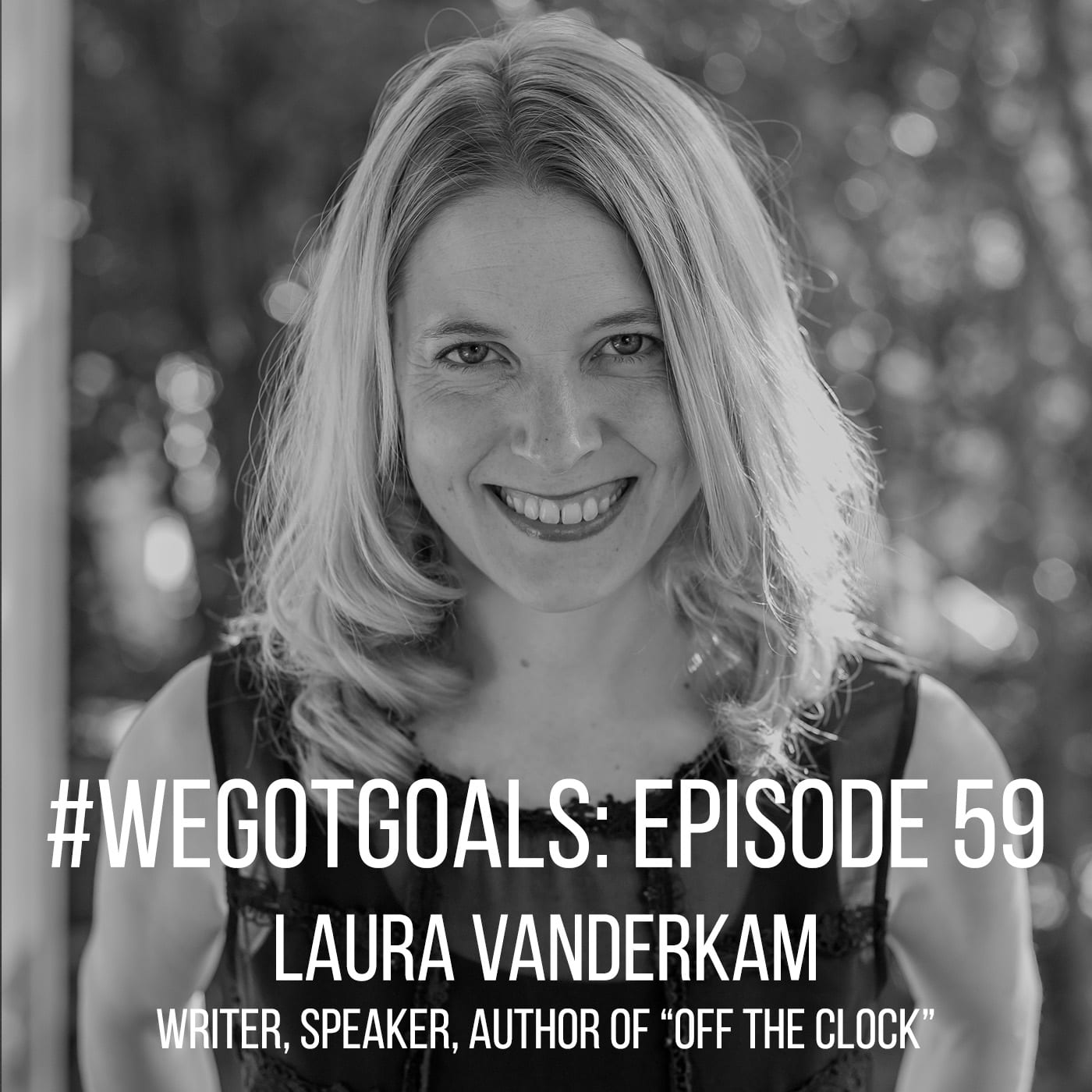
EPISODE · Jul 3, 2018 · 34 MIN
How Laura Vanderkam Uses Daily Time Tracking To Achieve Big Picture Goals
from #WeGotGoals by aSweatLife · host aSweatLife
In December 2017, I called Laura Vanderkam to ask her what I needed to know about time tracking if I was going to attempt to do it. What's time tracking? It's exactly what it sounds like - keeping tabs on how you spend your time all day, every day, for as long as you want - and I was intrigued by the prospect of attempting to do it. After reading Vanderkam's book I Know How She Does It, I knew I wanted to track my time for at least a week to see what I could learn (hint: so much). One of my biggest takeaways was that by analyzing the data on how you do spend your time, you can make better-informed decisions about how you want to spend your time and how you're going to do that. When Vanderkam came out with her latest book, Off The Clock, I knew there was no better time to have her as a guest on our podcast, #WeGotGoals. We've interviewed some pretty hardcore goal-setters and getters in the past, and discussed anything from how someone might attempt to sell every cup of coffee in the entire world, to doing whatever it takes to become the fastest woman in the world. Vanderkam is a high achiever whose goals take a different spin: she led the goal setting conversation with what she calls "better than nothing goals" - not Big, Hairy, and Audacious, but incredibly powerful nonetheless. Case in point, Vanderkam has run at least one mile a day for more than 500 consecutive days. She talks about how that wouldn't have been possible if she'd set a goal to run a marathon or even to run 30 miles a week, but that one mile is "like nothing," she says, and she's really content with and proud of that goal and the way it makes her feel. Clearly, Vankderkam is a process-driven person versus an outcome-based goal setter, as proven by her three year time-tracking streak. Prior to writing I Know How She Does It, she set the big goal to track all of her time for one year. Turns out, she liked the accountability it gave her so much, she just kept going. And the lessons she learned over three years of tracking time - plus input from other case studies and experts - make up the newest addition to her collection as an author Off The Clock. What time tracking taught her All of this tracking has helped her as she sets goals and spends her time in two key ways: 1. She remembers how she spent her time more fondly and with gratitude: By looking over her own spreadsheets to reflect back on where the hours went, Vanderkam sees all the things she's done - something our brains don't tend to do without bias. Vanderkam notes that our brains have the tendency to remember the negative over the positive (a phenomenon that's been tested and proven), but she's able to reminisce on her past more fondly and strip some of those negative connotations away. 2. She's able to separate the days from one another: She also took notice of what habits she tends to fall into and asks herself, "How is today going to be different from other days?" Vanderkam does this because it helps her to expand time by making memories more, well, memorable. "When the brain thinks about time, its sense of memory perception is affected by how many memories you have in that unit of time," Vanderkam says. When we talk about time flying by, she continues, we're experiencing the shortcut our brain takes to group similar memories together. "So that's how life starts to disappear into these memory sinkholes." Sure, we need routines to help us make decisions quickly and efficiently, but what are we turning into a routine that would be more fun if we did something otherwise? Vanderkam encourages doing things differently, from trying something new to simply walking a different route to work to make your brain remember days differently and apart from each other. Ready to hear all of her big goals? Listen to her on the full episode of #WeGotGoals on Apple Podcasts here. You'll hear the big goals she's outlined for the future and why she's still tracking her time down to the half-hour each and every day. If you like the show as much as we do, be sure to subscribe wherever you get your podcasts and leave it a rating and a review it really does help. And stick around until the end of the episode, goal getters. We have real life goal getting to share from a listener. Transcript: -------------------- C:Welcome to #WeGotGoals, a podcast by aSweatLife.com on which we talk to high achievers about their goals. I'm Jeana Anderson Cohen; with me, I have Maggie Umberger and Kristen Geil. MU:Morning, Jeana. KG:Hey Jeana. JAC:Thanks for joining me ladies. Maggie, you did the podcast today and you interviewed Laura Vanderkam. MU:I did. I interviewed Laura Vanderkam, who is a writer, an author, a speaker. She's written so many books that just the title alone makes you just think, I need to read this book. Recently she just finished off the clock and so it has just been released. She's a time management expert. She tracks her own time. She helps other people become more productive by analyzing how they spend their time and it's a really fascinating job that she has, that she's also turned into a career in multiple different facets. So companies work with her, she works with individuals and she, she tracks her time personally and kind of describes her experience doing that as well. JAC:Now when you say time tracking, it gives me flashbacks to agency life, but she means it differently, right? Maggie? MU:Yes and no. She tracks her time down to the 30 minute increment, which does remind me of agency life for having to remember who you're working with and what clients you're working on, all the way down to the quarter hour. But Laura tracks our time by analyzing where she spends her time with work, with her personal life and doing life admin things. She keeps the categories really broad, but it gives her information about really where she's spending her time and what her habits are and if she is aligning what her goals are with where she is spending her days. JAC:Super interesting and she even gets right down to the sleep time, which you'll hear more about in the episode. I don't want to blow it for you. But Maggie, I know you tracked your time personally right around the New Year, so you have experience with this. MU:I do, I got to interview her already for just a phone conversation and ask her how to go about starting to do this task because it seems pretty daunting at first, but she, she told me not to get too bogged down or in the weeds with it. I could keep it really general, but just to keep a log and I did it in my google calendar of how I'm spending my time. And it did a lot of things for me as in terms of showed me where I was spending more time than I thought. Sometimes I would say that I was completely bogged down with some assignment or some piece of work and then when I looked at where I was spending that time, sometimes it was just in the transition of getting from place to place and so it wasn't actually with that task or whatever it was. MU:It's just a nice way to see where you're actually spending time and then the story you create around that. But it also helped me see where I could be a little bit more productive and so if I would put it in my calendar that I was going to do it. I actually did it during and I try to do that more often than not. But when I was doing that exercise, I was super accountable to myself by saying this is realistically going to take me 90 minutes and then I would make sure it took me 90 minutes and if I needed more time I would carve out a separate hour or whatever it was later in my week so that I could be really realistic about how long things were going to take me. I was checking more things off of my to-do list and I felt like I was actually doing the things I was said I was going to be doing. KG:Maggie, Laura also mentioned something that I had never heard of before that she called better than nothing. Goals. Can you give us an idea of what that is? MU:Yeah. So, and I also don't want to spoil it in the episode either, but we could have talked forever about just time tracking because it is really fascinating. But, uh, the idea of looking at time tracking and how it can help you set your goals is something that we kind of focus this episode on. She talks a little bit about those better than nothing goals. And one of those, um, goals that she has was just running a mile every day. She talks about it being almost like nothing. Like she could just slough it off and just that could, she could attain that goal no matter what. But if she set even a m...
Embed this episode
NOW PLAYING
How Laura Vanderkam Uses Daily Time Tracking To Achieve Big Picture Goals
No transcript for this episode yet
Similar Episodes
No similar episodes found.
Similar Podcasts
No similar podcasts found.