
EPISODE · May 27, 2026 · 12 MIN
How Old Is the Water Under Quebec’s Eskers?
from Waterlines: How Water Shapes Our World · host jaywen
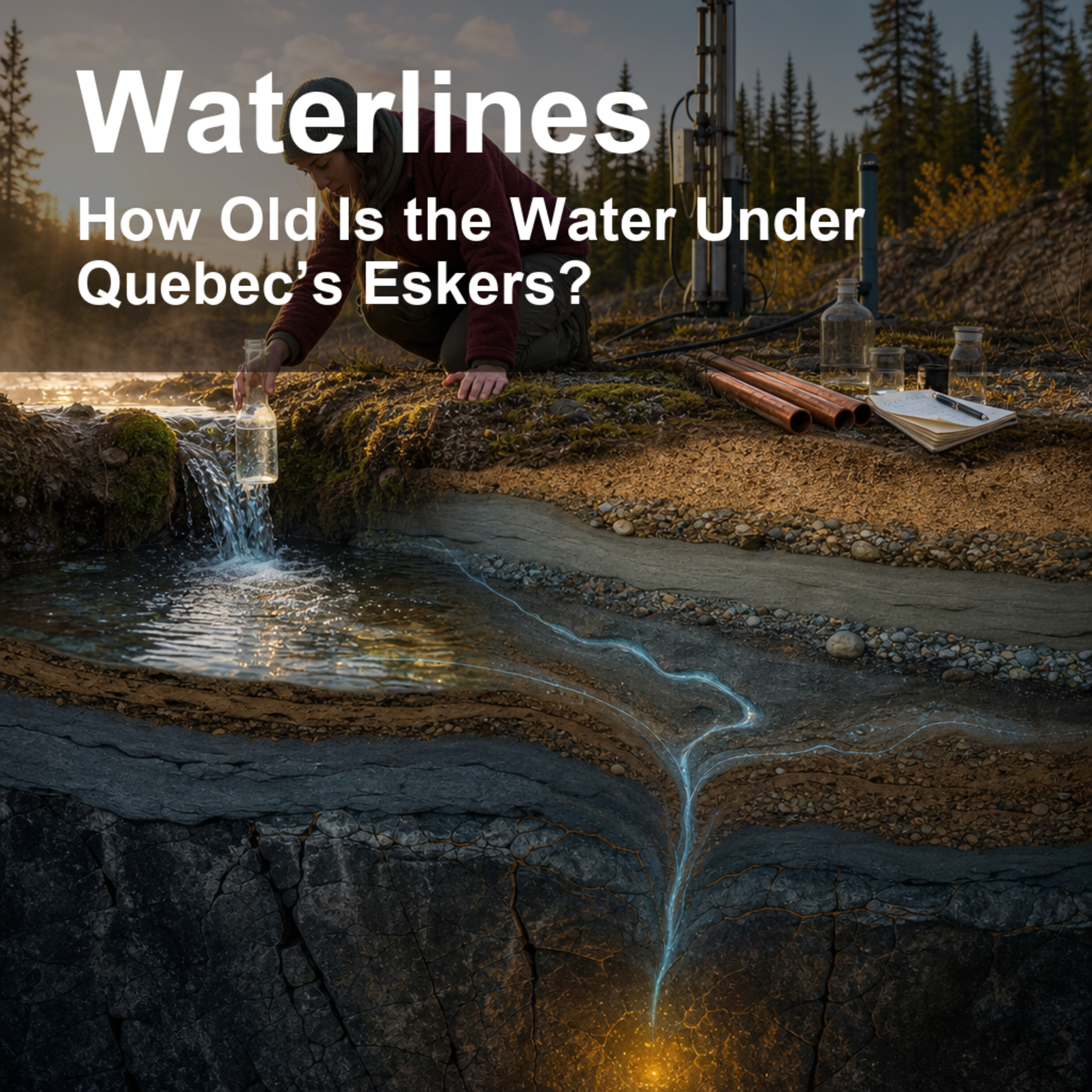
A glass of clear groundwater can look timeless, but its age matters for people deciding how much to pump, where to place roads and gravel pits, and how to protect drinking water from spills. This episode visits the Amos region of northwestern Quebec, where long ridges of sand and gravel left by melting ice, called eskers, store unusually clean water. Scientists used tiny traces of helium and tritium to ask a practical question: is this water being renewed quickly, or are some parts of the aquifer a one-time inheritance from ancient ice ages?We unpack how water can carry a time stamp, why young groundwater can be both renewable and vulnerable, and why deep, old water may not come back on any human schedule. The study finds modern recharge in parts of the Saint-Mathieu–Berry esker and Harricana moraine, with apparent ages of about 7 to 32 years, but also signs of much older, helium-rich water rising from fractured bedrock below, including possible fossil meltwater thousands to more than one hundred thousand years old. The result is a layered aquifer story: fast, fresh flow near the top; older, saltier, slower water below; and mixing between them.Citation: Boucher, C., Pinti, D. L., Roy, M., Castro, M. C., Cloutier, V., Blanchette, D., Larocque, M., Hall, C. M., Wen, T., & Sano, Y. (2015). Groundwater age investigation of eskers in the Amos region, Quebec, Canada. Journal of Hydrology, 524, 1–14. https://doi.org/10.1016/j.jhydrol.2015.01.072Disclosure: This Waterlines episode package is written for public science communication and is intended for production with AI-generated voices.
Embed this episode
NOW PLAYING
How Old Is the Water Under Quebec’s Eskers?
No transcript for this episode yet
Similar Episodes
No similar episodes found.
Similar Podcasts
No similar podcasts found.