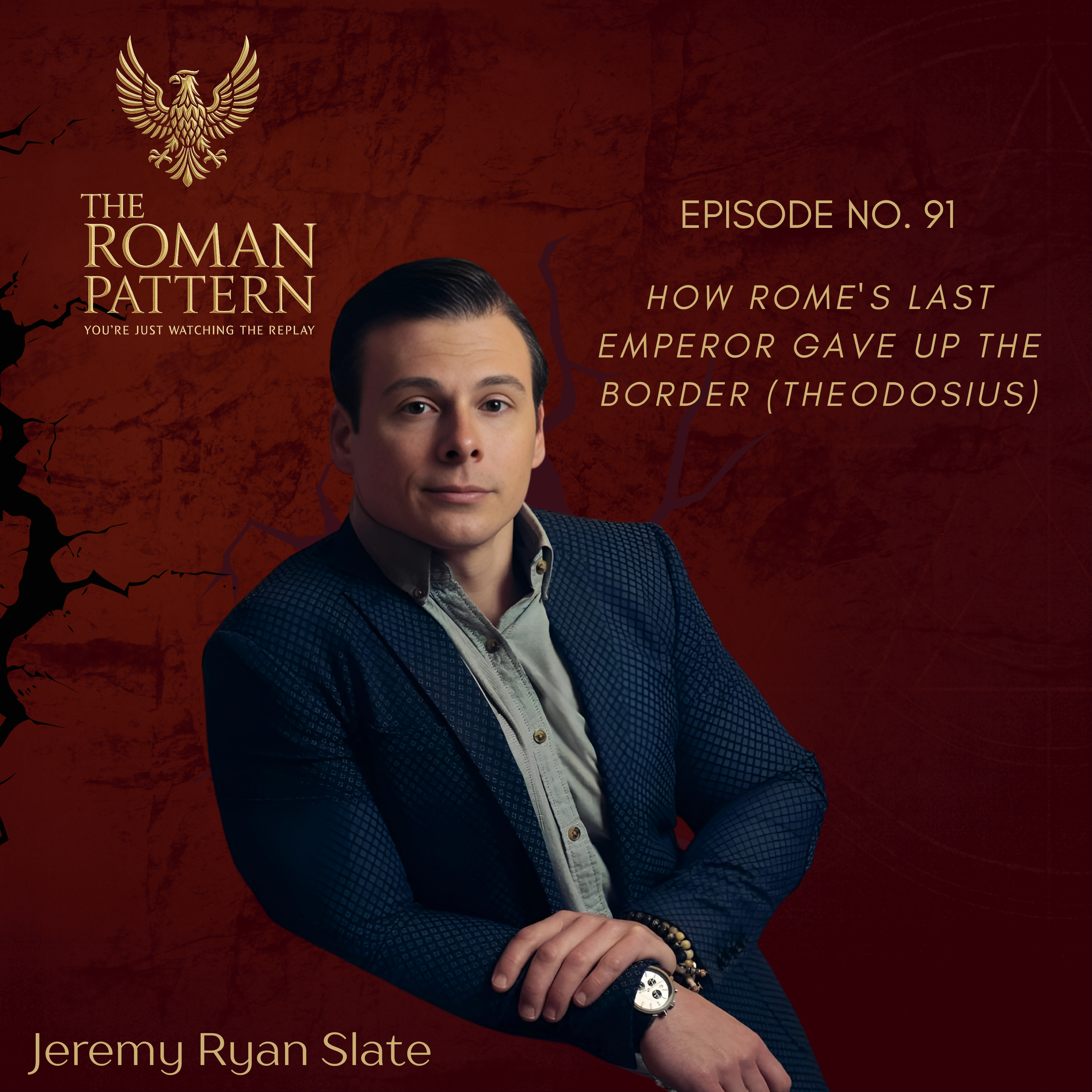
How Rome's Last Emperor Gave Up the Border (Theodosius) episode artwork

EPISODE · May 25, 2026 · 26 MIN

How Rome's Last Emperor Gave Up the Border (Theodosius)

from CYOL with Jeremy Ryan Slate Archive 1 · host Jeremy Ryan Slate

We picture Rome falling to barbarians — warriors crashing through marble gates, fire in the streets, civilization ending in a single dramatic moment. That's the myth. The reality is quieter and worse.In 378 AD, an emperor named Valens rode into a valley outside Adrianople with two-thirds of the Eastern Roman army. By sunset he was dead, his army was destroyed, and Rome's ability to defend its own territory was gone.The man who inherited what was left — a Spanish general named Theodosius — made a decision no Roman emperor had ever made before. He didn't rebuild the border. He dissolved it.In 382 AD, Theodosius signed a treaty that settled the Goths inside Roman territory as a semi-autonomous, armed, self-governing nation. Not outside the empire anymore. Inside it. The Danube stopped being the hard edge of Roman civilization. It became an administrative line that people crossed under negotiated terms.Then in 380, the Edict of Thessalonica made Nicene Christianity the sole legal religion of the empire. Every other form of worship became illegal. The pagan temples were closed, their assets confiscated, and that wealth moved — most of it to the Christian Church, which suddenly became one of the largest institutional landowners in Rome.The currency kept failing. The treasury kept hemorrhaging. The army kept becoming more dependent on Gothic mercenaries. Theodosius held it together for sixteen years through personal competence — and when he died in 395, the empire split in two and never reunified.This is the autopsy of how Rome's last unified emperor turned military defeat into managed surrender. Theodosius didn't destroy Rome. He was probably the last person capable of slowing its collapse at all. But the choices he made guaranteed that when he was gone, the cracks he had managed would become the fault lines along which the empire permanently split apart.Collapse doesn't begin when systems stop functioning. Collapse begins when systems stop solving problems and start managing them instead.00:00 — Rome Didn't Fall to Barbarians02:16 — Welcome to The Roman Pattern02:41 — Adrianople: The Autopsy04:06 — The Refugee Crisis Rome Broke06:51 — Why Valens Couldn't Wait08:28 — Theodosius Takes Power09:57 — The Treaty That Dissolved the Border12:21 — The Edict of Thessalonica15:55 — The Monetary Spiral18:58 — Two Civil Wars with Gothic Armies21:06 — 395: The Empire Splits23:14 — The Pattern Closes25:43 — When Management Replaces Restoration

We picture Rome falling to barbarians — warriors crashing through marble gates, fire in the streets, civilization ending in a single dramatic moment. That's the myth. The reality is quieter and worse. In 378 AD, an emperor named Valens rode into a valley outside Adrianople with two-thirds of the Eastern Roman army. By sunset he was dead, his army was destroyed, and Rome's ability to defend its own territory was gone. The man who inherited what was left — a Spanish general named Theodosius — made a decision no Roman emperor had ever made before. He didn't rebuild the border. He dissolved it. In 382 AD, Theodosius signed a treaty that settled the Goths inside Roman territory as a semi-autonomous, armed, self-governing nation. Not outside the empire anymore. Inside it. The Danube stopped being the hard edge of Roman civilization. It became an administrative line that people crossed under negotiated terms. Then in 380, the Edict of Thessalonica made Nicene Christianity the sole legal religion of the empire. Every other form of worship became illegal. The pagan temples were closed, their assets confiscated, and that wealth moved — most of it to the Christian Church, which suddenly became one of the largest institutional landowners in Rome. The currency kept failing. The treasury kept hemorrhaging. The army kept becoming more dependent on Gothic mercenaries. Theodosius held it together for sixteen years through personal competence — and when he died in 395, the empire split in two and never reunified. This is the autopsy of how Rome's last unified emperor turned military defeat into managed surrender. Theodosius didn't destroy Rome. He was probably the last person capable of slowing its collapse at all. But the choices he made guaranteed that when he was gone, the cracks he had managed would become the fault lines along which the empire permanently split apart. Collapse doesn't begin when systems stop functioning. Collapse begins when systems stop solving problems and start managing them instead. 00:00 — Rome Didn't Fall to Barbarians 02:16 — Welcome to The Roman Pattern 02:41 — Adrianople: The Autopsy 04:06 — The Refugee Crisis Rome Broke 06:51 — Why Valens Couldn't Wait 08:28 — Theodosius Takes Power 09:57 — The Treaty That Dissolved the Border 12:21 — The Edict of Thessalonica 15:55 — The Monetary Spiral 18:58 — Two Civil Wars with Gothic Armies 21:06 — 395: The Empire Splits 23:14 — The Pattern Closes 25:43 — When Management Replaces Restoration

NOW PLAYING

How Rome's Last Emperor Gave Up the Border (Theodosius)

0:00 26:36

No transcript for this episode yet

We transcribe on demand. Request one and we'll notify you when it's ready — usually under 10 minutes.

No similar episodes found.

Tales Of A Superstar DJ The Insomniac Spun seemingly out of nowhere from her complacent life in the corporate world, turned seemingly overnight from 16-Hour shift work and into the life of a literally starving artist and working musician, The Protagonist navigates her supposed rise to fame and superstardom on a journey through spiritual awakening, coming-of-age, and intimate self-realization--guided by an omnipresent force and equipped with the power of love, magic, and music. {Enter The Multiverse.} [The Festival Project] The Festival Project, Inc.™ is a multidimensional multimedia platform which encompasses exploratory and artistic social personifications and expressions on cosmic theory, spirituality, growth, health & wellness, philosophy and theoretic dynamics in entertainment such as music, design, film, television, radio, dance and festival culture, art, fashion, literature, and science. The Festival Project™ and its subsidiary Non-Profit, The Collective Complex © aims to challenge modern artistic and philosop Explicit Bitcoin Is Dead Trey Carson Welcome to Bitcoin is Dead, the ultimate Bitcoin variety show where host Trey takes you on a journey through the ever-evolving world of Bitcoin. Each episode brings new personalities, fascinating locations, and insightful conversations with politicians, educators, and innovators shaping the future of Bitcoin. Whether you're a seasoned Bitcoiner or just starting your journey, tune in for thought-provoking discussions, unique perspectives, and a deep dive into the ideas and people driving the Bitcoin revolution. Explicit Northern Sass and Southern Class Tay and Ani Come sit in on girl talk with Tay and Ani as we discuss life in Texas, girl math, food, wine and roasting each other. Explicit Never Time to Give Up Shadoe Lass A nod to the classics with a note from the future. A project meant to encompass every call I wanted to make but never went through. Seriously, it's just me, calling you. Pick up the phone? :) Hosted on Acast. See acast.com/privacy for more information. Explicit

Frequently Asked Questions

How long is this episode of CYOL with Jeremy Ryan Slate Archive 1?

This episode is 26 minutes long.

When was this CYOL with Jeremy Ryan Slate Archive 1 episode published?

This episode was published on May 25, 2026.

What is this episode about?

We picture Rome falling to barbarians — warriors crashing through marble gates, fire in the streets, civilization ending in a single dramatic moment. That's the myth. The reality is quieter and worse.In 378 AD, an emperor named Valens rode into a...

Can I download this CYOL with Jeremy Ryan Slate Archive 1 episode?

Yes, you can download this episode by clicking the download button on the episode player, or subscribe to the podcast in your preferred podcast app for automatic downloads.
URL copied to clipboard!