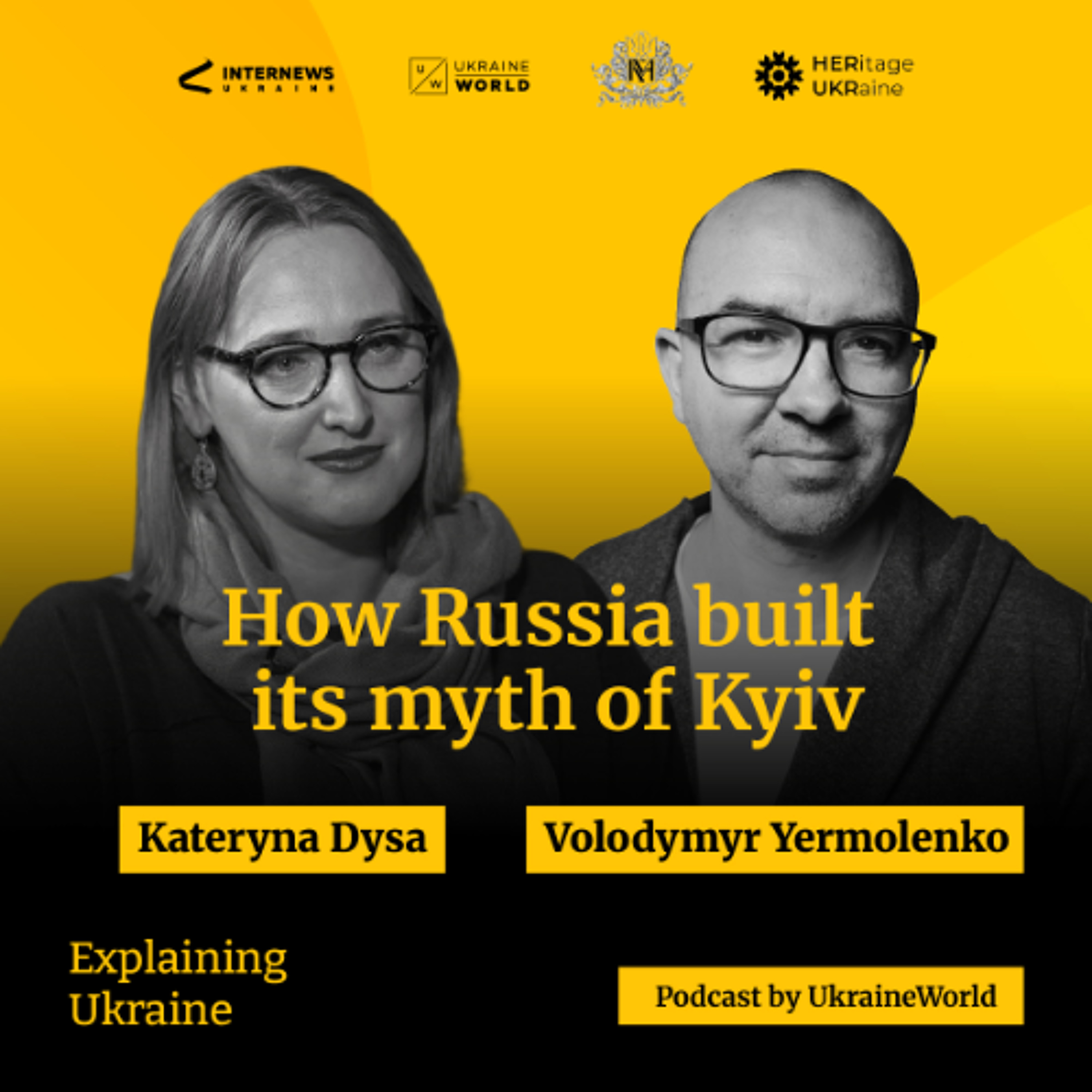
How Russia built its myth of Kyiv - with Kateryna Dysa episode artwork

EPISODE · Nov 21, 2025 · 42 MIN

How Russia built its myth of Kyiv - with Kateryna Dysa

from Explaining Ukraine · host UkraineWorld

Russian propaganda claims that Ukraine is not a separate nation, but merely a “preliminary form” of Russia. Today’s Kremlin ideology seeks to annex Ukrainian history in order to justify its territorial aggression. But this myth has a birth certificate. It emerged in the 19th century, when the Russian Empire started inventing its “ancient” medieval roots. Before that, Russian travellers in Ukrainian lands showed little interest in such historical questions. In this episode, we trace the genealogy of the myth that Kyiv is a “Russian city” and that its history somehow belongs to Muscovy. *** Explaining Ukraine is a podcast by UkraineWorld, an English-language media platform about Ukraine, run by Internews Ukraine. Host: Volodymyr Yermolenko, a Ukrainian philosopher, editor-in-chief of UkraineWorld, and president of PEN Ukraine. Listen on various platforms: https://li.sten.to/explaining-ukraine UkraineWorld: https://ukraineworld.org/en *** Guest: Kateryna Dysa, a Ukrainian historian and Associate Professor at Kyiv-Mohyla Academy. She has been a visiting fellow at Harvard, Stanford, Paris, and Oxford, and a visiting professor at the University of Basel. Currently, she is researching how the image of Kyiv was constructed in travel literature from the late eighteenth to early twentieth centuries. *** SUPPORT: You can support our work on https://www.patreon.com/c/ukraineworld Your help is crucial, as we rely heavily on crowdfunding. You can also contribute to our volunteer missions to frontline areas in Ukraine, where we deliver aid to both soldiers and civilians. Donations are welcome via PayPal at: [email protected]. *** CONTENTS: 00:00 Kateryna Dysa, a Ukrainian historian and associate professor at Kyiv-Mohyla Academy. 00:15 Where and when did the myth of Kyiv belonging to Moscow actually begin? 02:05 How did 18th-century Russian travelers initially view Kyiv, and why was their interest superficial? 04:05 How did the rise of history as a discipline change Russia's perception of Kyiv? 12:17 Why did the French philosopher Madame de Staël describe Kyiv as a "semi-Tatar" or nomadic place? 15:17 What were the two extreme ways Westerners described Kyiv? 21:04 When did the annexation of the past become an "aggressive policy" and a part of Russian imperial ideology? 35:03 Why were Russian travelers unwilling to communicate with locals, stressing that Ukrainians were "the other"? 38:07 Why did Russian travelers consistently feel "not at home" in a place the Empire claimed as its "cradle"? 39:16 What aspects of Kyiv's social and cultural history in the 19th century still remain "understudied"? *** This episode is made in partnership with Kyiv-Mohyla Academy and under the framework of the project “HER-UKR: Challenges and opportunities for EU heritage diplomacy in Ukraine”, co-funded by the EU within the ERASMUS+ Jean Monnet Policy Debate action.

Russian propaganda claims that Ukraine is not a separate nation, but merely a “preliminary form” of Russia. Today’s Kremlin ideology seeks to annex Ukrainian history in order to justify its territorial aggression. But this myth has a birth certificate. It emerged in the 19th century, when the Russian Empire started inventing its “ancient” medieval roots. Before that, Russian travellers in Ukrainian lands showed little interest in such historical questions. In this episode, we trace the genealogy of the myth that Kyiv is a “Russian city” and that its history somehow belongs to Muscovy. *** Explaining Ukraine is a podcast by UkraineWorld, an English-language media platform about Ukraine, run by Internews Ukraine. Host: Volodymyr Yermolenko, a Ukrainian philosopher, editor-in-chief of UkraineWorld, and president of PEN Ukraine. Listen on various platforms: https://li.sten.to/explaining-ukraine UkraineWorld: https://ukraineworld.org/en *** Guest: Kateryna Dysa, a Ukrainian historian and Associate Professor at Kyiv-Mohyla Academy. She has been a visiting fellow at Harvard, Stanford, Paris, and Oxford, and a visiting professor at the University of Basel. Currently, she is researching how the image of Kyiv was constructed in travel literature from the late eighteenth to early twentieth centuries. *** SUPPORT: You can support our work on https://www.patreon.com/c/ukraineworld Your help is crucial, as we rely heavily on crowdfunding. You can also contribute to our volunteer missions to frontline areas in Ukraine, where we deliver aid to both soldiers and civilians. Donations are welcome via PayPal at: [email protected]. *** CONTENTS: 00:00 Kateryna Dysa, a Ukrainian historian and associate professor at Kyiv-Mohyla Academy. 00:15 Where and when did the myth of Kyiv belonging to Moscow actually begin? 02:05 How did 18th-century Russian travelers initially view Kyiv, and why was their interest superficial? 04:05 How did the rise of history as a discipline change Russia's perception of Kyiv? 12:17 Why did the French philosopher Madame de Staël describe Kyiv as a "semi-Tatar" or nomadic place? 15:17 What were the two extreme ways Westerners described Kyiv? 21:04 When did the annexation of the past become an "aggressive policy" and a part of Russian imperial ideology? 35:03 Why were Russian travelers unwilling to communicate with locals, stressing that Ukrainians were "the other"? 38:07 Why did Russian travelers consistently feel "not at home" in a place the Empire claimed as its "cradle"? 39:16 What aspects of Kyiv's social and cultural history in the 19th century still remain "understudied"? *** This episode is made in partnership with Kyiv-Mohyla Academy and under the framework of the project “HER-UKR: Challenges and opportunities for EU heritage diplomacy in Ukraine”, co-funded by the EU within the ERASMUS+ Jean Monnet Policy Debate action.

NOW PLAYING

How Russia built its myth of Kyiv - with Kateryna Dysa

0:00 42:13

No transcript for this episode yet

We transcribe on demand. Request one and we'll notify you when it's ready — usually under 10 minutes.

The Cleveland Ukraine Podcast The Cleveland Ukraine Podcast Capturing the impactful stories of the Cleveland Ukrainian population at home and abroad. Sikkerhedsudvalget 24syv Siden 1946 har den amerikanske præsident hver dag modtaget den såkaldte PDB ‘The President’s Daily Brief’ om de aktuelle trusler mod verdens og USAs sikkerhed. 24syv giver nu alle lyttere - politikere, beslutningstagere og embedsmænd - et dagligt sikkerhedsbrief. I programmet ‘Sikkehedsudvalget’ vurderes alle aktuelle trusler mod rigets sikkerhed. Vid alt om terrorisme, Ukraine, Mellemøsten, cybertrusler, kritisk infrastrutur - og mød landets mest vidende eksperter og beslutningstagere. The Fight: A podcast on life & war in Ukraine. The Cipher Brief The Cipher Brief team brings you a brand new podcast that examines the war in Ukraine, and the impact it has on the world. Ukraine - History in the Making Emil Juhler When I started the conversation series ”Ukraine - History in the Making” I could have never imagined where this journey would lead me. It all started in March 2023 after I got home from an exchange stay in Chile and felt, that I had to do more for Ukraine, than what I did on my social media accounts and on the streets in the spring and summer of 2022. I think most of us remember that initial period after Ruzzia’s the full-scale invasion of Ukraine. Speaking from a European/Danish point of view it was a time of big fear, desperation and uncertainty, but also a time of high hopes, energy and big solidarity. In the very first conversation of the show with Veronika Netrebenko, she says the following about the feelings of Ukrainians during the Maidan Revolution: ”We understood we gotta fight for it, and it was something totally different, we felt different, we felt that we need to fight for it”. To a certain degree I believe you can say the same about what happened within the hearts and mi

Frequently Asked Questions

How long is this episode of Explaining Ukraine?

This episode is 42 minutes long.

When was this Explaining Ukraine episode published?

This episode was published on November 21, 2025.

What is this episode about?

Russian propaganda claims that Ukraine is not a separate nation, but merely a “preliminary form” of Russia. Today’s Kremlin ideology seeks to annex Ukrainian history in order to justify its territorial aggression. But this myth has a birth...

Can I download this Explaining Ukraine episode?

Yes, you can download this episode by clicking the download button on the episode player, or subscribe to the podcast in your preferred podcast app for automatic downloads.
URL copied to clipboard!