
EPISODE · Jan 14, 2026 · 1H 7M
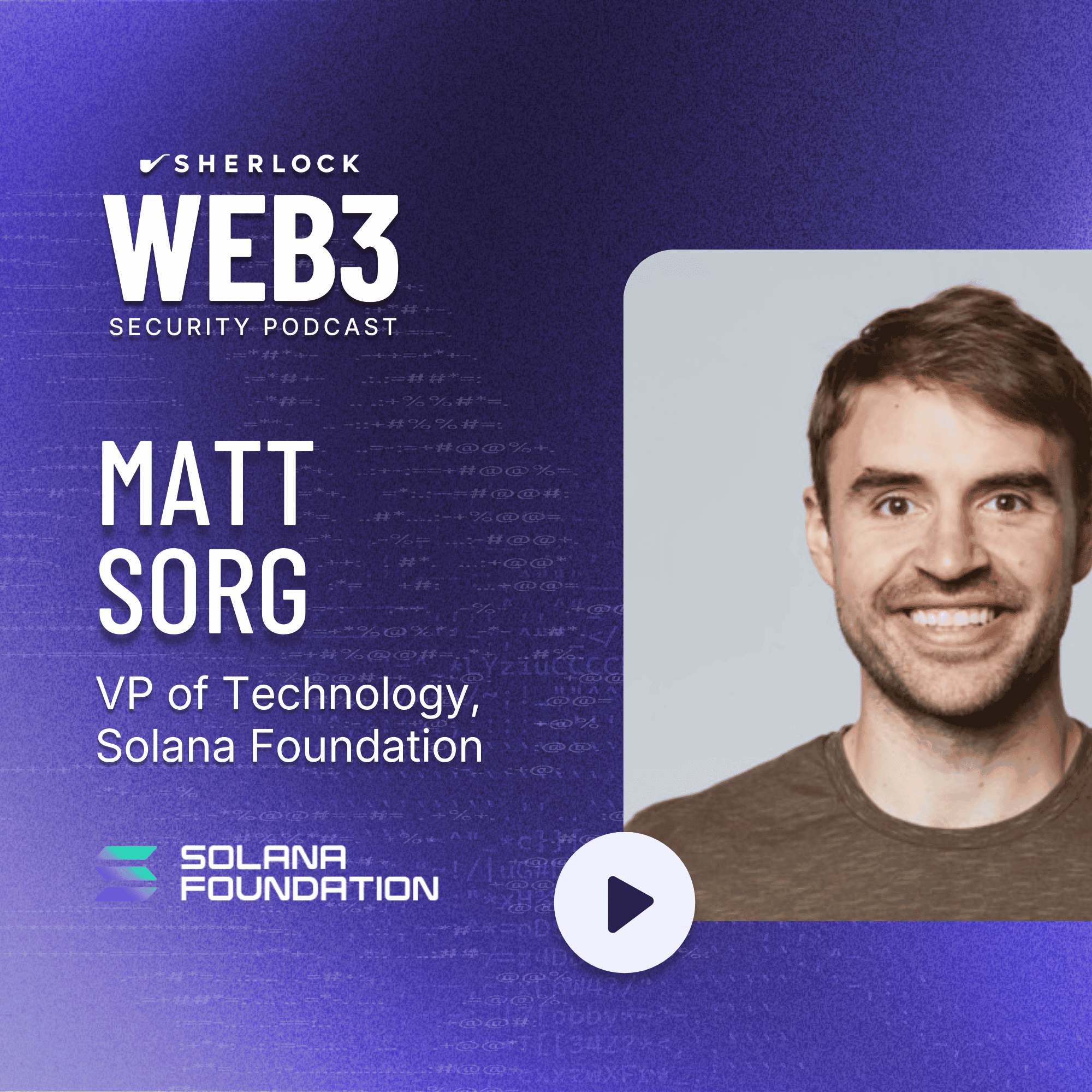
How Solana achieved 2 years uptime after launching with $3M | Matt Sorg (Solana Foundation)
from The Web3 Security Podcast · host TheWeb3SecurityPodcast
When Solana dropped to $8 during FTX, Matt Sorg watched Twitter erupt while his validator network stayed focused on the technical roadmap. The VP of Technology at Solana Foundation had built something that would prove more valuable than hype: a technically aligned community shipping performance improvements on a quarterly cadence. Matt explains why Solana's early instability wasn't architectural it was financial constraint forcing impossible tradeoffs. Spring 2018's dead ICO market meant launching with roughly $2-3 million versus the hundreds of millions typical L1s raise today. The choice: ship with tech debt or die waiting for perfect code. They shipped, survived the resulting instability crisis, and spent the next several years systematically eliminating every bottleneck through what Matt calls "mindful engineering." The maturity shows in the security infrastructure. Four independent audit firms review every Anza code release. Continuous fuzzing catches performance regressions. Firedancer's launch as a second client enables differential testing that's becoming the de facto Solana specification. The result: approaching two years of continuous uptime with upgrades shipping every three months. But the real technical leap is what's coming: Alpenglow consensus enabling 40% validator failure tolerance, multiple concurrent leaders eliminating MEV by removing block building monopolies, and local inclusion certificates delivering Web2 speed feedback before global consensus. Topics discussed: Launching mainnet spring 2018 with $2-3M in dead ICO market versus modern $100M+ L1 funding Systematic tech debt elimination through bottleneck analysis achieving nearly two years uptime Four independent audit firms plus continuous fuzzing reviewing every Anza release Firedancer second client enabling differential testing becoming canonical Solana specification Alpenglow consensus mechanism allowing 40% validator failure versus standard 33% Byzantine tolerance Multiple concurrent leaders requiring only one honest leader among eight for inclusion guarantees Local inclusion certificates providing Web2 speed feedback before global consensus finalization 800+ profitable validators independently reviewing GitHub releases on bare metal versus cloud VMs Savvy validator recruitment through performance focused mission attracting talent that only operates on Solana AI powered social engineering replacing technical exploits as dominant app layer attack vector Applications over engineering financial components before product market fit validation Non financial primitives like points enabling faster iteration without security overhead
Embed this episode
Ready to play
How Solana achieved 2 years uptime after launching with $3M | Matt Sorg (Solana Foundation)
No transcript for this episode yet
Similar Episodes
No similar episodes found.
Similar Podcasts
No similar podcasts found.