
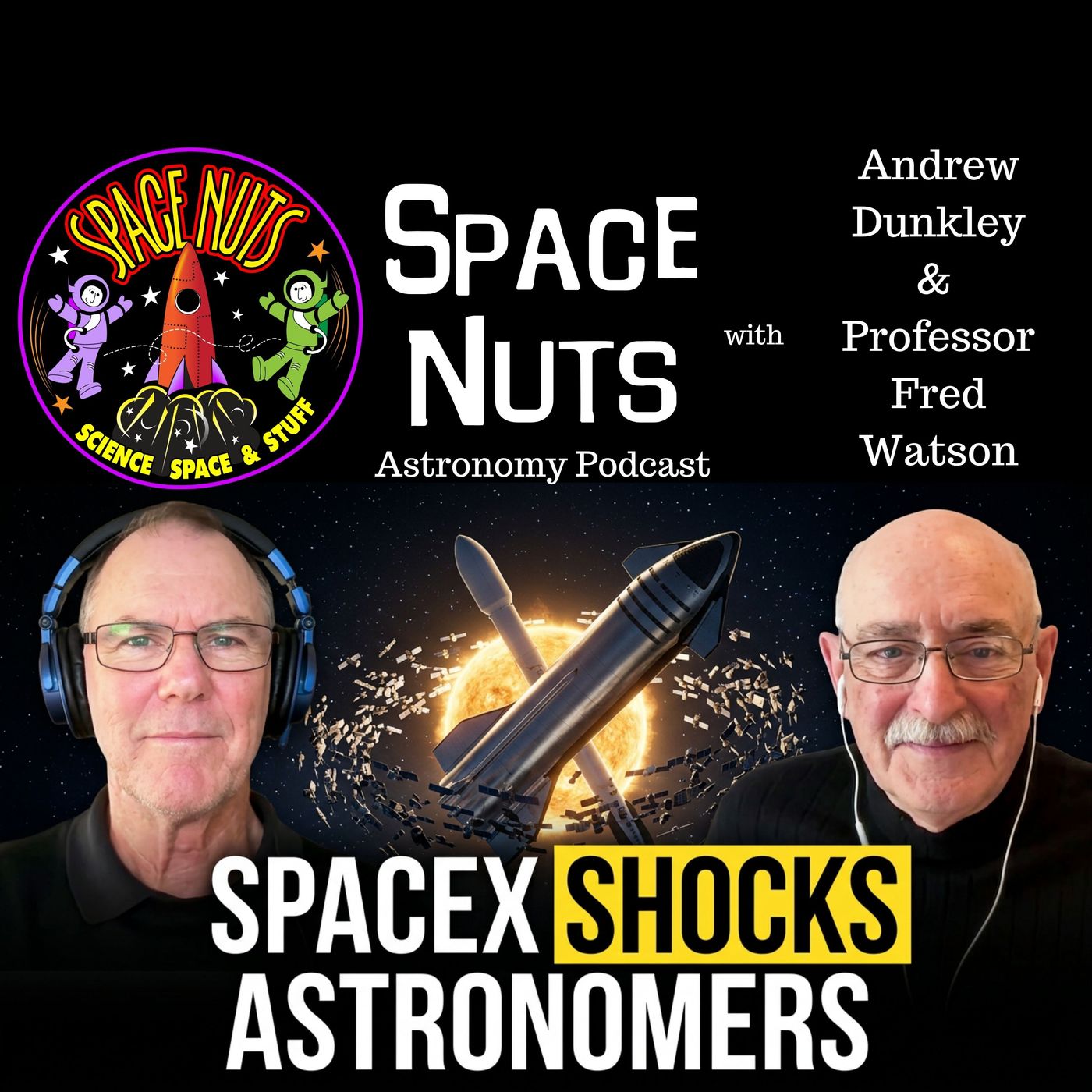
EPISODE · Jul 9, 2026 · 35 MIN
How SpaceX Breaks Satellite Records and What It Means for Earth Orbit Safety
from Space Nuts: Astronomy Insights & Cosmic Discoveries · host Professor Fred Watson and Andrew Dunkley
Space Nuts Episode 641: Exploring SpaceX Milestones, Lunar Realities, and Particle PhysicsIn this episode, Andrew Dunkley and Professor Fred Watson delve into recent breakthroughs in space technology, lunar surface understanding, and the physics of light and matter. From SpaceX's record-breaking satellite launches to the complexities of stopping photons and the intriguing origins of interstellar objects, this episode covers some of the most fascinating topics in space science today.In this episode:SpaceX has launched over 15,000 satellites, more than all other space launches combined since 1957The successful reuse of Falcon 9 boosters, setting a new milestone in spaceflightThe ambitious plans for orbital data systems using Starship and their impact on space trafficChallenges faced by lunar explorers, including dust, terrain tilt, and small craters, highlighted by NASA’s expert critiqueComet 3i Atlas offers clues about the early universe, potentially 10-12 billion years oldThe physics behind slowing down—then stopping and reviving—photons in Bose-Einstein condensatesHow relativistic effects prevent particles in colliders from exceeding the speed of light during high-energy collisionsInnovative ideas for managing space debris, including repositioning defunct satellites into graveyard orbitsThe questions about how different cosmic fields may intertwine, forming superpositions in fundamental physicsA humorous sci-fi joke about neutrinos and a reminder to ask questions about our universeTimestamps:00:00 – Introduction and overview of topics02:00 – SpaceX's satellite launch record and starlink constellation05:00 – Reusability of Falcon 9 boosters and future launch plans08:00 – SpaceX’s enhanced satellite megaconstellation and artificial intelligence systems12:00 – Challenges for lunar surface exploration: dust, terrain tilt, and small craters16:00 – NASA’s critique of lunar surface imagery and exploration preparedness20:00 – Comet 3i Atlas: what it reveals about the early universe25:00 – Isotopic analysis of interstellar objects and their origins30:00 – Physics of stopping and reviving light in Bose-Einstein condensates40:00 – Relativistic collision velocities and Einstein's effects at particle accelerators55:00 – Managing space debris and satellite orbits through action-reaction principles61:00 – Fields and superpositions in fundamental physics66:00 – Fun question: neutrino jokes and questions viewers sent in70:00 – Wrap-up and upcoming episodesResources & Links:SpaceX’s Satellite Missions & StarlinkNASA Artemis ProgramNASA's Space Resources RoundtableComet 3i Atlas Discoveries in Nature AstronomyNASA Webb Telescope SciencePhysics World article on Stopping LightConnect with Fred Watson:Professor Fred Watson - LinkedInFred Watson - Official SiteNote:Stay curious, ask questions, and look up the references for more in-depth understanding of these fascinating topics. The universe is vast and full of surprises—adventure awaits.Become a supporter of this podcast: https://www.spreaker.com/podcast/space-nuts-astronomy-insights-cosmic-discoveries--2631155/support.
What this episode covers
Space Nuts Episode 641: Exploring SpaceX Milestones, Lunar Realities, and Particle PhysicsIn this episode, Andrew Dunkley and Professor Fred Watson delve into recent breakthroughs in space technology, lunar surface understanding, and the physics of light and matter. From SpaceX's record-breaking satellite launches to the complexities of stopping photons and the intriguing origins of interstellar objects, this episode covers some of the most fascinating topics in space science today.In this episode:SpaceX has launched over 15,000 satellites, more than all other space launches combined since 1957The successful reuse of Falcon 9 boosters, setting a new milestone in spaceflightThe ambitious plans for orbital data systems using Starship and their impact on space trafficChallenges faced by lunar explorers, including dust, terrain tilt, and small craters, highlighted by NASA’s expert critiqueComet 3i Atlas offers clues about the early universe, potentially 10-12 billion years oldThe physics behind slowing down—then stopping and reviving—photons in Bose-Einstein condensatesHow relativistic effects prevent particles in colliders from exceeding the speed of light during high-energy collisionsInnovative ideas for managing space debris, including repositioning defunct satellites into graveyard orbitsThe questions about how different cosmic fields may intertwine, forming superpositions in fundamental physicsA humorous sci-fi joke about neutrinos and a reminder to ask questions about our universeTimestamps:00:00 – Introduction and overview of topics02:00 – SpaceX's satellite launch record and starlink constellation05:00 – Reusability of Falcon 9 boosters and future launch plans08:00 – SpaceX’s enhanced satellite megaconstellation and artificial intelligence systems12:00 – Challenges for lunar surface exploration: dust, terrain tilt, and small craters16:00 – NASA’s critique of lunar surface imagery and exploration preparedness20:00 – Comet 3i Atlas: what it reveals about the early universe25:00 – Isotopic analysis of interstellar objects and their origins30:00 – Physics of stopping and reviving light in Bose-Einstein condensates40:00 – Relativistic collision velocities and Einstein's effects at particle accelerators55:00 – Managing space debris and satellite orbits through action-reaction principles61:00 – Fields and superpositions in fundamental physics66:00 – Fun question: neutrino jokes and questions viewers sent in70:00 – Wrap-up and upcoming episodesResources & Links:SpaceX’s Satellite Missions & StarlinkNASA Artemis ProgramNASA's Space Resources RoundtableComet 3i Atlas Discoveries in Nature AstronomyNASA Webb Telescope SciencePhysics World article on Stopping LightConnect with Fred Watson:Professor Fred Watson - LinkedInFred Watson - Official SiteNote:Stay curious, ask questions, and look up the references for more in-depth understanding of these fascinating topics. The universe is vast and full of surprises—adventure awaits.Become a supporter of this podcast: https://www.spreaker.com/podcast/space-nuts-astronomy-insights-cosmic-discoveries--2631155/support.
NOW PLAYING
How SpaceX Breaks Satellite Records and What It Means for Earth Orbit Safety
No transcript for this episode yet
Similar Episodes
Apr 21, 2026 ·13m
Apr 19, 2026 ·16m
Apr 17, 2026 ·13m
Apr 13, 2026 ·11m
Apr 11, 2026 ·16m