
EPISODE · Jun 11, 2026 · 1H 23M
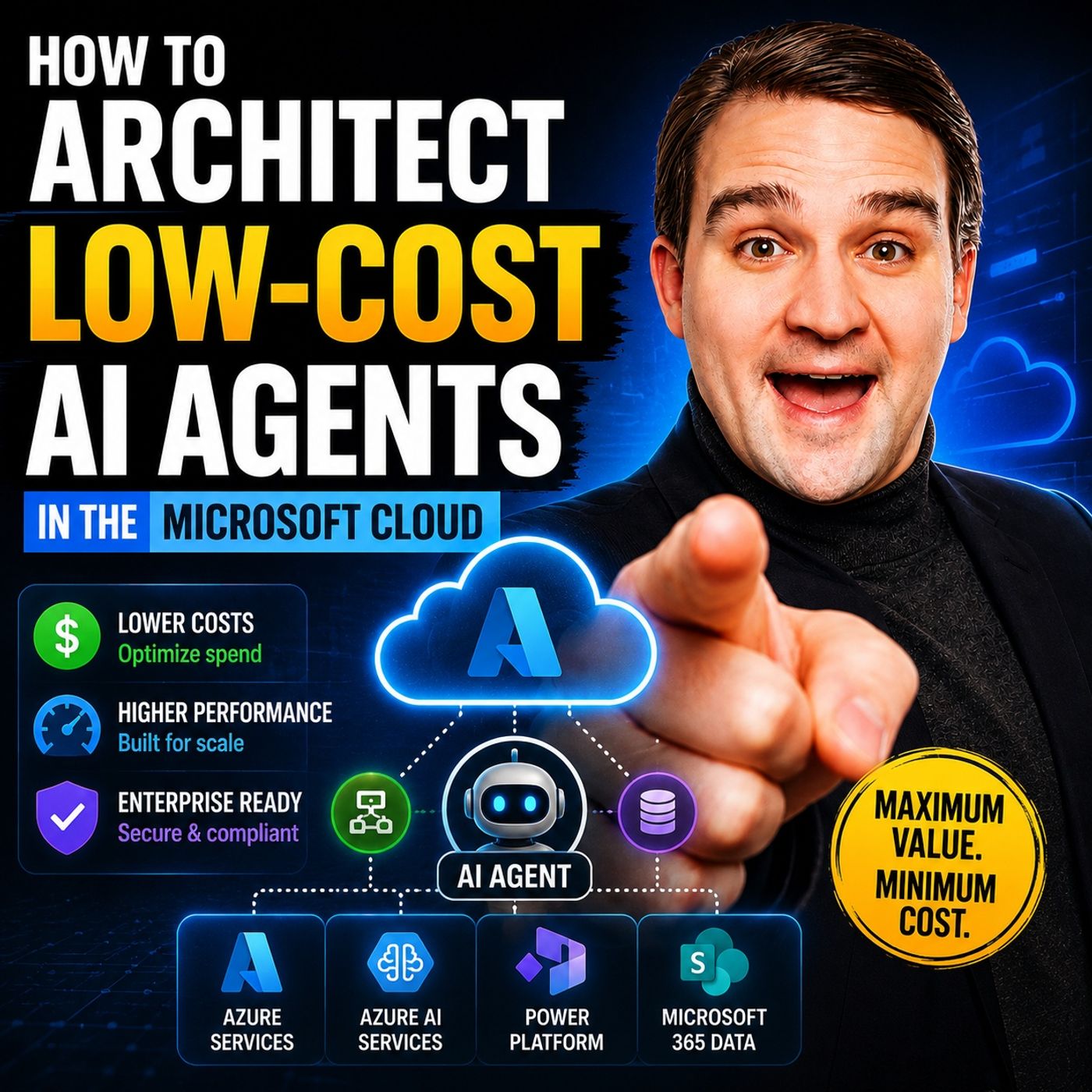
How to Architect Low-Cost AI Agents in the Microsoft Cloud
from M365.FM - Modern work, security, and productivity with Microsoft 365 · host Mirko Peters - Founder of m365.fm, m365.show and m365con.net
Most organizations think their AI costs are driven by model pricing.They're wrong.The biggest cost problems in Microsoft AI environments often have nothing to do with GPT-5, Azure OpenAI, or Copilot licensing. Instead, they come from hidden architectural decisions that quietly multiply costs behind the scenes.In this episode, we break down the real economics of building AI agents in Microsoft Azure, Microsoft 365, Copilot Studio, and Azure AI Foundry. You'll learn why some organizations spend thousands of dollars per month on AI while others deliver the same business outcomes for a fraction of the cost.We explore the three hidden taxes affecting nearly every enterprise AI deployment: the Context Tax, the Reasoning Tax, and the Autonomous Tax. Together, these invisible costs can turn a successful proof-of-concept into a budget crisis.More importantly, you'll learn how to eliminate them.THE PROMISE VS THE INVOICEMicrosoft has made AI easier to deploy than ever before.Copilot appears inside Teams, Outlook, Word, PowerPoint, and Microsoft 365. Azure AI Foundry simplifies model deployment. Copilot Studio allows low-code agent development. Power Platform integrates AI into business processes.But simplicity often hides complexity.The moment you build a custom Copilot Studio agent, connect SharePoint knowledge sources, invoke Azure OpenAI models, or trigger autonomous workflows, you enter a world of consumption billing where every token, action, and retrieval operation has a cost.In this episode, we uncover how Microsoft's AI billing layers actually work and why understanding them is the foundation of any successful AI architecture.THE THREE HIDDEN TAXES OF ENTERPRISE AIMost organizations unknowingly pay three separate AI taxes.The Context TaxPoor retrieval design floods prompts with irrelevant content.Instead of retrieving only the information needed to answer a question, many RAG implementations pull dozens of documents into the prompt, dramatically increasing token consumption while often reducing answer quality.The Reasoning TaxMany organizations route every request to their most expensive model.Simple FAQ requests, classifications, and summarizations frequently run on frontier models when smaller and cheaper models could deliver identical outcomes.The Autonomous TaxAutonomous agents never sleep.Background workflows, Graph grounding, Power Automate actions, and event-driven agents continue consuming credits long after employees have logged off.When these three taxes combine, AI spending can spiral out of control.UNDERSTANDING COPILOT STUDIO COSTSCopilot Studio has become one of the most powerful tools in the Microsoft ecosystem.It also introduces new consumption models that many organizations underestimate.We discuss:Copilot CreditsCapacity PacksPay-As-You-Go billingGraph Grounding costsAgent actionsAutonomous triggersAI Builder transitionsThe November 2026 licensing changesUnderstanding these mechanics is essential before deploying large-scale business agents.THE NOVEMBER 2026 AI BUILDER DEADLINEOne of the most important dates in Microsoft's AI roadmap arrives on November 1st, 2026.On that date, seeded AI Builder credits disappear.Organizations currently relying on included AI Builder capacity may discover that previously "free" AI workloads suddenly become billable.We explain:What changes in November 2026Which workloads are affectedHow to prepare before the deadlineWhy many organizations could face unexpected costsHow to build a transition strategy todayTHE COST ARCHITECTURE FRAMEWORKReducing AI costs isn't about buying cheaper models.It's about designing better architectures.The framework discussed in this episode focuses on four core engineering principles:Semantic CachingAvoid generating answers that already exist.Using Azure API Management and vector similarity search, organizations can dramatically reduce repeat LLM calls while improving response times.Prompt CompressionMost prompts are larger than they need to be.We explore Microsoft's LLMLingua framework and how prompt compression can reduce token consumption without reducing answer quality.Model RoutingNot every request deserves GPT-5.Azure AI Foundry's Model Router enables intelligent routing between GPT-5 Nano, GPT-5 Mini, and larger frontier models based on task complexity.Capacity OptimizationLearn when Pay-As-You-Go pricing makes sense and when Provisioned Throughput Units (PTUs) become financially attractive.AZURE AI FOUNDRY AND MODEL ROUTINGOne of the most exciting developments in Microsoft's AI stack is model routing.Instead of selecting a single model for every task, organizations can allow the platform to automatically choose the most cost-effective model for each request.We explore:GPT-5 GlobalGPT-5 MiniGPT-5 NanoAzure AI Foundry Model RouterMulti-model architecturesCost optimization strategiesEnterprise deployment patternsThe result is often substantial cost reductions with little or no impact on user experience.AZURE COST MANAGEMENT FOR AIYou can't optimize what you can't measure.This episode walks through practical techniques for monitoring AI costs using:Azure Cost ManagementAzure MonitorLog AnalyticsKusto Query Language (KQL)Azure CopilotResource TaggingCost Classification FrameworksLearn how to identify cost anomalies before they become budget problems.BUILDING A GOVERNANCE MODEL FOR AITechnology alone won't solve cost challenges.Organizations need governance.We discuss:Cost Classes (Gold, Silver, Bronze)Chargeback ModelsPlatform Team ResponsibilitiesCitizen Developer GovernanceBudget ControlsConsumption CapsAI Service CatalogsQuarterly Review ProcessesWithout governance, cost optimization efforts rarely survive long-term.THE 90-DAY IMPLEMENTATION ROADMAPTo help organizations move from theory to execution, this episode presents a practical 90-day roadmap.Days 1–30: AuditGain visibility into your AI costs.Days 31–60: Quick WinsDeploy caching, retrieval optimization, and budget controls.Days 61–90: Architecture TransformationImplement compression, model routing, governance, and long-term optimization.The roadmap provides a practical path toward sustainable AI economics.REAL-WORLD CASE STUDYWe conclude with a detailed case study showing how a support agent architecture was redesigned using the techniques discussed throughout the episode.The results demonstrate how:Retrieval optimization reduced prompt sizeSemantic caching eliminated redundant requestsModel routing lowered inference costsGovernance prevented future cost driftThe outcome was a dramatic reduction in operating costs while maintaining service quality and user satisfaction.WHO SHOULD LISTEN?This episode is designed for:Microsoft 365 AdministratorsCopilot AdministratorsAzure ArchitectsEnterprise ArchitectsIT LeadersCIOsCTOsAI EngineersPlatform EngineersPower Platform ProfessionalsCopilot Studio DevelopersFinOps TeamsCloud Financial Management TeamsSecurity & Governance ProfessionalsIf you're building AI solutions on Microsoft technologies, this episode provides a practical blueprint for controlling costs without sacrificing innovation.Become a supporter of this podcast: https://www.spreaker.com/podcast/m365-fm-modern-work-security-and-productivity-with-microsoft-365--6704921/support.
Embed this episode
What this episode covers
Most organizations think their AI costs are driven by model pricing.They're wrong.The biggest cost problems in Microsoft AI environments often have nothing to do with GPT-5, Azure OpenAI, or Copilot licensing. Instead, they come from hidden architectural decisions that quietly multiply costs behind the scenes.In this episode, we break down the real economics of building AI agents in Microsoft Azure, Microsoft 365, Copilot Studio, and Azure AI Foundry. You'll learn why some organizations spend thousands of dollars per month on AI while others deliver the same business outcomes for a fraction of the cost.We explore the three hidden taxes affecting nearly every enterprise AI deployment: the Context Tax, the Reasoning Tax, and the Autonomous Tax. Together, these invisible costs can turn a successful proof-of-concept into a budget crisis.More importantly, you'll learn how to eliminate them. THE PROMISE VS THE INVOICE Microsoft has made AI easier to deploy than ever before.Copilot appears inside Teams, Outlook, Word, PowerPoint, and Microsoft 365. Azure AI Foundry simplifies model deployment. Copilot Studio allows low-code agent development. Power Platform integrates AI into business processes.But simplicity often hides complexity.The moment you build a custom Copilot Studio agent, connect SharePoint knowledge sources, invoke Azure OpenAI models, or trigger autonomous workflows, you enter a world of consumption billing where every token, action, and retrieval operation has a cost.In this episode, we uncover how Microsoft's AI billing layers actually work and why understanding them is the foundation of any successful AI architecture. THE THREE HIDDEN TAXES OF ENTERPRISE AI Most organizations unknowingly pay three separate AI taxes.The Context TaxPoor retrieval design floods prompts with irrelevant content.Instead of retrieving only the information needed to answer a question, many RAG implementations pull dozens of documents into the prompt, dramatically increasing token consumption while often reducing answer quality.The Reasoning TaxMany organizations route every request to their most expensive model.Simple FAQ requests, classifications, and summarizations frequently run on frontier models when smaller and cheaper models could deliver identical outcomes.The Autonomous TaxAutonomous agents never sleep.Background workflows, Graph grounding, Power Automate actions, and event-driven agents continue consuming credits long after employees have logged off.When these three taxes combine, AI spending can spiral out of control. UNDERSTANDING COPILOT STUDIO COSTS Copilot Studio has become one of the most powerful tools in the Microsoft ecosystem.It also introduces new consumption models that many organizations underestimate.We discuss: Copilot Credits Capacity Packs Pay-As-You-Go billing Graph Grounding costs Agent actions Autonomous triggers AI Builder transitions The November 2026 licensing changes Understanding these mechanics is essential before deploying large-scale business agents. THE NOVEMBER 2026 AI BUILDER DEADLINE One of the most important dates in Microsoft's AI roadmap arrives on November 1st, 2026.On that date, seeded AI Builder credits disappear.Organizations currently relying on included AI Builder capacity may discover that previously "free" AI workloads suddenly become billable.We explain: What changes in November 2026 Which workloads are affected How to prepare before the deadline Why many organizations could face unexpected costs How to build a transition strategy today T HE COST ARCHITECTURE FRAMEWORK Reducing AI costs isn't about buying cheaper models.It's about designing better architectures.The framework discussed in this episode focuses on four core engineering principles:Semantic...
NOW PLAYING
How to Architect Low-Cost AI Agents in the Microsoft Cloud
No transcript for this episode yet
Similar Episodes
No similar episodes found.
Similar Podcasts
No similar podcasts found.