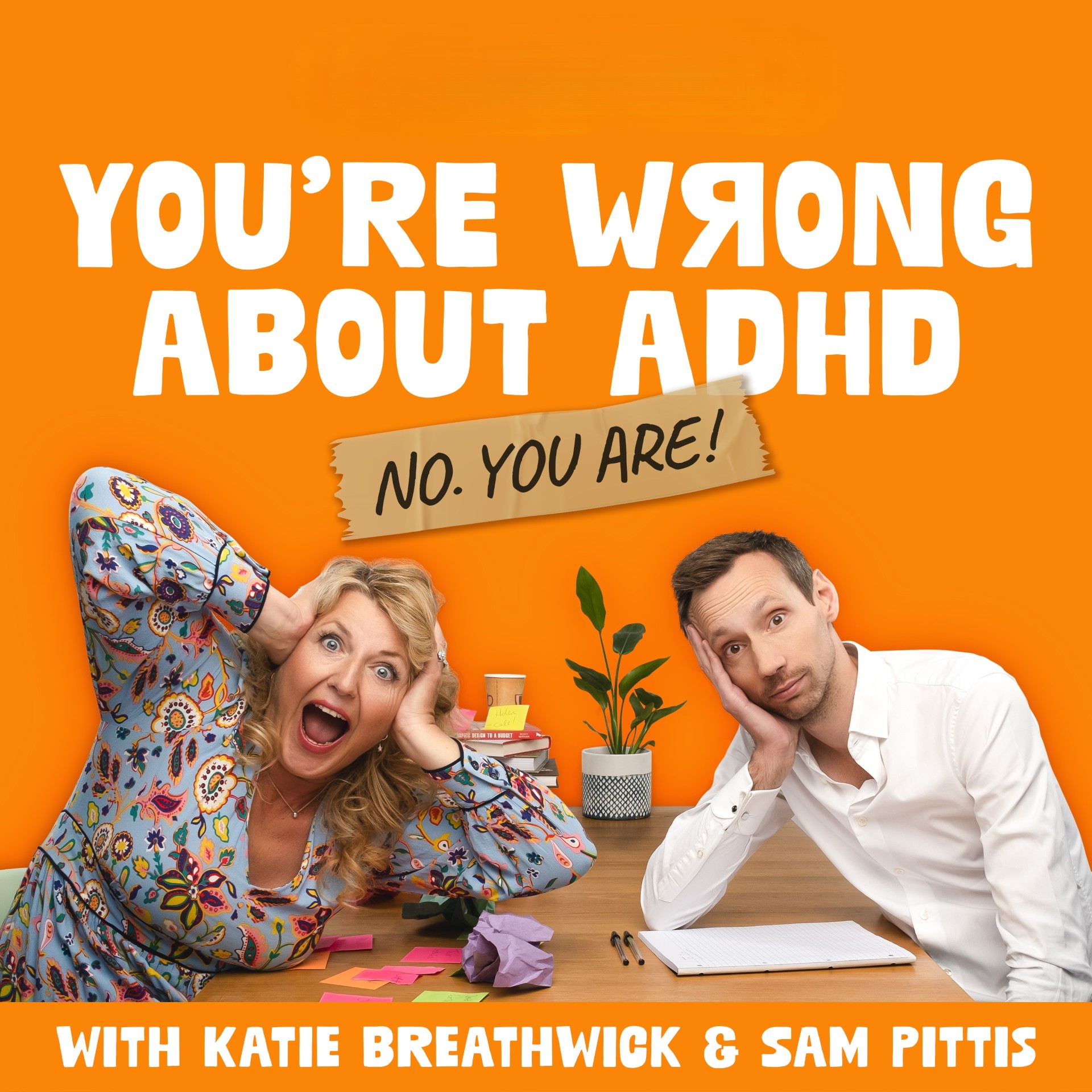
This is a Global Player Original Podcast. Hello, I'm Katie Refwick. And I'm Sam Pritis, and welcome to our new podcast, You're Wrong About ADHD. No, you are.
No, you are. No, you are. Mrs. Stupid.
Stop it. Sam and I have been friends for nearly 20 years. A couple of years ago, we both found out we had ADHD. But I think it's fair to say we feel very differently about this.
Getting an ADHD diagnosis answered lots of questions, but also raising new ones. Each week we're going to be talking about everything from our experiences being diagnosed as adults, to relationships, coping strategies, and how we manage these very special brains. So we can learn more about ADHD and what it means to be neurodivergent. Alright, Sam.
Yeah, I'm not doing too bad. I'm quite tired at the moment. I'm always tired because I've got two small children, but particularly with ADHD, I find tiredness is one of my big things, particularly this time of year. And it's remembering to take the pressure off yourself and give yourself a bit of a rest.
I want to ask how you are though, because a couple of weeks ago, we talked about the medication shortage, we talked about how you were managing with that and frankly struggling with that. How are you doing? Well, you know, alright, not great, to be honest. I had a pretty rubbish day yesterday.
I finally got a call back from our local surgery from a clinical pharmacist, whose job it was to basically ring me and tell me that there was nothing they could do. And interestingly, I've had a number of people who've been listening to this, who have got in touch with me. And I'm really grateful to them for taking the time to do that, who had got in touch to give me advice on what I could expect and what would happen, and all of which turned out to be true. And it turns out that if, as I did, you go for a private diagnosis and then enter into a shared care agreement with your GP, which I have now done, you essentially fall between the cracks, because I can now not go back to my GP to get a re-prescription or a new prescription for a different kind of drug, which is what I'm chasing at the moment.
I can't get a hold of elephants. So I want either a different kind of a stronger elephant or a different kind of ADHD meds. And my GP can't do that for me. I have to go back to my private consultant, which means hundreds more pounds.
And I sat there all afternoon yesterday, feeling fairly fried and not getting anything done. It's December. And I've got, you know, I'm a care of divorced, elderly parents, and I'd rather be down to the syndrome and I'm buying Christmas presents on behalf of them, and for everyone else, and trying to think about the shopping and, you know, everything else on top of it. And I just watched the clock tick.
And in the end, I just thought, you know what, I'm just going to shell out for this and I'm just going to do it. How much does my sanity cost in the run up to Christmas? And my fear is that in the aftermath of all of this, when those meds become available again, we're told April, but my pharmacist suggested it would be later than that. Am I going to have to pay again to get a new prescription and a new titration?
I don't know. I just feel like I'm caught between a rock and a hard place. I've literally, I've slipped between the cracks and there's nobody taking responsibility. But there we go.
I'm so sorry that you're in this situation. And we've talked about it, you and I, it is crazy that people are facing this and you are, you know, and you shouldn't feel guilty about it. You've been able to go private, you've paid and be make guilty. I do feel guilty.
I'm aware that I am a somebody who was not sectioned by their ADHD. It leaves me feeling anxious and sometimes sad and certainly incredibly lacking motivation. But I'm not somebody who is sectioned by it. I'm also somebody who can afford to go private.
And yet here I am sitting complaining about the situation. I feel terrible if I was guilt. I'm also comes back to that thing. I'm sitting talking to somebody for whom the meds don't work.
Well, honestly, you've got to give yourself a break as we said before. And I think you've done the right thing. But it is crazy that there are so many people out there who isn't going to be an option who are saying, I haven't got my medication and I can't afford to go and get it privately. Which is, as I said, it's crazy.
And we're going to talk to Henry Shelford from ADHD UK shortly and he will give us an idea of what the picture is at the moment. We're going to talk about Christmas as well. We've been asking for your experiences and your messages about Christmas because we really wanted to do an episode of Christmas because it is such a stressful time for people. And an emotional time.
I think about Christmas as it throws up. Memories of the past. It throws up. If feeling someone we were children, we meet people who perhaps we don't see the rest of the year and that brings with it.
It's own emotion. You know, family's always bring emotion into the situation. I think that is something which for so many people, ADHD or not, can be overwhelming, can be overstimulating. It is essentially trying to face down emotions that maybe we tried to hide or we tried to keep hidden.
And here they are popping up in our face. And when you add ADHD into that, actually that is even harder because suddenly you're facing emotion, this regulation, you're facing overwhelm. So we're going to look at some of your stories and we're going to ask Henry, what are some of the ways we can cope this Christmas? Henry, it's lovely to see you again.
It's wonderful to be here. Can I start with telling you why I find Christmas such a stressful time for me. And maybe you can give me some tips on how I can handle it better. I have always felt I get to September.
I don't know where four months ago. It just goes like that. And for me, it's about the lists. It's about the overwhelm of jobs to do, all the people to think about.
And at the same time knowing that I've got to, whilst meeting everyone's needs, make it perfect for everyone. You know, everyone's experience of Christmas is riding on me. And along with all of that comes that emotional overwhelm as well. So where do you even start with that?
Christmas just so much comes together at once. Right. It's a deadline. You've got lots of different people judging you and a responsibility to them.
And you've got that mix of different expectations and trying to fulfill them all. So it's now reflected as an unclear exactly what success looks like. Yeah. And so little time to do all of that stuff as well.
Everyone wants to meet you for a Christmas drink in December. So, you know, the time in which you can get all of the stuff. You've got more friends than me. I don't know about that.
But, you know, it's that, oh, let's get together for a just a quick Christmas drink. I think I have less and less time. Why can't we meet in January when the pressure is off? And I don't have to think about where the flipping Christmas decorations are at the back of the attic.
And there's so many different things to think about. And so many ways in which you can fail. I think that's the thing that really stresses me out. I know that I can let people down in so many different ways, you know, forgetting to buy a Christmas presents.
Or another thing I've done is I bought Christmas presents twice because I'd forgotten that I bought it the first time and then put it in the place where I put the Christmas presents and gone, oh no. And now I've got to find the time to take the first one back having found the receipt because I don't know where that is either. Everything gets lost. Everything just goes completely wrong.
Pick it up on your point about forgetfulness. That leads us nicely onto our first question, I think, which is lovely story from Pip who says she's newly diagnosed, 40 years old. I've been waiting for every new episode every week, really enjoying the podcast. Well, thank you for listening, Pip.
I do have Christmas chaos, she says. The worst was when I left the bags of Christmas presents for all my friends and family from my last minute Christmas shopping at the pub on the 24th of December when I popped in for a last minute drink with some friends. I mean, that's a really good illustration of the forgetfulness and the stress that we're talking about. How do we go about at Christmas time trying to reduce the stress so that we can perhaps try to manage our memory?
You know, I am a four-year-old child in the respects of my back. Like, if I have to anything in addition to my back bag gets tied to my back bag. If I could do a socially acceptable to have my gloves attached to a piece of string through my anorac, I would absolutely be doing that. Let me tell you that I've had my gloves on an asterisk as an adult before for exactly that reason.
Okay. Now, this was long before an ADHD diagnosis, but trust me, that was one of the best winters I have ever had because I didn't buy five to ten pairs of gloves to get through it. But, you know, why not have your gloves on an asterisk? But it's so interesting because I am the same.
I have one bag. It's a backpack. It's a very special backpack to me and it has a pocket for everything that is important to me. So, you know, my past to get into work, where my wallet goes, are all very, very, very specific places.
And they all have to go back in that pocket. And without the bag, I feel like a little bit of me is lost because it has become such an important part of my... ...organizational process. And I love the idea of tying things onto your bag, because that's the only way it works.
If you put it down and it's not in the bag, you can guarantee I will leave it behind. That's how my brain works. I forget to look. I forget to remember, you know, it's a nightmare.
When you're looking, you glitch. Like, I'll look across this over looking for something and my focus glitches as I'm doing it. And I miss it. I had a pleasure of interviewing Henson Blumenthal and he came up with a phrase.
He talked about importance of being able to see things and then being really clear so you could see them. And he just said, Twydying is hiding. It is. It is.
It absolutely is. Tidy is hiding. You need open shelving. You need glass doors on cupboards.
You need to be able to see everything in order. You know, my desk is always a mess. But the point is that the desk is a mess because I can see everything on it. And if you start putting it into tidy piles, I will lose it.
I won't be up to see it. Obviously, I can't cope with mess. I can't deal with mess. It stresses me out.
I have to have everything tucked away and put somewhere. Because if everything's got a home, then I know where it is. And that's how I try and remember things, which perhaps makes me unusual. But that's my method of remembering.
That's a stretch. Because out of interest, like, is the mess on your desk and then are there aspects of tidies? I'm tidied to draw a messy desk. Am I tidy anywhere?
I'm trying to think. Is there anywhere in my life where I'm tidy? No. No.
I have to be. Because I'm a mother to two teenage boys and a wife and a daughter and a sister. And all those different relationships mean that I have to be efficient. So I have systems, but they're not very tidy systems.
They tend to involve piles of things in the corners of rooms. And eventually those piles can get a little bit overwhelming. Like Christmas presents actually. At the moment, there are piles of Christmas presents.
And people aren't allowed to go into certain rooms because they'll see their Christmas presents because I've got no better system for hiding them than that. But if I put them away, I'll forget that I bought them and I'll buy them again. So I have to leave them out where I can see them and hope that I remember to look at them before I head down to the shops again. I sound like a mad woman, Henry.
You don't mean I bet you said people listening? You don't. Because this is our world. We're all unique individuals plus ADHD.
So there isn't one size fits all. I think the big step and one that we often really struggle with is just that step back and go, right, how am I going to do this? Something that I find works really well is you'll get other advice, which is just chip away at it to a little bit here and a little bit there. And it's just useless, right?
Because I'm either going 100% or I don't. I don't have that in between modes. So what I find works really well is to say right on this day, I'm doing the presents. And I just do all the presents as many as I possibly can.
And I find that just blocking it out and saying that's what I'm doing as a whole. I actually find that goes beyond being a coping strategy. It works so well. I find it really nice.
It does make it easy. The only problem point is when you're like, you know, what do you want? Then they don't reply. Oh, yes.
Now my day's gone. Oh my God. Yeah. Yeah.
Or you forget, you forget that they are, I now have, I now have a note, a Christmas note that I send to myself in September, which has the list of all the people that I need to buy for. And I write on it. I have emailed to ask what they want for Christmas. I have to put every step down on that piece of paper in order to remember at which stage I am with each individual because I cannot hold that information in my head.
And the people who don't reply are so infuriating. The people who don't realize that you need to know a month in advance. But you can't leave it until the week before, because a week before is too late for me and by then I'll be frazzled and cross and chatting everybody. I need to have got this stuff planned pretty much before December, actually.
Otherwise it's too late. It's too late. And everything else to think about. And that's what you're saying is that Henry is making a plan, making a routine, making a structure to essentially what you're doing.
Try and try and take that step back. But the problem though is the other people problem. Like I've got kids, like we have to put a list together, like who's buying what for which I discovered a list system like this one in Amazon. I can do wish this doesn't have to be an Amazon product.
Fantastic. We've got two buses. One of my relatives didn't know that they needed to be ticked off as boards. I thought it was panacea to that problem.
Speaking of other people, we've had a note from someone who wishes to remain anonymous and you'll see why. She says she was diagnosed with ADHD as a 54-year-old woman and she says, I have somehow managed to hold together my family, but I'm aware they can all find me really difficult and I am dreading Christmas with my in-laws. I spend most years secretly wishing I could hide away upstairs. Is there anything I can do to stop feeling so overwhelmed?
And Sam and I often talk about this. There's a lot of guilt involved I think with the feeling of overwhelm and the desire to creep away and be on your own for a bit. And I now look back and I realize there have been a lot of moments over the years where I've done just that. And my husband has come into the bedroom and said, what are you doing?
Why not downstairs? What are you doing? You can't hide away up here. And yet I do feel I need to do that every now and then.
I need to be on my own just to sort of reset the social battery so I can then go out into the fray again. Is that something you need to do? Since talking around like that feeling of overwhelm is something a lot of people experience and I know something about a strategy of like, it's the nap strategy. Where they say to the host, I've eaten so much.
I'm just going to have to have an hour. And it's a really socially smooth way to be able to come out for an hour or so whilst making it about celebrating how wonderful the meal and everything's been. I think looking to see how you can curate the day to work better for you. So if you're hosting, you're in control.
If you're not, you've still got some opportunity. So it may be that you find going out on a walk the fact that then you can just be talking to one person and it being much more managed and not jumping around actually that being really useful. It happens that's one of us and family traditions to go out there. My parents have told us and I've never realized how important that is to me.
It really gives me that time out. We have a friend group who love a game of charades where it becomes a memory game. So first round is normal, second round you're allowed to do less, third round, even less. And I can't remember any of them.
I hate that game. It just makes me feel really dumb and I don't like exposing it. So what do you do, Henry? What do you do in that situation?
Well, so thinking about what games can I bring? Because usually there's a bit of like what should we play? Usually there's some people in your family who you can speak to and say like this thing. Like if we could do this instead of it would really help and they can be alright.
I really like to play that game. So you don't need to go and speak to everyone and say we want to do this. You can just help it happen. I find games.
I haven't got patience for games to be honest. I just feel people firing questions at me or anything like that. I'm either not interested in the answer or it doesn't move quickly enough for me. Or I can play it for five minutes.
Whether it's a board game, whether it's your aunt's, I play for five minutes. I think this has been fun. Let's move on and do something else. So yeah, I'm totally with you on games.
And social situations, I know, everybody says at Christmas that you have a room full of people that can be overwhelming. The difference for me and ADHD is that I get confused. I get mentally confused. I get to the point where I'm so tired that I can't then communicate and I have to take myself away.
So I can be enjoying it. But even with it's with family, I need to go away and have 20 minutes or so. Maybe longer or I just am able to give my brain the rest. And I find that it's something that then brings a lot of guilt because you feel bad about trying to extricate yourself from a social situation where people are just trying to be friendly.
And I think what you said about trying to curate your day is interesting. It is maybe planning things in that suit you and knowing that when you're going to do something that doesn't suit you, can you have a conversation with the person who's hosting? I mean, that's probably the key, isn't it? Is letting other people know that you're struggling.
Yeah, yeah. Actually, do you know what? It's been more open about your ADHD, I think, really, isn't it? And actually, you know, it goes back to what we have talked about before, the whole diagnosis element of ADHD can be a really big deal because for the first time you recognise why you can't do certain things and why you need certain people to understand certain things about you.
And actually, that's a really big deal on a day like Christmas Day when there are 15 people in your house and loads of needs to meet and, oh my God, it all can get a bit of a pressure cooker because you're all in one room all at the same time. But to be able to say, you know what, I just need to go in half half an hour on my own because I have ADHD. It's a really, really big thing. It is.
And some people are allies about it. And when you're talking about being open, obviously, we all vary up. But oftentimes you are deciding who to tell. Like, some people, it's going to be positive telling.
And some people, you know, it's not. And one of the challenges in a family group is you might have people in both camps. And so thinking about who's an ally, you can help you. Allies can be a great approach.
There is, for me, anyway, the thing that really makes me struggle with ADHD is stress. A large part of this is reducing stress, isn't it? It's reducing pressure on yourself. What are some of the best ways to do that, do you think?
I think that taking that step back to having a think, trying to build up a plan. If you're not hosting, talking to someone who's been there for to understand what's likely to happen. Otherwise, you're stepping into the unknown. And you can't work out what to do, where you're likely to have issues, because you don't know.
I have a very simple issue. If you don't feed me at meal times, I'm going to be very hungry. And I actually think that I actually do think it's in respect related to my ADHD. So because you need enough sugar in your brain to fight for it to fight.
Otherwise, you have to have memory issues and you have focus issues. And I've already got those. So like, if you make those worse, I'm in real trouble. There's a whole load of people who think they look Christmas.
It's absolutely fine to have lunch at 3pm. And that's totally true. It's totally true. Alcohol at 11.
Alcohol at 11 in food at 3pm. And I'm the same as you. I need to have a meal in between breakfast and lunch. So basically, my strategy is, Christmas is instead of a three meal day, it's a four meal day.
I'm having lunch. I'm having lunch. I'm having a big 3pm thing as well. Yeah, well maybe so maybe that's about thinking.
I mean, that's putting on my parent of young children hat now. And remembering back to the Times when, of course, with small stomachs, I had to have snacks fable at the time to make sure that they were always had energy. And maybe again, that's about thinking about things like having a secret snack spot where you've got nuts or whatever it is that you need that will keep your brain and your emotions regulated so that you're not feeling. So the alcohol doesn't completely throw your system out of kilter.
And so when you are in the hands of someone else who isn't going to feed you until 3pm, you at least have a little bit of control over you. But again, it's remembering to take them. I think that's a really good point. And Henry, you really made me think about that because I'm someone who absolutely food affects.
And if I haven't eaten, I get confused. For me, it's all about getting confused. And I think the other thing on Christmas Day is sometimes that gap between breakfast and lunch. I think while I just eat this mound of chocolate that the children have got, which doesn't help either.
And it just gives me a buzz and has the oxish. So remembering to have another meal is key. I mean, that is a tip I'm going to take away with me. And also, in terms of snacks, just be the guest who turns up with loads of dips and chips and snacks.
And you're like, I'm doing you like, are I a wonderful guest? Also, I'm fed. Yeah, I love that. I love that.
Being, coming armed, coming prepared. What are you saying earlier about planning your day? It isn't just about planning when you're going to, well, even planning a whole of Christmas. It isn't just about planning when you're going to buy your presents.
It's not just about planning the time for dinner. This is actually about planning. I'm going to eat this time, this time, this time, this time, this time. This is when I'm going to go for my nap.
This is probably how long I think I can manage going to a party. I mean, it is planning your time in that regimented way. I think that's what we're talking about, isn't it? It's also having to just be aware of self awareness.
So you know, like it's right, getting to one o'clock and I seem to your age. I mean, of course I'm on edge. But I'm really, really hungry. So having that awareness, for some of it will work, having quite an exact plan.
And for some it'll be like having the awareness so you can see stuff starting to be a problem before it is. I think that can be very helpful too. We've got another question. Paul says, I'm 62.
I was diagnosed five years ago. When I was diagnosed, medication was suggested. I was apprehensive. I tried it for a week.
It really didn't like the way it made me feel. My fear was that it might leave me less effective. If there is a part of ADHD, which is helping me to be successful, then I don't want to lose it. However, I believe that my ADHD has been problematic in my relationships and I've often been tempted to reconsider.
Paul asks, how can you manage ADHD without medication? This is a really important question for people, particularly at the moment when there is a medication shortage. How do you manage your ADHD without medication? And I say that somebody who doesn't take medication and what you said earlier about self awareness, for me, it is about recognizing my symptoms.
What would you say to Paul? Data is pretty clear. Data is about 80% of people find medication helpful in the UK. Your statistics suggest between 15 and 75% of medication.
So we know people are treading both paths and both paths are absolutely equally valid. People talk about medication being a helping hand and making a very big difference for them. Obviously others not. We do have a middle path for people opting to take medication to help them build up their own self awareness and their own strategies to a point where they feel that they don't feel the need for the helping hand medication.
And so there is that middle path as well. Sometimes a building up strategies. Number one is education. It's listening to podcasts.
It's going to support groups. It's talking to other people with ADHD. It's understanding how it's impacting you. It's finding where's the line between you and your ADHD.
What's me where I find some really difficult work for others. It is a molehill for me. It's a mountain and I need to have a strategy and a plan. I need to be kind to myself.
But I'm a complex human being and I am totally capable of making a mountain out of a model. At which point I need to give myself a big hard shelf and go, come on, come on, Henry, you can do it. Get it done. And recognize that you need to know the difference because particularly for us late diagnosed people, we thought everything was give yourself a big hard push and force yourself over the mountain and not think about doing things differently and strategies for it.
And one of those strategies being just not doing it and recognizing that. And it's often been pretty hard because we've always done that push. And so I think step one is the self awareness piece and the awareness of ADHD piece. And so I think that's one of the key ways to manage ADHD without medication.
I think what you said though about not making a mountain out of a molehill is really interesting because one solution to all that is to say that social situation is going to really stress me out and I'm going to get really tired. Therefore, I'm not going to see the family at Christmas. Well, that isn't a solution. Sometimes you do have to push through.
Sometimes you have to say I'm going to go myself in a situation which is going to be perhaps uncomfortable. I'm going to have to recognize it's uncomfortable. But then I also know that maybe there's a time limit on that. Or maybe I give myself two hours to go to that party rather than thinking I can go all night.
And I think that is self awareness not to not to do things but to just manage almost to take stock of how much you can manage. And that's what really works for me. With everyone in particular with people with ADHD who are successful, they've worked out that they need to do a bit differently. We're usually talking about that about work, but it's actually about life.
Okay, it is about Christmas and it's about other events about doing it a bit differently in the way that works. That's the key. So if we were to sum up all the different things that we've talked about, what would be your top tips for Christmas, Henry? Well, bearing my, obviously, we're all unique individuals plus ADHD.
So there's a breadth of us. That's only the number one is that awareness of you and Christmas. What are the bits that you find particularly challenging? So having that step back and having a think and to do that, you've also got to know your day.
Now, if you're hosting, you do. You're in charge. But if you're going somewhere else, you don't. And you've talked to people who've gone there before and person hosting, I understand what the plan for the day is what's going to happen.
Having an ally, like some people you spoke to, like they know you understand where you might be having a challenge that can help you. And that can be as simple as helping, supporting if you need a bit of time out to bring yourself back together. And this one is a fantastic strategy. It's called a napsh Shashi, where they're like, I've had such a lovely big meal.
I should have it. I need to have it now. And that's just a lovely sneeze way that's a havoc out. On the other side of the sidelines, there are some people who are offering some people who are going to be critical, like you might say things.
And that's particularly if you're newly diagnosed and you've told people and they are critical of something that you know is a part of ADHD. That can be pretty brutal. And so recognizing that and trying to have a plan for that, that plan could be as simple as like, you know, I hear you and just moving on very quickly moving away and getting around like can help you. And then the last top tip is like, take control of the games, like no memory games.
I don't even like, I will lose to a three year old snap. Like, let's control the games. One thing. Choose the game.
Love it. I love that one. That's brilliant. Well, it's been a pleasure to talk to you as ever.
Henry, thank you so much for joining us today. It's been a pleasure to talk to you too. It's been absolutely wonderful. Merry Christmas.
Thank you, Henry. As always with Henry, that was really interesting. It made me think about how what I'm going to do this Christmas. Yeah, and for me, the two things I'm taking away were ally and snacks.
I am finding an ally and I'm taking snacks and going to give myself a bit of a break. I'm definitely going to remember to have an extra meal, about 10, 11 o'clock in the morning, maybe another one. So breakfast, big meal, then I'll have Christmas dinner and another big meal in the evening. It's a four meal day.
And the thing to remember is that by the time you get to Christmas day, you've done all of the faff and you are through it and if something goes wrong, it's okay. Try not to be too obsessed with making it perfect and just say, do you know what? What happens happens and try and enjoy it? I think it doesn't get exactly as you planned.
That's okay. You can listen for your wrong about ADHD for free on Global Player. Download it from the App Store or go to Global Player.com. See you next time.
This is a Global Player Original Podcast.