
EPISODE · Mar 31, 2026 · 31 MIN
How to Compare Smart Device Automation Logic and Conditional Triggers
from The Smart Home Setup Podcast
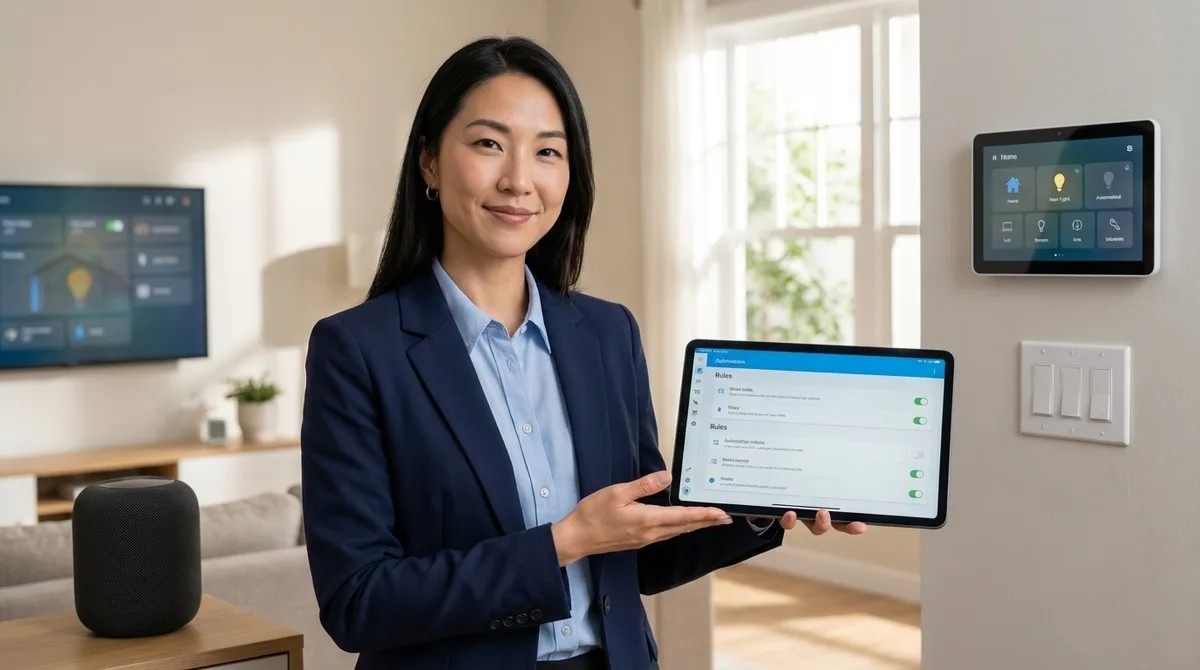
Ever notice how your smart home sometimes feels more demanding than helpful? Lights that blast on at full brightness when you're stumbling to the kitchen at 2 a.m., or automations that ignore the fact you just manually adjusted something five minutes ago. The difference between frustrating smart home reactions and truly invisible automation comes down to how well you've structured your conditional logic. This episode walks through a rigorous methodology for comparing automation platforms, examining trigger conditions, latency expectations, and the interoperability quirks that determine whether your routines feel seamless or stubbornly mechanical. Write out every automation as explicit if-then-else pseudocode before touching any app—this reveals exactly what your platform must support, from nested conditions to Boolean operators, and prevents discovering limitations after devices are already installed. Protocol choice directly impacts automation reliability: Zigbee and Z-Wave sensors typically report within 100–400 milliseconds locally, while cloud-dependent Wi-Fi devices can take one to three seconds or fail entirely when your connection drops. Not all platforms handle layered decision trees equally—some require splitting complex logic into multiple automations that can conflict with each other, while others support elegant grouped conditions with AND-OR operators. Create a comparison matrix tracking each device's protocol, whether automation runs locally or in the cloud, actual measured latency (not manufacturer claims), and trigger granularity to understand what your system can realistically handle. Matter 1.4 aims to standardize trigger behavior across ecosystems, but as of 2026, implementation quality still varies significantly between manufacturers—test your specific devices rather than assuming compatibility. The goal is automation that anticipates needs rather than demands attention: lights that adjust before you notice dusk, climate that responds to occupancy patterns instead of scheduled guesses, technology that genuinely disappears into the background of daily life. Read the full article: https://mysmarthomesetup.com/how-to-compare-smart-device-automation-logic-and-conditional-triggers
Embed this episode
NOW PLAYING
How to Compare Smart Device Automation Logic and Conditional Triggers
No transcript for this episode yet
Similar Episodes
No similar episodes found.
Similar Podcasts
No similar podcasts found.