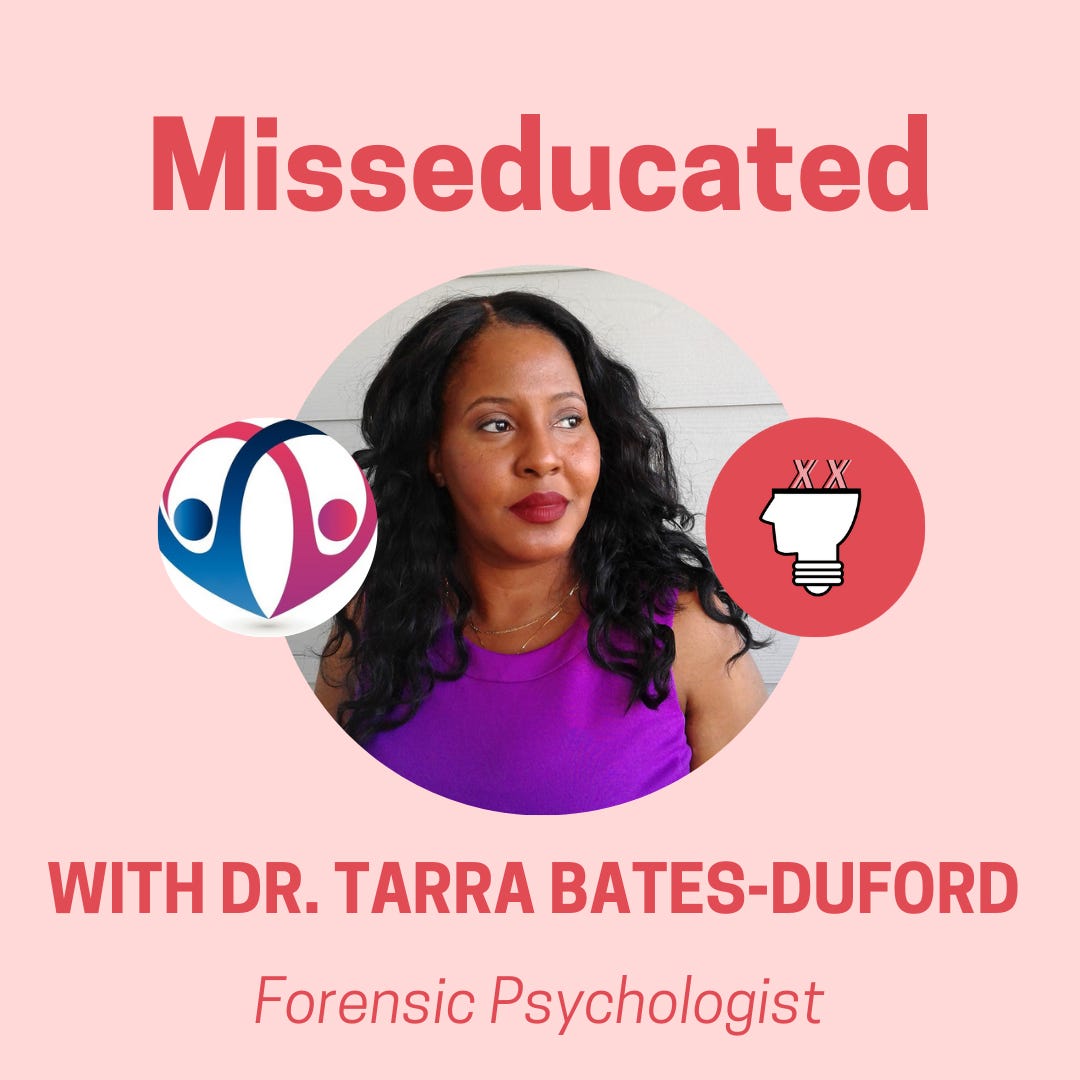
How to Help Someone in an Abusive Relationship
from Misseducated Hosted by Tash Doherty and Dr. Tarra Bates-Duford
Hello everyone! This week I’m sharing an interview with Dr. Tarra Bates-Duford about how to help someone in an abusive relationship. Below you’ll find a summary of our key talking points, and then the full transcript of our discussion so you can read along. I hope you find this informative, and that it comes in handy one day. Please share the episode and article with anyone you think it would help. Love, Tash 💌 ✍️ How to Help Someone in an Abusive Relationship Discussion with Dr. Tarra Bates-Duford, PhD, a forensic psychologist specializing in familial dysfunctions and trauma. You can find her on LinkedIn and Instagram. What is the definition of domestic violence? Domestic violence is a pattern of intentional violent or aggressive behavior. It can be physical, sexual and verbal against a close family member or romantic partner. What are the main misconceptions about domestic violence? * That the individual can leave (In reality, they often can’t). * That they’re choosing to remain in the relationship (In reality, they may not have a choice). * That it doesn’t happen in affluent communities (In reality, it can happen to anyone, from all walks of life, religions, relationship types, and sexual orientations). How do abusive relationships often begin? * They often begin with the depreciation of a person and mean-spirited jokes, then gradual isolation: * E.g. “You’re stupid. You don’t do well on your own. Those people aren’t your friends. You’re so gullible. Left to your own devices, bad things could happen.” * They suggest the person can’t do anything right, and that they would be safer if they gave control and decision-making over to their more knowledgeable partner or family member. * Gradually the tone changes and because we accepted their language as a joke, it feels inconsistent and like too big of a deal to bring up now. * Over time, it can escalate into violence and fears for their safety or their children’s safety. What traits do abusive partners often have? * They are usually insecure people who struggle with power. * They tend to be overlooked. * They may not be taken seriously in their own lives, so they look for people they can exert power over to feel validated. * They are trying to compensate for feelings of powerlessness and helplessness. What traits can victims of abuse relationships have? * Marginalization, or growing up in a toxic family * A history of domestic violence, maladaptive behavior, or dysfunction in their own family * Unless we learn how to manage this or have something to compare it to, we may subconsciously try to replicate the environment that we are familiar with and rebuild dysfunctional families ourselves. * Lack of a father figure growing up can lead to a controlling idea of what a father is that the victim confuses with love e.g., “I don’t want you to have that. I don’t want you to wear that.” What are the signs of an abusive relationship? * Your partner makes you feel less than, not valuable, not worthy. * If you're constantly trying to fulfill the need of your partner without that person trying to meet your needs. There is no compromise. It's either this way or the highway. * You do not have a voice in your relationship. How can you stop early signs of relationship abuse? * Have clear deal-breakers and personal boundaries that you enforce. * E.g. Say “I do not tolerate racial comments, even jokingly. I do not accept language like this, not even in jest.” * The Camel Exercise: Imagine a two-humped camel and the straw that broke the camel’s back. What you're willing to accept is one hump and what you're not willing to accept is the straw between them, or the things in your life that you are unwilling to compromise on. Beware of comments or language that are another straw on your camel’s back that you don’t accept. * Announce and assert your boundaries to eliminate confusion when someone has crossed the line. If you have boundaries that have not been announced, you don't have boundaries because people don't know where you end, and they begin. * Do not violate your own boundaries. From this, an abusive partner will realize that your boundaries are permeable and that they don’t mean anything. * If you’re able to enforce your own boundaries, an abusive person will likely not remain close to you in your life, and eliminate themselves, which is what you want. And this can help you give space to healthier people and relationships in your life. * Reflect on your experiences in your relationship: if a friend came to you and said she was having a similar issue that you’re having, what advice would you give to her? Would her relationship sound abusive to you? How can you help someone in an abusive relationship as a friend or bystander? * Encourage that person to empower themselves, and create a safety plan (see below for details). * Don’t “add to” the victim experience by pressurizing them. If you give controlling commands e.g. “You need to leave that relationship,” what distinguishes you from the abuser? Instead, you have to create a distinct voice that is totally different from the person abusing the victim. * Don't put demands e.g. “If you don't do leave him, then don't even bother contacting me again.” Don't give ultimatums. Ultimatums suggest that your love is contingent upon what that survivor is willing and unwilling to do. * Remember that just because you tell them to leave their relationship doesn’t mean that it’s safe for them to do so. * Remember that when someone is about to end or leave an abusive relationship, it’s the most dangerous time. * Anticipate what you don’t know. If you’re suggesting they leave, where should they leave to? Or if they have kids, leave and go where? Do what? What do we do about food, income and shelter? Be able to provide some real resources instead of demanding them to leave. * Have them keep someone in the know, like a close friend who knows their schedule, who will realize if anything happens outside the norm. What should you include in a safety plan? * It’s a written-out or agreed-upon plan on how to leave an abusive relationship. * It describes when and how the victim can leave in ways that might be safe e.g. when their partner is sleeping or out of town. * It could involve: * Plans to make separate keys for the car * Packing bags * Pacing belongings in other locations so you’re not fumbling around the house trying to find things when you leave * Stashing money somewhere, in case your joint bank account is no longer available to you * Having cash so they can’t track your credit card purchases * Remaining in contact with a friend the abusive partner doesn’t know about, where the victim could stay and hide at that house * Having the numbers to case managers and Domestic Violence shelters. * A good safety plan also includes a lot of alternatives, including plans for picking up the children from school, and what to do if the victim needs to get out of their house quickly. How can we stop abusive relationships from happening in society? * Hold perpetrators more accountable for their actions, not just send them to jail for a couple of hours to cool off. * Understand that more than our spoken language, it’s our unspoken language that impacts our children. We may be teaching our children these maladaptive relationship patterns without realizing what we’re teaching them. What else should we know about sexual abuse in relationships? * It can happen at any relationship stage, and it doesn’t matter if you’re married or not married, if you know the person or not. If you say no, and you’re not interested in engaging in sexual activity, it’s still no. No one has the right to violate you and disrespect your boundaries. * Some people think it’s different for married couples because they see marriage as some sort of ownership, instead of a partnership. How might you figure out if what you’re experiencing is relationship abuse? * Imagine that instead of yourself, a friend is recounting her experiences to you like the ones that you’ve had in your relationship. What would you say to your friend about her situation? Podcast Interview Transcript Tash: Hello, it's Ta… Get full access to Misseducated by Tash Doherty at misseducated.tashdoherty.com/subscribe
Embed this episode
No transcript yet.