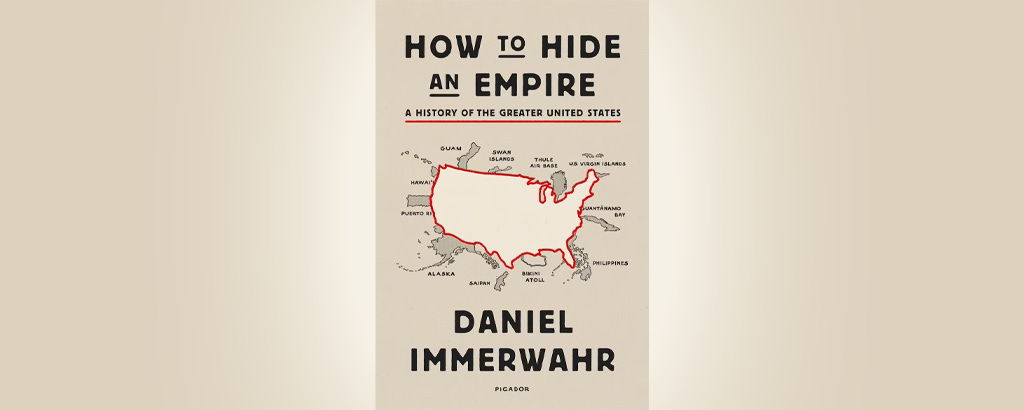
How to Hide an Empire
from Ralph Nader Radio Hour Hosted by Ralph Nader
Ralph welcomes professor and historian Daniel Immerwahr to discuss the history of the United States' overseas possessions and his book "How to Hide an Empire: A History of the Greater United States." Daniel Immerwahr is a professor and historian at Northwestern University. He is the author of Thinking Small: The United States and the Lure of Community Development and How to Hide an Empire: A History of the Greater United States. What I wanted to do in the book was to look at the United States and to take seriously the parts of the United States that don’t always feature in the textbooks—that are outside of the mainland, the contiguous blob. And what I discovered when I did that was that these places were often in the mainland’s mind seen as peripheral places, but this was not a peripheral history…It turns out that once you’ve got the territories in view, you have a different understanding of them. And so a lot of US history (and really important parts of US history) has actually taken place outside of the part of the country that we normally think of as the United States. Daniel Immerwahr I got really interested in the book in how it came to be and why it mattered that US standards prevailed and how other countries dealt with that by either jumping on the ship or trying to resist and that became difficult for them. And how emotionally hard it is for other parts of the world to [face] this onslaught of not just the US military, not just US planes, its bombs—we know all that stuff, and I don’t want to diminish it, but all the US stuff and ways of talking and the English language and the dollar. And each one of those comes as a kind of challenge: Are you going to adopt this or not? Because life’s going to be a little harder if you don’t, but if you do, you’re kind of a puppet. And everyone in the world has had to deal with that challenge on a daily basis—what screws they use, what language they speak, all that kind of stuff. And we don’t talk about that a lot, but that actually strikes me as a really important facet of US power. Daniel Immerwahr News 1/23/26 * Our first two stories this week come to us from New York City. On January 16th, Mayor Zohran Mamdani drew a line in the sand in an address celebrating a historic settlement with A&E real estate. While A&E is a serial offender, racking up “over 140,000 total violations, including 35,000 in the last year alone,” Mayor Mamdani made clear that this was to serve as an example for other landlords, saying “City Hall will not sit idly by and accept this illegality, nor will we allow bad actors to continue to harass tenants with impunity.” Mayor Mamdani made tenants rights a central pillar of his campaign and is signaling that it will be a major aspect of his administration as well, with the centerpiece being the “Rental Ripoff” hearings he plans to hold in all five boroughs. Yet again, Mamdani provides a blueprint for other Democratic elected officials in cities across the nation, if only they would pick up the mantle. * In other news out of New York, on January 13th New York State Attorney General Letitia James announced a “settlement ending Betar US’s…campaign of violence, harassment, and intimidation against Arab, Muslim, and Jewish New Yorkers.” Betar, an extremist Zionist outfit, is considered so fringe that even the ultra-Zionist Anti-Defamation League (ADL) has labeled it an “extremist group” for its “embrace of Islamophobia and harass[ment] of Muslims.” Examples of Betar’s bias-motivated harassment include labeling keffiyehs, traditional Palestinian scarves – as “rape rags” and claiming that the number of babies who had died in Gaza was “not enough,” adding, “we demand blood in Gaza.” According to this announcement, Betar is seeking to dissolve its nonprofit corporation and intends to wind down operations in New York. Mayor Mamdani added, “For years, Betar has sowed a campaign of hatred across New York, trafficking in Islamophobic extremism and harassing those with whom they disagreed. There is no place for their bigotry in our politics, and I’m grateful for [Attorney General James’s] unflagging pursuit of justice.” * In more Israel news, earlier this week Israeli human rights lawyer Alon Sapir recounted the following story on social media. “On Saturday, I represented an American Jewish activist in deportation proceedings from the country due to his leftism. In the hearing, they presented him with a photo from a demonstration in the US to link him to anti-Israel organizations.” The photo in question was “taken at a demonstration against the Nazis in Charlottesville [Virginia],” and the Israelis “apparently took it from a page that promotes white supremacy.” This deportation proceeding – wherein the Israeli government used a white-supremacist photograph of an activist protesting Nazism to deport him on the grounds of being anti-Israel, is of course, stunningly backwards. But, as Sapir writes, “Indeed, [this is] grounds for deportation from the Jewish state.” * In more news from abroad, the New York Times reports the People’s Republic of China has hit a new economic milestone: the world’s largest trade surplus ever. According to economic data released by the country’s General Administration of Customs, “China’s surplus, the value of goods and services it sold abroad versus its imports, reached $1.19 trillion, an increase of 20 percent from 2024.” As this piece notes, “The enormous trade surplus…came despite efforts by President Trump to use tariffs to contain China’s factories.” While the tariffs succeeded in reducing China’s trade surplus with the United States by 22% last year, Chinese firms compensated by increasing sales to other regions and “in many cases bypassing American tariffs by shipping goods to the United States through Southeast Asia and elsewhere.” In short, the tariffs have succeeded only in raising prices for American consumers by forcing Chinese firms to route their products through secondary markets instead of selling directly to Americans – further enriching China while further immiserating everyday Americans. * This trade surplus is expected to widen further with news of an economic thaw between China and Canada. AP reports Canada has “agreed to cut its 100% tariff on Chinese electric cars in return for lower tariffs on Canadian farm products,” according to Prime Minister Mark Carney. Carney added that there would initially be an annual cap of 49,000 Chinese EVs coming into the Canadian market at a tariff rate of 6.1%, but this cap would grow to about 70,000 over the next five years. In return, China will “reduce its total tariff on canola seeds, a major Canadian export, from 84% to about 15%,” and allow visa-free travel to China for Canadian citizens, many of whom are of Chinese descent. This deal is obviously a humiliating disaster for President Trump, who sought to both isolate China economically and force Canada to further subjugate itself to the United States, going so far as to muse about annexing the country and making it the “51st state.” Like the Greenland fiasco, this is a case of Trump needlessly alienating American allies, driving them into the open arms of more rational partners like China. * Meanwhile, in South Korea, Al Jazeera reports former Prime Minister Han Duck-soo has been sentenced to 23 years in prison for his role in the failed coup attempt orchestrated by ousted president Yoon Suk-yeol. In a moving statement, Judge Lee Jin-gwan of the Seoul Central District Court, said Han “disregarded his duty and responsibility as prime minister,” and “As a result…South Korea was in danger of returning to the dark past when the basic rights and liberal democratic order of the people were violated, potentially preventing them from escaping from the quagmire of dictatorship.” These words sound especially tragic to American ears at this moment, as our country slides ever further away from basic rights and liberal democratic order. Han is “the first member of Yoon’s cabinet to be found guil… Get full access to Ralph Nader Radio Hour at www.ralphnaderradiohour.com/subscribe
Embed this episode
No transcript yet.