
EPISODE · Apr 2, 2026 · 30 MIN
How to Organize a Home STEM Lab for Progressive Skill Development
from The STEM Lab
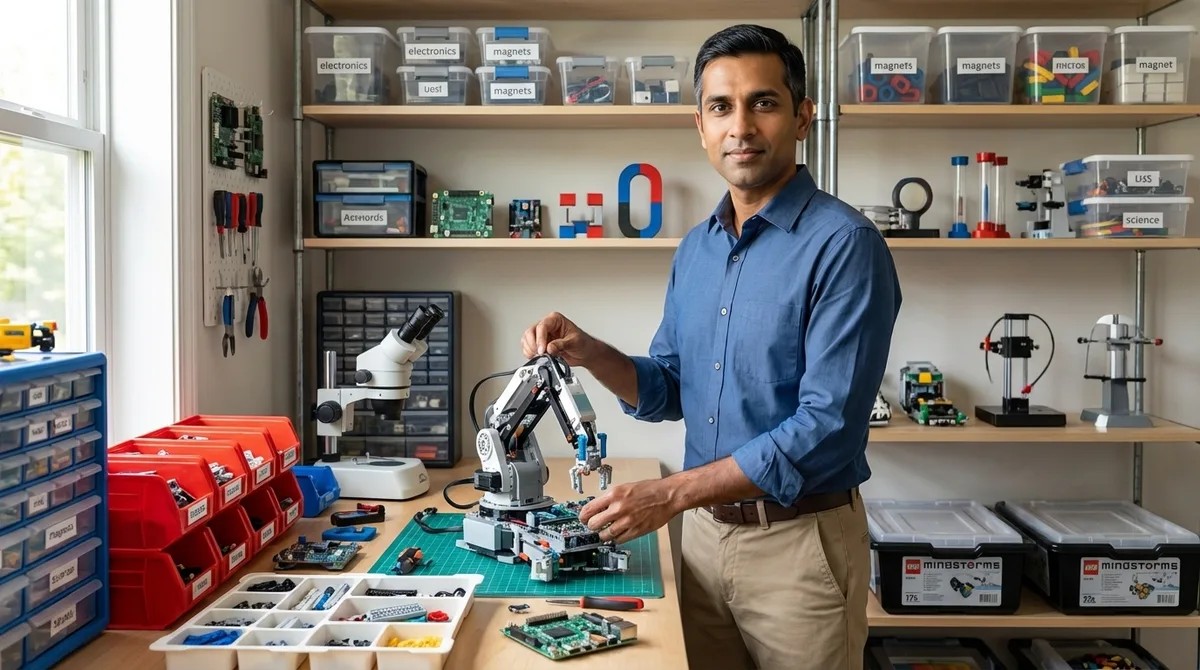
Ever watched expensive STEM equipment become an elaborate dust collector? The difference between a home lab that actually builds real skills and one that becomes a glorified junk drawer isn't about spending more money—it's about strategic organization. In this episode, Rajiv Patel shares the exact system he's developed through consulting with dozens of families, revealing why organizing around capability milestones rather than age ranges or product categories transforms outcomes. Whether you're setting up your first home STEM lab or rescuing one that's stalled, this framework connects daily learning directly to industry-relevant skill development. Skip age-based product recommendations entirely—a motivated 9-year-old can master Arduino robotics that stumps an uninterested 13-year-old, so always assess actual capability first by documenting concrete outputs like "assembles 3-component circuit from diagram." Zone your physical lab space around tool chain progressions, not arbitrary categories like "electronics" or "coding"—one station might span Scratch through Python while another progresses from hand tools through CAD to 3D printing. Use a three-tier staging protocol adapted from manufacturing: Active Learning Zone (current skill level only), Next-Milestone Staging (visible but not accessible, creating motivation through anticipation), and Archive Storage for advanced equipment and completed projects. Create equipment compatibility documentation to prevent technical debt—that Raspberry Pi 5 project kit requiring Python 3.11 won't run on an older Pi Zero W, and mismatched components kill project momentum fast. The system requires 6–8 hours for initial setup plus 30-minute monthly audits, and engineering hiring managers specifically cite "systems thinking" and "tool chain fluency" as differentiators between junior candidates. Clear storage labels should use capability descriptors rather than component names—"After completing 5 functional Scratch games" works better than "Advanced sensors" for maintaining progression clarity. Read the full article: https://stemlabguide.com/how-to-organize-a-home-stem-lab-for-progressive-skill-development
Embed this episode
NOW PLAYING
How to Organize a Home STEM Lab for Progressive Skill Development
No transcript for this episode yet
Similar Episodes
No similar episodes found.
Similar Podcasts
No similar podcasts found.