
EPISODE · Mar 29, 2026 · 1H 52M
How to R.E.S.P.O.N.D. (Rogers et al., 2026) | FT50 AMR
from Revise and Resubmit - The Mayukh Show · host Mayukh Mukhopadhyay
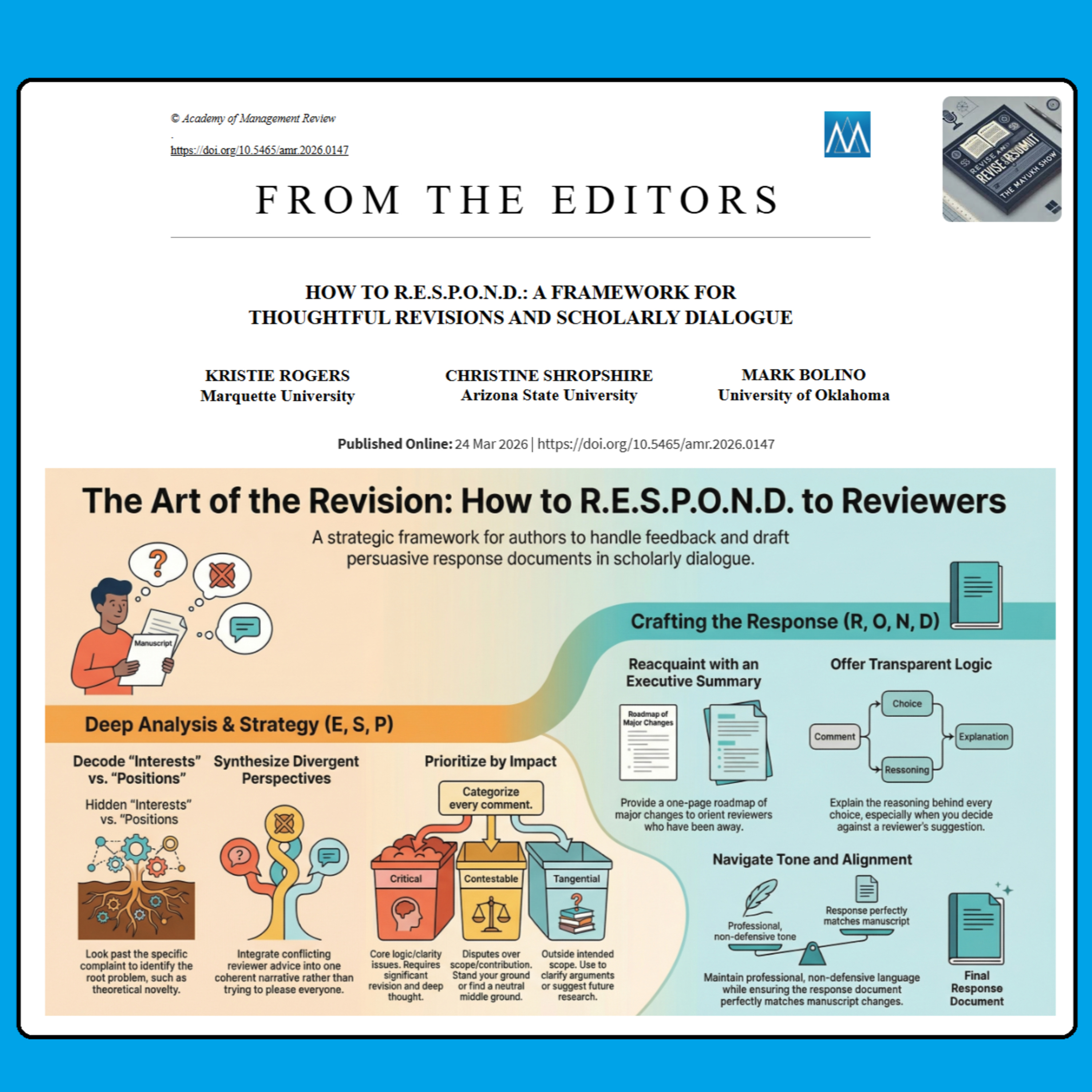
English Podcast Starts at 00:00:00Bengali Podcast Starts at 00:53:14Hindi Podcast Starts at 01:16:05Danish Podcast Starts at 01:40:38ReferenceRogers, K., Shropshire, C., & Bolino, M. (2026). How to R.E.S.P.O.N.D.: A Framework for Thoughtful Revisions and Scholarly Dialogue. Academy of Management Review. https://doi.org/10.5465/amr.2026.0147Youtube Channelhttps://www.youtube.com/@weekendresearcherConnect over linkedinhttps://www.linkedin.com/in/mayukhpsm/Welcome to Revise and Resubmit 🎙️✨There are some academic articles that do more than instruct. They steady your breathing. They reach across the long table of scholarship, where editors, reviewers, and authors so often meet in a haze of anxiety, and they say, gently but firmly, let us try to do this better. That is the feeling I had reading “How to R.E.S.P.O.N.D.: A Framework for Thoughtful Revisions and Scholarly Dialogue” by Kristie Rogers, Christine Shropshire, and Mark Bolino, published online on 23 March 2026 in the Academy of Management Review 📚💡And that matters, because Academy of Management Review is not just any journal. It is one of the most prestigious journals in management scholarship, and yes, it belongs to the FT50 journal list 🏛️⭐. This is the kind of place where ideas are not merely submitted. They are tested, clarified, sharpened, and sometimes lovingly dismantled before they are allowed to stand. So when a paper appears here offering guidance on how to revise with intelligence, dignity, and grace, it is worth our full attention.What I love about this piece is that it understands something every scholar eventually learns, usually the hard way. Revision is never just technical. It is emotional. It is rhetorical. It is relational. A manuscript comes back to us marked by many hands, carrying praise, confusion, contradiction, and sometimes a sentence that makes us stare at the wall for five full minutes ☕📝😅. And yet Rogers, Shropshire, and Bolino do not treat the revision process as a bureaucratic obstacle course. They treat it as scholarly dialogue, as an act of conversation, maybe even an act of character.Their R.E.S.P.O.N.D. framework offers a way to meet that moment thoughtfully. Not defensively. Not performatively. Thoughtfully. It helps scholars reacquaint editors with the paper’s core contribution, sort through competing reviewer demands, prioritize what matters most, and explain revisions with clarity and professionalism. For conceptual work especially, where there is no new dataset to rescue a weak argument, this kind of intellectual discipline becomes everything 🔍🧠And maybe that is why this article feels larger than its immediate purpose. It is about revision, yes. But it is also about how we conduct ourselves in the life of the mind. How we answer criticism. How we preserve conviction without becoming stubborn. How we enter dialogue without losing our voice.So in today’s episode, I want to sit with this paper not only as a practical framework for publishing, but as a small philosophy of scholarly exchange, one that asks us to see revision not as humiliation, but as collaboration, not as defeat, but as a second chance 🌱📖My sincere thanks to Kristie Rogers, Christine Shropshire, and Mark Bolino, and to the Academy of Management for publishing this thoughtful and deeply useful article 🙏If you enjoy conversations like this, please subscribe to Revise and Resubmit on Spotify, and to Weekend Researcher on YouTube 🎧📺 You can also find the channel on Amazon Prime and Apple Podcast 🍎🎙️And as we begin, here is the question I want to carry into this episode: when a revision asks us to change our paper, is it only changing the manuscript, or is it quietly changing the scholar too? ✨
Embed this episode
Ready to play
How to R.E.S.P.O.N.D. (Rogers et al., 2026) | FT50 AMR
No transcript for this episode yet
Similar Episodes
No similar episodes found.
Similar Podcasts
No similar podcasts found.