How to render cloud FPGAs useless (39c3) episode artwork

EPISODE · Dec 28, 2025 · 40 MIN

How to render cloud FPGAs useless (39c3)

from Chaos Computer Club - recent audio-only feed · host Dirk

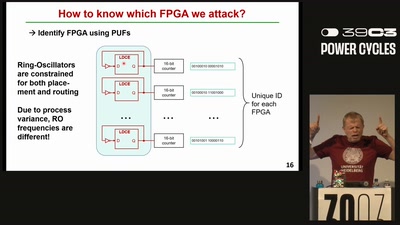
While FPGA developers usually try to minimize the power consumption of their designs, we approached the problem from the opposite perspective: what is the maximum power consumption that can be achieved or wasted on an FPGA? Short answer: we found that it’s easy to implement oscillators running at 6 GHz that can theoretically dissipate around 20 kW on a large cloud FPGA when driving the signal to all the available resources. It is interesting to note that this power density is not very far away from that of the surface of the sun. However, such power load jump is usually not a problem as it will trigger some protection circuitry. This led us to the next question: would a localized hotspot with such power density damage the chip if we remain within the typical power envelope of a cloud FPGA (~100 W)? While we could not “fry” the chip or induce permanent errors (and we tried several variants), we did observe that a few routing wires aged to become up to 70% slower in just a few days of stressing the chip. This basically means that such an FPGA cannot be rented out to cloud users without risking timing violations. In this talk, we will present how we optimized power wasting, how we measured wire latencies with ps accuracy, how we attacked 100 FPGA cloud instances and how we can protect FPGAs against such DOS attacks. FPGA instances are now offered by multiple cloud service providers (including Amazon EC2 F1/F2 instances, Alibaba ECS Instances, and Microsoft Azure NP-Series). The low-level programmability of FPGAs allows implementing new attack vectors including DOS attacks. While some severe attacks (such as short circuits) cannot be easily deployed as users are prevented to load own configuration bitstreams on the cloud FPGAs, it has been demonstrated that it is possible to leak information (like cloud instance scheduling policies or the physical topologies of the FPGA servers) or to mount DoS attacks by excessive power hammering. For instance, basically all cloud FPGAs provide logic cells that can be configured as small shift registers. This allows building toggle-shift-registers with 10K and more flip-flops, which can draw over 1 KW power when clocked at a few hundred MHz. In our work, we created fast ring-oscillators that bypass all design checks applied during bitstream cloud deployment and how we achieved toggle rates of 8 GHz inside an FPGA by using glitch amplification. The latter one was calibrated with the help of a time-to-digital converter (TDC). As a first attack, we used power hammering to crash AWS F1 instances by increasing power consumption to 300 W (three times the allowed power envelope). We used physical unclonable functions (PUFs) to examine the behaviour of the attacked FPGA cloud instances and we found that most remained unavailable for several hours after the attack. As a more subtle attack, we tried to cause permanent damage to FPGAs in our lab by driving fast toggling signals to virtually any available wire (and primitive) into a small region of the chip. With this, we created hotspot designs that draw 130 W in less than 1% of the available logic and routing resources of a datacenter FPGA. Even though the achieved power density was excessive, it was insufficient to induce permanent damages. This is largely due to the area inefficiencies of an FPGA that limit the power density. For instance, FPGAs use large multiplexers to implement the switchable connections and there exists only one active path that is routed through the multiplexers, hence, leaving most of the transistors sitting idle. Similarly, FPGAs provide a large number of configuration memory cells (about 1 Gb on a typical datacenter device) that draw negligible power as these do not switch during operation. All these idle elements force the power drawing circuits to be spread out, hence limiting power density. Anyway, when experimenting with different hotspot variants, we found thermal runaway effects and excessive device aging with up to a 70% increase in delay on some wires. We achieved this aging in just a few days and under normal operational conditions (i.e. by staying within the available power budget and having board cooling running). Such a large increase in latency can be considered to render an FPGA useless as it will usually not be fast enough to host (realistic) user designs. Beyond exploring these attack vectors, we developed countermeasures and design guidelines to prevent such attacks. These include scans of the user designs, use restrictions to resources like IOs and clock trees, as well as runtime monitoring and FPGA health checks. With this, we believe that FPGAs can be operated securely and reliably in a cloud setting. Licensed to the public under http://creativecommons.org/licenses/by/4.0 about this event: https://events.ccc.de/congress/2025/hub/event/detail/how-to-render-cloud-fpgas-useless

While FPGA developers usually try to minimize the power consumption of their designs, we approached the problem from the opposite perspective: what is the maximum power consumption that can be achieved or wasted on an FPGA? Short answer: we found that it’s easy to implement oscillators running at 6 GHz that can theoretically dissipate around 20 kW on a large cloud FPGA when driving the signal to all the available resources. It is interesting to note that this power density is not very far away from that of the surface of the sun. However, such power load jump is usually not a problem as it will trigger some protection circuitry. This led us to the next question: would a localized hotspot with such power density damage the chip if we remain within the typical power envelope of a cloud FPGA (~100 W)? While we could not “fry” the chip or induce permanent errors (and we tried several variants), we did observe that a few routing wires aged to become up to 70% slower in just a few days of stressing the chip. This basically means that such an FPGA cannot be rented out to cloud users without risking timing violations. In this talk, we will present how we optimized power wasting, how we measured wire latencies with ps accuracy, how we attacked 100 FPGA cloud instances and how we can protect FPGAs against such DOS attacks. FPGA instances are now offered by multiple cloud service providers (including Amazon EC2 F1/F2 instances, Alibaba ECS Instances, and Microsoft Azure NP-Series). The low-level programmability of FPGAs allows implementing new attack vectors including DOS attacks. While some severe attacks (such as short circuits) cannot be easily deployed as users are prevented to load own configuration bitstreams on the cloud FPGAs, it has been demonstrated that it is possible to leak information (like cloud instance scheduling policies or the physical topologies of the FPGA servers) or to mount DoS attacks by excessive power hammering. For instance, basically all cloud FPGAs provide logic cells that can be configured as small shift registers. This allows building toggle-shift-registers with 10K and more flip-flops, which can draw over 1 KW power when clocked at a few hundred MHz. In our work, we created fast ring-oscillators that bypass all design checks applied during bitstream cloud deployment and how we achieved toggle rates of 8 GHz inside an FPGA by using glitch amplification. The latter one was calibrated with the help of a time-to-digital converter (TDC). As a first attack, we used power hammering to crash AWS F1 instances by increasing power consumption to 300 W (three times the allowed power envelope). We used physical unclonable functions (PUFs) to examine the behaviour of the attacked FPGA cloud instances and we found that most remained unavailable for several hours after the attack. As a more subtle attack, we tried to cause permanent damage to FPGAs in our lab by driving fast toggling signals to virtually any available wire (and primitive) into a small region of the chip. With this, we created hotspot designs that draw 130 W in less than 1% of the available logic and routing resources of a datacenter FPGA. Even though the achieved power density was excessive, it was insufficient to induce permanent damages. This is largely due to the area inefficiencies of an FPGA that limit the power density. For instance, FPGAs use large multiplexers to implement the switchable connections and there exists only one active path that is routed through the multiplexers, hence, leaving most of the transistors sitting idle. Similarly, FPGAs provide a large number of configuration memory cells (about 1 Gb on a typical datacenter device) that draw negligible power as these do not switch during operation. All these idle elements force the power drawing circuits to be spread out, hence limiting power density. Anyway, when experimenting with different hotspot variants, we found thermal runaway effects and excessive device aging with up to a 70% increase in delay on some wires. We achieved this aging in just a few days and under normal operational conditions (i.e. by staying within the available power budget and having board cooling running). Such a large increase in latency can be considered to render an FPGA useless as it will usually not be fast enough to host (realistic) user designs. Beyond exploring these attack vectors, we developed countermeasures and design guidelines to prevent such attacks. These include scans of the user designs, use restrictions to resources like IOs and clock trees, as well as runtime monitoring and FPGA health checks. With this, we believe that FPGAs can be operated securely and reliably in a cloud setting. Licensed to the public under http://creativecommons.org/licenses/by/4.0 about this event: https://events.ccc.de/congress/2025/hub/event/detail/how-to-render-cloud-fpgas-useless

NOW PLAYING

How to render cloud FPGAs useless (39c3)

0:00 40:45

No transcript for this episode yet

We transcribe on demand. Request one and we'll notify you when it's ready — usually under 10 minutes.

Breaking News Show | eTurboNews Juergen Thomas Steinmetz News is relevant to the global travel and tourism industry, human rights and global issues.Breaking news when it happens and only from the source. That Hoarder: Overcome Compulsive Hoarding That Hoarder Hoarding disorder is stigmatised and people who hoard feel vast amounts of shame. This podcast began life as an audio diary, an anonymous outlet for somebody with this weird condition. That Hoarder speaks about her experiences living with compulsive hoarding, she interviews therapists, academics, researchers, children of hoarders, professional organisers and influencers, and she shares insight and tips for others with the problem. Listened to by people who hoard as well as those who love them and those who work with them, Overcome Compulsive Hoarding with That Hoarder aims to shatter the stigma, share the truth and speak openly and honestly to improve lives. HOMELAND HOMELAND The Church is a body not a building. It's the bride of Jesus Christ! Jesus is coming back for a mature bride. That means it's time for the church of Jesus Christ to move from milk to meat. This is the hour of maturity!HOMELAND is an announcement that the church is being set free. Only the church has the ability to transform the world. The kingdom's of this world will become the kingdoms of our Lord and Savior!All of creation has been waiting for this moment! Sons and daughters of God are rising up and taking their seat! LIGHTS, CAMERA, SMILE! Creatives Club Media Lights, Camera, Smile, is a podcast for anyone with a dream to share something with the world, out of the overflow of themselves - be it their mind, their heart, their personalities, and much more. Each of us are alive in this moment in time, with an innate ability to have ideas and create various things to benefit both ourselves and the people around us for a reason, and here, you will find the encouragement, the inspiration, and the motivation to do just that. Hosted by Cicily, founder of Creatives Club, she dives into various topics surrounding creativity and business. Exploring entrepreneurship for creatives in a corporate reality, sharing tips and tricks in a media centered company, answering questions regarding what a creative actually is are just a few of the things discussed on this podcast. Be encouraged to create for yourself as Cicily gets vulnerable by pivoting the camera to herself for the first time.To submit questions for Cicily to answer, or have her address certain t

Frequently Asked Questions

How long is this episode of Chaos Computer Club - recent audio-only feed?

This episode is 40 minutes long.

When was this Chaos Computer Club - recent audio-only feed episode published?

This episode was published on December 28, 2025.

What is this episode about?

While FPGA developers usually try to minimize the power consumption of their designs, we approached the problem from the opposite perspective: what is the maximum power consumption that can be achieved or wasted on an FPGA? Short answer: we found...

Can I download this Chaos Computer Club - recent audio-only feed episode?

Yes, you can download this episode by clicking the download button on the episode player, or subscribe to the podcast in your preferred podcast app for automatic downloads.
URL copied to clipboard!