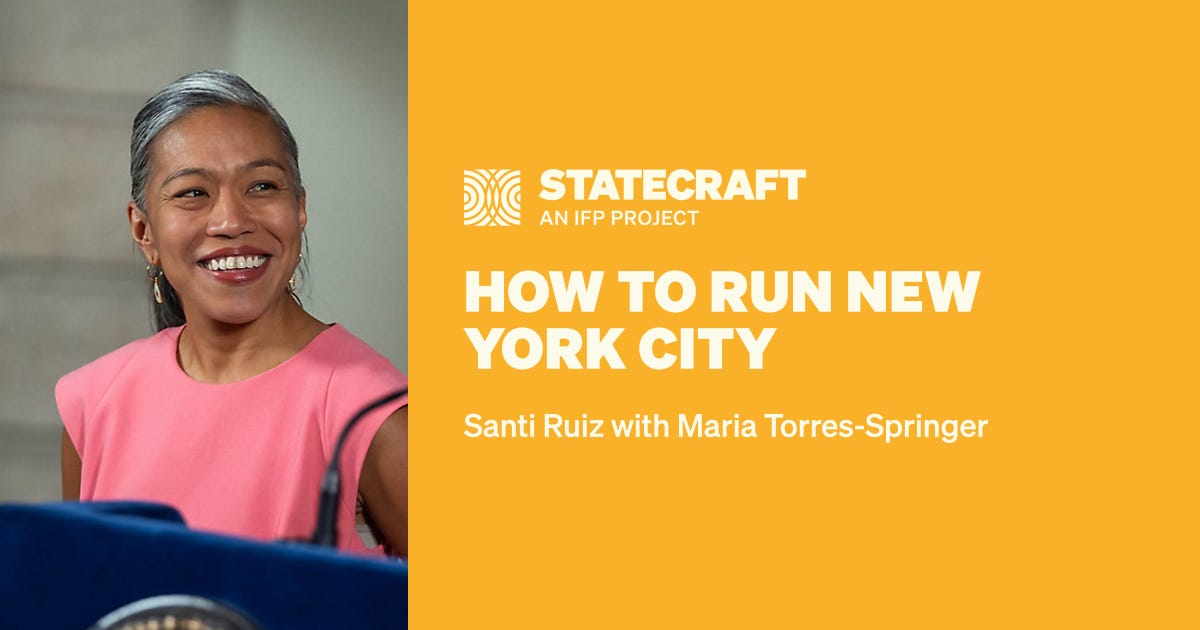
How to Run New York City episode artwork

EPISODE · Oct 31, 2025 · 1H 18M

How to Run New York City

from Statecraft · host Santi Ruiz

You can find the full transcript of this conversation at www.statecraft.pub.The likely next mayor of New York City is Zohran Mamdani, if polling is anywhere close to being correct. Much of the conversation has revolved around the day-to-day administration of City Hall. If Mamdani wins, does he have what it takes to run the city’s government?Today’s guest is still active in NYC political life, and it was clear I would not get an answer to that particular question. Instead, I took this opportunity to investigate how City Hall actually runs, and how the past three mayors have structured their administrations. But if you read between the lines, you can treat this conversation as a guide about what has worked in New York’s governance over the last 20 years, and the likely stumbling blocks for an ambitious new administration.Maria Torres-Springer moved to New York City a week before 9/11, and spent most of the following 20 years in city government — first as a top appointee in the Bloomberg administration, then in several high-powered roles under Bill de Blasio, and eventually as second-in-command for Eric Adams. Her most recent role was as first deputy mayor: functionally the Chief Operating Officer of New York City. Torres-Springer resigned in February 2025 (she was not implicated in the overlapping Eric Adams corruption scandals).To put it lightly, Torres-Springer has fans. In November 2024, City & State New York wrote a cover story titled, “The Vibe at City Hall is Thank God for Maria Torres-Springer.” It quotes political figures from the far left, center left, and right, calling Torres-Springer “a phenomenal leader,” “a very classy, charismatic, knowledgeable individual,” and, “a serial overachiever in a good way.” When Adams appointed her as first deputy mayor, he said, “She has the ability of landing the plane.”Torres-Springer is widely described as one of the most effective political operators in New York City, and she’s been linked in media stories as a potential official in the next mayoral administration (although she recently took a role as President of the Revson Foundation, a NYC-based philanthropic organization). She’s maybe the best possible guest to talk about steering City Hall.Given constraints on what Torres-Springer could discuss, I wanted to get into two big topics. One is process. What does it take to run City Hall? How have different mayors done it differently? The other is outcomes. Torres-Springer was one of the champions of City of Yes, the Adams-backed initiative to build 500,000 new housing units in the city over the next 10 years. I wanted to better understand City of Yes, what she’s most excited about, what didn’t make the cut, and how it all came together politically.We discuss:* What it takes to succeed working for three very different mayors* How Bloomberg, de Blasio, and Adams governed differently* How to work effectively under constant pressure* The political coalitions that made City of Yes possible* Why it takes over a year to turn over a NYCHA apartment* How to fix the plumbing of government* What the next mayor should prioritize to keep New York thrivingThanks to Harry Fletcher-Wood, Eamonn Ives, and Katerina Barton for their judicious audio and transcript edits for length and clarity. This is a public episode. If you would like to discuss this with other subscribers or get access to bonus episodes, visit www.statecraft.pub

NOW PLAYING

How to Run New York City

0:00 1:18:07

No transcript for this episode yet

We transcribe on demand. Request one and we'll notify you when it's ready — usually under 10 minutes.

The History of China Podcast Ibnul Jaif Farabi / Light Knot Studios What does the world's oldest continuous civilization, with over 3,000 years of recorded history, have to teach us about power, philosophy, innovation, and human nature? "The History of China Podcast" delivers the epic saga of China in accessible, daily chapters, transforming a vast and complex past into a compelling narrative you can absorb in just minutes a day.This show chronicles the full sweep of China's story, from the mythical Xia Dynasty to the rise of the modern superpower. We explore the dazzling heights of Tang poetry and Song technology, the brutal calculus of Legalist statecraft, and the quiet wisdom of Daoist sages. Each episode focuses on a pivotal event, a transformative figure, or a defining idea—whether it's the construction of the Great Wall, the mind of Empress Wu, or the invention of paper money—weaving them into the grand tapestry of the dynastic cycle. The tone is authoritative yet vividly human, making emperors, poets, and peasants alike feel immediate and real. Small World, Big Problems JHU SAIS Philip Merrill Center for Strategic Studies Small World, Big Problems – a SAIS Strategy Podcast. ​A SAIS student podcast supported by the Philip Merrill Center for Strategic Studies. ​In Small World, Big Problems, we ask the experts about the biggest challenges in the world of strategy and national security. ​It’s a small world, and it’s only getting smaller. But it seems like every day, there is a new problem on the horizon: great power conflict, political extremism, climate change – the list goes on and on. In this student podcast sponsored by the Philip Merrill Center for Strategic Studies, we ask leading experts in the fields of national security, strategy, and statecraft about what problems the world is facing and, more importantly, how to solve them. ​Please address any questions to [email protected]. Samael's Podcast Samael's Podcast Welcome to Samael, a daily research-intensive podcast series that conducts an "intellectual archaeology" of the Horn of Africa by synthesizing diverse disciplines such as genetics, linguistics, and mythology. The publication moves beyond traditional nationalist narratives to explore the deep-seated identities of Ethiopia and its neighbors, utilizing sources ranging from Ge’ez and Sabaean texts to modern DNA haplogroup data. By examining a wide array of topics—including Aksumite statecraft, Cushitic cosmologies, and medieval hydro-diplomacy—Arcielss reclaims lost narratives and positions the region as a central hub of civilizational innovation rather than a historical periphery. www.samael.ink What’s New in New Defence? Digital Defence Ecosystem Finland; Valtteri Vuorisalo Europe’s security landscape is shifting at unprecedented speed. What’s New in New Defence, the new podcast from the Digital Defence Ecosystem, brings you the insights behind the transformation. Each episode breaks down the technologies, capabilities and strategic developments shaping Europe’s future of security.Join DDE’s Dr Valtteri Vuorisalo and a line-up of leading Finnish experts as they unpack the breakthroughs redefining technology, cyber, intelligence, space, climate security and economic statecraft.

Frequently Asked Questions

How long is this episode of Statecraft?

This episode is 1 hour and 18 minutes long.

When was this Statecraft episode published?

This episode was published on October 31, 2025.

What is this episode about?

You can find the full transcript of this conversation at www.statecraft.pub.The likely next mayor of New York City is Zohran Mamdani, if polling is anywhere close to being correct. Much of the conversation has revolved around the day-to-day...

Can I download this Statecraft episode?

Yes, you can download this episode by clicking the download button on the episode player, or subscribe to the podcast in your preferred podcast app for automatic downloads.
URL copied to clipboard!