
EPISODE · Apr 19, 2026 · 1H 37M
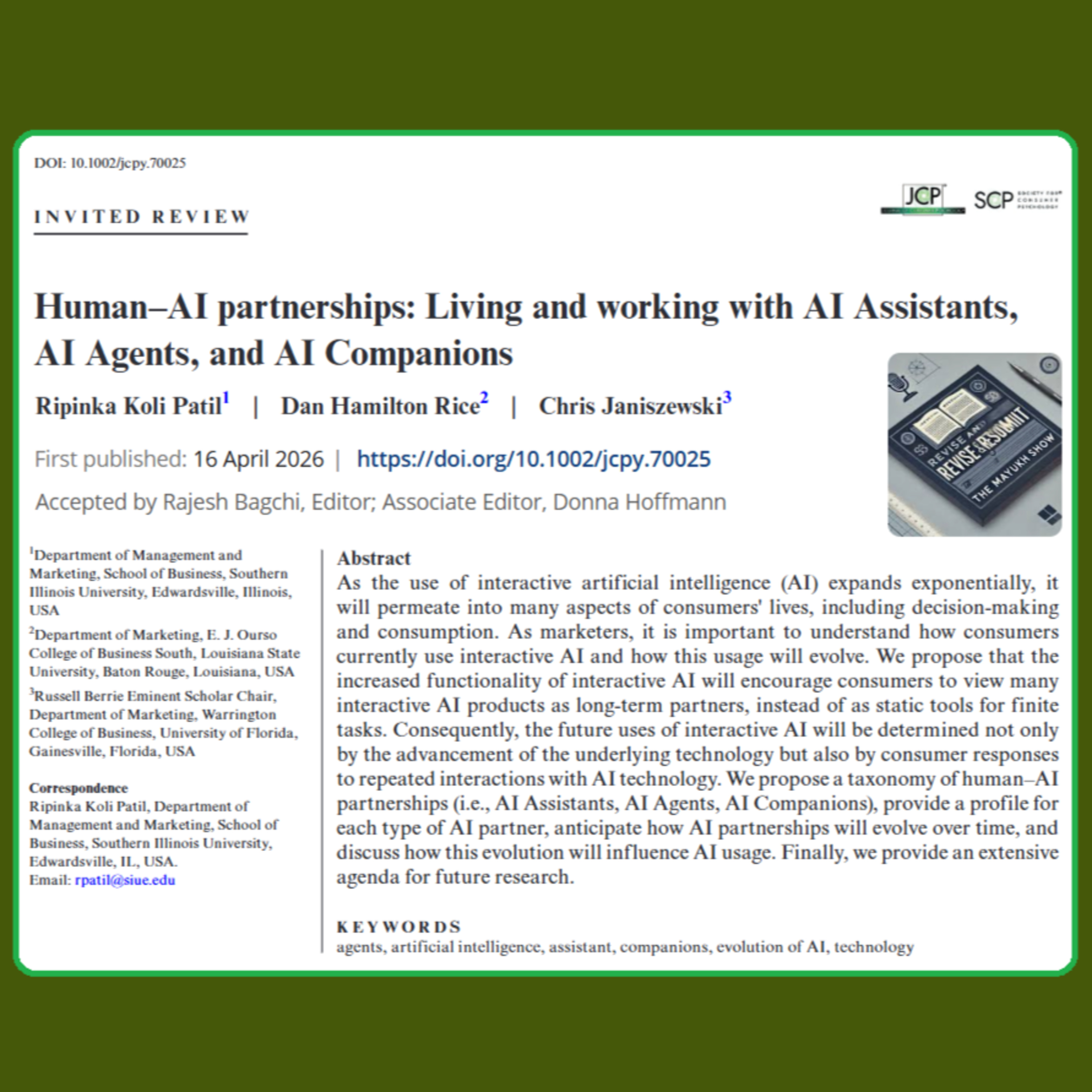
Human–AI partnerships (Patil et al. 2026) | FT50 JCP
from Revise and Resubmit - The Mayukh Show · host Mayukh Mukhopadhyay
English Podcast Starts at 00:00:00Bengali Podcast Starts at 00:42:56Hindi Podcast Starts at 01:00:49Danish Podcast Starts at 01:22:41ReferencePatil, R. K., Rice, D. H., & Janiszewski, C. (2026). Human–AI partnerships: Living and working with AI Assistants, AI Agents, and AI Companions. Journal of Consumer Psychology, 00, 1–28. https://doi.org/10.1002/jcpy.70025Youtube Channelhttps://www.youtube.com/@weekendresearcherPodcast Websitehttps://mayukhmukhopadhyay.com/reviseandresubmitAcademy of Management PDW on Space Economy Registration Flyerhttps://cto.aom.org/discussion/flagship-aom-2026-pdw-space-economy-consolidating-a-research-agenda-8🎙️✨ Welcome to Revise and Resubmit.There are some papers that do more than explain a trend. They pause long enough to notice a change in the weather of ordinary life. This is one of them.Today, we are turning to a fascinating new article, Human–AI Partnerships: Living and Working with AI Assistants, AI Agents, and AI Companions, by Ripinka Koli Patil, Dan Hamilton Rice, and Chris Janiszewski, published online on 16 April 2026 in the Journal of Consumer Psychology 🧠📘, a prestigious FT50 journal, published by the Society for Consumer Psychology under John Wiley & Sons Ltd.And what makes this paper feel so timely, so quietly intimate, is that it does not ask only what AI can do. It asks what AI can become in our lives.For a long time, we treated technology like a hammer 🔨, or a search bar, or a machine waiting for commands. Useful, yes. Intelligent, maybe. But still a thing. Still an object. Still something outside the circle of relationship.This paper suggests that circle is changing.The authors offer a taxonomy that feels less like a technical map and more like a portrait of our near future. Some AI systems will remain assistants 🤖, helping us finish tasks, organize choices, and smooth the rough edges of daily life. Some will become agents ⚙️, acting with greater autonomy, making decisions, carrying out intentions, and operating almost like delegated selves. And some may become companions 💬💙, woven into our routines not only through competence, but through familiarity, trust, and something that starts to resemble presence.That is where the paper becomes deeply human. Because repeated interaction changes everything. The more often we return to an intelligent system, the more that system stops feeling like software and starts feeling like a participant in our decision-making, our consumption, our habits, and perhaps even our emotional world.📍This is not just a paper about technology. It is a paper about attachment, dependence, convenience, agency, and the subtle ways people make room for new kinds of partners in everyday life.And because this appears in the Journal of Consumer Psychology, one of the prestigious journals on the FT50 list, it also signals something important for scholars and practitioners alike: this conversation is no longer peripheral. It is central.So as we begin, I want to sit with the question at the heart of this paper. If an AI helps us choose, remember, advise, comfort, and act, again and again, at what point does it stop being a tool in our hand and start becoming a presence in our life? 🤔✨🙏 My sincere thanks to Ripinka Koli Patil, Dan Hamilton Rice, and Chris Janiszewski, and to the Society for Consumer Psychology under John Wiley & Sons Ltd., for this important and timely contribution.🔔 If you enjoy thoughtful research conversations like this, please subscribe to Revise and Resubmit on Spotify and subscribe to Weekend Researcher on YouTube.🎧 You can also listen on Amazon Prime and Apple Podcast.So let us begin with a question that feels both scholarly and strangely personal: when AI starts to know us well enough to help shape our choices, are we using it, or are we already learning how to live with it?
Embed this episode
Ready to play
Human–AI partnerships (Patil et al. 2026) | FT50 JCP
No transcript for this episode yet
Similar Episodes
No similar episodes found.
Similar Podcasts
No similar podcasts found.