
EPISODE · Jan 29, 2025 · 12 MIN
Hunting for Orphan Afterglows: The Story of AT2019pim
from Multi-messenger astrophysics · host Astro-COLIBRI
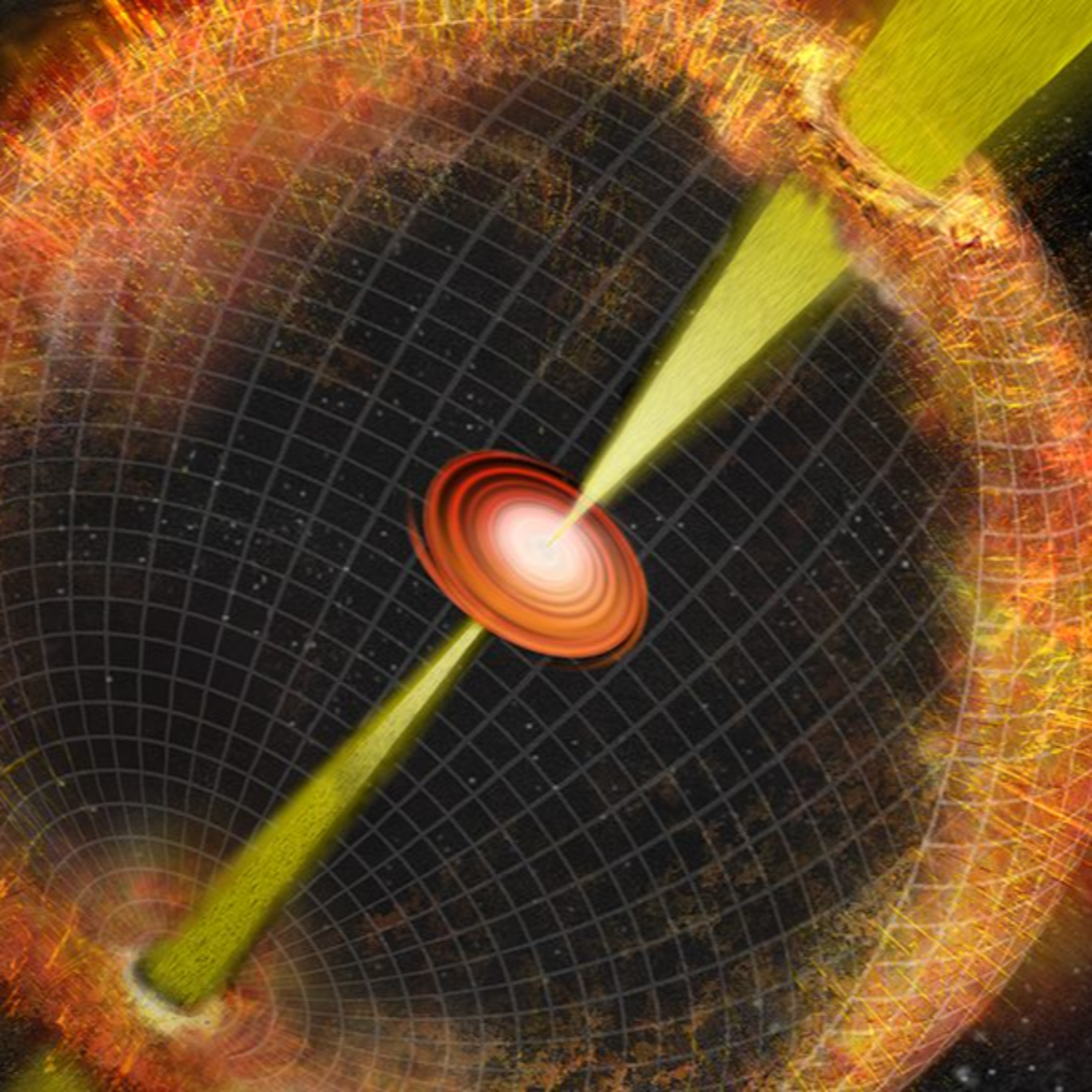
Introduction: This episode discusses the groundbreaking discovery of AT2019pim, the first spectroscopically confirmed afterglow of a relativistic explosion with no observed high-energy gamma-ray emission. This event challenges our understanding of gamma-ray bursts (GRBs) and suggests the existence of "orphan afterglows," which are afterglows not associated with typical GRB prompt emission. The discovery was serendipitous, occurring during follow-up observations of a gravitational-wave trigger and in a TESS sector. Key Findings: AT2019pim is characterized by a fast-rising, luminous optical transient with accompanying X-ray and radio emission. No gamma-ray emission was detected by Fermi-GBM or Konus, placing strong constraints on an associated GRB. The afterglow's properties are consistent with a moderately relativistic outflow with an initial Lorentz factor of Γ0 ≈ 10–30, significantly lower than in typical GRBs. This supports the “dirty fireball” scenario, where high-energy emission is suppressed by pair production. The event might also be explained by a structured jet model, where only the line-of-sight material was ejected at a low Lorentz factor, off-axis from a classical high-Γ jet core. The transient's light curve was constructed using data from ZTF and TESS, showing a rapid rise to peak brightness, followed by a decay. Spectroscopic analysis revealed a redshift of z = 1.2592, confirming its cosmological distance. The afterglow was observed across multiple wavelengths, including optical, X-ray, and radio. Radio observations show strong interstellar scintillation (ISS), suggesting a small source size and limiting the average Lorentz factor. Modeling of the afterglow supports a low Lorentz factor outflow as a possible explanation. Implications: AT2019pim demonstrates that luminous optical afterglows without detected GRB counterparts can be identified and spectroscopically confirmed in real-time. This discovery challenges the traditional GRB paradigm, suggesting that a population of GRB-like events exists with weak or no high-energy prompt emission. It opens new avenues for studying relativistic outflows and jet structures associated with collapsing stars. The event highlights the importance of wide-field surveys and multi-messenger astronomy for detecting and understanding such transients. Future observations of more orphan afterglows will allow for detailed studies of the structure of jets in GRBs, and help to determine if "dirty fireballs" exist. Reference: Perley, D. A., et al. (2025). "The Luminous, Slow-Rising Orphan Afterglow AT2019pim as a Candidate Moderately Relativistic Outflow." MNRAS, arXiv:2401.16470v2 Acknowledements: Podcast prepared with Google/NotebookLM. Illustration credits: B. Saxton, NRAO/AUI/NSF
Embed this episode
Ready to play
Hunting for Orphan Afterglows: The Story of AT2019pim
No transcript for this episode yet
Similar Episodes
No similar episodes found.
Similar Podcasts
No similar podcasts found.