
EPISODE · Jun 5, 2026 · 1H 16M
I building a Synthetic Market for M365 Strategy
from M365.FM - Modern work, security, and productivity with Microsoft 365 · host Mirko Peters - Founder of m365.fm, m365.show and m365con.net
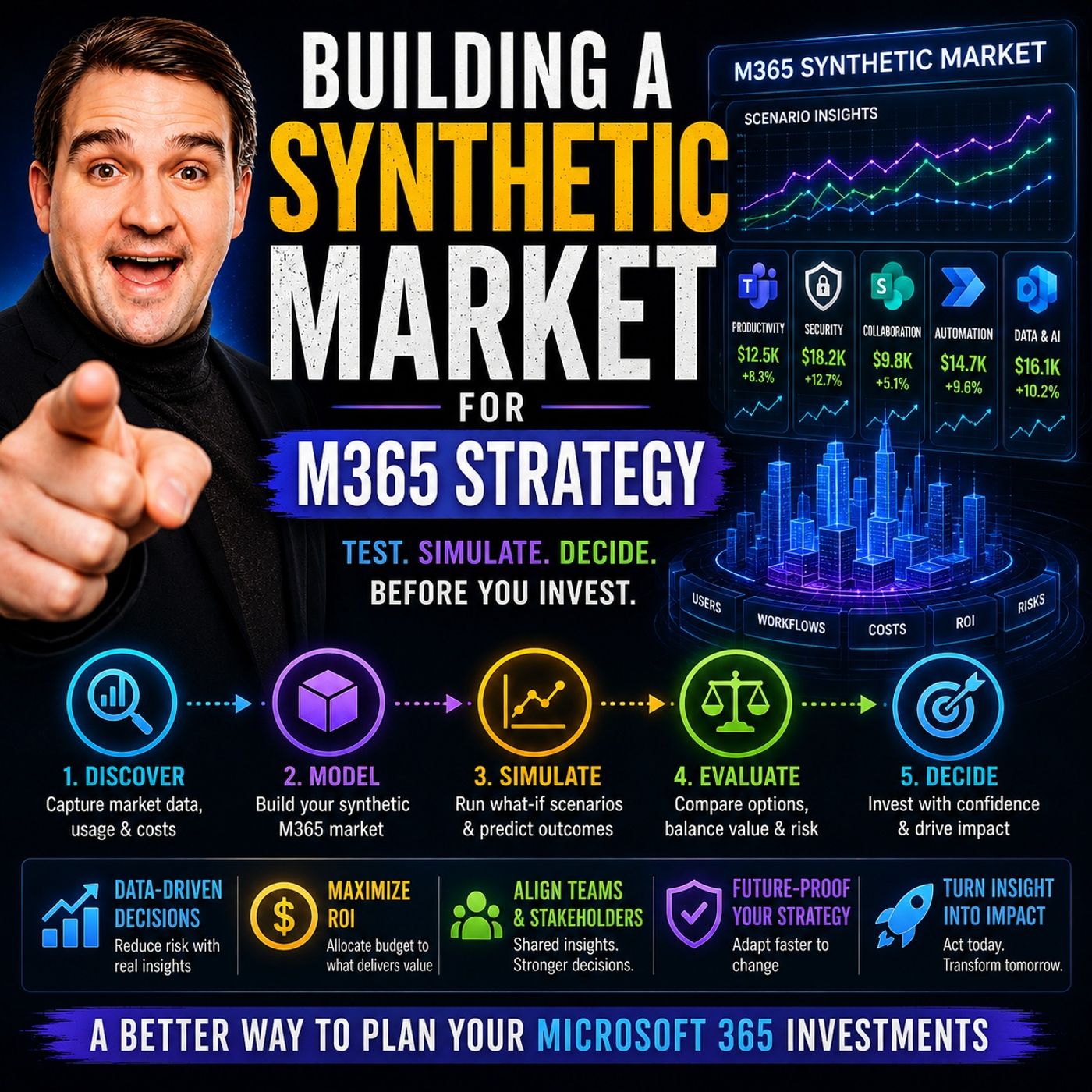
What if you could test every major Microsoft 365 decision before making it?What if you could simulate governance changes, Copilot deployments, security investments, automation initiatives, and organizational transformation strategies before spending a single dollar?In this episode of M365 FM, Mirko Peters explores a groundbreaking approach to Microsoft 365 strategy: building a synthetic market of digital organizations to simulate decision-making, predict outcomes, and understand how governance choices impact AI adoption at scale.Using Azure AI Foundry, GraphRAG, synthetic company personas, and multi-agent simulations, Mirko created a virtual market consisting of 100 unique organizations. Each organization had its own governance model, collaboration patterns, security posture, identity architecture, and operational culture. The goal was simple: understand why some organizations successfully scale AI while others repeatedly fail despite investing in the same technology.WHY MOST AI ADOPTION FAILSThe biggest obstacle to AI success isn't technology.It's governance.Most organizations approach AI adoption as a procurement exercise. They purchase licenses, launch pilot programs, measure usage, and expect business value to emerge automatically. The reality is far different. The simulation revealed that most AI initiatives fail because they are deployed into operating models that were never designed for AI-driven work.Throughout the episode, Mirko demonstrates how identity sprawl, collaboration chaos, automation debt, unclear ownership, and compliance theater create predictable failure patterns that appear in almost every organization.The surprising discovery wasn't that organizations fail.It was how consistently they fail.THE FIVE FAILURE PATTERNSAfter running more than 1,000 simulation iterations across 100 synthetic organizations, five governance patterns repeatedly emerged as the primary causes of AI adoption failure.These patterns include:Identity Blind SpotsCollaboration Sprawl Without Lifecycle ManagementAutomation Without GovernanceOwnership and Accountability GapsCompliance TheaterEach pattern emerged at predictable stages of AI adoption and produced measurable business consequences, including stalled adoption, compliance incidents, security concerns, operational failures, and declining user trust.Most importantly, the simulation revealed exactly what successful organizations did differently.SYNTHETIC ORGANIZATIONS AND DIGITAL MARKETSTraditional strategy relies heavily on historical data and executive intuition.Synthetic markets introduce a different approach.By creating realistic digital representations of organizations, leadership teams can simulate future scenarios, test strategic assumptions, evaluate governance models, and predict outcomes before making investments.Mirko explains how Azure AI Foundry, GraphRAG, Knowledge Graphs, and Multi-Agent Systems were combined to create a virtual market where synthetic CISOs, Architects, Compliance Officers, and Business Leaders interacted with one another and made decisions under realistic constraints.The result was a living laboratory for Microsoft 365 strategy.THE GOVERNANCE-FIRST MODELOne of the most important findings from the simulation was that governance is not a constraint on innovation.Governance is the foundation that makes innovation possible.Organizations that treated governance as documentation consistently struggled. Organizations that treated governance as an operational system of ownership, automation, monitoring, and accountability consistently outperformed their peers.The episode explores how modern governance must evolve beyond policy documents and become embedded directly into the architecture of Microsoft 365 through automated controls, lifecycle management, access reviews, and operational guardrails.Topics covered include:Identity GovernanceData ClassificationLifecycle ManagementAutomation GovernanceContinuous ComplianceTHE IDENTITY READINESS FRAMEWORKEverything starts with identity.Before organizations can safely scale Microsoft Copilot, AI Agents, or Automation, they must understand who has access to what and why.The simulation showed that organizations with mature identity governance consistently achieved higher adoption rates, fewer security incidents, and faster time-to-value.Learn how identity cleanup, least privilege, access reviews, managed identities, and ownership models create the foundation for successful AI transformation.THE DATA, COLLABORATION, AND AUTOMATION LAYERSOnce identity is under control, organizations must address the remaining governance layers.Mirko introduces a practical readiness framework that covers:Data Classification and ProtectionCollaboration Lifecycle ManagementWorkspace OwnershipPower Automate GovernanceLogic Apps GovernanceEnvironment SeparationAutomation MonitoringTogether, these capabilities create the operational foundation required for trustworthy AI systems.FROM GOVERNANCE TO INTELLIGENCEMost organizations try to deploy AI first and fix governance later.The simulation proved this approach repeatedly fails.Instead, successful organizations follow a clear adoption sequence:Identity → Data → Collaboration → Automation → IntelligenceOnly after the first four layers are operational should organizations scale Copilot, AI Agents, and intelligent automation.This sequence dramatically increases adoption success rates while reducing security incidents, compliance risk, and operational disruption.THE 90-DAY READINESS ASSESSMENTHow ready is your organization for AI?To answer that question, Mirko introduces a practical readiness framework that evaluates five critical domains:Identity ReadinessData ReadinessCollaboration ReadinessAutomation ReadinessGovernance ReadinessThe resulting score provides a surprisingly accurate predictor of AI adoption success and helps organizations identify where they should focus before scaling AI initiatives.WHO SHOULD LISTEN?Microsoft 365 ArchitectsCIOs and CTOsGovernance LeadersSecurity ProfessionalsCompliance TeamsEnterprise ArchitectsCopilot Strategy TeamsAI Transformation LeadersDigital Workplace TeamsMicrosoft MVPsIN THIS EPISODEBuilding synthetic organizationsCreating digital markets for strategy simulationAzure AI Foundry and GraphRAGMulti-Agent SystemsMicrosoft 365 GovernanceAI Adoption ModelsIdentity GovernanceCopilot ReadinessAutomation GovernanceCompliance and SecurityDigital Twins for OrganizationsStrategic SimulationEnterprise AI AdoptionGovernance Operating ModelsKEY TAKEAWAYSGovernance predicts AI success more accurately than technology selectionMost AI failures are structural, not technicalSynthetic markets allow organizations to test decisions before implementationIdentity is the foundation of AI readinessGovernance should be automated, not documentedAI amplifies existing organizational weaknessesSuccessful organizations build foundations before scaling intelligenceGovernance is not a barrier to innovation—it enables innovation at scaleThe future of Microsoft 365 strategy won't be built on assumptions, best practices, or intuition alone.It will be built on simulation.The organizations that win with AI will increasingly test their decisions in synthetic environments before making them in the real world. Those that do will move faster, reduce risk, and create a significant competitive advantage in the age of intelligent work.Become a supporter of this podcast: https://www.spreaker.com/podcast/m365-fm-modern-work-security-and-productivity-with-microsoft-365--6704921/support.
Embed this episode
What this episode covers
What if you could test every major Microsoft 365 decision before making it?What if you could simulate governance changes, Copilot deployments, security investments, automation initiatives, and organizational transformation strategies before spending a single dollar?In this episode of M365 FM, Mirko Peters explores a groundbreaking approach to Microsoft 365 strategy: building a synthetic market of digital organizations to simulate decision-making, predict outcomes, and understand how governance choices impact AI adoption at scale.Using Azure AI Foundry, GraphRAG, synthetic company personas, and multi-agent simulations, Mirko created a virtual market consisting of 100 unique organizations. Each organization had its own governance model, collaboration patterns, security posture, identity architecture, and operational culture. The goal was simple: understand why some organizations successfully scale AI while others repeatedly fail despite investing in the same technology. WHY MOST AI ADOPTION FAILS The biggest obstacle to AI success isn't technology.It's governance.Most organizations approach AI adoption as a procurement exercise. They purchase licenses, launch pilot programs, measure usage, and expect business value to emerge automatically. The reality is far different. The simulation revealed that most AI initiatives fail because they are deployed into operating models that were never designed for AI-driven work.Throughout the episode, Mirko demonstrates how identity sprawl, collaboration chaos, automation debt, unclear ownership, and compliance theater create predictable failure patterns that appear in almost every organization.The surprising discovery wasn't that organizations fail.It was how consistently they fail. THE FIVE FAILURE PATTERNS After running more than 1,000 simulation iterations across 100 synthetic organizations, five governance patterns repeatedly emerged as the primary causes of AI adoption failure.These patterns include: Identity Blind Spots Collaboration Sprawl Without Lifecycle Management Automation Without Governance Ownership and Accountability Gaps Compliance Theater Each pattern emerged at predictable stages of AI adoption and produced measurable business consequences, including stalled adoption, compliance incidents, security concerns, operational failures, and declining user trust.Most importantly, the simulation revealed exactly what successful organizations did differently. SYNTHETIC ORGANIZATIONS AND DIGITAL MARKETS Traditional strategy relies heavily on historical data and executive intuition.Synthetic markets introduce a different approach.By creating realistic digital representations of organizations, leadership teams can simulate future scenarios, test strategic assumptions, evaluate governance models, and predict outcomes before making investments.Mirko explains how Azure AI Foundry, GraphRAG, Knowledge Graphs, and Multi-Agent Systems were combined to create a virtual market where synthetic CISOs, Architects, Compliance Officers, and Business Leaders interacted with one another and made decisions under realistic constraints.The result was a living laboratory for Microsoft 365 strategy. THE GOVERNANCE-FIRST MODEL One of the most important findings from the simulation was that governance is not a constraint on innovation.Governance is the foundation that makes innovation possible.Organizations that treated governance as documentation consistently struggled. Organizations that treated governance as an operational system of ownership, automation, monitoring, and accountability consistently outperformed their peers.The episode explores how modern governance must evolve beyond policy documents and become embedded directly into the architecture of Microsoft 365 through automated controls, lifecycle management, access reviews, and...
NOW PLAYING
I building a Synthetic Market for M365 Strategy
No transcript for this episode yet
Similar Episodes
No similar episodes found.
Similar Podcasts
No similar podcasts found.