
EPISODE · Aug 18, 2026 · 8 MIN
Hayden Panettiere, Lindsay Clancy and How Postpartum Women Are Being Failed
from Anchor Baby – the audio · host Rosemary Mac Cabe
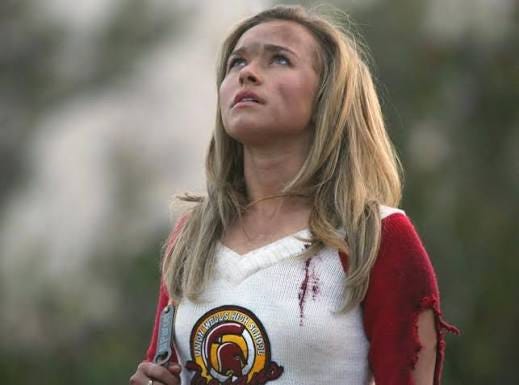
In honour of Hayden Panettiere, I’ve donated $100 to the Whaleman Foundation; and in honour of Hayden Panettiere, Britney Spears, Lindsay Clancy, and all of the many, many women who are failed by society and the system when it comes to maternal mental health, I’ve donated $100 to the Maternal Mental Health Leadership Alliance.Anchor Baby is a reader-supported publication. To receive new posts and support my work, consider becoming a free or paid subscriber.I woke up to pee at 4.11am last night – since having kids, I can’t sleep through the night without waking to pee, so honestly they’d better not end up being Republicans or none of this will have been worth it – and brought my phone to the bathroom, which is one of my top three worst habits. I like to check Instagram, to see if anyone’s sent me any mean messages; then I look at my emails, God knows why because all I ever get are solicitations to spend money (I mean… I KNOW WHY, because I’m always dying to spend some money); then I play Royal Match for a few minutes, just in case my brain isn’t wide awake yet – I need to make it as difficult as possible to fall back to sleep when I finally wipe and stand and wash and get back under the covers, manoeuvring my body in around the cat.This morning, I didn’t get past Instagram, where I saw this post from the New York Times (deeply problematic coverage of the Israeli genocide in Gaza aside, one of the very few mainstream US news publications I feel is in any way reliable). I’m not really one for waxing poetic about celebrity deaths. That feels like an odd sentence to write, but there are people out there who are ones for waxing poetic about celebrity deaths. Whenever a famous person shuffles off this mortal coil, I know where to go for wordy recitations about what, exactly, they contributed to the world, and how their contribution will echo through the ages. You know yourself. It’s just not my “thing”. (What is my thing? I couldn’t help but wonder. Rambling diary-style entries about my life in consumerism, with the odd piece of misandrist bigotry thrown in for good measure?)This morning – maybe it was the hour, the time that exists in that kind of liminal space between sleeping and waking – I felt, honestly, a type of grief I’ve never imagined feeling for someone I’ve never met, someone I knew relatively little about. Hayden Panettiere was 36 years old when, on a hot afternoon in Greenville, South Carolina, a friend called 911 to report having found her unresponsive and in cardiac arrest. She was pronounced dead at the scene.Thanks for reading Anchor Baby! This post is public so feel free to share it.I was a big fan of the TV show, Heroes, in which Panettiere starred as cheerleader Claire Bennet, who discovers she’s impervious to harm. Her survival becomes a central tenet of the show, as Masi Oka’s time travelling Hiro Nakamura imparts the crucial message to Milo Ventimiglia’s Peter Petrelli: “Save the cheerleader, save the world.” I can’t stop thinking about that phrase, in terms of Panettiere’s untimely death (36! way too young). A child star who got her “big break” in the soap opera One Life to Live at the age of four, Panettiere is yet another woman who was chewed up and, rather than spat out, swallowed whole, by Hollywood. She would go on to star both in Heroes and in Nashville (also worth a watch, even if – and I know this is blasphemy – Connie Britton’s Rayna James becomes painfully earnest and worthy about halfway through season one, and never recovers), and to struggle, publicly, with severe postpartum depression following the birth of her daughter, Kaya, in 2014, with then-fiancé, former professional boxer Wladimir Klitschko (50; they met in 2009, when Panettiere was 19 and Klitschko was 33).Following her daughter’s traumatic birth – she suffered a postpartum hemorrhage and, according to news sources, required seven blood transfusions and a life-saving operation to save her life – Panettiere suffered from severe PPD, which then led to her becoming addicted to alcohol and opioids.Three years later, Klitschko and Panettiere would break up, followed that same year by the pair’s highly publicised decision to give sole custody to Klitschko, who would eventually move back to his native Ukraine with their daughter. (Today, they live in Kyiv, where Klitschko enlisted in Ukraine’s territorial reserve army in February of 2022, when Russia declared its “special military operation" in the country, a war that remains ongoing.)It’s easy, sometimes, to ascribe meaning to people’s deaths – and lives – in ways that are dramatic, exaggerated or borderline ridiculous. But somehow, Panettiere’s death – the absolute failure of the system and structures around her to help, protect, and shelter her – could be read as a damning indictment of the world at large. We could, at any stage, have saved the cheerleader. We didn’t.Hers is a descent that feels, instead inexorable. She was a child star who became incredibly successful as a teenager; then, a young mother, suffering from postpartum depression; later, losing both her fiancé and her child, and subsequently sliding into substance abuse. She would later meet Brian Hickerson, a man who would go on to be arrested (and convicted) for assaulting her.“I am prepared to do my part to make sure this man never hurts anyone again,” she told People in 2020, following Hickerson’s arrest, but the pair were on and off again up to the day before her death, when they flew to South Carolina from LA.That she died in the middle of another highly publicised case involving the failure of a system – and society at large – to support another mother whose postpartum period was marred by mental illness and what appear to be exhaustive efforts to get help for said illness feels somehow significant. (Lindsay Clancy, the Boston-area mother charged with murdering her three young children in 2023, suffered from postpartum psychosis, a very different illness to that documented by Panettiere, but it’s fair to say that the system failed them both.) In Panettiere’s case, it’s clear that her public profile had a major impact on her perceived ability to get help. She spoke about not wanting to call 911 when she was abused by Hickerson, because of the publicity that would surround her; is it fair to assume that decisions made around her addiction, and treatment (or lack thereof) for said addiction, were made with the same considerations in mind? It’s difficult, too, not to think of Britney Spears, whose very public breakdown, in February of 2007, occurred when her second child was just five months old (her first was 17 months old). In Spears’ own memoir, The Woman in Me, released in 2023, she wrote about being beside herself with grief following the death of her aunt that January, and suffering from postpartum depression following the births of her sons. Her marriage had broken down that November, two months after she gave birth, and resulted in an increase in the already-intense media scrutiny which saw her being stalked by paparazzi 24/7; who doesn’t remember footage of the 25-year-old Spears sitting in a cafe, pregnant, crying, holding her then-eight-month-old?There are so many moments at which we, as a society, failed these women – and so many women, worldwide, who suffer from postpartum depression or psychosis or both, whose stories haven’t ever been, and perhaps won’t ever be, told – that it’s almost impossible to pinpoint the moment. But it does feel as though there should have been one: a moment when the paparazzi, hounding Britney Spears as she drove around LA in her wedges, could have chosen to give her a break; a moment when someone could have (should have?) told Panettiere to take a year, or two, after the birth of her daughter (she was in the midst of the third season of Nashville when her daughter was born, a gruelling production schedule that filmed for nine months of each year); several moments when Lindsay Clancy could have been given the intensive support she so desperately needed (and asked for). Like I said, I just feel so f*****g sad – about Hayden Panettiere, dead at 36 (and her parents, who have now lost both of their children, at horrifying, unimaginably young ages); about Britney Spears, and what we, as a society, do to women who soar too high, too young, and too unencumbered; about Lindsay Clancy, whose life has been destroyed by something (someone) she could never have hoped to control. We could have saved the cheerleader. (We should have saved the cheerleader.) This is a public episode. If you'd like to discuss this with other subscribers or get access to bonus episodes, visit rosemarymaccabe.substack.com/subscribe
Embed this episode
Ready to play
Hayden Panettiere, Lindsay Clancy and How Postpartum Women Are Being Failed
No transcript for this episode yet
Similar Episodes
No similar episodes found.
Similar Podcasts
No similar podcasts found.