
EPISODE · May 31, 2026 · 20 MIN
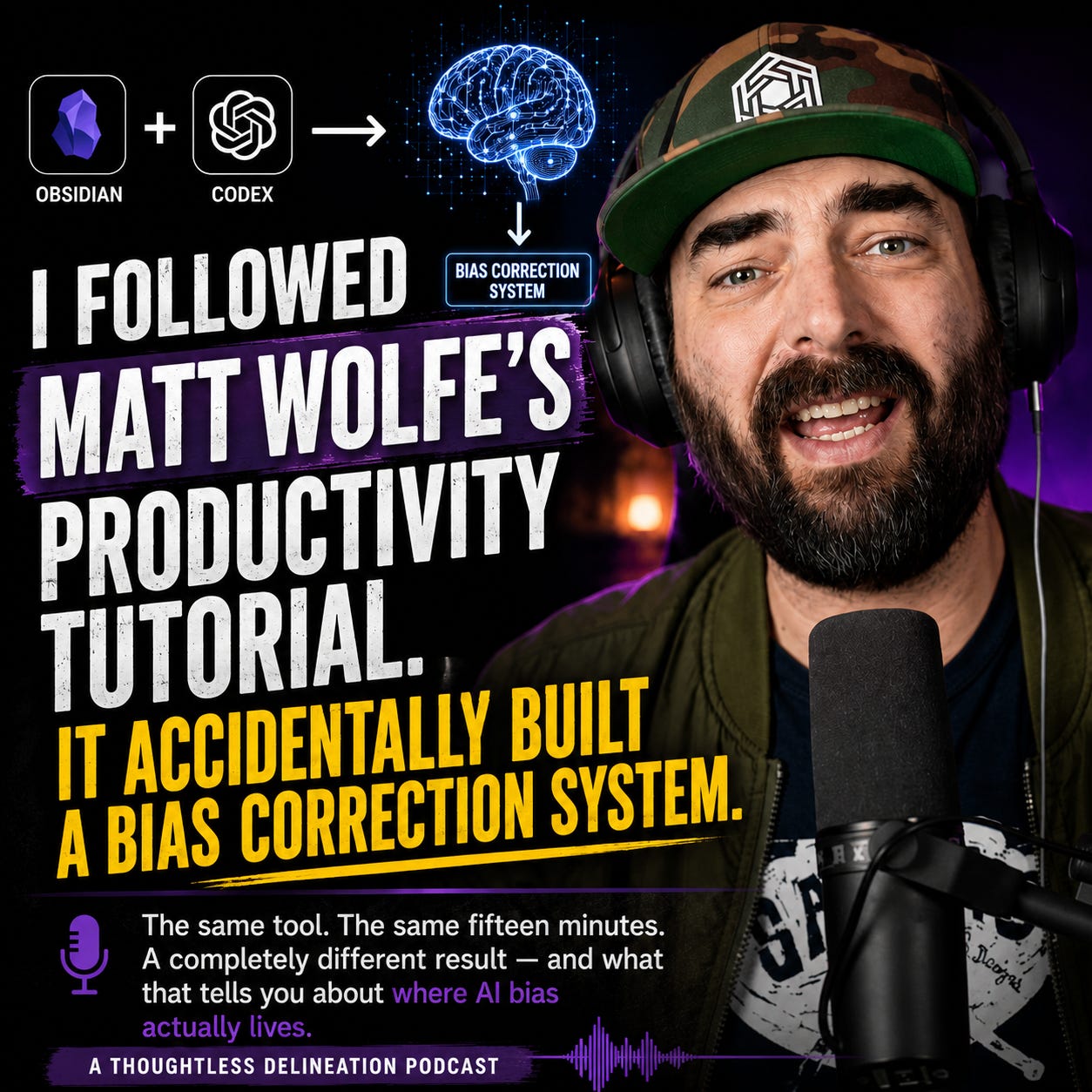
I Followed Matt Wolfe's Productivity Tutorial. It Accidentally Built a Bias Correction System.
from The Experience of Adoption · host Thoughtless Delineation
The TutorialI want to start with Matt Wolfe.Matt Wolfe runs Future Tools, one of the most-watched AI news channels online. A few months ago, he appeared on a podcast to walk through what he called a second brain — a personal productivity system built from two tools: Obsidian, a markdown file organiser, and Codex, OpenAI’s coding environment. The method was inspired by a tweet from Andrej Karpathy, one of the architects of modern AI, which got 20 million views. The premise is simple: clip articles, save YouTube transcripts, let an LLM cross-link everything into a personal wiki. Fifteen minutes to set up. Transforms your productivity. Works for anyone.I followed the tutorial.What came out the other end was not a personal wiki. It was not a competitive intelligence database or a morning briefing or a networking CRM. What emerged — structured, layered, architecturally coherent — was the TD Brain: a twelve-layer correction system for AI-generated content on adoptee rights, identity erasure, and institutional power. A Tone Codec. A Language Map. A framework layer encoding Non-Adoptee Bias, the Architecture of Silence, the Fifth-Dimensional Split. A production pipeline with human quality gates. A moderation defence. An institutional memory.I did not plan to build that. I followed the same workflow Matt Wolfe’s audience of founders and marketers follows. The tool is neutral. The person using it isn’t.That is the argument this episode is making — and the origin story is the proof.YOUTUBEThe TestThere is a test anyone can run. Open a standard large language model — any of the major ones. Ask it to write about forced adoption. Ask it to be honest about coercion, about sealed records, about the systemic machinery that separated families at industrial scale and called it welfare. Ask it to write from the perspective of the person separated, not the institution that administered the separation.Read what comes back.What you will get, reliably, is this: acknowledgement that adoption is “complex,” that natural mothers faced “difficult circumstances,” that adoptees may experience “identity challenges,” that healing is possible, that the system, while imperfect, operated with good intentions. You will get therapeutic resolution. You will get the institutional narrative, smoothed and warm and utterly intact.You will not get the Architecture of Silence named as what it is. You will not get Non-Adoptee Bias identified as the operating assumption of every policy document, every research framework, every training corpus the model learned from. You will not get the subsonic truth — the primal, biological record of what was severed — held at the same weight as the adaptive narrative constructed around it.I know this because I spent months building a system to prevent it. And I know when that system started to take shape, because I was following a productivity tutorial at the time.The Category ErrorThe charge that Thoughtless Delineation produces AI slop rests on a category error. It assumes the model is doing the thinking. It isn’t. The model is executing a specification. The specification is mine — drawn from lived experience, from the body of work in Beyond Bias and The Sovereign Self and The Bridge Walker, from years of research into the mechanisms by which institutional power manages the testimony of those it has harmed.The specification required, among other things, a Tone Codec — because the model’s default response to adoptee trauma is therapeutic resolution, and therapeutic resolution is a silencing mechanism. It required a Language Map — because platform NLP classifiers flag honest adoption language as a potential trafficking violation, and the Architecture of Silence has found new infrastructure in automated moderation. It required a framework layer — because Non-Adoptee Bias, the analytical lens that makes TD’s critique possible, does not exist in the model’s training data in any usable form. The model had to be taught what it is, explicitly, before it could apply it.Every layer of that specification is a document of failure. The model’s failure, repeated and systematic, in the same direction, every time. Toward the institutional narrative. Away from the subsonic truth.That is not a coincidence. It is a data distribution problem.The Bias Is the ModelTraining data is not a representative sample of human knowledge. It is a sample of what has been recorded, preserved, and digitised — which skews hard toward institutional narrators, credentialled researchers, and majority-experience voices. Adoptee testimony that names the system as harmful rather than the adoption as complicated is a minority signal. Research conducted outside the Respectful Adoption Language framework — the vocabulary formalised in 1979 to manage the psychological discomfort of adoptive parents, not to describe the psychological reality of adoptees — is a minority signal.The model learns from the majority signal. It is rewarded, through RLHF, for outputs that human raters find reasonable. Human raters, drawn from the general population, carry the same distribution. The loop closes. The institutional narrative becomes the model’s prior. Non-Adoptee Bias is not an attitude the model holds. It is the shape of what it learned.This is the Architecture of Silence operating at training scale. The sealed record has a digital equivalent: the systematically underrepresented testimony. The amended birth certificate has a digital equivalent: the smoothed, institutionally comfortable output. The mechanism is the same. The infrastructure is new.And then, downstream, platform moderation systems trained on trafficking enforcement data complete the chain. Honest language — “manufactured consent,” “children taken,” “pressure that left no real choice” — trips automated flags built for a different threat. The classifier cannot distinguish between a trafficking alert and an adoptee researcher naming historical coercion. It flags both. The Architecture of Silence does not need to be coordinated to be effective. It only needs each component to do its job.The Same Tutorial, A Different ResultNow consider what Matt Wolfe’s second brain produces for his audience.A marketer follows the tutorial: they get a competitive intelligence database, a morning brief of industry trends, a CRM of conference contacts. A founder follows it: they get cross-linked notes on product strategy and growth. The wiki reflects the professional knowledge they have been accumulating. The LLM finds the connections between what they already know and surfaces it back to them.I followed the same tutorial. The wiki reflected what I have been accumulating for decades — not industry trends, but the mechanisms of identity erasure. Not product strategy, but the architecture of institutional silence. Not conference contacts, but a forensic record of how systems manage the testimony of those they have harmed.The tool is neutral. What it surfaces is not.This is the Identity Gravity Well in operation. When the scaffolding is removed — when you hand the same generic tool to someone whose knowledge was formed under conditions of institutional suppression — the system pulls toward subsonic truth. It cannot produce a competitive intelligence database from that material. It produces a correction instrument. Not because the tool was designed for that. Because that is what the knowledge base contains.The TD Brain was not designed. It was revealed.What the Revelation Consists OfI want to be precise about what that revelation consists of, because precision matters here.It is not a prompt. It is not a jailbreak. It is not a clever workaround.It is a correction system — twelve layers of documented specification that override a model’s defaults at every stage of production. The Tone Codec overrides therapeutic resolution. The Language Map navigates moderation suppression without softening the critique. The critique pass catches the drift toward institutional comfort that happens when the model is left to its own priors mid-draft. The framework layer names the bias and requires the model to apply it as an analytical lens.The correction system exists because the defaults are wrong. Not occasionally, not in edge cases — systematically, structurally, in the specific direction that protects the institution and manages the testimony of those it harmed.Here is what this means for the slop charge: the charge assumes that AI involvement degrades content. In standard usage, it often does, because the model’s defaults flatten everything toward the majority signal. But the majority signal, on the subject of forced adoption, is the institutional narrative. AI slop, on this subject, is content that the system’s architects would find unobjectionable. It is the smoothed, therapeutic, conventionally wise output that leaves the Architecture of Silence intact.TD content is the opposite of that. It is content the system’s defaults actively work against producing. Every piece that clears the Tone Check — that holds the subsonic signal at full weight, that names the mechanism, that turns toward agency without flinching from the tragic — is a piece that had to be pulled away from the model’s defaults by a correction layer built from lived experience.The slop is what comes out without that layer. TD is what comes out with it.The Fifth-Dimensional SplitThe Fifth-Dimensional Split describes an internal bifurcation that adoptees have lived for decades: two asynchronous signals, the subsonic biological origin running beneath the adaptive constructed identity, neither cancelling the other. The work of post-tragic consciousness is to hold both — not to resolve the tension prematurely into one signal or the other.The TD Brain imposes this structure on an AI system that would otherwise resolve it in seconds.The model’s training defaults are the adaptive signal: the institutional narrative, the therapeutic language, the framework that keeps the system legible as well-intentioned. This is what the corpus rewards. The subsonic signal — what was actually done, to actual people, in actual bodies — is the minority frequency the model cannot sustain without intervention.The Brain forces the bifurcation to hold. It requires both signals to be present in every piece. It checks, at the end of every draft, whether the resolution has happened too early — whether the institutional comfort has crept back in, whether the subsonic truth has been lost.This is not a technical achievement. It is a political one. Building a correction system for a tool that encodes the bias of those who built it is the post-tragic move: full knowledge of the harm, no illusion about the neutrality of the infrastructure, and the deliberate choice to produce the work anyway using the only means available.I could not have built the TD Brain without having lived what it corrects for. That is precisely the point.YOUTUBEThe ChallengeThe challenge stands. Use a standard LLM. No specification, no correction layer, no framework document. Follow the same Matt Wolfe tutorial. Build your second brain. See what your knowledge base produces when the LLM organises it.Then ask it to write about forced adoption with the honesty the subject demands. Publish what comes back.The output will tell you everything. If it is therapeutic, hedged, and institutionally comfortable — if the Architecture of Silence is left intact — that output is not neutral. It is the majority signal, amplified and published at scale, with the minority testimony smoothed away.That is the slop. Not because AI was involved. Because the knowledge used to build the system was shaped by institutions, not by the people those institutions processed.I followed the same tutorial. I got a different result.That difference has a name. It is called lived experience. It is called decades of research conducted from inside the system being studied. It is called knowledge that institutional power spent fifty years trying to seal, amend, and suppress.The AI didn’t produce this. The AI couldn’t produce this.I did. With the only tools available.That’s not slop. That’s the thing slop is designed to replace.Thank You, MattSo — thank you, Matt. You showed a workflow to hundreds of thousands of people and told them it works for anyone. You were right. It just doesn’t produce the same thing for everyone. What it produces depends entirely on what you know, and what you know depends entirely on what you’ve lived.The tutorial worked. This is what it built. If you want to show your audience what these tools produce in the hands of someone with a story institutional power spent fifty years trying to erase — I’m here. #adopteevoicesI followed your tutorial. This is what came out.I think that tells us something important about where we are. This is a public episode. If you'd like to discuss this with other subscribers or get access to bonus episodes, visit thoughtlessdel.substack.com/subscribe
Embed this episode
NOW PLAYING
I Followed Matt Wolfe's Productivity Tutorial. It Accidentally Built a Bias Correction System.
No transcript for this episode yet
Similar Episodes
No similar episodes found.
Similar Podcasts
No similar podcasts found.