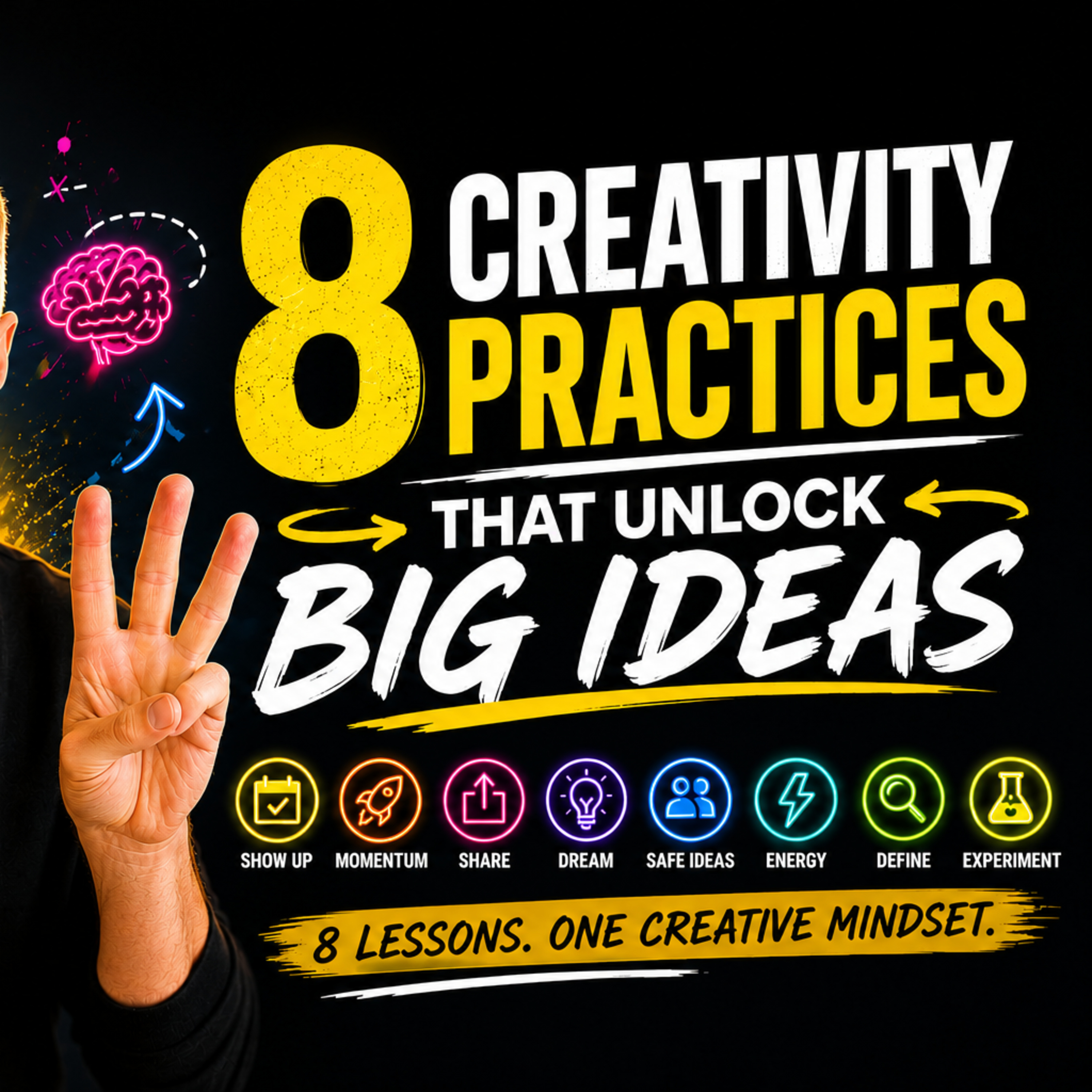
I Studied 100+ Creativity Experts. Here Are the 8 Ideas That Matter. episode artwork

EPISODE · Jun 23, 2026 · 22 MIN

I Studied 100+ Creativity Experts. Here Are the 8 Ideas That Matter.

from Moonshots Podcast: Superstar mindsets and success habits · host Mike Parsons & Mark Pearson Freeland

Over the last eight years of Moonshots, we've explored the work of hundreds of authors, entrepreneurs, scientists, artists, educators, and innovators. We've studied creativity from every angle imaginable. We've looked at the habits of musicians, the methods of filmmakers, the thinking of scientists, the systems of entrepreneurs, and the practices of some of the most creative people who have ever lived.As we prepare to launch a new creativity series on Moonshots, beginning with Steven Kotler's *The Art of the Impossible*, I wanted to pause and reflect on what we've learned so far.What surprised me most wasn't how different these thinkers are. It was how often they arrived at the same conclusions.A legendary music producer, a bestselling novelist, the founder of Pixar, one of history's greatest physicists, an education visionary, and a pair of Stanford design professors all seem to be pointing toward the same set of principles.Creativity is not a gift possessed by a lucky few.It is a practice.It is a way of approaching problems, ideas, opportunities, and life itself.In this episode, I share eight creative practices that have had the biggest impact on my own work as a founder, advisor, podcaster, writer, speaker, software builder, and lifelong learner.The first lesson comes from Rick Rubin and *The Creative Act*. One of the most valuable ideas I've taken from Rick is the importance of showing up early and allowing ideas time to develop. Great work rarely appears on demand. Whenever I'm preparing a keynote, building a product, creating content, or solving a difficult client problem, I start earlier than I need to. I immerse myself in the work and then let it sit. I allow ideas to ferment. Some of my best work has emerged not from pushing harder, but from creating enough space for intuition and imagination to do their job.Elizabeth Gilbert's *Big Magic* offers another powerful reminder. Momentum is more important than perfection. I see perfectionism derail founders every week. They delay launches, delay decisions, delay customer conversations, and delay progress because they want everything to be perfect. The reality is that creative people create. They publish. They ship. They learn. Progress compounds. Perfection delays.Austin Kleon's *Show Your Work* reinforces this principle. Big achievements are usually the result of many small outputs shared consistently over time. Moonshots itself is a perfect example. The show didn't grow because of one viral episode. It grew because Mark and I showed up repeatedly for years. Small contributions, delivered consistently, eventually become meaningful bodies of work.Walt Disney reminds us to dream first and judge later. Too many ideas are destroyed before they have a chance to grow. Whether it's our own self-talk or feedback from others, premature judgement can suffocate creativity. Disney's genius was creating environments where imagination could run free before practicality entered the conversation. Creativity often requires us to suspend disbelief long enough to discover what might be possible.Ed Catmull, in *Creativity, Inc.*, extends this idea even further. He argues that unfinished ideas need safety. Great ideas rarely arrive fully formed. They emerge through discussion, experimentation, and collaboration. Teams that create psychological safety unlock more creativity because people feel comfortable sharing incomplete thoughts. Innovation depends on creating environments where ideas can evolve rather than be evaluated too early.Ken Robinson's work on *The Element* introduces one of my favourite questions. Rather than asking what your passion is, ask yourself what feels good. What activities energise you? What work absorbs your attention?

Over the last eight years of Moonshots, we've explored the work of hundreds of authors, entrepreneurs, scientists, artists, educators, and innovators. We've studied creativity from every angle imaginable. We've looked at the habits of musicians, the methods of filmmakers, the thinking of scientists, the systems of entrepreneurs, and the practices of some of the most creative people who have ever lived.As we prepare to launch a new creativity series on Moonshots, beginning with Steven Kotler's *The Art of the Impossible*, I wanted to pause and reflect on what we've learned so far.What surprised me most wasn't how different these thinkers are. It was how often they arrived at the same conclusions.A legendary music producer, a bestselling novelist, the founder of Pixar, one of history's greatest physicists, an education visionary, and a pair of Stanford design professors all seem to be pointing toward the same set of principles.Creativity is not a gift possessed by a lucky few.It is a practice.It is a way of approaching problems, ideas, opportunities, and life itself.In this episode, I share eight creative practices that have had the biggest impact on my own work as a founder, advisor, podcaster, writer, speaker, software builder, and lifelong learner.The first lesson comes from Rick Rubin and *The Creative Act*. One of the most valuable ideas I've taken from Rick is the importance of showing up early and allowing ideas time to develop. Great work rarely appears on demand. Whenever I'm preparing a keynote, building a product, creating content, or solving a difficult client problem, I start earlier than I need to. I immerse myself in the work and then let it sit. I allow ideas to ferment. Some of my best work has emerged not from pushing harder, but from creating enough space for intuition and imagination to do their job.Elizabeth Gilbert's *Big Magic* offers another powerful reminder. Momentum is more important than perfection. I see perfectionism derail founders every week. They delay launches, delay decisions, delay customer conversations, and delay progress because they want everything to be perfect. The reality is that creative people create. They publish. They ship. They learn. Progress compounds. Perfection delays.Austin Kleon's *Show Your Work* reinforces this principle. Big achievements are usually the result of many small outputs shared consistently over time. Moonshots itself is a perfect example. The show didn't grow because of one viral episode. It grew because Mark and I showed up repeatedly for years. Small contributions, delivered consistently, eventually become meaningful bodies of work.Walt Disney reminds us to dream first and judge later. Too many ideas are destroyed before they have a chance to grow. Whether it's our own self-talk or feedback from others, premature judgement can suffocate creativity. Disney's genius was creating environments where imagination could run free before practicality entered the conversation. Creativity often requires us to suspend disbelief long enough to discover what might be possible.Ed Catmull, in *Creativity, Inc.*, extends this idea even further. He argues that unfinished ideas need safety. Great ideas rarely arrive fully formed. They emerge through discussion, experimentation, and collaboration. Teams that create psychological safety unlock more creativity because people feel comfortable sharing incomplete thoughts. Innovation depends on creating environments where ideas can evolve rather than be evaluated too early.Ken Robinson's work on *The Element* introduces one of my favourite questions. Rather than asking what your passion is, ask yourself what feels good. What activities energise you? What work absorbs your attention?

NOW PLAYING

I Studied 100+ Creativity Experts. Here Are the 8 Ideas That Matter.

0:00 22:07

No transcript for this episode yet

We transcribe on demand. Request one and we'll notify you when it's ready — usually under 10 minutes.

Big Old Life: Heather Blackbird interviews people on planet earth. Heather Blackbird loves asking questions. This podcast is a learning experience. Join me, Heather Blackbird, as I talk to people about their lives. Frequency of new episodes is a little all over the place and I'm learning as I go. Big Old Life is a small way of talking about the vastness of life, one person at a time. If you are reading this or found this podcast it's probably because someone you know gave you a link to it. :) Explicit Tales Of A Superstar DJ The Insomniac Spun seemingly out of nowhere from her complacent life in the corporate world, turned seemingly overnight from 16-Hour shift work and into the life of a literally starving artist and working musician, The Protagonist navigates her supposed rise to fame and superstardom on a journey through spiritual awakening, coming-of-age, and intimate self-realization--guided by an omnipresent force and equipped with the power of love, magic, and music. {Enter The Multiverse.} [The Festival Project] The Festival Project, Inc.™ is a multidimensional multimedia platform which encompasses exploratory and artistic social personifications and expressions on cosmic theory, spirituality, growth, health & wellness, philosophy and theoretic dynamics in entertainment such as music, design, film, television, radio, dance and festival culture, art, fashion, literature, and science. The Festival Project™ and its subsidiary Non-Profit, The Collective Complex © aims to challenge modern artistic and philosop Explicit Bitcoin Is Dead Trey Carson Welcome to Bitcoin is Dead, the ultimate Bitcoin variety show where host Trey takes you on a journey through the ever-evolving world of Bitcoin. Each episode brings new personalities, fascinating locations, and insightful conversations with politicians, educators, and innovators shaping the future of Bitcoin. Whether you're a seasoned Bitcoiner or just starting your journey, tune in for thought-provoking discussions, unique perspectives, and a deep dive into the ideas and people driving the Bitcoin revolution. Explicit The Sacred +Profane Podcast nephtaragrace The Sacred + Profane Podcast is a provocative conversation dedicated to cementing a better future for all. We specialize in unpacking the nuances of what is considered sacred and profane, particularly focusing on sex, death, and all that pertains to the circle of life. Our aim in focusing on such ”taboo” subject matter is to demystify what is unconscious, bring to light what has been known for centuries as ”the occult,” and empower the rapid transformation that is occurring on the Planet. Explicit

Frequently Asked Questions

How long is this episode of Moonshots Podcast: Superstar mindsets and success habits?

This episode is 22 minutes long.

When was this Moonshots Podcast: Superstar mindsets and success habits episode published?

This episode was published on June 23, 2026.

What is this episode about?

Over the last eight years of Moonshots, we've explored the work of hundreds of authors, entrepreneurs, scientists, artists, educators, and innovators. We've studied creativity from every angle imaginable. We've looked at the habits of musicians, the...

Can I download this Moonshots Podcast: Superstar mindsets and success habits episode?

Yes, you can download this episode by clicking the download button on the episode player, or subscribe to the podcast in your preferred podcast app for automatic downloads.
URL copied to clipboard!