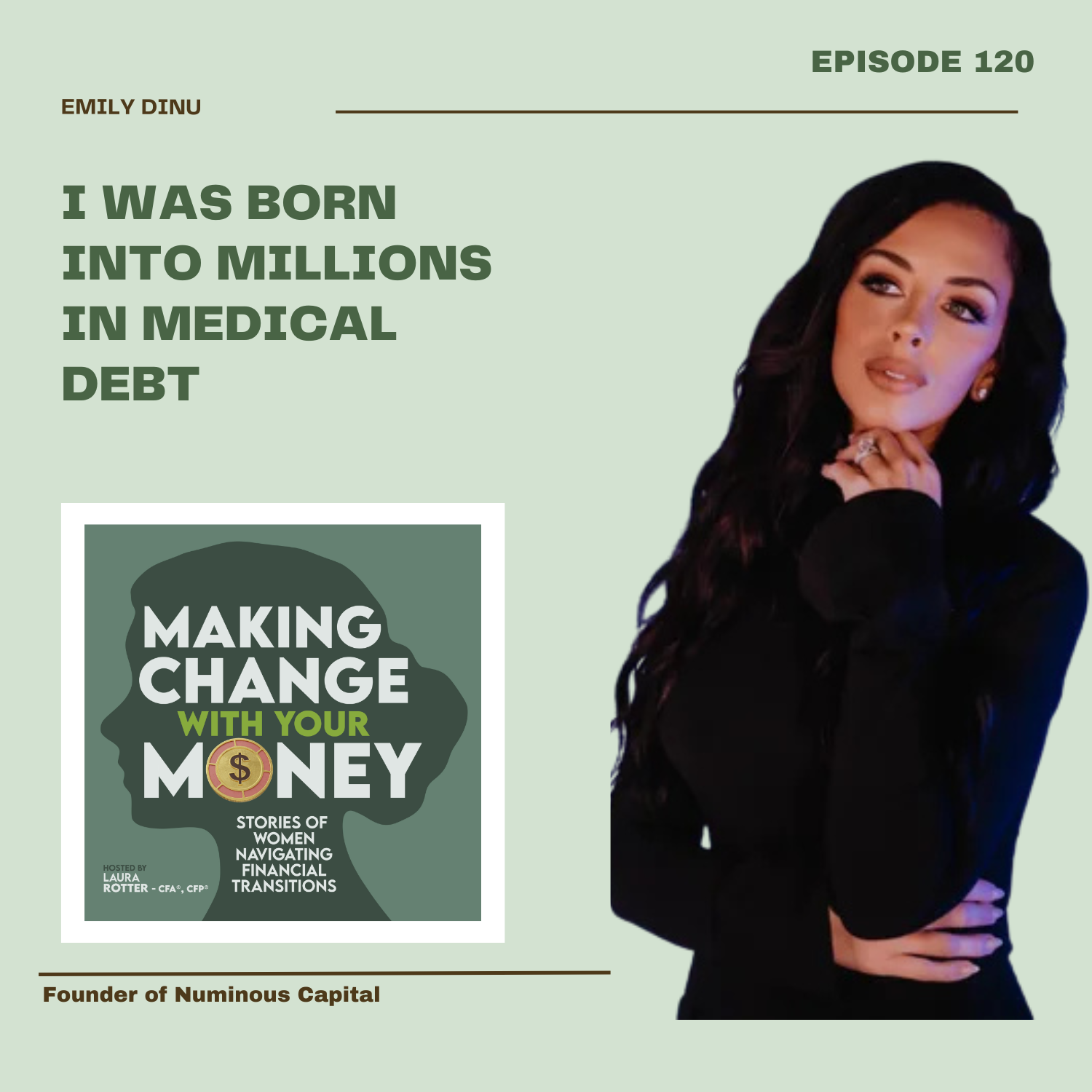
I Was Born Into Millions in Medical Debt episode artwork

EPISODE · May 31, 2026 · 46 MIN

I Was Born Into Millions in Medical Debt

from Making Change with your Money · host Laura Rotter, CFA, CFP® | Financial Advisor for Women in Midlife Transitions

Imagine growing up watching your mother choose between paying the electric bill or buying groceries. Imagine filing bankruptcy, losing your house, living in cars.At some point, you've probably asked: How do I break free from the money patterns I inherited? How do I build wealth when I'm starting from nothing?Maybe you've tried to outrun your financial past. You've worked hard, done everything "right." But financial trauma doesn't disappear because you get a paycheck. And for women especially, we're more likely to live in poverty in retirement, take career breaks that cost us earning potential, and prioritize everyone else's financial security before our own.Emily was born months after her sister passed away, into a household drowning in medical debt, depression, and hopelessness. By eleven, her father had abandoned the family. Her mother, unable to separate emotions from financial decisions, gave up hope.But Emily chose differently. She graduated high school three years early, started working, and at nineteen launched her first business as a virtual assistant to C-suite executives and family offices.That gateway changed everything. She learned how capital moves by working with the people who controlled it. She helped create one of the first blockchain ETFs. Today, she runs Numinous Capital—a venture capital firm investing in biotech and deep tech companies building between the coasts.Here's what Emily learned that her mother never could: sometimes debt feels more secure and comfortable than not having it. "Debt acts almost like a father that's not there," she told me. "It's on your back constantly. And it may feel secure and safe."This is the paradox of financial trauma. The very thing destroying you can feel like the only stable relationship you have. It's familiar. It's known. And letting it go can feel more terrifying than keeping it.Emily witnessed this in her mother, who stayed trapped in the cycle until she passed away. But Emily chose differently. She learned to recognize the pattern without repeating it.Now, financial security means something entirely different: nervous system regulation. "It's this sense of calm and peace that we all owe ourselves," she says. Not about buying more things. Not about keeping up with anyone. Just knowing her money's growing, knowing she has a fallback plan, knowing she's creating opportunity for future generations.Emily's closing message for anyone navigating financial hardship or transition: "You have it all already. Everything that you need you already have. Don't be afraid to take risks. Don't be afraid to take chances on yourselves."And here's the mindset shift she practices: when you hit a snag and start losing hope, try something different. Just once, say "Maybe this is a good thing. Let me make this into a good thing."That's how you bend reality. Not by denying your circumstances, but by reframing how you deal with them. Not by pretending your past doesn't matter, but by refusing to let it determine your future.Guest: Emily is the founder of Numinous Capital, a venture capital firm investing in biotech, deep tech, and capital-intensive companies building between the coasts. She started her first business at nineteen and has spent her career learning how capital moves through markets—from family offices to hedge funds to venture capital.Resources:Numinous CapitalLinkedIn

Imagine growing up watching your mother choose between paying the electric bill or buying groceries. Imagine filing bankruptcy, losing your house, living in cars.At some point, you've probably asked: How do I break free from the money patterns I inherited? How do I build wealth when I'm starting from nothing?Maybe you've tried to outrun your financial past. You've worked hard, done everything "right." But financial trauma doesn't disappear because you get a paycheck. And for women especially, we're more likely to live in poverty in retirement, take career breaks that cost us earning potential, and prioritize everyone else's financial security before our own.Emily was born months after her sister passed away, into a household drowning in medical debt, depression, and hopelessness. By eleven, her father had abandoned the family. Her mother, unable to separate emotions from financial decisions, gave up hope.But Emily chose differently. She graduated high school three years early, started working, and at nineteen launched her first business as a virtual assistant to C-suite executives and family offices.That gateway changed everything. She learned how capital moves by working with the people who controlled it. She helped create one of the first blockchain ETFs. Today, she runs Numinous Capital—a venture capital firm investing in biotech and deep tech companies building between the coasts.Here's what Emily learned that her mother never could: sometimes debt feels more secure and comfortable than not having it. "Debt acts almost like a father that's not there," she told me. "It's on your back constantly. And it may feel secure and safe."This is the paradox of financial trauma. The very thing destroying you can feel like the only stable relationship you have. It's familiar. It's known. And letting it go can feel more terrifying than keeping it.Emily witnessed this in her mother, who stayed trapped in the cycle until she passed away. But Emily chose differently. She learned to recognize the pattern without repeating it.Now, financial security means something entirely different: nervous system regulation. "It's this sense of calm and peace that we all owe ourselves," she says. Not about buying more things. Not about keeping up with anyone. Just knowing her money's growing, knowing she has a fallback plan, knowing she's creating opportunity for future generations.Emily's closing message for anyone navigating financial hardship or transition: "You have it all already. Everything that you need you already have. Don't be afraid to take risks. Don't be afraid to take chances on yourselves."And here's the mindset shift she practices: when you hit a snag and start losing hope, try something different. Just once, say "Maybe this is a good thing. Let me make this into a good thing."That's how you bend reality. Not by denying your circumstances, but by reframing how you deal with them. Not by pretending your past doesn't matter, but by refusing to let it determine your future.Guest: Emily is the founder of Numinous Capital, a venture capital firm investing in biotech, deep tech, and capital-intensive companies building between the coasts. She started her first business at nineteen and has spent her career learning how capital moves through markets—from family offices to hedge funds to venture capital.Resources:Numinous CapitalLinkedIn

NOW PLAYING

I Was Born Into Millions in Medical Debt

0:00 46:16

No transcript for this episode yet

We transcribe on demand. Request one and we'll notify you when it's ready — usually under 10 minutes.

MG Show MG Show The MG Show, hosted by Jeffrey Pedersen and Shannon Townsend, is a leading alternative media platform dedicated to uncovering the truth behind today’s most pressing political issues. Launched in 2019, the show has grown exponentially, offering unfiltered insights, comprehensive research, and real-time analysis. With a commitment to independent journalism and factual integrity, the MG Show empowers its audience with knowledge and encourages active participation in the political discourse. いろはにマネーの「ながら学習」 IrohaniMoney この番組では、インターン生2人が、金融、経済、投資関連の気になる情報を分かりやすくお伝えしていきます。インターン生の会話を「ながら聴き」する感覚で一緒に勉強していきましょう!ご意見箱フォーム:https://forms.gle/TTGaVP2TJksNMKJo7ぜひお便りや感想をお待ちしています!公式X:https://x.com/irohanimoney番組のハッシュタグは「#いろはにながら」です。番組への感想をお待ちしています!いろはにマネー:https://www.bridge-salon.jp/money/姉妹サイト:https://kabu.bridge-salon.jp/姉妹サイト:https://bridge-salon.jp/(株)インベストメントブリッジ運営 Eat to Live Jenna Fuhrman, Dr. Fuhrman Our health is our most precious gift and smart nutrition can change your life. Each month, join Dr. Fuhrman and his daughter, Jenna Fuhrman as they discuss important topics in the world of nutrition. Eat to Live will change the way you eat and think about food. French Your Way Jessica: Native French teacher founder of French Your Way Boost your French listening skills and test your comprehension with this one of a kind series of podcasts. Get the chance to listen to a real conversation between native speakers talking at normal speed AND customise your learning experience through carefully designed sets of questions (2 levels of difficulty) available for download at www.frenchvoicespodcast.com. All interviews also come with the transcript. French teacher Jessica interviews native speakers of French from around the world who share a bit of their life and passion. Where else would you meet in one same place a French yoga teacher based in Melbourne, a soap manufacturer from Provence, or a couple cycling around the world?

Frequently Asked Questions

How long is this episode of Making Change with your Money?

This episode is 46 minutes long.

When was this Making Change with your Money episode published?

This episode was published on May 31, 2026.

What is this episode about?

Imagine growing up watching your mother choose between paying the electric bill or buying groceries. Imagine filing bankruptcy, losing your house, living in cars.At some point, you've probably asked: How do I break free from the money patterns I...

Can I download this Making Change with your Money episode?

Yes, you can download this episode by clicking the download button on the episode player, or subscribe to the podcast in your preferred podcast app for automatic downloads.
URL copied to clipboard!