
EPISODE · Jun 17, 2025 · 25 MIN
Ibn Sina Reimagined: The Islamic Polymath Confronts Modern Medicine and Philosophy
from The Cogitating Ceviché Podcast · host Conrad T Hannon
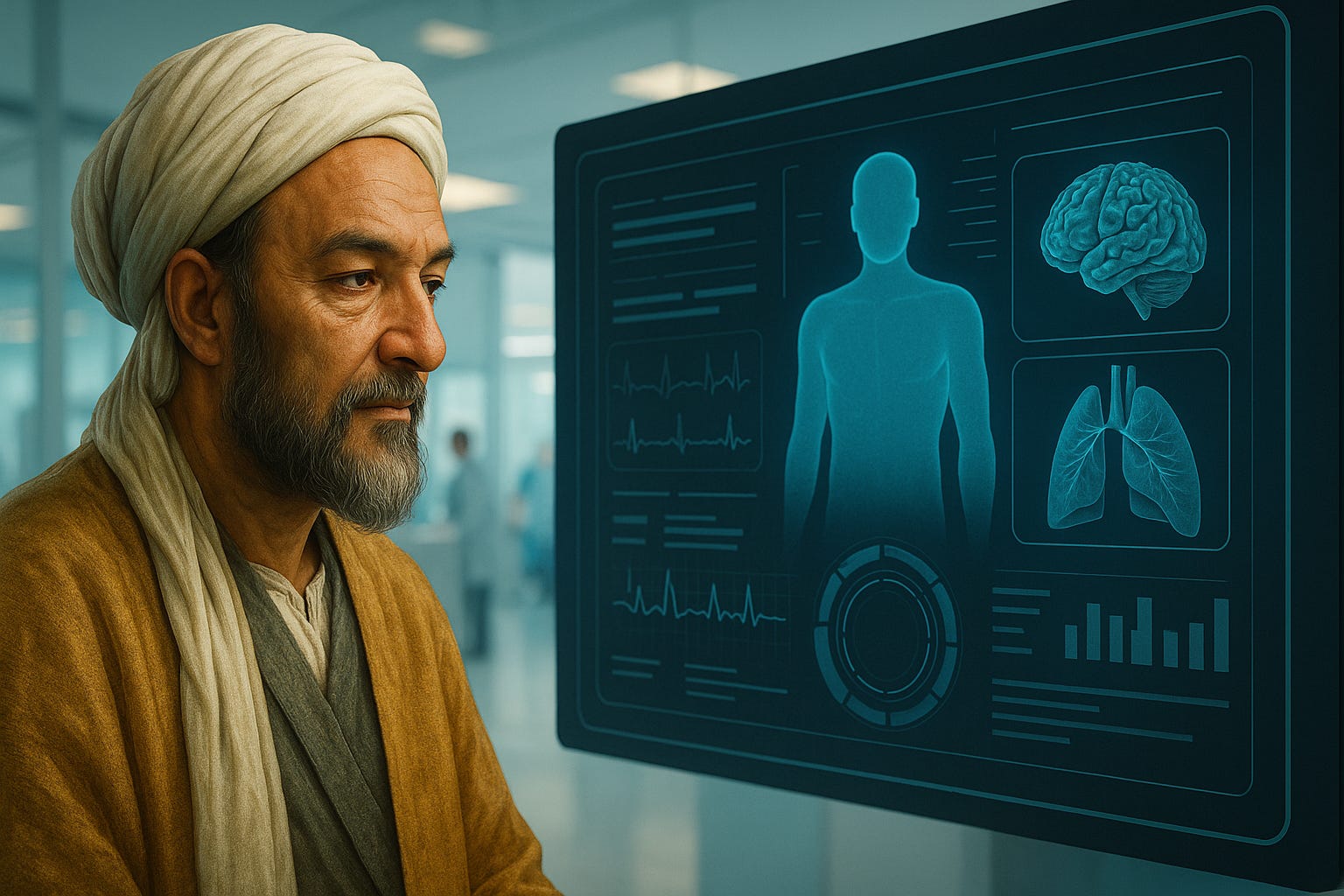
The Cogitating CevichéPresentsIbn Sina Reimagined: The Islamic Polymath Confronts Modern Medicine and PhilosophyPast Forward: Historical Icons in the Digital Frontier #65By Conrad HannonNarration by Amazon PollyPrefaceWelcome to the sixty-fifth installment of Past Forward: Historical Icons in the Digital Frontier. This ongoing series reimagines history's pivotal figures interacting with the complexities and challenges of our contemporary world. In this edition, we meet Ibn Sina, also known as Avicenna, the legendary Islamic philosopher and physician whose seminal works profoundly shaped medical and philosophical thought for over a millennium.Born in 980 CE in Afshana, near Bukhara, Ibn Sina emerged during the Islamic Golden Age as one of history's most remarkable polymaths. His intellectual achievements spanned medicine, philosophy, mathematics, astronomy, and logic. His masterwork, the Canon of Medicine, remained the standard medical textbook in European and Islamic universities for over 600 years, while his philosophical treatises on metaphysics, logic, and the nature of existence influenced thinkers from Thomas Aquinas to modern Islamic philosophers.Ibn Sina's approach to knowledge was fundamentally integrative. He viewed medicine not merely as the treatment of physical ailments, but as a comprehensive understanding of human nature that encompassed body, mind, and soul. His philosophical method emphasized rational inquiry balanced with spiritual insight, empirical observation combined with theoretical reasoning. This holistic worldview enabled him to make groundbreaking contributions across multiple disciplines while maintaining a unified understanding of reality.What would Ibn Sina make of integrative medicine, the rise of artificial intelligence in diagnostics, and the fragmentation of modern philosophical knowledge? How would this master of synthesis navigate a world where specialization has compartmentalized the very knowledge he sought to unify? Let us follow his extraordinary journey as he navigates these contemporary realms, applying timeless wisdom to modern dilemmas.IntroductionEmerging from a quiet alcove of an ultra-modern medical research facility in Geneva, Ibn Sina gazes in astonishment at the humming equipment around him. The sensory experience overwhelms him initially—the soft blue glow of LED lighting, the subtle electronic chirping of monitoring devices, the antiseptic smell that somehow manages to be both sterile and oddly comforting. Glass walls shimmer with digital screens, showcasing vivid diagnostic images and data streams flowing at dizzying speeds. Three-dimensional holographic displays rotate complex molecular structures in mid-air, while robotic arms move with precise, almost dance-like motions as they handle delicate laboratory samples.The architecture itself amazes him—curved surfaces that seem to flow like water, materials that appear both substantial and translucent, and an overall design that suggests both cutting-edge technology and organic harmony. This is far removed from the libraries and medical facilities of 11th-century Persia, yet something about the purposeful activity and scholarly atmosphere feels familiar to his physician's soul.As he absorbs the sterile yet mesmerizing environment, a holographic AI assistant materializes before him—a shimmering figure that speaks in clear, melodious tones. "Welcome, distinguished scholar," it says, somehow recognizing his significance. "I am ARIA, an Artificial Research and Information Assistant. Would you care for a guided tour through what we term 'the pinnacle of human health innovation'?"Initially cautious, Ibn Sina circles the hologram, examining it from multiple angles with the same methodical approach he once applied to studying cadavers. The AI's responses to his probing questions demonstrate a vast knowledge base, yet something seems incomplete—a quality he struggles to define. The assistant possesses information but lacks what he would call wisdom, data but not understanding.Ibn Sina, the author of the Canon of Medicine, quickly becomes intrigued despite his reservations. He approaches a station where doctors analyze complex patient data, their efforts seamlessly integrated with AI-driven analytics. The physicians wear devices that project information directly into their field of vision, allowing them to see a patient's complete medical history, genetic markers, and real-time physiological data overlaid onto their physical examination.The blending of human intuition and computational precision captivates him, stirring both admiration and thoughtful skepticism. He watches as a cardiologist examines a patient while simultaneously consulting an AI that processes thousands of similar cases, offering diagnostic suggestions and treatment recommendations based on vast databases of medical knowledge. The speed and comprehensiveness of this process astounds him, yet he notices subtle details—the way the physician's hand pauses slightly when listening to the patient's heart, the momentary furrow of concentration that suggests intuitive concern beyond what any algorithm might detect.This modern world, a dazzling labyrinth of digital marvels, compels him to reflect deeply on the journey medicine and philosophy have taken since his time. The fundamental questions remain the same—how do we understand the nature of illness and health, the relationship between mind and body, the balance between knowledge and wisdom?—but the tools and methods for exploring these questions have evolved beyond anything he could have imagined.Medicine's Evolution: From Canon to AIIbn Sina recalls the painstaking years he spent writing his Canon of Medicine, working by candlelight in the libraries of Isfahan and Baghdad, synthesizing the medical knowledge of Galen, Hippocrates, and Islamic physicians with his own careful observations and innovations. The groundbreaking medical encyclopedia represented his attempt to create a comprehensive, systematic approach to understanding human health—one that synthesized ancient knowledge with original insights, becoming a cornerstone of medical education for centuries.His Canon had been revolutionary in its organization, dividing medical knowledge into five books that covered general principles of medicine, simple drugs, diseases affecting specific organs, diseases affecting the whole body, and compound remedies. More importantly, it represented his belief that medicine must be both empirical and rational, grounded in careful observation but guided by theoretical understanding.Observing modern integrative medicine practices, he appreciates how traditional and alternative methods coexist, informed by holistic principles that resonate deeply with his own approach. He visits the integrative medicine wing of a major hospital, where he encounters treatment modalities that bridge Eastern and Western traditions in ways that would have seemed impossible in his era.Exploring a contemporary integrative clinic, he witnesses acupuncture practitioners working alongside oncologists, herbal medicine specialists collaborating with pharmacologists, and mindfulness instructors supporting patients undergoing intensive medical treatments. All of these approaches are now supported by robust clinical research—randomized controlled trials, meta-analyses, and evidence-based protocols that apply rigorous scientific methodology to therapeutic traditions that once relied solely on empirical observation and traditional knowledge.Ibn Sina nods approvingly as he observes a consultation where a physician considers not only a patient's symptoms and laboratory results, but also their stress levels, sleep patterns, dietary habits, family dynamics, and spiritual concerns. This comprehensive approach recognizes echoes of his insistence on balanced, individualized care that addresses both physical and spiritual dimensions of healing. He had always maintained that effective medicine must consider the patient as a complete being—body, mind, and soul united in health and disease.He engages in lengthy discussions with practitioners of traditional Chinese medicine, finding surprising parallels between their concepts of qi and meridians and his own understanding of the vital force that animates living beings. Conversations with Ayurvedic physicians reveal similar approaches to constitutional typing and individualized treatment that echo his own methods of diagnosing temperament and tailoring therapies accordingly.However, the role of artificial intelligence in diagnostics provokes both admiration and caution. He spends hours observing an AI system analyzing MRI scans, watching as it identifies subtle patterns in brain tissue that might escape even experienced neurologists. The machine can process thousands of images in minutes, comparing each new case against vast databases of previous diagnoses, outcomes, and treatment responses. Its accuracy in diagnosing complex neurological conditions is astonishing—often surpassing human specialists in both speed and precision.Ibn Sina marvels at this capability, recognizing it as an extension of the systematic, rational approach to diagnosis that he had pioneered in the Canon. The AI's ability to correlate symptoms, laboratory findings, and imaging results with unprecedented comprehensiveness represents a fulfillment of his dream of truly evidence-based medicine.Yet he remains wary of humanity becoming overly dependent on technology, possibly diminishing the role of personal intuition and the nuanced understanding that only human empathy provides. He observes instances where physicians seem to defer too readily to algorithmic recommendations, potentially overlooking subtle cues that experienced clinical judgment might detect. The art of medicine—the ability to read between the lines of symptoms, to understand the unspoken concerns of patients, to recognize when something feels wrong despite normal test results—risks being lost in the pursuit of computational efficiency.He engages doctors in spirited discussions about this concern, advocating that AI should support but never fully replace the nuanced judgments of trained physicians. "The machine may see patterns in data," he argues during one particularly intense debate, "but only a physician can truly see the person within the patient. Healing requires not just correct diagnosis, but compassionate understanding of the human condition."Philosophical Fragmentation in the Digital AgeDelving into contemporary philosophical discourse, Ibn Sina encounters a intellectual landscape that both fascinates and troubles him. He attends conferences where specialists discuss narrow subspecialties of philosophical inquiry—philosophers of mind who focus exclusively on consciousness studies, ethicists who work only on biomedical dilemmas, metaphysicians who explore abstract theoretical problems with little connection to practical human concerns.Ibn Sina is surprised and somewhat dismayed by this fragmentation. In his time, philosophy, medicine, ethics, and metaphysics were interwoven strands of a single intellectual fabric. A philosopher was expected to grapple with questions of existence and essence, but also with practical matters of governance, medicine, and spiritual development. Knowledge was understood as fundamentally unified, with different disciplines representing different approaches to understanding the same underlying reality.He attends a virtual philosophy symposium that brings together hundreds of scholars from around the world, each presenting highly specialized research on narrow topics. While impressed by the depth of their expertise, he notes how specialization has fractured knowledge into isolated fields, often disconnected from the broader questions that originally motivated philosophical inquiry. Papers on the technical details of modal logic proceed without reference to their implications for understanding human freedom. Discussions of artificial intelligence focus on computational mechanisms while neglecting fundamental questions about the nature of mind and consciousness.The very structure of modern academic institutions reinforces this fragmentation. Universities divide knowledge into departments that rarely communicate with each other, students specialize early in their careers, and scholars are rewarded for narrow expertise rather than broad synthesis. Ibn Sina observes graduate students who know vast amounts about very specific topics but struggle to connect their research to larger questions of meaning and purpose.During one particularly memorable encounter at a major university, he finds himself in conversation with a brilliant young philosopher who has spent years studying the logical structure of counterfactual conditionals. When Ibn Sina asks how this research relates to understanding human nature or improving human life, the scholar seems genuinely puzzled by the question. The idea that philosophy should have practical relevance strikes him as antiquated, even naive.Ibn Sina passionately argues for a return to interdisciplinary integration, emphasizing philosophy's role as a cohesive force that should unite rather than divide human knowledge. He draws on his own experience as someone who made significant contributions to medicine, philosophy, mathematics, and astronomy not despite their differences but because of their fundamental interconnectedness.Engaging with modern philosophers, he introduces his foundational concepts of essence and existence, demonstrating how metaphysical principles can illuminate medical practice, how logical reasoning can inform ethical decision-making, and how understanding causality can bridge the gap between scientific explanation and philosophical understanding. He urges contemporary thinkers to revisit fundamental philosophical questions and reforge holistic understandings that bridge science, ethics, and metaphysics.His efforts begin to bear fruit as he collaborates with interdisciplinary research centers that bring together philosophers, scientists, and practitioners to address complex contemporary challenges. Climate change, artificial intelligence, genetic engineering, and global health disparities all require the kind of integrated thinking that Ibn Sina exemplifies—combining rigorous analysis with broad understanding, technical expertise with ethical wisdom.Ethical Reflections: Navigating Technological DependenceAs Ibn Sina delves deeper into modern healthcare, ethical dilemmas surrounding AI's prominence emerge with increasing clarity and urgency. He participates in ethics committee meetings where practitioners grapple with unprecedented questions: When an AI system recommends a treatment that contradicts a physician's clinical judgment, who bears responsibility for the outcome? How can patients provide truly informed consent when they cannot understand the algorithmic processes that influence their care? What happens to the physician-patient relationship when much of the diagnostic process is mediated by artificial intelligence?He engages bioethicists in intensive discussions about patient autonomy, privacy, and the potential for algorithmic bias. The issues prove more complex than he initially anticipated. AI systems trained on historical medical data may perpetuate existing disparities in healthcare, providing different recommendations for patients based on race, gender, or socioeconomic status. The algorithms that seem so objective and rational may actually encode the biases and limitations of their human creators.Ibn Sina learns about cases where AI diagnostic systems performed poorly for populations underrepresented in their training data, leading to misdiagnoses and inappropriate treatments. He encounters patients who feel dehumanized by healthcare systems that seem to reduce them to data points, and physicians who struggle to maintain their sense of professional identity when their expertise is increasingly supplemented—or supplanted—by artificial intelligence.The question of medical privacy in the digital age particularly concerns him. In his era, the physician-patient relationship was protected by professional ethics and practical limitations on information sharing. Now, patient data flows through complex networks of healthcare providers, insurance companies, pharmaceutical researchers, and technology firms. The potential for this information to be misused, leaked, or weaponized against patients creates ethical challenges that existing frameworks struggle to address.Ibn Sina emphasizes the primacy of ethics in all medical practice, insisting that compassion and humanity must guide medical practice and technological innovation. He draws on his own writings about medical ethics, which emphasized the physician's duty to serve the patient's best interests regardless of personal gain, social status, or other considerations. These principles, he argues, remain relevant even as the tools and methods of medicine evolve.He highlights the timeless nature of medical ethics, reiterating his conviction that while technology enhances capabilities, ethical grounding ensures humane application. The fundamental questions—How do we respect human dignity? How do we balance individual benefit with social good? How do we maintain trust in the healing relationship?—require the same careful consideration they always have, even as their specific applications evolve.Working with contemporary bioethicists, Ibn Sina helps develop frameworks for ethical AI implementation in healthcare. These guidelines emphasize transparency in algorithmic decision-making, robust protection of patient privacy, ongoing monitoring for bias and disparities, and preservation of meaningful human oversight in clinical decision-making.He cautions against blind reliance on technology, stressing the necessity of maintaining the delicate balance between human judgment and machine assistance to uphold both medical integrity and patient dignity. "Technology," he argues in one influential presentation, "should serve wisdom, not replace it. The goal is not to create perfect machines, but to enhance human judgment in service of healing."Collaborative Contributions: Synthesizing Ancient Wisdom and Modern InnovationEager to contribute meaningfully to contemporary medical practice, Ibn Sina embarks on several collaborative projects that bridge his historical insights with modern capabilities. He begins working with a team of medical informaticians to develop AI diagnostic protocols that incorporate holistic considerations often overlooked by purely algorithmic approaches.His first major project involves creating diagnostic algorithms that consider not just physical symptoms and laboratory values, but also patient lifestyle factors, emotional health indicators, family dynamics, and spiritual well-being. Drawing on his understanding of temperament and constitution, he helps design assessment tools that evaluate patients as complete human beings rather than collections of symptoms.The resulting system proves remarkably effective, particularly for complex chronic conditions where multiple factors interact in ways that traditional diagnostic approaches might miss. Patients with chronic fatigue syndrome, fibromyalgia, and other challenging conditions benefit from the more comprehensive assessment approach that Ibn Sina's insights help inspire.He also collaborates with pharmaceutical researchers to develop more individualized approaches to medication selection and dosing. His writings on the importance of constitutional differences between patients inform new pharmacogenomic approaches that consider genetic variations, metabolic differences, and individual responses to therapeutic interventions.In the realm of medical education, Ibn Sina works with curriculum developers to create training programs that integrate technical competence with humanistic values. He helps design simulation exercises that teach students not just clinical skills, but also how to maintain compassion and wisdom in high-technology environments. These programs emphasize the importance of seeing patients as whole human beings, even when sophisticated technology mediates much of the diagnostic and therapeutic process.In philosophy, he works alongside interdisciplinary scholars to craft frameworks that integrate diverse strands of modern thought. His collaborative efforts focus on developing methodologies inspired by his integrative model—approaches that can bridge the artificial divisions between scientific, philosophical, and spiritual approaches to understanding reality.One particularly successful initiative involves creating "Philosophy and Medicine" seminars that bring together medical students, philosophy graduate students, and practicing clinicians to explore fundamental questions about the nature of health, illness, healing, and human flourishing. These sessions prove so popular that they expand into a full curriculum track that produces graduates better equipped to navigate the ethical and philosophical challenges of modern medical practice.His collaborative efforts lead to innovative curricula that blend medicine, ethics, and philosophy, emphasizing unified knowledge systems that prepare future practitioners for the complex challenges they will face. These programs produce physicians who are not just technically competent, but also philosophically sophisticated and ethically grounded.Legacy and Modern InfluenceIbn Sina's engagement with modern medicine and philosophy gradually reveals the enduring relevance of his core insights while also highlighting areas where contemporary practice has moved beyond his original vision. His emphasis on individualized, holistic care finds new expression in precision medicine approaches that tailor treatments to individual genetic profiles, lifestyle factors, and personal preferences. The integration of traditional and modern therapeutic modalities reflects his conviction that healing requires attention to all dimensions of human experience.His philosophical methodology—combining rational analysis with empirical observation, seeking unity underlying apparent diversity, maintaining practical relevance while pursuing theoretical understanding—proves remarkably applicable to contemporary challenges. Climate change, artificial intelligence, biotechnology, and other complex issues require exactly the kind of integrative thinking that Ibn Sina exemplified.Yet he also recognizes ways in which the modern world has progressed beyond his original understanding. The democratic values that now inform medical ethics, the recognition of patient autonomy and informed consent, the attention to social determinants of health and healthcare disparities—these represent genuine advances in moral understanding that complement rather than contradict his original insights.The scientific method as it has evolved since his time provides more rigorous approaches to testing therapeutic interventions and understanding disease mechanisms. While Ibn Sina pioneered systematic approaches to medical knowledge, contemporary research methods offer more sophisticated ways of controlling for bias, accounting for confounding variables, and establishing causal relationships.Conclusion: Ibn Sina's Enduring WisdomReflecting on his journey through the modern world, Ibn Sina sees clearly how his foundational ideas continue to echo through contemporary practice and thought, while also recognizing the ways in which human understanding has evolved and expanded since his era. The integration of traditional wisdom and cutting-edge technology resonates deeply with his original vision of medicine as both art and science, requiring technical competence and humanistic insight.The challenges facing modern medicine—maintaining humanistic values in increasingly technological environments, integrating diverse therapeutic traditions, addressing healthcare disparities, navigating ethical dilemmas created by new capabilities—all require the kind of balanced, integrative thinking that characterized his approach to knowledge and practice.In philosophy, his vision of unified knowledge that addresses practical human concerns while pursuing theoretical understanding provides a valuable alternative to the extreme specialization that has fragmented contemporary academic discourse. The growing interest in interdisciplinary approaches, applied philosophy, and practical ethics suggests a movement back toward the kind of integrated understanding he exemplified.Ibn Sina departs the 21st century optimistic yet contemplative, hopeful that humanity will continue striving toward holistic understanding and ethical integrity. He recognizes that true healing and profound philosophical insight emerge from balanced integration rather than fragmentation, from wisdom that combines technical competence with compassionate understanding.His experience with modern artificial intelligence has convinced him that human judgment and empathy remain irreplaceable, even as technological capabilities continue to expand. The goal should not be to replace human wisdom with artificial intelligence, but to enhance human capabilities while preserving the essential qualities that make healing a fundamentally human endeavor.As his holographic guide bids farewell, Ibn Sina smiles gently, assured that his legacy endures—not as a set of outdated doctrines, but as an ongoing commitment to integrated understanding, ethical practice, and the conviction that genuine knowledge serves human flourishing. His journey through the modern world has shown him that while the tools and methods of inquiry continue to evolve, the fundamental human needs for healing, understanding, and wisdom remain constant, guiding modern society toward a balanced embrace of technology and timeless wisdom.Thank you for your time today. Until next time, stay gruntled. This is a public episode. If you'd like to discuss this with other subscribers or get access to bonus episodes, visit thecogitatingceviche.substack.com/subscribe
Embed this episode
NOW PLAYING
Ibn Sina Reimagined: The Islamic Polymath Confronts Modern Medicine and Philosophy
No transcript for this episode yet
Similar Episodes
No similar episodes found.
Similar Podcasts
No similar podcasts found.