Hi, this is Sarah Koenig with News About Our Latest Podcast from Serial Productions and The New York Times. It's called Metro. Well, technically it's called Metro with Sarah Koenig because the show is supposed to be by me, but I prefer the name Metro, so let's just go with Metro. Stories about New York City and its most fascinating raw material. New Yorkers.
Each week on Metro we bring you investigations. Don't tell them you're gonna go to jail if every talk about this last night. Personal stories. I don't think this is the word dump when you're talking about your death session. Essays and interviews.
Are you a fan of them, Mayor? Yeah. I don't hate them. Stories that take a bigness of New York and make it human scale and relevant, no matter where you live. See, I consider myself a citizen of everywhere.
So come along with me, you two Jersey, and let's hang out with the best talkers in New York City. Metro, wherever you get your podcasts. From The New York Times, I'm Rachel Abrams, and this is The Daily. Two fatal shootings by federal immigration agents in Texas and in Maine have once again put a spotlight on the Trump Administration's deportation tactics. Today, my colleague Ahmed Al-Zeeze explains how these killings signal a return to a more aggressive form of immigration enforcement, one that can easily turn a routine moment like a traffic stop, into a deadly confrontation.
It's Thursday, July 16th. Ahmed, in the six months since two Americans were killed by federal agents in Minnesota, the government's deportation crackdown has felt a little bit quieter. Federal agents, of course, withdrew from cities. The protests that we saw after Minnesota really died down. We stopped seeing these gruesome confrontations between law enforcement and civilians that people have been capturing on video.
And so all of this put together, I think, made these two recent shootings in Houston and then in Maine feel, at least to some people, like they almost came out of nowhere. Yeah, I mean, I think that's a fair assessment as far as the public see you, because in the months after Minneapolis, arrest numbers dropped pretty dramatically across the country. But that kind of came to an end in late June when suddenly, at least at ICE, there was this sense that the White House wanted more arrests, that the enforcement needed to go up dramatically. Okay, we're going to talk about what has led to all of that, but I just want to talk about the two shootings first. We are still learning the details of what happened both in Maine and in Houston, but can you just tell us, Ahmed, what do we know so far about both of those incidents?
Yeah, so the first shooting was on July 7th in Houston. And in that incident, ICE was looking for two individuals that they wanted to come and arrest. And as they're doing that surveillance, as they're looking for those two individuals, they come across a van to them that seemed suspicious. And in fact, inside this van, they believe individual in the car resembled one of the targets that they were looking for. And so they start to look up the license by information of this van and they find that it's registered to somebody who is undocumented.
And so they decide to go after the car. They're basically thinking, oh, even if it's not the people we're looking for, maybe we could pick up another person who's here legally. Yeah, essentially, I mean, this is the, you're at a point now that you have created this level of reasonable suspicion that's going to be a lot of the time. So that's the first suspicion that ICE officers need to pursue individuals. And that's at this point, really, during this attempt to stop this van where the narratives really start to diverge, where the passengers and witnesses in this van say that the van was not doing anything dangerous.
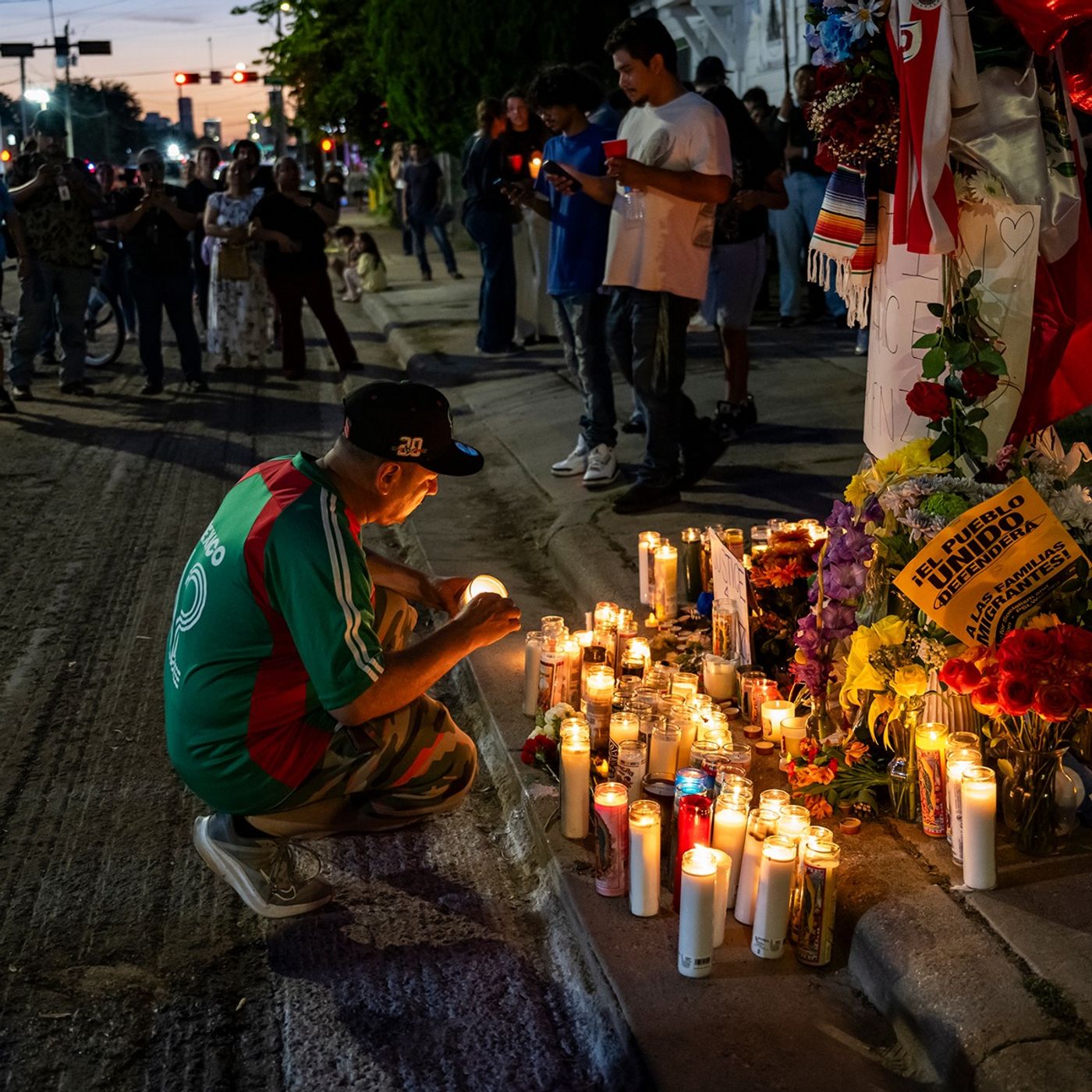
And where ICE says the van was actually putting their officers in danger, that it was being weaponized, that the officers essentially feared for their safety and needed to use that lethal force. So that's at this point that we know, but we don't have a clear video of this incident. But we do know, of course, that they shot into the vehicle killing this person in Houston. So what do we know about the victim at this point? Lorenzo Salgado Aruo. He lived in the country for more than 30 years. He's undocumented.
And he actually had a, his own construction crew, his brother was part of it, his brother was in the van. And this story took off for many reasons, but one of them was... I want to tell you about my dad. Really this impassioned speech from his son, Ronaldo. He wanted nothing else in life but to provide for his wife and see his sons become great people.
Who just really spoke glowingly about his father? I saw a video posted on Facebook that he had been shot. I recognize him immediately. Not from his appearance, but from his voice. Crying for help as he lay on the street, bleeding out.
You could see in his tears how sad he was about what had happened to him and something that they never expected. He did not deserve to be reduced to a headline of Mexican man shot and killed by ICE. He deserved to live a quiet life as Lorenzo Salgadoco, a husband, a father, and a job creator for dozens of men who also wanted the American Dream. So the story, I think, really resonated for people because when this administration talks about immigration enforcement, they often talk about in the highlight individuals who have horrific criminal convictions and the type of criminal histories that they really want to put on display, but in this case, this was a man going to work.
As we mentioned, there were two incidents. The second one was in Maine. Tell us about the details. In that case, what do we know there? So on Monday in Biddeford, Maine, this really sleepy small town, ICE agents were targeting an individual who had a deportation order, and they decided to target somebody going into a vehicle, and they decided to try to stop that vehicle.
But according to ICE, the vehicle tried to flee the scene, and it was during this time they felt there was a fear. Actually, the way they put it was they were fearing for public safety, and the ICE officer decided to shoot into the vehicle. This man, Joanne Sebastian Guerrero, a 25-year-old Colombian immigrant, was killed. And just to be clear, do we know for certain whether he was or was not somebody that ICE was looking for? They don't clearly say that in the statement. Senator Angus King said that he spoke with DHS Secretary Mark Wayne Mullen, who told him that Mr. Guerrero was not the target of the police.
So if that is the case, it is very similar in some ways to what happened in Houston. Can you tell us what do we know about him, Guerrero, the victim at this point? Mr. Guerrero, he lived in Biddeford. He worked as a food delivery driver. He was also a cleaner at a veterinary clinic. He has a three-year-old child, and his wife shared a photo of their family on social media, and she wrote that I will love you all the days of my life.
His father actually gave an interview with the Colombian news outlets. In it, he said that his son had work authorization and was in the United States legally. The Trump administration, though, said that Mr. Guerrero had illegally entered the country in 2023 and was released into the United States by the Biden administration. So we don't necessarily have clarity yet on his status, it sounds like.
We do not have any clarity on that, yeah. What has the public reaction been to these two cases that we just talked about? Yeah, I think there is a lot of anger. These agents have no business drawing their guns. They aren't judged during an executioner.
He wasn't even the guy that they were looking for, and so now in his administration... People are asking for investigations, they're asking for accountability. We need to remain a perfect general to just ask for a congressional hearing so that we can help. As I was making my way through Biddeford on Monday, there was a pretty large protest outside of the office of Senator Susan Collins. Susan Collins, for such time.
The local residents had signs, anti-is signs surrounding that office just hours after that shooting. I think a lot of this stems from public distrust of DHS, of this administration, and their narrative as to what happened. We've seen incidents before in which there is an explanation of what happened and video comes out and ends up contradicting the facts presented by the government. We can look to January when Alex Pready was shot by Border Patrol agents and the DHS Secretary at the time, Christine Oum, came out that same day and said that Mr. Pready was planning to harm the agents, brandishing his weapon, and Americans actually saw that video, and they saw that none of the things that she was saying were reflected in that video, so I think there is a lot of distrust of the official narrative.
I think there are probably a few things about these incidents that remind people of what happened back in Minneapolis back in January, and as you described though, since then the administration's tactics have the very least become less visible. And so I wonder whether the events of the last week represent some kind of return to that earlier more aggressive phase of enforcement, or whether the federal government has had more of a presence in American cities this entire time than people perhaps realized. Yeah, I mean, if you go back to January in Minneapolis, it really comes in a time when Stephen Miller is pushing for more arrests, more deportations. He's put out this goal of 3,000 arrests a day, a figure that I was never able to reach, and they really went on a string of targeting major American cities and states, and Minneapolis became a major target after a series of stories about the Somali community there.
So thousands of DHS agents are there. They are trying to arrest as many people as possible. There are videos of people with legal status being pulled over. It seems like this is chaotic. Two American citizens are shot dead in the streets, and at the end of all this, President Trump decides to quiet down the situation in Minneapolis, and he puts his borders are Tom Homan in charge, and ultimately the DHS agents leave the state.
Then DHS Secretary Christy Nome is ultimately fired and incomes Mark Wayne Mullen, the senator from Oklahoma who in his confirmation hearing actually sets out this goal that he wants to keep his agency out of the headlines. He wants them to be quieter than they have been, and enforcement after the time he takes over really starts to drop. You start seeing around a thousand arrests a day. Right, which is probably why this felt a little bit less present to a lot of people. Exactly. I mean, it kind of in many ways was a situation in which I sort of try to stay out of the public's view.
But even though it seems like things have quieted down, Stephen Miller has continued to push for more numbers. He has always wanted more arrests, more deportations. He never wanted to quiet things down. Exactly. And by June Miller in this administration is in a position to where they can get what they've always wanted.
We'll be right back. Law transforms agreement into reality. A word becomes an agreement. An agreement becomes a contract. A contract becomes law.
Today, Harvey, the AI platform for legal work, is writing the next chapter. More than 200,000 lawyers are building with Harvey, accelerating review, sharpening negotiations, and more. This is how the future of agreements is being crafted now. Harvey, learn more at harvey.ai. Harvey does not provide legal advice.
Users should always independently review and verify any output from Harvey. I'm Deborah Cayman. I'm an investigative reporter for the New York Times. One morning a few months ago I got an email, and this person said to me, Hey, I have some documents I think you want to see. So I got on a plane that afternoon and I met them in person and I photographed the documents, and we were able to tell a story that moved our reporting forward in a really significant way.
When you subscribe to the New York Times, you're getting a whole team of reporters who are willing to jump and go verify information and bring back documents and shine light on things that other people would like to keep in it. If you're a subscriber, thank you for being a part of that. I met what happened in June that, as you said, allowed Stephen Miller to once again pursue his deportation strategy as aggressively as he's been wanting to. You know, we know that this administration has really been making this push to dramatically grow ice for the last year, but June is really when we saw those efforts come to fruition. You'll remember that DHS was funded with an extra $170 billion by the Big Beautiful Bill, and a lot of that going toward ice, allowing them to hire these thousands of new officers.
But the process of getting them out on the street, that takes time. There's training, there's all kinds of different administrative tasks that are necessary. So by the time June rolled around, it was almost a year since that hiring push, and they're in a position now where they're able to, on their own, make this push for more enforcement, make it a reality. They have thousands of new officers to send out into American streets to arrest people and ramp their numbers up. And in fact, in late June, there was this idea within ice, this perception within ice that 2000 arrests a day, that that is the new goal, but that is the new actually not even goal expectation.
So there's a new quote you're saying. And while it's lower than the original quote that Stephen Miller said out earlier on, it sounds like this 2000 number is maybe a firmer expectation. Like, ice never really met that 3000 a day quota, but the expectation now is that 2000 should be an achievable number. Exactly. And in late June, in a period of five days, they arrested more than 10,000 people averaging more than 2000 arrests a day, and one day, I just officially told me that that was the highest five day stretch of arrests by ice during the Trump administration.
I mean, this is really unprecedented territory we're in, 10,000 people picked up by this agency in just a five day swing. And I think there was a sense at the time, you know, is this just a minor blip? Is this just kind of a momentary enforcement blip? But we've seen on several occasions after that five day stretch ice again, hitting that 2000 number. You know, I think I'm at it for people listening to this and hearing how ice has really grown its ranks.
A natural question is, well, how well trained could these people be? And did training or a lack of training contribute to the end results that we saw this past week? So what do we know about that? Yeah, you know, as the administration, as ice was trying to push out these thousands of new officers, they really cut down on the days for these ice officers to go through their training. In fact, there was a whistleblower, an individual who was a former ice lawyer who came out and said that they had cut more than 200 hours of classes involving firearms training, use of force, law for arrests, the limit of their authority.
And so that raised a lot of questions about exactly what these officers were being trained on and whether or not they were really capable of handling these really high stress situations. Sure. And I think what's happening now is that as this agency and as the officers are being pushed to do more, they're being pushed to get that number of 2000 arrests a day. In fact, ice has ordered their field offices to send out more officers every single day to ramp up operations. What that means is you're going to see more of these confrontations, more of these situations where ice is in a sense of urgency to get as many arrests as possible.
And what they're being met with in many cases is immigrant communities who are incredibly fearful of what's going to happen to them. You know, they have seen the videos. They have seen the news of people being deported to Africa, to detention in El Salvador. And so that tension is very high. And so these officers in some cases are running in situations where the immigrants themselves, they want to flee the situation.
They do not want to be arrested. They are terrified. And in many ways, it's a recipe for disaster. And on Tuesday morning, I reported on the case of a 28 year old man who came across ice at a gas station in St. Augustine, Florida.
And he ran away from them. And he ran into the street and was struck and killed by a truck. These are the types of situations where we've seen this before in California. People fleeing in panic to immigration enforcement and they're being lethal consequences. And so this is the kind of recipe for disaster that can make a routine interaction, like a traffic stop, a really combustible situation, like what we saw happened in Houston and Maine.
The public outcry over those shootings has been mounting. And I wonder what the reaction from the administration has been so far to the reaction that we've seen from the public. Yeah, it's been really interesting to see the way they made their argument. We saw the administration pause vehicle pursuits, vehicle stops, except for certain situations. And that seemed to be kind of this moment where the administration was taking a beat to evaluate what they were doing and then move forward.
But President Trump on Truth Social on Wednesday morning, he said not only was ice doing a great job, but they should continue to do the vehicle stops. That there was no pause. So you have a situation in which perhaps the agencies are looking at it one way and the president is decided for them that they should continue with their aggressive approach. Right. I mean, just to read a couple lines from the president's true social post, he said, quote, we cannot give up on one of ice's most important and effective crime fighting tools, the traffic stop.
Once we do, we are playing right into the criminals hands. He went on to say in the same post, keep those crime stat records coming. So I think it seems pretty clear that the president is walking back any kind of attempt to maybe moderate the tactics that we saw over the past week being deployed in Houston and Maine. 100%. Both of these incidents right now, both of these shootings are currently under investigation.
But in the past, when civilians have been shot by federal law enforcement agents conducting these kinds of immigration crackdowns, we did not see indications from the administration that they were very eager to pursue thorough investigations. And I sort of wonder what we know about these investigations, whether they are being run any differently. And if you have any indication at this point, I'm at when and what we may ultimately learn. Yeah. I mean, these types of investigations, typically any type of officer involved shooting, even at a local level, it takes a long period of time.
A lot of resources go into figuring out what happened with the shooting, whether or not the officer was in the right. And case in point, we can look at the shootings of Alex Pready and Renee Goodman-Eapolis. We are six months out from those shootings. We don't have any indication when those investigations will be concluded. So I think what we can expect is, in this instance, like past instances, the DHS inspector general taking a long period of time to come up with their analysis and to finally decide what they concluded on these shootings.
The FBI is also involved with the investigation, but is primarily just involved with the threat to the officer. So DHS IG is the one that is really directing this entire investigation. Ahmed, if it is true that more violent interactions are basically all but inevitable, do you think it's fair to assume that the president has basically decided that whatever the cost is of these stops, of reaching this quota, that that cost is ultimately worth it to execute the agenda, that they have wanted to execute when it comes to deportations? Yeah, the first thing that comes to mind is an interview that JD Vance gave recently in which he said that law enforcement and the work of law enforcement, it's not a very pretty process.
And I think for this administration, the thing that I look at is actions, and I think actions matter. And this administration, since these shootings, they have not relented in their push for more arrests. They have gotten days in which they've arrested more than 2,000 people a day. They pause car stops for seems like a matter of hours before President Trump stepped in and said they needed to continue. So I think it's fair to say at this point that this administration believes that the mass deportation campaign, it hovers above everything else, above the process, above the calls for accountability, the calls to defund the agency, the push to stop ice from doing what it's doing.
The goal is mass deportation and nothing is going to stand that way. Ahmed Ali Aziz, thank you so much. Thank you for your time. The FBI is investigating whether there were drugs in the van driven by Lorenzo Salgado, Ariujo, at the time that immigration agents killed him in Houston. That's according to a search warrant application reviewed by the New York Times.
There's been no indication that agents pursuing the van that day suspected that drugs were present. We'll be right back. I'm Gilbert Cruz. This week on the Book Review Podcast, we have a special Halloween treat, or trick, or treat. Two hard riders recommend some titles that are sure to keep you up at night.
I am a big fan of sentient houses in general. I think this is one of the scariest books I've ever read. Listen to the Book Review, wherever you get your podcasts. That door shouldn't be open. Who left it open?
Here's what else you need to know today. The clarifying, Mr. Blanche. Do you believe it is the President's right and duty to order the investigation or prosecution of his perceived enemies? Yes or no?
I can't answer that. Yes or no. The confirmation of President Trump's choice for Attorney General Todd Blanche remained uncertain on Wednesday. After his testimony before a key Senate committee failed to win over crucial Republicans, including John Cornyn of Texas. But just to be clear, the President of the United States has not agreed in writing to delete the Weaponization Fund.
And there's no way. In what was widely seen as a revealing slip up, Blanche, Trump's former personal lawyer, suggested that he still sees himself in that capacity. Are you in President Trump, Frans? I'm his lawyer. I'm his lawyer.
I'm his lawyer. I'm his lawyer. And in a vote on Wednesday, almost half of House Democrats supported a measure to eliminate USA to Israel. The measure ultimately failed, but the vote reflected a rapid and dramatic shift within the Democratic Party away from decades of unequivocal support for the Jewish state. Today's episode was produced by Adrian Hurst, Ricky Novetsky, and Chris Benderov.
It was edited by Michael Benoit and Rob Zippo, and contains music by Mary Ann Lozano and Dan Powell. Our theme music is by Wonderly. This episode was engineered by Chris Wood. Special thanks to Zoll and Cano Young's and Caitlyn Rufin. That's it for the Daily.
I'm Rachel Abrams. See you tomorrow.