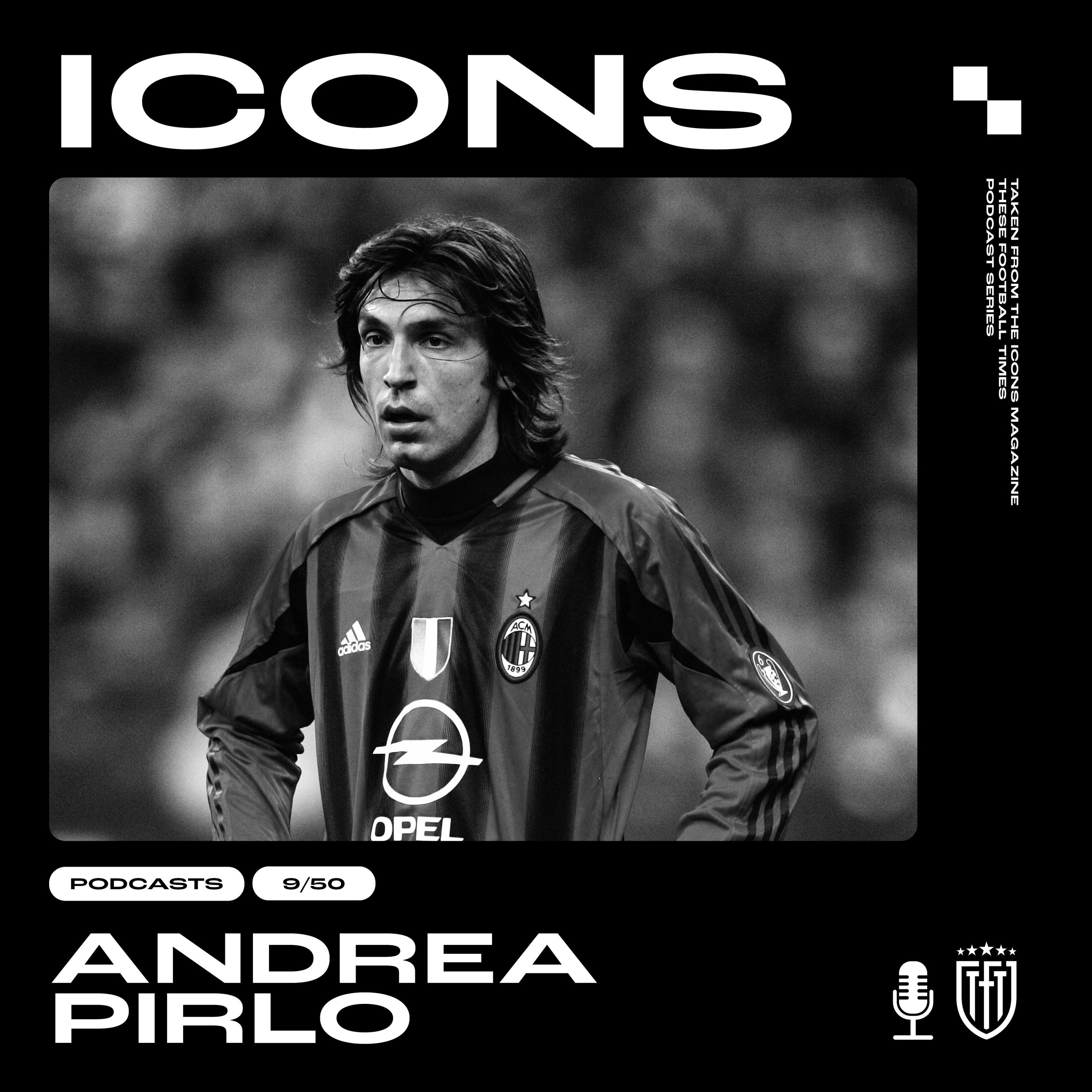
Welcome to The Lobb, your home of in-depth coverage and analysis by These Football Times, a movement of journalism you can trust. Each week, we endeavour to bring you the very best coverage of the game, exploring stories from the past and present, with analysis by expert guests from around the world. Find more of our award-winning content online and in print. In the meantime, enjoy the podcast. Hi, and welcome to Lobb Podcast from These Football Times. In this mini-series called Icons, a number of the team from TFT Towers will be chatting about players, recent or past, who they consider worthy of being described as true icons of the football world.
My name's Gary Thacker, and in this episode, I'm chatting with the technical wizard of TFT, Dave Bowler, about one of his footballing icons. Hi, Dave. Good to speak to you again, Gary. Indeed so, mate. It was a lot of chatting about football. Lovely. I've got myself a cup of coffee, and it's a Saturday morning. It's sunshine, I know, in the UK. Perhaps not so good, but there we go. Tell us who your icon is we're going to talk about now. From the sunshine land of Italy. It's Andrea Pirlo. Ah, okay. That's good. Okay, so we'll delve into a little bit of detail. What makes Pirlo an icon? All kinds of things, I think. I mean, you'll like this, Gary, in particular. Johan Cruyff. Pirlo can make his foot do whatever he wants. He's a genius.
Now, who am I to disagree with Johan Cruyff? Or who is anybody to disagree with Johan Cruyff? I'm not going to do it, that's for sure, bro. I think, you know, over the first 20th century, I think nobody was a more elegant figure on the football pitch than Pirlo. He's one of those players who, you know, when you're watching a game on television, you can always see what the right pass is because you've got the whole thing getting from you. A lot of the time, you know, players don't make the right pass because, you know, they're stuck in amongst the legs and the muck and bullets. And not only did Pirlo make the right pass virtually every time, like Zidane, I suppose, you know, 10 years earlier.
He made the pass that he didn't even know was the right pass before he made it. And that, I think, was his genius. He could see passes and angles and movements before anybody else could see them. He got no particular pace, no great stamina, wasn't a great tackle. But as soon as the ball was at his feet, he was one of those players where the stadium would hold its breath because they knew something was going to happen. And it was going to happen in a perfect Italian suit kind of a way. I'm amazed I've got in here before Stephen Scrogg, frankly, because, I mean, this is the hipster choice. But, yeah, I mean, everything about cool and elegance.
and beauty and all that kind of stuff. That's the way Pirlo was played, I think. I love that metaphor. It was like playing, you can imagine him playing in a finely cut Italian suit with the Lions and he's not going to get dirty, is he? He's not going to get dirty, he's going to stay calm. I mean, I guess, you know, so you mentioned the sort of early years of the century and I guess, you know, people look at Italian football and I think, you know, they might think of people like, you know, Gentile or that sort of thing, you know, who's probably the least gentile player in the world. You know, the hard-knock defenders or the sort of nigger little forwards.
But he was none of that, was he really? In the era where the Italian football stars were either the guys who were going to help for the goals or kick somebody up in there. In this era, he was a sort of different type of Italian player. You mentioned Zidane, I guess I would see the league there as well. Yeah, just graceful, intelligent, thoughtful. I mean, I suppose in some senses, he was more a Spanish player than an Italian player from that kind of era. You could see him fitting in that Barcelona team or the Spanish team that won the World Cup and the Euros. He was that kind of a player.
It's such a lazy thing to say, but I'm going to say it anyway. He was playing chess, that kind of a footballer, I think. He was the one that could see the moves that were coming and he could manipulate people around to get into the places that he wanted him to be in, which is a remarkable skill. He was kind of the, again, an obvious one, but he was conducting the orchestra in that sense. And, you know, interestingly, he didn't start off in that position. I mean, he became the epitome of the deep-lying playmaker, playing just in front of the defence. But, I mean, he started further up the pitch. He was a number 10 and stuff. And it wasn't until he went to Brescia on loan, having started there, then moved to Inter, he went back to Brescia on loan. And that was when he started playing there. He was an attacking midfielder before that. But I think that move unlocked everything because, as I say, he hadn't got that pace. So playing higher up the pitch, you've got to have that bit of acceleration and that bit of something about you, that bit of speed. But playing deeper with everything in front of him, and, you know, you can see all the pictures from there.
And that range of passing, a Glenn Hoddle-type range of passing, that sort of thing, 40, 50 yards, drop it exactly where you want it to, or play it shorter. All of those things, I mean, it's not revolutionising the game, but it's play in that position as well as anybody's ever played it, I think. Definitely, absolutely. I mean, it's interesting not to say about players who haven't got a lot of pace, you know, the first five yards is ahead. Well, for Perlow, the first five seconds ahead of anybody else was in his head. As you say, you could see things before other people could, and then gave him that ability to play that deep-blooded role. One of those, you want a dog in midfield playing alongside him, get the ball, give it to Perlow and shut up.
Let him play, let him play. He will open the fences up because that was his stocking trade. Okay, so we'll sort of round up the discussion about him. So are there any sort of, and I guess, you know, for English sport, English fans or British fans listening in who aren't sort of familiar with Italian football so much, certainly of that era perhaps, are there any sort of defining matches or seasons where his ability sort of shone through? I mean, one of the great things is the longevity. I think for 10 years, he was at that kind of level. But I think the one that the people in this country, above all, will remember is the 2006 World Cup, which for me, he was a player of the competition. I thought he was absolutely outstanding through that whole competition. And you've got to remember Italian football at that point was going through all the chaos of the bribery and all of that. And nobody knew he was still going to be in Serie A the following season and what was going to happen to Milan, what was going to happen to Juventus and all of that. So there's a lot of chaos going on. And he's the sort of the calm in the middle of the storm, really. The semi-final.
against Germany. I think it's one of my favourite games of all time. It was a fabulous game of football. It wasn't necessarily the crash-bang wallop of the... This is West Germany against Italy in 1970. That was an epic in a different way. But this was just such a great game of football and he was running the show really all the way through. He's the one that, in the finish, unlocked the game. He played a pass-through for Grosso to score the first goal. And he said, when you play with Andrea, you always have to expect the pass that nobody else can see. When he's not looking, that's when you're going to get the pass.
And that was how that passed up. But that was how it was all the way through the game. I mean, a few years later, because I've always followed Juventus from getting a football angle when I was about five, and they were in black and white. It was in black and white. And they were wearing the same kit as the Albion. I thought, oh, this one must be all right. Oh, Dave, oh, Dave, oh, Dave. How disillusioned you must have been afterwards. A good friend of mine, Simon Miotto, who was a goalkeeper at the Albion, an Italian-Australian, big Juventus fan. And I went over with him to see Juventus two or three times in Turing. And the thing about Pirlo...
is if he ever gave the ball away and i think he gave it away twice in three games the stadium actually does the stadium actually he was like how did that happen what happened there this isn't this isn't right there must have been an earthquake or something And that's that kind of control that he had of the ball and of everyone around him. It's not quite a midfield general in that sense, but very much the one setting the tone for everything. I think that 2006 World Cup was a perfect example of that. But I think the other one that English supporters will remember is the Euros in 2012, when he basically finished Joe Hart. And, you know, you kind of forget. I was looking at preparation for this, but Italy were 2-1 down after two penalties. They missed the penalty, and he's taking the third one. Now, if that one doesn't go in, England probably win.
So he's got to level it up and he sends this Penenka down the middle and Joe Hart is never the same footballer ever again after that. England fall apart and Italy eventually advance to the finals and lose to Spain. But that presence of mind, that calm, that temperament in that moment with the whole of Europe watching. The Italians, much as they love their players, they're not short on giving them a bit of stick if they've done the wrong thing either. So you know that if you go back to Italy having tried a Penenka and you've just dropped it into Joe Hart's hands and lost the game, you're coming for a bit of stick. So to do that in extremis.
Again, that is just the mark of somebody who is a cuttable. We've used a few words to sort of describe Perlow and his sort of plan, pitching, elegance and calm and cool. A few months ago, probably 12 months ago now, we produced a Liverpool magazine and I wrote a piece on Xabi Alonso. I've always liked Alonso. I think he was not of Perlow's, but that's a similar sort of approach to the game. And I've just described it as like he was listening to a Rodrigo guitar concerto in his ear and everybody else would listen to a thrashing metal. That was the difference between the sort of sereneness almost of the play. And Perlow had that in spades, didn't he?
Absolutely. I mean, you know, he said before the World Cup final, you know, people said, he was asked afterwards, well, did you feel the pressure? Did you feel the nerve? He said, no, I didn't give a toss really. I spent the afternoon resting and playing PlayStation and then in the evening I went to win the World Cup. It's just the sort of something we all have, isn't it really, in fairness? I guess this is an interesting thing to ponder on. I guess, did he redefine his position in the play or almost did he define it rather than refine it? That sort of play, as you said, converted from being the sort of number 10 to more like a number four.
sit in front of the back, but not as a sort of shield, as the guy with the space to be creative. I've been thinking about this the last couple of days to try and work out exactly where, because I mean, there have been blind playmakers before and all of that. I think what he did... was he still played as a number 10, but he did it 50 yards further back. Because with the passing ability that he'd got, he was still able to unlock any defences from there. He didn't have to be in and around the 18-yard box. He could be on the halfway line and do it. And obviously, of course, he got further forward. He scored goals and was a great free kick taker and all of that. But I think with that vision and that ability to spot, not just the run, but the moment. It's the ebbs and the flows. And it's spotting that moment in the music where you want to play the solo or you want to...
change chord or whatever it is. And that was the thing that he got, you know, he got that football of intellect to spot. That was the moment. And that's very, very few players have got that, you know. I mean, you are, again, talking about the great playmakers, the Zidans, that level of player. He could see, you know, again, another quote, Ancelotti said that Pelo could see in a split second a pass that most players wouldn't see in a lifetime. And that, you know, that absolutely is what he could do.
There have been number fours. I don't know what this number four business is, to be honest. Me and you, Gary, from a different world. I was trying to graduate myself with the kids. People have played that position before, haven't they?
As I say, I think he sort of remodelled it a bit into being a number 10 all that way back, just because of the ability that he got. And also, if you play that far back, you give yourself that little bit more room, you give yourself that little bit more time than if you are playing just off the striker. Obviously, it's a bit more congested. Give him that little bit of room and he can take anybody apart. Yeah, you're right. I mean, it's a good way to describe number 10 playing in the number four role. Because whereas a number 10 can breach a defence with a five-yard pass, Perler could do with a 50-yard pass. And of course, playing further back, obviously, he had more space too.
to sort of be creative at that time. I guess, you know, this is an interesting one to consider. You mentioned about the sort of bribery issues that were going around in match fixing at the time. So any sort of controversies or setbacks that affected him? How did he handle them?
I suppose the big setback was early on in his career when he went to Inter and never made it through. Never really got into the Inter team. Two lone spells right at the early stage of his career. And God, Inter must be ruining that now, particularly given that they then sold him to Milan and he went and played three European Cup finals for them within four or five years. I think in terms of setbacks, it's always...
self-belief. I think arrogance is probably too strong a word because I don't think there was ever much arrogance about his play. I think for all the brilliance of it, I think there was a sort of humility about his football. He was in the service of the team rather than in the service of Peeler. That I think is an important one. There are people that will get talked about in this Icon series who are more about them than the team. They've been hugely successful as a result and their teams have benefited from that.
And Lippi has got a big part to play in that, because I think in 2006, it was all about the team. Italy were the best team in that World Cup as well as having great players. They were the best team. And Pirlo, I think, probably was central to that, but I think he learned from it as well. Self-belief is how he dealt with any sort of setbacks. Obviously, I can't believe Stephen Strauss is not talking about this, but Istanbul, obviously, he said, he was thinking of packing it up. He was thinking, no, I can't do this anymore, I'm going to retire. But ultimately came back and then won another Champions League against Liverpool with Milan. So, you know, redemption, I suppose, in a sense, in that way. So I think it's believing in what you do. That's the way he sort of came back from it. Yeah, it's interesting. I mean, I guess a lot of the players we're going to be talking about in this series are going to be discussing this series, but I've had a... What's the word I'm looking for?
a larger-than-life-off-the-field character, shall we say, in many sort of times. But I guess with Perlow, it didn't so much do you? I mean, you never heard of Perlow being involved in a nightclub fight. And you can't imagine it happening. I mean, you can imagine him going out to a nice restaurant and having a nice meal with his family or whatever, and you can imagine him going to, I don't know, I can imagine Perlow going to the opera. I don't know if he did. He'd just got that, what's the word, cultured appearance, that sort of aura about him.
and is sort of a non-persona off the field. It sort of feeds into that, doesn't it? Absolutely. He owns a vineyard. Oh, there you go. See? Straight down the middle of the fairway. Well done, Gary. I mean, I read his book, the translation of his book. Yeah. It got me ten years ago now. And the book's called I Think Therefore I Played. That's right.
I mean, that sums everything up, doesn't it, really? And that is one of the great elements of football. Not all of my favourite footballers are like that, but people like him, like Zidane, like Cruyff. A lot of it happens, as much happens in the brain as it happens in the feet. And I find that really interesting and absorbing to watch. And there are other players where it is all about the feet. And again, that's spectacular. There's nothing wrong with that. But I'm by and large drawn to those players like that. So I think, therefore, I play.
That's like a motto for life, isn't it, really? I can't imagine as many footballs or autobiography with the sort of lifted the title from a René Descartes statement. But, yeah, we should all get rid of all the mottos at the bottom of all the football badges and shove that in. I think they've all had that. Yeah, OK, so did they, again, because his off-the-field image is so sort of unusually quiet, shall we say, did he influence the football world beyond the pitch? But I guess perhaps the attitude he had and the sort of ethos he had about playing, as I say, you don't really imagine him being a big personality, you know, not particularly massively outgoing, not particularly seeking a paparazzi.
I think it was Conte who said, you know, when he went to Juventus later on, that he leads with his feet. You know, he's not one of those in the dressing room who's shouting and screaming and, you know, leading that way by top-thumping. He leads by example. And I think that's, you know, that's... It's a very difficult thing to counter. I think he's one of those people who is a footballer's footballer, if you like. He's one of those ones who, I mean, you're right, I think he's hugely underestimated over the last 10 years. And I think people don't talk about him a great deal now that he's finished. And, you know, I think he was in the top 10 of the Ballon d'Or three times. How did he not win it? You know, never mind only being in the top 10 three times. I mean, who the hell was in the top 10 of the other 10 years? But you're right, and particularly, you know, more and more in the social media age and the age it's written out, you have to...
claim attention, don't you? You have to go out and get it. There's so much, you know, the new group in an era of two and three TV channels and no foreign football and all of that. Now you're bombarded with it from every possible angle. You've got Blue Sky, you've got X, you've got Facebook, you've got Instagram, you've got TikTok, you've got God knows what else. And if you're not on all of them, you know, you just don't get the, you know, you're not part of the story. So I think in that sense, he's been a little bit forgotten, which is scandalous, really. And, you know, he's managerial.
Time hasn't worked out thus far. You know, Juventus and Santori, it's not gone particularly well. So, you know, that kind of chips away at your general reputation a little bit. But I think he's going to be one of those that when people write learning books and magazine articles, he'll be one of those that comes to the fore again and again, I think, because, you know, people will dig in and say, yeah, yeah, this is the fellow that made that work. That's fascinating. Just something that came to mind when you were saying that, is he the kind of player that will be more appreciated in 50 years' time than he is five or six years after he finished?
There's time for people's attitude to mature about the sort of things that you've achieved. Yeah, I think you're right. I mean, I think, you know, as I say, with modern culture as it is, everything goes so quick. And so, you know, the stuff that happened yesterday is of no value to anybody because we're looking at what's happening tomorrow because things move on so fast. And it's only when you're, you know, you're looking at when the documentaries are made or the books are written or the, you know, that kind of stuff. And you're taking a look at it back from this perspective that the people will see it. And I think that's the great advantage he's got compared to, I don't know, Bobby Charlton, for instance, or Pushkas or...
Di Stefano or, you know, because they weren't on television very much and there's not a huge, I mean, not even Bobby Charlton was on television that much. There's not a huge amount of them to look at, you know. We've seen all the clips that there are of Pushkas to see. There's about eight of them or ten of them and that's it. Whereas, you know, at least you would imagine that on YouTube you'll be able to go back and watch as many Pirlo games as you like in the future and they'll still be there. And not just him, but, you know, his entire, his generation and, you know, the Ronaldo generation and all that. They'll be there. They'll be there for people to come and look at. So I think that'll be, I think you're right. I think, you know, we...
It won't be me and you. But in 50 years' time, when people come looking back, I think he will get the sort of credit that perhaps he deserves. Yeah, yeah. OK, so a final thing to consider, and I always like this sort of question, you know, it's one of these things where you can ponder and there's no right answer. I think there is. I think we'll probably prove it as well. How would Perlow, I mean, we're not talking about, you know, a guy who played 50 years ago, but how would he fit in the game's moves, honestly, as you said, how would Perlow fit into the modern game? I think, as I say, it's only, what, 10 years since he backed up, so, I mean, although the game has changed, it's not changed that much. I think he would, to me, a lot of the time.
The game is crying out for somebody like that. Because, you know, regular listeners will know, I have not a lot of patience with a lot of what's happening in football. This business of the pass, pass, pass, pass, pass between the centre-halves. Yeah, great. The centre-halves now have more passes than anybody else in the team. It's a bloody use of that. Because frankly, if you're a centre-halves, you can't pass. Because that's why you're playing centre-halves. So, to me, it's screaming out for the goalkeeper not to be playing it to the two centre-halves who are standing in the penalty box. Play to Peele and then somebody who's got the ball can do something with it. You know, I think playing through the thirds and all of that.
there's a lot to be said for it. And, you know, we both remember when football never saw the middle third. From one goal to the other, basically. There's a lot to commend what's going on in the game. But give it to the fellas who can use it. Don't give it the centre half. Give it to the blog like Pirlo who can play the hard pass, the Glenobble, the Zidane, you know. I guess the problem with that is there aren't that many Pirlo's about these days. I mean, I think, you know, how many fit into the modern game?
With typical grace and elegance, I think, would probably be, you know, I mean, yeah, I mean, if you had a guy like that playing in front of you, back forward, to deploy midfielder, creation, creation midfielder, all right, when it was a central, then give it to Perla. Although, the odds are, the opposition are going to know, they're going to be in my marketing, but yeah, I mean, I think players like that, especially this era, as you say, playing through the press, as it were, is quite vogue-ish. You know, a guy who can split a defence from 50 or 60 yards. I mean, Jesus, I mean, can you imagine playing in City, you know, for City, I mean, it's a bit of a massive issue, they'll go about missing Rodri, but it's okay. He ain't not Perla, he ain't even close.
So, yeah, I can imagine somebody having that space now, and the pitches, of course, obviously, are now on. It would be amazing, wouldn't it? Well, he was amazing, and, you know, that again, it would be amazing to table, wouldn't it? Without a shadow of a doubt, I mean, I think, you know, if Rodri's winning the Ballon d'Or, Peela would definitely be winning it at last. Yeah, we know that's awesome. Yeah, to you as a coffee phrase, I'm sure he'd be the best in the world, but he'd certainly be the top one, wouldn't he?
OK, so that's a massive thanks today for sharing his thoughts on Perlow and his iconic status in football. Thanks for listening. We'll catch us again on the next episode of a Love Podcast from These Football Times. Many thanks for joining us today on The Love, a These Football Times production. For more of our content, check out our award-winning print magazine featuring some of the game's foremost writers, artists and photographers exploring areas of the game rarely covered in high-end print. For now, we look forward to you joining us again soon.