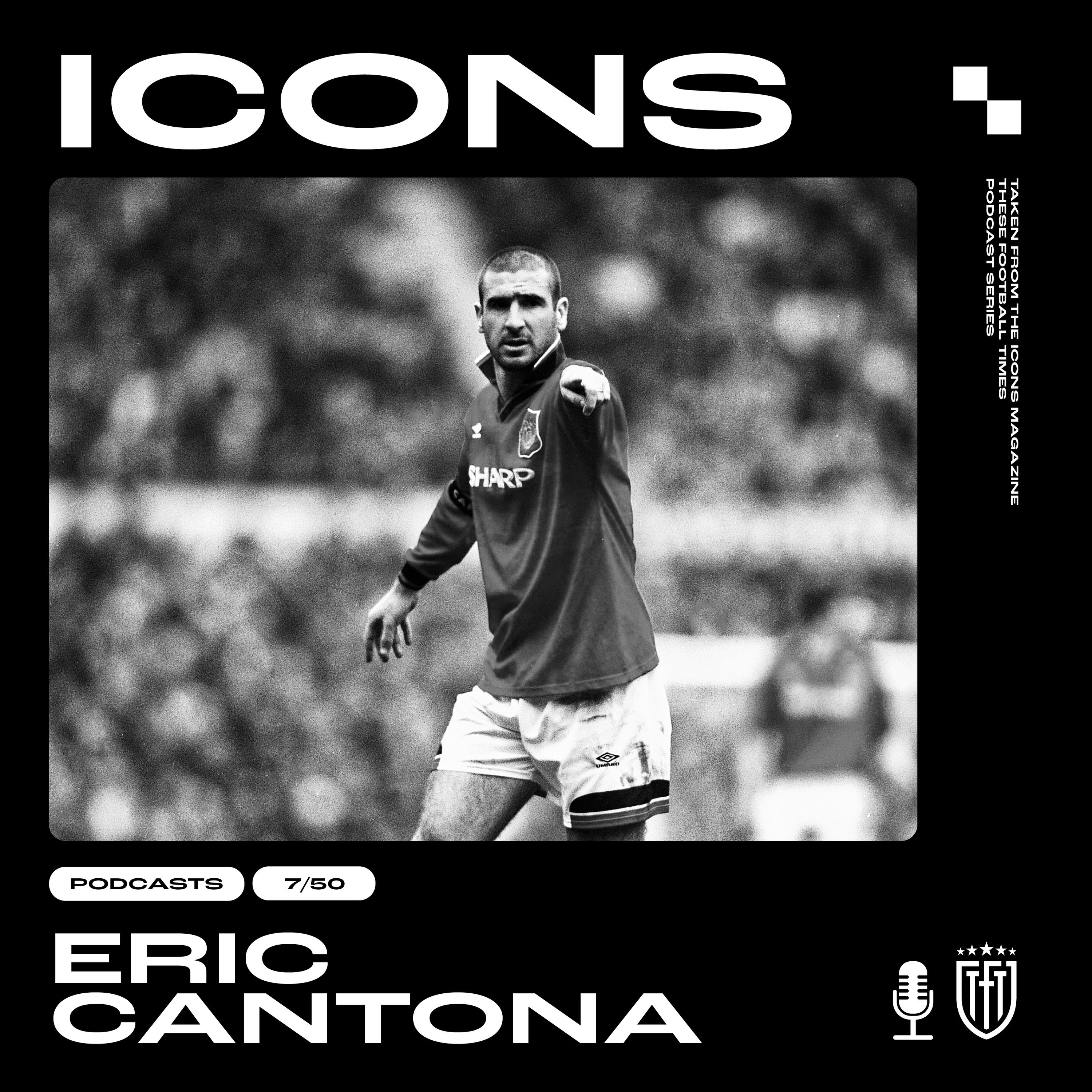
Welcome to The Lobb, your home of in-depth coverage and analysis by These Football Times, a movement of journalism you can trust. Each week, we endeavour to bring you the very best coverage of the game, exploring stories from the past and present with analysis by expert guests from around the world. Find more of our award-winning content online and in print. In the meantime, enjoy the podcast. Hello and welcome back to Icons, a podcast brought to you by These Football Times. We are celebrating another icon in our series today and we are recording this on video and the man opposite me, Gary Thacker, is wearing his collar. Hi.
for this next icon in the series. Gary, who are you talking about today? There's only one with a collar turned up, and that's Eric Cantona. For many United fans, like God, for other people who supported his, other teams, perhaps they look at a different point of view, but as iconic footballers go, even in a club that Manchester United had so many stars, this guy stands out as a true icon of football, certainly in that early era of the 90s. As a 90s kid, Gary, that I am, and having written a book about the 94-95 season, this episode could well go into the double figures in terms of hours, because I could talk about this player forever. But Eric Cantona was such an iconic figure in the Premier League, but...
as a bit of a teaser. Why is he so iconic and still remembered now? I guess he was so spectacularly individual. He had that presence about him that made him appear to be special, and it was special. But I think, you know, players who have joined teams and had success, it was, and I won't say he didn't do anything as a player because he did massive things as a player, but he also had that, he gave the rest of the team that belief. And they bought him for top safety from Leeds, as great players go. It was a steal. I think they paid a million pounds for him. It was almost a steal. And this is a guy who'd come to Sheffield Wednesday and had a trial under Trevor Francis.
And to France, I'm not sure, can he come back again next week? Well, Eric Cantona was a Skyder guy. He was not going to give you two chances to turn him down. And that belief in his own ability, the confidence, that winning mentality was very much what he took to Manchester United. And it was the final piece in the Manchester United jigsaw that made Ferguson side so dominant in that period. And his influence on 90s football in England was a little bit different to his influence in French football, wasn't it? He certainly made the headlines wherever he went, didn't he? He had one or two run-ins and things like that. So sort of in terms of context that Cantona are.
Why was he like that? Why was he kind of causing all these problems in France for various managers? And then obviously he comes to England and has two quite strict managers in Howard Wilkinson and Sir Alex Ferguson. What was the personality of a man like Cantona? That's a great question. I think strong is the first answer to what kind of personality he was. And he didn't suffer who he considered to be fools gladly. He was certainly, you know, the French's own enfant terrible in France. It was a classic moment. He was brought before the French FA as he was several times for misdemeanours. And rather than saying, you know, I'm really sorry he won't have the game, I think he would called all the members of the Discipline Committee a sac de mer.
That's a shit. And that didn't really help him avoid a suspension. But that was Cantona. There again, his international performances for France. He didn't play that many times. And perhaps he'd have been a bit more pliable, shall we say. But I don't think it's anything he'd ever change because that's who he was. And it's interesting to say what he came to England and certainly with Howard Wilkinson, a very uncompromising manager. He won how long he would have lasted at Leeds. He won the chap title, obviously, with Leeds in the first season there. Legend has it now true, which is I don't know, that there was a conversation going on between Wilkinson and Ferguson about signing Dennis Irwin. I think we should have signed Dennis Irwin.
He said, OK, well, basically, thanks, guys. And we thought, oh, what about Cantona? Would you be interested in selling Cantona? And Wilkinson said, I'll ring you back. I'll ring you back shortly afterwards. Now, there's talk that Cantona was having a relationship with one of the players who was here. That's true, I don't know. But you wouldn't be surprised if he was, because that was the sort of guy he was, I guess. But, you know, that was the sort of way you end up at Manchester United. And then, you see, if you put those two together, you think that ain't going to work.
But he ducked out perfectly. And as I say, his character, his personality, his presence was exactly the thing that Manchester United needed to sort of kick them onto the dominance that they had. In France, he was only liked by the fans of the teams he played for. And then not all of them, because he would fall out with people. But certainly, he had great success at Leeds and magnificent success at Old Trafford. And this time of year, they'll be singing, you know, five Cantonaise, four Cantonaise, three Cantonaise on the Stratford end. And that's how much he's still revered at Manchester United.
What I always find interesting about Cantona, when he signs for Manchester United, it looks like a genius move now. But at the time, it didn't seem like the last piece of the jigs. Obviously, United and Leeds had gone for the title in 91-92. Leeds had pipped them to the post. United had loads of games in hand and a big fixture congestion at the end of the season. Leeds had kind of been really strong throughout and consistent, took the title from them. And it sort of looked like it might never happen for Ferguson. And it was probably a bit of a risk, wasn't it? Actually bringing him to Old Trafford at that point, because it didn't seem like he was going to fit in with that. You know, Ferguson got rid of people like Paul McGrath, Norman Whiteside. He didn't want...
There was still quite a heavy culture of drinking, let's say, at United, but actually removed some players out of it. Well, Cantona's impact was almost immediate, wasn't it? I looked up some of his stats beforehand. So in that 92-93 season at Leeds, he starts 12 games, scores six goals and makes five, moves to United, starts 21, scores nine and creates 11. So he was such an impactful player, wasn't he, in that run-in to get Ferguson over the line. And that's when he changes United, wants to get that first title, he gets his feet under the table. And how does he kind of progress, I suppose, from there?
It's really weird. You're absolutely right when you say it was a risk. You look at players that Ferguson had and discarded. I mean, he was sort of a little bit out there, shall we say. I mean, Lee Sharp was the other one who was perhaps seen as a little bit of, you know, loose cannon, shall we say. I mean, not disrespect to Lee Sharp. But he didn't seem like a Ferguson sort of player. And yet, you look at players that he did have there who he persevered with. Roy Keane, for example. Derek had a strong personality. Perhaps, you know, you wouldn't see him buckled down. But, I mean, under Ferguson, it worked. He'd moved Brian Robson on. But there's other players there as well who had that sort of, David Beckham, who had a bit of a love-hate relationship with Ferguson.
Ferguson knew the value of him. And whether it was amazingly perceptive of Ferguson or it was just a little putt that worked, who can say? But, you know, as you say, the success he had there was phenomenal. And it's not just him as a player as well, as I say, he had that personality. And that's one of the famous goals against Leeds or Arsenal, I can't remember, when he chipped from the edge of the area and stood there just sort of looking around. That sort of belief, that was what he gave that team as well. They thought, this is, you know, there's nothing we can't do. And, you know, pretty much for a while, that was true. And one thing I suppose we'll need to talk about, Gary, in that...
Eric Cantona was in English football from 91-92 and he won the league title with Leeds. 92-93, he won the league title with Manchester United. You see where I'm going? 93-94, he won the league title with Manchester United. 94-95 is the only season that he didn't win a league title with Manchester United and unfortunately didn't finish the season with Manchester United either. We certainly saw the other side of Eric when his foot was in the chest of a Crystal Palace fan on that fateful January 1995. I mean, we'd seen him stamp on John Moncur and he'd been sent off for other things, but that really is...
I would probably say the only moment that we saw the French version of Eric Cantona, shall we say? Yeah, I mean, you say it's the other side of Cantona. I mean, to some extent, I think it's actually the same side of Cantona. It was the guy who doesn't put up with crap or what he perceives to be crap. And, you know, OK, I'm doing the court case. I don't know if the guy's not going to. The guy's not going to.
He apparently said, he apparently claimed that he said to Cantona, off you go, Eric, go and have an early bath. Don't be ridiculous, son. Nobody believes he said that. And he obviously gave Cantona, as fans are one to do, especially as, you know, star players in the opposition. And as the players would have walked past us, you know, small roofing, no, no, just Cantona was not that person, honestly. He was, you know, that sort of fierceness came out of him again. And, you know, and he did that, he did the famous Kung Fu kick. And I don't think really he ever regretted it. It was who he was. Strangely enough, Manchester United fans.
And a lot of other fans, I mean, I came to myself as one. I had a little bit of sneaking admiration for him not putting up with the crap that some players have to put up with. I remember when Beckham had the World Cup sending off and the terrible amounts of abuse and insults and curses that his family had to put up with. And he brought that cross and got through it. But Cantina was not the sort of guy to let that go. And I can understand why. And I can have a measure of sympathy and understand why he did it. And it was who he was. It was who he was. He had that fierceness about him. And it transported him onto the football field to make some great performances.
But outside the football field as well, he had excesses in other ways, shall we say. Yeah, and I think that season, especially for Cantona, is a real challenge. But as you say, he doesn't regret any of it. I'm sure he doesn't. Not one bit. And I think that side of him is actually quite important because that's what makes him who he is, doesn't it? And that's where, you know, in the series of someone being an icon, that's what makes him very different. And I always found it interesting, you know, after that, the fact that he had such an influence on the young players at United, that class of 92. And he was so supportive, wasn't he, of them and their journey. And you hear about extra training. Do you think...
I mean, I know that Class of 92 are very much in the media and sort of in the public eye now, but do you think that that side of Cantona has forgotten a little bit about how he was such an integral squad player and he was a real leader as well, wasn't he? Yeah, I think he probably is. Yeah, I think he's probably forgotten a bit in his, because there were so many other things about Cantona that were sort of more in the public eye, that sort of thing does get a little bit unfairly, unfairly forgotten. Yeah, I mean, he had that sort of, his personality didn't suggest he would be that sort of person, but he was. And as you say, you know, he did sort of help a lot of the young players coming through. Yeah, you know, you look back at...
Manchester United players. I've had some great players in the past. You know, going back to Charlton Best and Rory, Brian Robson, Ronaldo, Mark Hughes. I mean, you can't pick many, many players. I don't think anybody is celebrated this day as much as Cantona is at Manchester United. Nobody ever, I mean, I say, I mean, it's a different time, but you don't hear them singing about Ronaldo. You don't see five Ronaldo's, four Ronaldo's. But you do with Cantona because it was also something, that anger he had in, that fire he had in him, was something that fans could identify with because their passion was there for them as well as for him. So I think that he's certainly not the greatest player at Manchester United.
I don't know if he was the greatest player in the team he played in, but he was perhaps the greatest personality, the greatest influence, the greatest. I can't conjure up the right word, but it's the guy who had that ability to make the team a better team as well. But yeah, I mean, I think it's a little bit of a sort of dichotomy about the way Cantona's perceived. Great player, great player. Perhaps not the greatest player, or certainly the greatest player in Manchester United, but certainly a great player. But his perhaps importance was a little bit beyond that as well. And I think as well, talking about someone as an icon, that comes into it as well, doesn't it? You know, he was iconic for that team at that time with the collar up.
the number seven. They always remember that black kit that they're wearing, especially when he's in the crowd at Crystal Palace. He's got so many key moments as well. When he comes back from his ban, he scores a penalty against Liverpool, jumps up the sort of stanchion post behind the goal, swings around it. Then against Liverpool in the 96 FA Cup final, he scores that goal that seems to sort of arrow through about eight bodies and flies into the back of the net. How many titles did he kind of almost haul United over the line at times when it felt like every week it was Manchester United win, Cantona scores, Manchester United win, Cantona. There's almost that inevitability that maybe a team like a Newcastle didn't have.
you know, when they were challenging United with Ferdinand, Andy Cole and the like, they didn't have, and even Blackburn to a certain extent, I know they won the title in that 94-95 season, but no one in the Premier League had a Cantona type player. I do wonder though, What do you think the impact of his lack of international success has on his legacy maybe outside of the Premier League? Because we all know, as football fans of English football, and obviously other football, but primarily English football in the Premier League, he's held up as an icon, a great player. But actually, maybe it's that success on the international stage, certainly with United, because obviously in the European Cup, which was the Champions League, they weren't great. They were getting knocked out in group stages. He didn't really play for France. Do you think that impacts his legacy? Yeah, I think it does. Well, I think outside of the UK, outside of England, outside of the UK, and particularly outside of Manchester.
outside of Old Trafford's fans, shall we say. Man City fans probably won't be too impressed, but I think outside of that area, yeah, I mean, I don't know who he looks on with France, but I can imagine he's certainly not looked on as the same way they consider Zidane or somebody like that. I think, yeah, as I said earlier, he's the kind of player who's loved by the fans of the club he plays for. But fans of other clubs perhaps have this sort of, well, understandably, a less loving approach to him. He mentioned something that sort of triggered my mind. The turning up of the collar made him stand out. It was...
He wanted to show, I am Harry Cantona. I ain't these other guys. I'm Harry Cantona. And that sort of dominant personality that, you know, I'm the guy. I'm the guy. As I said, you know, that really works for Manchester United in that team. And the personality, you know, that arrogance about it. I can't think of another footballer in England who had that sort of turn the collar. And I don't know why he did it. I don't know why he did it. It's what inspired him to do it. But I can understand the sort of pleasure he got from doing it. That sort of, you know, it's a statement. It's what it was a statement of, you know.
Some people might have a headshade or Beckham have a Mohican or whatever, whatever they're called. But that was Cantona. I am Cantona. My collar's turned up. You know who I am. And for him, that is his iconic status, isn't it? The impression that he gives to other people about his impression on the pitch, the way he interacts with the fans, the way he interacts with the players, the referees, all of that comes within it, I suppose. And maybe this is quite hard to describe. He's another player who is quite unique in his playing style, isn't he? Because how would you describe his playing style?
or his position, or his kind of responsibilities that he had on the pitch? His responsibility just to make the team win. It's a stupid thing to say, but that's how we would see it. I'm the guy. I'm the guy who's going to make the team win. He's a nine and a half, wasn't he? He couldn't say he was a central striker, and yet he had the ability to score goals. I mean, he's a big lad. There was no sort of shrinking virus physically. I mean, certainly not emotionally, but certainly physically as well. But he also had the skill to be the guy, correct? You can go up to the figures there. As many assists as goals. It'd be a pleasure to play alongside.
as long as you don't let him down. Because I bet he's the kind of guy, you know, if you later have a chance and you miss one, he might get away. If you miss two, he's going to give you a right earful. So, yeah, I mean, I think he had that, he was the kind of guy who, you know, players wanted to play with him as well because he created chances. Although Andy Collard had a fair enough time with him. That system didn't really work. Whereas with, well, look, that Dufftel and I said, it didn't really work with Camden. But, you know, he had that ability to, as I say, to make players play better. And perhaps he was, I don't know, it always sounds a bit weird to say, but where there was a fear of letting him down because he was the guy who was...
He was going to create things. He was a winner. Define what he was. He was a winner. And he didn't tolerate things when they didn't go well for him. And this happened so many times. When he thought he'd been wronged in France, he didn't stand for not being a winner. So, yeah, I think his task was to make the team win games. And I think he took that on and thought, I'm the guy to do this. This is my job. This is what I do. And I will do well. And it did. And it's interesting to look back on it. And they're going to one of these stories that may be apocryphal rather than true. But apparently one of the times he was packing it in, he disappeared to Paris.
Rumour has it, whether it's true or not, legend has it to say, that Ferguson went on the back of a motorbike around Paris trying to find Cantona to persuade him not to pack in. Now, I can't imagine, if that's true, I can't imagine that Ferguson doing that for any other Manchester United player. And that was the sort of value that he had to the team. And I think that's why you sort of described him as that nine and a half. And I think Ferguson did whatever he could to fit Cantona into the team, didn't he? We were starting to see that more continental approach of a withdrawn second striker.
You know, it wasn't a little and large strike force where you knock it to the big man. He knocks it, because like you say, Cantona was a big man. It wasn't a knock it to Cantona. He'll knock it down for an Andy Cole or, you know, someone else to run to. But he wasn't a 10.
as in he created a lot of goals, but he wasn't a passing creator that you might think of a typical number 10 or a Brazilian number 10 who might have been small and blessed with incredible dribbling ability. He didn't have a lot of pace, so he wasn't kind of a number nine and behind. He was such a hybrid player. And credit to Ferguson for maybe seeing that in him, that he could actually fit him within that system they had at United, because obviously they had Kanchelskis and Giggs, who obviously were just rapid, and they could get up and down like nobody's business. And then Insane Keane behind them.
They basically played the same as four central midfielders, those two, because they covered every blade of grass. They were box to box all the time in that sort of classic 90s fashion. And I love the fact that Ferguson just let Cantona be Cantona. And like you said, Gary, a little bit was kind of, he didn't suffer fools and maybe he didn't think Ferguson was a fool. So actually, you know what? If you give me this little bit of leeway.
I'll pay you back in spades. I'll pay you back in league title. Because a lot of the X-Men United players say, you couldn't be late unless you're Eric. You couldn't train hard. You had to train hard unless you're Eric. You had to do your sprints or whatever unless you're Eric. And very much, it was kind of, if you're Eric, you could get away with everything. And maybe, you know, Ferguson and Cantona needed each other. Maybe he helped Ferguson a little bit with some of these younger players coming through saying, you know, maybe don't be as hard on them all the time because, you know, when I was young and people were hard on me, I didn't like it and I reacted and, you know, he kind of took them.
took them under his wing a little bit, didn't he? So I kind of, I like how he was used, I suppose, at United. If we jump forward, I suppose. Is there a player that's similar to Cantona in the modern game in terms of style or position? Or where could you see Cantona fitting? I mean, to be fair, I know it's an imaginary question, Gary, but I'm not going to put Cantona in this Manchester United team because I would not do that to him. You'd make him a better team, that's for sure. That would be awful. Imagine Cantona going into the mess that they'd be in at the minute. What kind of modern system or player is he kind of like, do you think? That's a good question. I mean, I guess, I don't know. I don't need to read this one. There's players who play a similar role. But I think, as I said, playing...
The role he played was just a small part, not a small part, but not the complete story of Eric Cantona. That sort of attitude of his personality was a big thing as well. And I don't think there's a player now. And I think a lot of it may be because clubs don't want that sort of player now. You know, we're talking about, you know, you can see an amazing player. We've got a player at Chelsea called Palmer who just looks amazing. But not the mentality that Cantona had. And the fact that afterwards, I mean, after he retired, he did some films. Not so long ago, I mean, 12 months ago, my daughter's a massive United fan. And he did tour singing.
And she went to see him. I mean, this isn't, you know, this isn't sort of a guy who said, I'm going to finish with football now. I'm going to commentate on Sky or work on talk sport and talk garbage for half an hour. I mean, this guy wanted to do other things. And even now, even now, I think it's on, it might be Twitter. I can't remember. There's an advert that comes up and it's Cantona. This is today. This is, so we're talking 30 years after this guy was sort of disappearing from football and his personality. You know, it's different. And this was film about it. It was there about, you know.
whereas Eric was something who was Eric Cantal. And if it appeared in films, this is the personality of the guy. This was a big personality. And I don't think footballers today have that. There might be someone that I can't think of, but I think the modern game doesn't tolerate it as much as it did. Certainly Ferguson did in the 90s or the 90s. I think you're right, Gary. I think he was quite a unique player because fundamentally he was a forward. He was there to get goals and, like you say, win the game. But actually, when you look at the game now, there probably aren't many nine and a halves out there. You're either a box player, you're a striker number nine.
or you're an old-fashioned number 7 or 11. You're a winger that cuts inside and tries to score goals. Or you're kind of that playmaker, Kevin De Bruyne type, whereas actually, I'm trying to think of modern football clubs, thinking about Real Madrid or Barcelona. He's not a Jude Bellingham. He's not a Vinicius. He's not a Jamal. He's not a Lewandowski. He's not any of those players, is he? Even at the time when Dennis Bergkamp arrived in England, Bergkamp was a second striker. Like you could say, Kant now was a second striker, but completely different styles of football, even though they're sort of technically filled.
Sort of a similar role, didn't they, for their clubs? But, you know, like you say, that modern equivalent maybe doesn't exist. Have you got a lasting memory of Cantona? You talked earlier, Gary, about the chip, the chip with the collar up and that look around Old Trafford. I think that's the one that always sticks in my mind. I was saying, my daughter was a man in our defence, so we watched a lot of Manchester United games on Sky, because obviously that's what you want to do. But that was the one that sort of sticks in my mind. And that speaks of Cantona, the goal. Not only the goal, because it was exquisite chip. Was it Arsenal? I think it was Arsenal. I can't remember.
I remember it because it was Sunderland. Was it Sunderland? Oh, well, you were doing that catch, yeah. I mean, the skill to score the goal, but then this sort of presence just to stand there, not run about, I'm not doing that. I'm not running about. Look at me. Look at me. And he just looked that sort of, I mean, yeah, that's, not only was he an icon, Rob, he knew he was an icon as well. I have a weird theory about that goal that could be completely wrong. I think that's the moment he knows he's going to retire at the end of that season.
because he's got that sort of adulation, that moment from the Old Trafford crowd and he just kind of thinks, you know, this is me. I'm not going to get any more than this. I'm not going to get any younger. I'm not going to get any better. I'm carrying this team to like another title and then that's it. And I always wonder about, I mean, I could be just absolute pie in the sky, but I just kind of feel like it's such a moment of where you're taking everything. You very rarely see footballers actually do that in the moment of a match, but maybe we can think that he did that anyway.
That's Eric. That is Eric. And that is where we're going to end. That is Eric. And that probably sums it up better than anything else. A true icon of the 1990s, still an icon of Manchester United's history. We will be back with more icons in these Football Times series. But from me and Gary and Eric, we'll see you next time. Many thanks for joining us today on The Log at these Football Times production.
For more of our content, check out our award-winning print magazine featuring some of the game's foremost writers, artists and photographers exploring areas of the game rarely covered in high-end print. For now, we look forward to you joining us again soon.