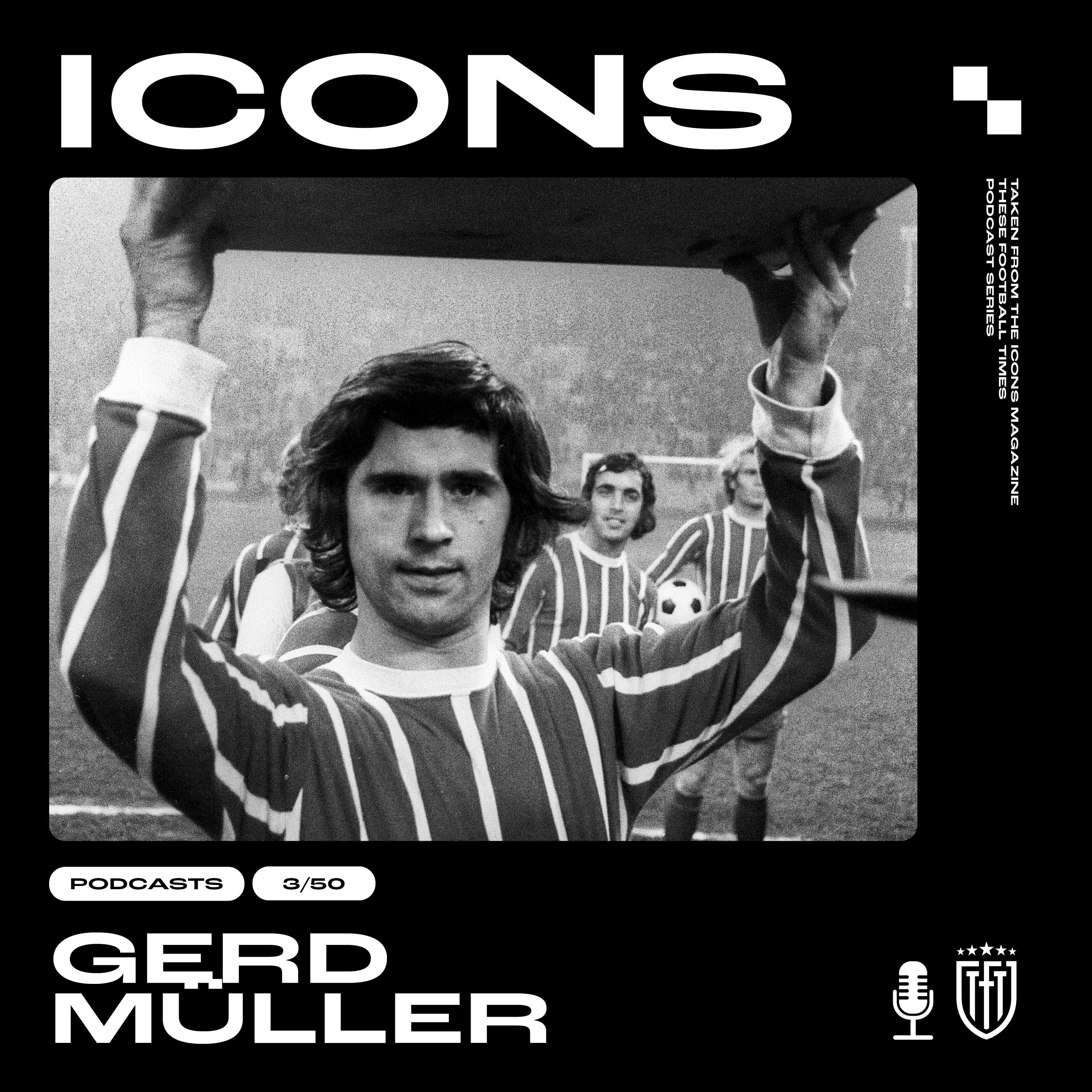
Welcome to The Lobb, your home of in-depth coverage and analysis by These Football Times, a movement of journalism you can trust. Each week, we endeavour to bring you the very best coverage of the game, exploring stories from the past and present with analysis by expert guests from around the world. Find more of our award-winning content online and in print. In the meantime, enjoy the podcast. Hello and welcome to Icons, a podcast brought to you by These Football Times in celebration of our new magazine of the same name. We've got 12 captivating episodes. We're going to dive deep into the lives, legacies and magic of some of football's greatest figures. Players who didn't just shape the game, but transcended it, becoming cultural icons of their time. And speaking of cultural icons, we haven't got one on the podcast this week, but we do have Dave Bowler chatting about some icons. Dave, who is the player you are going to be talking about today? Well, today we'll talk about Gaden Muller, shall we? One of the greatest goalscorers, possibly the greatest natural goalscorer of all time, I think.
Let's do it. And we're moving away from all these fancy number 10s with the flamboyance and dribbling and all that stuff they do and wowing the crowds and stuff to a sheer goal-scoring machine. I've seen a bit of Gerd Muller, actually. I remember around the, I think it might have been World Cup 98 or maybe just after, BBC did a programme on all the Golden Boot winners. And it was brilliant. I remember being a kid and watching, yeah, it was Lineker and Jules Fontaine was on it. And you learn about it. And then you look at Gerd Muller as a striker of that era who was kind of one of the supreme goal scorers at that time. What was it like probably for Muller at that time? Because obviously, if you think about modern football, this...
Type of striker probably is quite rare at the moment. He was very much a boxing goal scorer. What was kind of the context of Muller in his era, really? He was the machine. I mean, I suppose in an English context, you would think of perhaps Jimmy Greaves, sort of slightly earlier than that of the previous decade. But, you know, you have to say he was the typical post-war Germanic machine. You know, he was everything that post-war Germany and the reconstruction of West Germany, as he was then. And the reconstruction after the war was about, you know, I mean, he was...
He was machine-tooled. He didn't look like a footballer. He didn't look like an athlete, but he looked like they just chucked him out of the box on a Friday night, by and large. I mean, he was a short, squat fella. He didn't have any of those sort of elegant attributes that you put against the great footballers, particularly some of the ones we've talked about in this series. But put him anywhere near the goal, and there was generally only one outcome. I think he was just absolutely ruthless. And I suppose if you're going to be a great finisher and a great goal scorer, you've got to have complete self-belief. I don't think, you know, you see some players that get through and it's a one-on-one, and you can see it going through their head.
What am I going to do now? I'm going to go around him. And then by the time they've decided what they're going to do, the chance has gone. I don't think Gerd Muller had any of that sort of reflection at all. I think he just thought, right, the ball's here. The next day, that's where it's going. And that was Gerd Muller, really. He was just, he was one of those, you know, people say it a lot nowadays, but genuinely with Gerd Muller, you never, ever thought he was going to miss. Muller in the area, it's a goal, that's it.
And his goal-scoring record is phenomenal. Wherever you look, I mean, it's just... It's ridiculous. Goal after goal after goal. I mean, I always... It's an interesting one when you look at some of these players because I always look for, especially, I mean, I know probably with Ronaldo or Messi, you're kind of... I'm not going to say spoilt, but you've got two players who are doing this sort of on the world game. When they score more goals than appearances, I just think that immediately elevates you into a completely different level because they talk about... They always just said that if you get one in two, one goal every two games, you're a top striker. I think, that kind of makes sense. You have 40-game season, 20 goals. You've probably got a striker with you.
12, 14, sort of your second striker. You look at Muller, you're like, oh, he's got 40 goals in 34 games one of those seasons. Oh, he got 66 goals in 49 games in one season with all the European games and cup games or whatever else. You look at him in the World Cup 1970, 10 goals. You think, well, he definitely didn't play 10 games in the World Cup because there's never been a World Cup with that many games maybe until now. But that sort of frightening record is just phenomenal. I always think with Muller, obviously they played, I mean, perfectly to his strengths, whether that was a Bayern or whether that was a Germany. Was he very much a lone striker or was the kind of...
a striker that supported him or was it more that he played off wingers because obviously he was phenomenal in the air and basically anything around the six yard box he'd gobble up what was his kind of role in comparison to the other players on the team how he sort of fitted in with that he was basically the focal point up top wasn't he I mean you know you talk about those numbers and we've got to throw some of them in 68 goals in 62 caps for West Germany he scored 34 goals in 35 European cup games 65 in 74 games in Europe altogether for Bayern 365 in 427 Bundesliga games now I mean that is just You have one season doing it, that's great. But that's a career where he just scores every game that he plays virtually. It's absurd. I think going back to 1970, Uwe Sealy was still in the team. I suppose at that point he was probably a number 10-ish kind of a player. But it was always that Muller was the one, the focal point. He did play on his own. He was the greatest goal poacher in and around the box. So anything loose in the box, he would be there. But it wasn't just that. He wasn't particularly quick over distance. He hadn't got great stamina in there. But his acceleration over five yards was absolutely lightning.
and it would just take him away from anybody. And if you can do that in the box, you know, you're going to score goals. And that, again, it is the same as Jimmy Greaves. I suppose you talk about, you know, Ronaldo and Harry Kane and people like that now. You know that they are the danger, man. You know that he's going to score goals given half a chance. You think, right, OK, well, what we're going to do is we're going to put a couple of blocks on him and we're not going to let him get on his own at any point during 90 minutes because we're going to mark him out of the game completely. And then he's half-time and twice he's managed to find himself in five yards of space to score.
I don't know how they do it, and that is the magic of a Gerd Muller or of a Jimmy Gribbs. You look at some of the goals he's got, I mean, there's not too many spectacular ones, but so often he's on his own and he's anticipated where that ball is going to go. He's dropped off a defender or, you know, Atletico Madrid, one of the European Cup finals, he's just on his own at the back post, on his own, Gerd Muller, in the European Cup final. You know, one torch and bang in the back of the net. I don't know what it is in these players that they manage to create that space. You know, the goal in the 74 World Cup final, he seems to have forever.
to stick that ball in the back of the net. It's the World Cup. Why are you not marking him within an inch of his life? And of course they were, but that's why he was a miracle. That's why he's an icon. He's a magician, really. He creates space where none exists.
And I think that's the thing that you can't maybe understand if you've not been at that sort of elite football level. When you think all of our tactical work, all of our training, all of our analysis is telling us he is the greatest goal scorer of this era. Please never let him be free. And you watch the highlights and you think, hang on a minute, he scored two of those goals and he's got no one near him. How has that happened? But I think someone like Muller, it was that movement and that sort of deafness of movement, I think, which is quite different to other strikers of that era in the sense that he didn't need a lot of time and space to score. But actually he could find the time and space when he needed it.
And I think that's where, and obviously we've talked a lot in this series about players who could, and we'll talk about at the end, how they could transfer into playing football in different eras. And I always feel like someone like Muller could just fit in at any time because his skill was, I will find space in the box and I will score. And I think one of the things I liked about him and thinking about him in this era is how different he is to other players who were famous around that time. So obviously the 70 World Cup, he obviously gets the golden boot and scores 10 goals. But you've got people like Pele, Jairzinho, who are completely different style of players. And there wasn't that kind of...
consistency in style, I suppose, at that time. And Muller really was part of that machine, wasn't he? Did that stretch, that stretch, I suppose, to Bayern and Germany as well, didn't it, for Muller? He was very much kind of that machine-like striker for both teams, wasn't he? Absolutely, yeah. I mean, machine, when you use it in the context of a person, of a football or whatever, it feels like it ought to be an insult. But in the case of Muller, it definitely is not an insult. He is, you know, perhaps not a machine, let's call him a Swiss watch, you know, a fine movement, a dual Swiss watch or something. I don't know quite how to put it, but I think as well that space thing comes from absolute belief.
Because again, there's no hesitation in anything that he does. When the ball comes to him, he knows what he's going to do before it's got to him. And so there's no, I've got to take a touch and then I'll have a look up. And by the time you've done that, you are covered in defenders. He's made his little, he's taken his step back, created that half a yard. And then as soon as the ball comes to him, right, that's where that's going. And that's the end of the story. You know, you've got to remember, of course, he was in teams with players like Beckenbauer and Oberath and Gunter Netzer later on. And, you know, people that could find him, great players that could get the ball through to him. But it's...
It's just that combination of things. I think that acceleration that could take him away from a defender when the ball was played through over the top or a through ball. So he was quick and onto that. And then once he got away, he was away. But in the box, it is supreme self-belief. Absolute confidence. I don't think there was any... You look at some strikers and they'll have six or seven games when they haven't scored a goal. It's all introspection and they're looking deep into themselves. What am I doing? And they're thinking about, well, perhaps if I try doing this. I don't think there was any of that with Gerdman. I think it was a very simple method that he had.
Give me the ball, I'll score a goal. And I don't think he ever wavered. 1972, again, European Cup, 11 goals he scored. They got knocked out in the quarterfinals. And this is not the Champions League where you play in a bunch of games. I think that's three rounds of football. That's six games, I think. 11 goals. It's also, I mean, we are going to talk about this later, but it is very difficult to compare across eras. But I think in the 70s, it was by and large quite a defensive era. The nature of football did change quite a lot. The Italians sort of brought it in in the 60s, the sweeper and Catanaccio and all of that. And by and large, football became a bit more.
a bit more brutal, perhaps, I think, in that period. And there was certainly more organisation, much more thinking about the defensive set-up than Real Madrid when they were winning the first five European Cups. I mean, teams then played, they just played, and it was probably easier to score goals then. It may be easier to score goals now with the way that you don't have the tackle from behind. Strikers are more protected, defenders can't lunge, and they are more likely to get centre. So I think not only did he score all these ridiculous number of goals, he scored them at a time when it was very, very difficult to do it. And as I say, nowadays, if he turned up looking like he did.
And, you know, they got the sports scientists at him and they weighed him and measured him. Well, no, he's never going to do it. But, you know, data isn't everything, is it? It's certainly not. And I think the 70s, I know when you did the 70s decade series, certainly about English football, it was almost that Maverick era, wasn't it? It was who were the players in your team who were different. And those players that were different are the ones who were probably going to win the trophies. I do find it kind of, I don't know, for him, playing for Bayern Munich, who had a lot of the players who were in the West German national team as well. They had that relationship and that.
system of we know how he plays we can find him all the time because almost you do have to almost play a specific way with Muller because of the style of forward that he actually is not that that's a negative thing it's just more the fact that we've got this efficient you know Swiss Army knife forward who can score headers score tap-ins he'll score from 8 yards 12 yards 10 yards or whatever and then you can kind of build that team around it looking at looking at Muller obviously Bayern I mean you look at we talked about statistics before about his goals you look at actually what he won as a player in that like 10 year prime that he has I mean it's frightening They won, obviously, four Bundesliga titles. He won three European Cups in a row. He won the World Cup in 74. He won the European Championships in 72. He was Golden Boot and Ballon d'Or in 1970 from, obviously, the Mexico World Cup. He won a lot of Cup competitions, Cup Winners Cup, Intercontinentals, all kinds of stuff he won. It's kind of, I almost asked you, what was the peak period of Gerd Muller's career? Well, actually, he probably has about an eight-year peak, doesn't he? Probably if you're looking at, like, I don't know, maybe back end of the 60s, so maybe kind of 67, 68 is when that sort of goal scoring sort of jumps off even more so than it had been before.
to sort of about 76, 77 before he ends up moving on. It is rare, isn't it, for a striker like Muller, who is getting roughed up by defenders, let's be honest. He was getting hacked, he was getting shoved, pushed, elbows, stung his toe, whatever they're doing to him. It is crazy that he has this big, huge peak, isn't it? And he wins everything in that period of time. And he wins everything because the teams he was playing for had got Gade Muller as much as anything else. They'd also got Franz Beckenbauer, which is quite useful. But yeah, I mean, the physical thing is such an important element to it. He was getting knocked away, but I mean, he was a big sort of...
Not tall, but he was sort of a ball, wasn't he? I mean, that was his build. He was physically robust, I'd say, nowadays. So a lot of challenges kind of bounced off him. But he was also, within that, he was athletic. I mean, you know, managing to get that goal against England in the 70s. I mean, that's a peculiar goal to score. It's an athletic goal to score. You know, you kind of always have this impression of Gerard Mullen, because of the goals that you see, by and large, that he was always six, seven, eight yards out, and that was how he scored his goal. But he scored all kinds of goals. And it's just, as you say, over that period of time, to get through it, to not...
to not get any really significant injuries that put him out for anything. I mean, let's face it, everybody on the other side wants to, you know, take an axe to him, basically. I mean, that's pretty much the only way you're going to stop him. To ride all that. And again, that's the low centre of gravity, I suppose. You know, it gave him that ability to ride tackles and get beyond them. So, you know, he sort of protected himself in that way. As you say, you know, we've been spoiled over the last 15 years, whatever it is with Messi and Ronaldo. I mean, that's a period in football. It's just insane that those two players should score, you know, so many goals over such a long, sustained period. But prior to that, I mean, you know, not many.
on ground for that length of time. Muller was one of them. You look back now, and I mean, Germany, West Germany, they've had prolonged periods of success in all kinds of eras. But at that sort of point, that kind of 66 to 74, which again was pretty much coincides with Muller's prime, certainly post-66, they were probably the most consistent team in world football. I don't know if it's dangerous or frightening, but they were the team that you wouldn't want to play against because you would always feel that they could find a way of winning games.
World Cup Final 1966, Semi-Final 1970, European Champion 72, World Champion 74. such a powerful combination of players. But we've seen lots of great teams. Think back to 1982 Brazil. They've got this lump Serginio up front. Now, if 1982 Brazil had got Paola Rossi, or if 1982 Brazil had got Gerd Muller, 1982 Brazil wins the World Cup in all likelihood. And that's, for all that we talk about, players in every other position, however important they are, it's the fellow who puts the ball in the net that really counts in the end. Now, one or two teams in history have succeeded without having a prolific goalscorer, but it's not very often that that happens. Whereas if you've got somebody who just absolutely... I mean, if you're sitting in the dressing room before a game...
And you're looking at Gerd Muller putting his socks on, you think, OK, we'll be all right. Because he's going to score three. So all we've got to do is make sure we don't let him more than two. That's quite a comforting place to be in. And again, if you're playing in a game and you're losing one over ten minutes ago, OK, find him, find him, find him. Something will happen. Something will happen. And in the rare instances where they were losing, it did happen. You made it happen. And that's why he's an icon, why he's a legend. Do you think there's an argument to be made that that German team and probably that Bayern team is a little bit forgotten in football? Because you've got England 66, which everyone talks about, obviously.
well, English people talk about. 70, you've got Brazil, because, you know, the football they played. 74, everybody goes straight to Cruyff. And you forget, I actually spent a lot of my younger years thinking that the Dutch won that World Cup. Because everybody talks about Cruyff and they talk about... And they look and you go, hang on a minute, they got beat. Like, they lost. And then 78, obviously people remember Kempes and Argentina and all that sort of stuff. So actually, there's probably a little bit of time and history there where West Germany probably didn't get thought of that highly. Maybe because it was the efficiency, maybe it was because of the style of play. You know, they weren't kind of a big bunch of mavericks, didn't have a Pele or a Cruyff.
who were actually changing world football at that point or whatever. What do you think Muller's legacy is from that era, even just as a goalscorer or a sort of style of player? I think you are right. I don't think West Germany got the credit for how good they were at that point. And as you say, it is Cruyff. It is Pelé's World Cup. It is Cruyff's World Cup. It was Ajax who won the three before Bayern. And I suppose we have to factor in the fact that it was still 25 years after the war. But support for West Germany was still fairly grudging at that stage. And also, as is the want, with teams that win everything. We don't like them.
in the end. I mean, we've talked about this in various podcasts over the piece. That sort of frailty. In the 90s, you talked a lot about Newcastle. It wasn't nothing. But we all remember Newcastle because they were exciting. And in the end, we probably remember them more because they didn't win. We probably remember Brazil 82 more because they didn't win. Because there's something, I don't know, something in human nature that likes that vulnerability we don't like, particularly in this country, we don't like success, success, success all the time. So I think you are right that there is a way that they are underrated. I mean, his legacy is the numbers, isn't it? You can't get away from the numbers in the end. They are just.
unbelievable that, you know, Ronaldo wouldn't get to those sort of numbers in a tougher goal scoring time, in a tougher goal scoring climate, I think. In terms of people trying to emulate him, I think it's, I think it's difficult because I think you've got, I mean, you've got to be, I mean, a lot of these icons, they're born, not made. I mean, that's why they're special. I think it's particularly the case with Gerd Muller. I think, you know, he was clearly born with this ironclad self-confidence and belief in his ability. He must have been, you know, you can't, how many psychologists do you go, so you can't graph that onto somebody. His physique was perfect for the time, you know, that powerful ball.
structure he'd got and the defenders bouncing off him and that acceleration you can work on acceleration but again that's a bit of a gift as well so I mean it was difficult to emulate in terms of would he fit into a modern day team I don't think there's enough money in the world to buy Gerd Muller if he was not going to can you imagine somebody it's Erling Haaland isn't it really that level of goal scoring and I think one of the things sort of from a legacy point of view is the fact that his goal scoring record stood for such a long period of time. I think Lewandowski only broke the Bundesliga goal-scoring record in the last sort of three years to get over 40 goals. He got 41. And then obviously he held the record for the most goals in a season for sort of club country. And that was only broken by Messi, which, you know, people will argue that Messi is probably the best player, let's say, maybe to ever play the game. So the fact that his goal-scoring record has only been broken by someone playing for an incredibly dominant buying team. Well, everything went through Lewandowski even more than everything went through Gerd Muller. And obviously Messi, I mean, there's probably never, ever...
going to be a player who's going to score and assist and dribble and win as much as Messi has, possibly for another 30, 40, 50 years. Maybe because we can't say the records will stand forever because people thought that when Pelé set records or the way that Muller played, you know, it always does happen at some point. It's just going to be a very, very long way off. You mentioned Haaland there, Dave. Are there any other sort of modern comparisons? Because I'm not going to make a grand sweeping statement and say the number nine is dead in football, but certainly the number nine that we sort of recognised maybe even like post-2005, post-2000 maybe. Is there anyone out there maybe who's similar in sort of style to Muller?
There doesn't seem to be that sort of out-and-out goal scorer anymore. Obviously, Harland is a different kettle of fish, but by the way, there doesn't seem to be somebody who just does that. I think, again, the way football's adapted and evolved, you want players to do two or three things now, don't you? You don't want him just to be, he scores goals. You want him to be, well, he'll come and join in, he'll come deep, or he'll stop him playing from the back, he'll trigger the press, he'll this, that and the other. So I think, in fairness to modern-day players, they don't have that.
Same opportunity, that same single focus. Again, Muller was there to score goals and he wasn't there to do anything else. Whereas most players, even ones who do play as the striker, they've got a couple of other jobs that they've got to do as well. And that takes you every deal. If you are closing down a goalkeeper, closing down a centre-half or whatever it is, that's taking up a bit of that spark that you want to have when you're in the box or when you're running onto a through ball. So I think it would inevitably be a slightly different game that Muller would have to play now. And that would probably affect his figures slightly. Although, that said, it is easy to score goals now, I think.
It just is, you know, with the way that the game has changed a bit, you know, physically. But if you had a game more than a, if you were a wise manager, you would say to him, don't worry about this tracking back. I don't want to see you any further back than the centre circle, frankly. Just go and score me, you know, 50 goals a season and that'll be fine. Thanks. Thanks very much. That move towards an ultimate team game is probably what's changed football quite a lot, hasn't it, in the last 20, 25 years. Not to say that it wasn't a team game.
in the 70s or the 80s or 60s or whatever. It was just, you had a role in the team and you did that. And often that role might be, just be yourself. Whereas now that role is, you can't be yourself. You can be what I think that you need to be. And if you've got those attributes, do that. It's like even someone like Mo Salah, isn't it? Liverpool scores tons of goals. He's still playing in that role, in that team. And if Mo Salah doesn't play well in that role, they generally don't play well. Because actually all the integral parts are kind of all linked together. But I mean, I appreciate he played with some absolutely phenomenal players, Muller for Bayern and for West Germany. But he had to be brilliant too. Because actually, if he wasn't brilliant, he'd have been gone. Because all the other players around him were some of the best that they've ever played. I know that...
People think he's probably the greatest striker that's ever been, maybe, or certainly one of the greatest number nines. There's probably two or three players who are pure number nines. I mean, not kind of someone who can score a lot of goals from the right, the left, around the box, because there's lots of those. But actually, he's a pure number nine. Maybe he's one of the best. He's up there with Brazilian Ronaldo as an out-and-out goal scorer, Jimmy Greaves, from an English perspective. Although, perhaps not so much at international level, but certainly domestically. And I suppose...
Cristiano Ronaldo, the way he changed who he was and what he did, you know, latterly in his career around Madrid onwards. But I mean, he's got to be in the conversation for the best, you know, the best simple goal scorer that there's ever been. Yeah, 100%. I think like we said, I mean, you look at the players who scored over 500 goals in their career, in their lifetime. Two of them are Ronaldo Messi, who one of them started as a winger. The other one is not quite a number 10. He's not a false nine. He's not an attacking midfielder. He's not a winger. Like, no one even knows. Like, what does Messi do apart from scoring and creating all the time? Like, actually, if you're putting him on a, I don't know, a football manager or a championship manager tactics board.
Where does he stand? You don't quite know. Probably same with Pellin. There's people like Romário and Pushkas, obviously. Pushkas is one of our icons in the series as well. It's probably someone like, maybe even like a Lewandowski, but again, he's a little bit different again because he's maybe a little bit more of a target man type than Muller. Muller was probably a classic poacher as well. I know he was great in the air, but Lewandowski again, a little bit different. But you look at some of the names who are on that list who've genuinely scored an absolute ton of goals and he pretty much is quite unique even amongst that list as well, isn't he? Yeah, again, people who didn't see Muller closer eventually took his record for the most goals for Germany and he took him twice as many games.
to score the same number of goals. And Closier's not a bad goal scorer, really. So, I mean, that tells his own title, doesn't he? I think he very much tried to play the Gerd Muller role, didn't he? No, he was, I'm only playing in the box. I'll do great in the World Cup competitions. I'll be a good goal scorer in club football. But actually, I know my place. I know my role. Obviously, he's nowhere near as good. He had the same sort of function within that system as a, you know, I will close, literally, I will close games out for you. I will get you the goals that get us the wins. And obviously, they're a very successful period of time that he had in that one.
Right, that is the end of this chat about Gerd Muller. And please do go find footage of the 70 World Cup and see some of the brilliant goals. A bit of pain for England as well amongst that. Just sprinkle that one in. And do have a look at that Bayern Munich team. Even if you just look at the line-up and look at some of the names and you realise how important some of those people are, certainly in the modern game or have been in the last sort of 20 years as well. So Dave, thank you for chatting us through Gerd Muller and his iconic status as a footballer. And for listeners out there, we will see you on the next Icons. Many thanks for joining us today on The Lob at these Football Times production.
For more of our content, check out our award-winning print magazine featuring some of the game's foremost writers, artists and photographers exploring areas of the game rarely covered in high-end print. For now, we look forward to you joining us again soon.