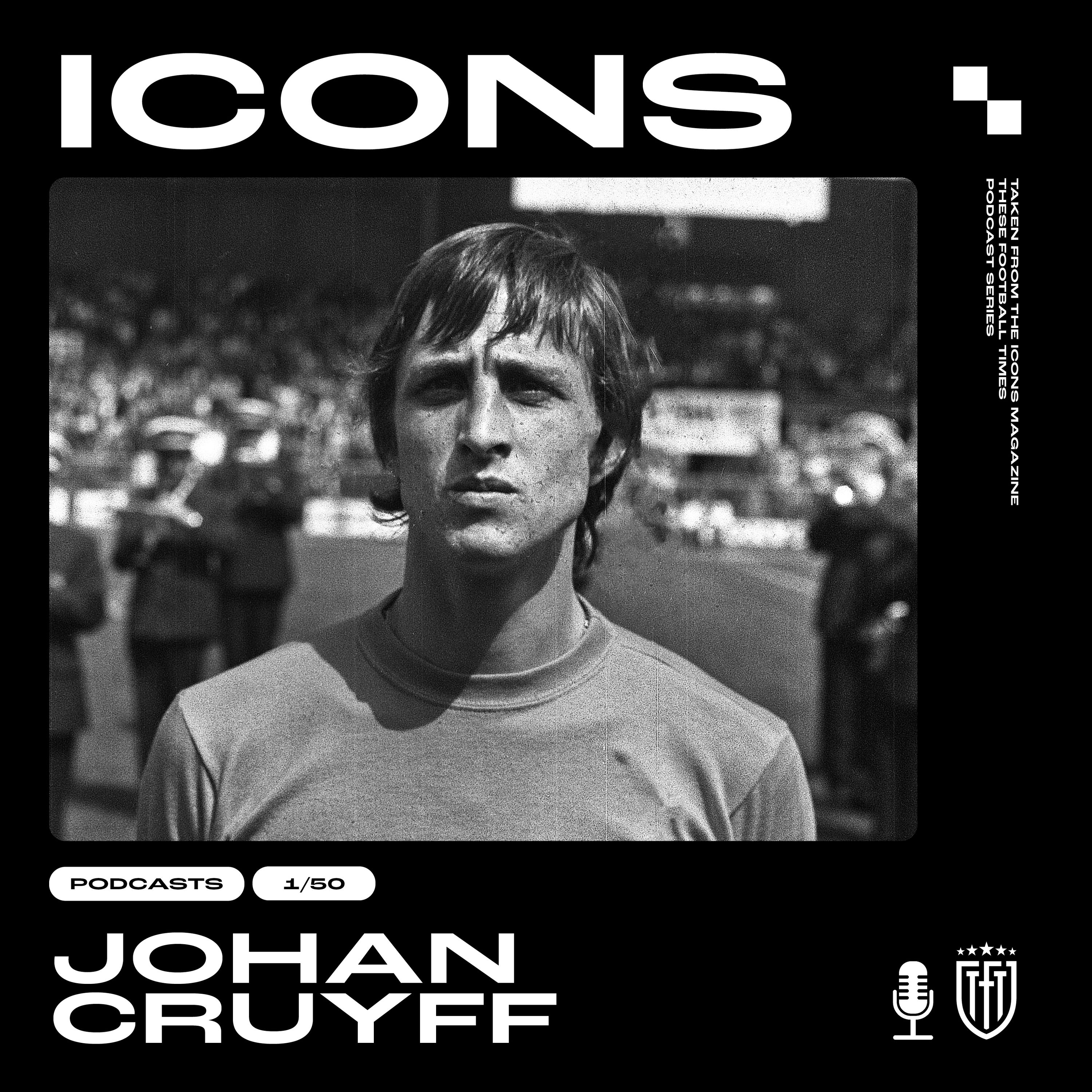
Welcome to The Lobb, your home of in-depth coverage and analysis by These Football Times, a movement of journalism you can trust. Each week, we endeavour to bring you the very best coverage of the game, exploring stories from the past and present with analysis by expert guests from around the world. Find more of our award-winning content online and in print. In the meantime, enjoy the podcast. Hello and welcome to Icons, a podcast brought to you by These Football Times in celebration of our new magazine of the same name. Across 12 captivating episodes, we'll dive deep into the lives, legacies and magic of football's greatest figures, players who didn't just shape the game but transcended it.
becoming cultural icons of their time. So let's kick off with our first Icons episode, a story of the legendary Johan Cruyff, an icon in every sense of the word. And to tell you the tale of this Dutch legend is the man who wrote about Dutch masters and beautiful bridesmaids. It's Gary Thacker. Hi, Gary. Hi, Rob. Thanks, sir. When I was asked to choose an icon, this was my first guy to go to, obviously. So yeah, the magic, the man himself. Right, let's kick it off, Gary, because we...
listeners out there, we are going short, we are going sharp, we are going quick because we are rattling through some of these icons. It's going to be fast-paced, but we've got lots of information to pack in about some of these brilliant players. So, Gary, just give us a little bit of an overview, a little bit of a teaser, a little bit of an intro as to why Mr. Johan Cruyff is so iconic. Well, I guess it was a short explosion time in the early 70s with Ajax when Ajax won the European Championship three times with the bounce and Cruyff went to Barcelona and transferred them, won the first title for, I think, for a decade and obviously had the success in the 1974 World Cup with the Dutch as well. First time they'd qualified since 1938.
think he was. But it wasn't only on the field also. He was a master tactician as well off the field, became a coach at Barcelona and later to the Ajax as well and took basically the Ajax way of playing and also the structure of the club to Barcelona in a situation that exists to this day. And his dream team and the iteration of the team he had at Ajax had so many players that turned into top class managers and Pep Guardiola to get just off the top of the head but there's probably six or seven who were sort of tutored in the way he had the way of playing football. So he's a guy who, all the way through his career, from a young kid bursting onto the scene with Ajax, I think he's on the first or second professional player at Ajax, and then the success he had under Mikuls and then under Stefan Kovacs, three European Cups, and then onto Barcelona, and obviously outside the 1974 World Cup. I'm not sure there's been a more influential player in football, in world football, let alone European football, than the iconic Johan Cruyff.
I totally agree, Gary. And I think when I think about someone like Cruyff, my first interaction with him as a manager at Barcelona and kind of seeing him in his long trench coat and his cigarette on the sidelines at the Nou Camp playing a sort of football system that I hadn't seen before, which was different to sort of like a Pele and Maradona type, I think. So for me, as a fan growing up in the 90s, he became that kind of iconic figure in the dugout. And then you sort of look back because what was that era like, that sort of late 60s, early 70s era in terms of kind of like the tournaments, the leagues and that kind of, what did the global game look like, I suppose, at that point? Well, I mean, it's fascinating. If Cruyff had come through at a Spanish club or Italian club or even an English club.
it would have been a little less amazing. Dutch football was broadly amateur, certainly in outlook, if not in definition, and very much a backwater of European football. And there was a game, the year was 67, 68, when they played Liverpool in the European Cup game, and absolutely murdered Liverpool. I think it was 6-1 or something, 5-1, 6-1, and then got a 2-2 drawing route in the second leg of Liverpool. And it was like a coming out party. And all of a sudden, little Ajax, unknown Ajax, this little club, and everybody just called them Ajax, obviously, because we were pretty naive in those days. So it became something to notice.
Croats sort of blossomed from there. As I say, you know, the LA Division titles, the one there, the KNVB Cups, but the massive thing, the key seasons were, I guess, the three European Cup triumphs where, you know, they were absolutely dominant as introducing a new way of playing football, a new dynamic, a paradigm that hadn't existed before. Well, certainly not in that format, although different versions of title football had perhaps existed. But that sort of early 70s where a team from a little-known backwater of European football became the dominant force in European football. And then with the Orange as the 1974 World Cup and, you know, probably the best team never to win the World Cup.
So those four years were probably the years that marked him out as a great player. But then, as you say, he became a manager afterwards in the other years. After going to Barcelona, winning the title of Barcelona, he became a manager there. And actually went back to Ajax and played again. And then fell out with Ajax's board. And then went to Feyenoord and won the double, I think, the double sitting in the league. With Feyenoord, they sort of hated rivals because Ajax wouldn't pay him the money he was due. So this is a guy who was sort of not only an iconic player, but an iconoclastic player as well. Sort of fought against the regimes all so often. And as I say, he inherited to the system where Ajax played that every team...
from his first team down to the youth team, played the same system. And he took that to Barcelona with him. And as I say to this day, it's still the Barcelona way. The Cruyff influence of Barcelona was so long lasting that they persisted with it and had the success that they have. So that burst 1971, 74, 75 with Barcelona were probably the years that made him as a player, but his talents extended beyond that into the management and coaching as well.
For you, Gary, as a football fan, what did it feel like seeing someone like that in some of those European games? Obviously, you know, late 60s, early 70s, the European Cup wasn't probably shown as much as it is now. It's certainly not. Everywhere on our TV station, seemingly endless games in that European tournament. What was it like for you as a fan to see someone like Cruyff? Well, that was, when sort of 71, I would be sort of 15, 16. That was sort of my sort of formative years of understanding the philosophy of football. And as you say, when you look back, you realise the games weren't live. The finals were, but not sort of the group games or the group games, the quarterfinals, et cetera. And it was things I'd look back and you sort of...
You think you've seen them live, but you didn't. But what you did see live was the Centre for World Cup, of course, and the majesty of Cruyff in that tournament. I think it was just the right age. You know, when you're sort of growing up in the same with music and that sort of thing, there's a sort of period in your life where you catch on to something that's going to be your favourite forever. And certainly with Ajax playing and the Orange at the Centre for World Cup, that sort of hooked into me that this is the way to play football. You don't need a big centre-half that can't play. You don't need a big winger who's going to go in three players and lose the ball. You need to pick your best 11 footballers and put them in positions. And this was the ability that Ajax had where they could change positions because they weren't.
locked into the system. So when players came to the Ags team, they were played. If you're the centre-half, it's happened to Barry Holtsoff when you're the centre-half. Mickles played him in midfield for almost a season, so he could learn how to play. That's the system. And this was, I'll say, such an important thing, such an important thing for me, my football education, and Cruyff was sort of the leading light, of course. So many moments you're going to be able to choose from this next question, Gary, because obviously such an iconic figure is going to have lots of defining seasons or performances. You've hinted at that one, his season at Feyenoord, where he was kind of the ageing, wily veteran, still winning trophies. But if you were to kind of pick a season or a performance or a moment...
maybe epitomised who Cruyff was, whether that's his footballing style, his attitude, what would you go for? I think, I mean, it would be in the orangish shirt in the 1974 World Cup against Argentina. And Hannigan loved his ball through almost over the back line. And Cruyff was there and he caressed the ball out of the air. Balletic balance Poison the elegance Skip around the goalkeeper And roll the ball But it was It was It sounds weird to say But it was almost musical The flowing movement And I think in that moment He just epitomised This is a guy who can You can walk on water I mean many years Years after that But in his later years of Barcelona I think it was 1978 77-78 Barcelona played Aston Villa In a cup-winner's cup I think it was a cup-winner's cup And I went because Aston Villa's quite Oh yeah I'm still in Walsh near Birmingham I've got to go I've got to go and see Cruyff And you know there's things The sound of the Grand Canyon is one of the things that you never are disappointed at when you go, Cruyff's the other one. This was a muddy pitch in November, cold Birmingham. And the pitch was a Roy Quagmire. And I'm still not sure to this day, Rob, whether his feet actually touched the ground. It was like a bullet of the whisper of the people plodding through this sort of quagmire. He's got a brilliant goal. And, you know, it was one of those sort of magical moments that sort of will live with me forever.
It's just magic. Absolutely magical. Magical. I think when I've watched Cruyff and looked at old clips back, sort of the way you describe him, it's like he's such a wiry, sort of slight figure that, especially in the 70s when it was maybe a little more cultured, shall we say, there was so much that was about power and physicality and not really wanting to dominate the ball. But someone like Cruyff, you know, when you look back, it was all about the ball, wasn't it? Was that all from Mickles and Ajax where it was kind of like the ball was king? A little bit, yeah. I mean, Cruyff always said he grew up playing football on the streets and sort of uneven surfaces and surfaces and being tackled by kids.
five, six, seven years older than he was. And he always said that this is not falling down when you get tackled heavily on the concrete so you get hurt. It was one of the things that helped to give him balance. And, I mean, even afterwards, after he retired and Mick Olsen's worked for the KNVB, they had this thing where, as part of this dossier he produced, I can't think of it, it's called the Erster Wiese or something, it means the view from Wiese where the KNVB were based. And one of the ideas was to introduce these mini football, which is called Cruyff Courts, sort of try to recreate that situation where players were playing, not on these perfect grassed areas, perfect sort of, even sort of synthetic grass.
But players had to learn to cope with even surfaces and now the ball was sort of bouncing about. You mentioned about his appearance in Spanish, it's called el placo, which means the narrow, thin person, slight. And that was very much him. And it allowed him to have, you see some players like Maradona had that low center of gravity that allowed him to sort of, but Cruyff could avoid things. He never really had a trick. He wasn't going to be George Best in three step overs. He almost glided past people. And the only other guy I can remember who had a similar was Michael Laudrup. He could do that as well. It was just a sway of the hips and just elegant, like water flowing down a...
down the screen. For someone like Cruyff, who had such a cultural impact as well as a footballing impact, he wasn't a winger. He wasn't really a winger, was he? I know he played out wide quite a little, but he wasn't a number nine. He wasn't sort of a 10. How would you describe how he sort of changed that sort of forward line or those forward roles? I know that he did it in tandem with other players in the Dutch national team and with Ajax, and it was a lot about the system, but he started to sort of change and mould those forward positions, didn't he? So that it wasn't just a big bustly target man and a couple of dribbling wingers. He was a little bit kind of in between all of that, wasn't he?
Very much so. I mean, you know, I suppose in some modern parlance, you might call him more of a 10 than a 9. And he certainly dropped deeper. And this sort of reputation he got, he'd be offered quite heavily marked. But dropping back, drew players out of position, created space for the players like Kaiser, Muren, who could sort of exploit the gaps that he created. But he would drift left and Kaiser would come inside or he'd drift right and create spaces there. Very much a mobile player. And a classic example, 1974 World Cup final, when the Dutch scored that first goal. The ball comes, gets the ball and the only Dutch player behind him is the goalkeeper. That's how deep he'd come. And he's sort of...
trotted forward, actually a little bit, then all of a sudden hit the sort of gas and he was away, dancing through, until he was brought down on the edge of the penalty area by Olly Ernest, although it's often said he was in front of Bertie Voughty, it wasn't, it was Olly Ernest, and won the penalty. But he came from being the deepest outfield player in the side, you know, in the first 60 seconds of a World Cup final. That's the sort of freedom he had, the movement he had, the ability to appear on the pitch where he could hurt the opposition. Do you think he influenced players who came after him or almost directly after him in his style? Or was he sort of so unique in that, in what he could do with the ball?
You can't actually really ever copy anyone like Cruyff. You could take elements from him, but you could never kind of be that full package. That's a great question, Robert. I think the answer is yes and no. Certain players tried to play like him. In the 1978 World Cup, Cruyff didn't go because his family had been attacked at home. Robert was at his house and he didn't want to leave his family alone. And one of the coaches there, a guy called Sam Voight-Cruyff, wanted Robert Rensomberg to take on the Cruyff role because he thought he could play, but Rensomberg didn't really want to do it because he didn't think he could and the rest of the players weren't sure. So they had to change the system.
They had to play a new system because they hadn't got Cruyff or Cruyff played in the qualification games. So I think, you know, you look at players who have played a similar situation. You could say Messi played a similar sort of role there again, but not so deep as Cruyff went, but certainly his false nine. I mean, I wouldn't say Cruyff was a false nine because he played a lot deeper than a false nine as well and certainly moved a bit more. But yeah, I think he created, he redefined a role that hadn't really existed before.
Something going back to 53 in the Hungarians, he had a guilty player as a full spine, dropping sort of sitting back, but not as far as Cruyff did, not to that same extent. So I think he redefined that role as a player. He could almost knock him down. It wasn't a 10, it wasn't a 9, it wasn't a 4, it wasn't an 8. Sometimes he was a 5 and a 6. So, you know, I mean, put your maths together and you've got a lot of big numbers there. It's interesting, isn't it? Because that's probably, as our series progresses through the icons, it's probably one of the things that's going to come out, isn't it, about a lot of these players, that modern players or players that came after them might have had that little bit from him or that little bit from another player, but never could kind of piece that together because they're just so unique and so different. And I think...
Obviously, there was a lot around Cruyff, as we said before, not just off the field. What were some of the more controversial... I mean, with a Dutch team, especially at tournaments, there's always something that's going to be a little bit controversial, or there might be a little bit of tension in the camp. What was the sort of things that Cruyff was involved in terms of controversies or setbacks that he might have had during his career? I'll just pick a two or three, because we could be here for an hour otherwise. But firstly, when his first game for the Dutch national team, he got sent off. And the KNVB decided to ban him, I think, for 12 months. And he sort of fell out. And ever since that time, and it got reduced in the end, but ever since that time, there was this...
I would say love-hate. It was a hate-hate relationship between the KNVB and Cruyff. Cruyff was never one to toe the line. He was never going to be a company man. And a lot of the things he did, people would say, you know, he was selfish and arrogant, and he was to some extent, but also the things he did helped the other players achieve success as well financially. In the 1974 World Cup, before the tournament started, the famous occasion about the KNVB had sold a shirt sponsorship to Adidas, and Cruyff was signed up to Puma.
Obviously, this is the ongoing conflict between the two German brothers, the Dassler brothers. And so part of the cross contract is he couldn't wear any of his stuff. So basically, he said, you know, I can't wear this shirt. If you're going to have this shirt, I can't play. And the KNVB said, well, it's our shirt. We'll do what we want. And Cruyff said, well, it's your shirt, but it's my head coming through with it that makes it valuable. And they had this thing. And in the end, he played with a shirt with two strokes rather than three, and that was a compromise he came to. But I have no doubt whatsoever. If they hadn't come to a compromise, he wouldn't have played.
I mean, he was that steadfast in his decision-making. And he was also, he fell out with the Ajax team on a number of occasions when Stefan Kovacs took over. Compared to Mikkels, Kovacs was very much a more laid-back coach. And Cruyff decided he was going to have to be the guy to tell the hard truth to some of the players. And he became quite sort of authoritarian in a way. You know, Mikkels had done it and Kovacs wasn't that sort of a manager. So he sort of upset a lot of players there. And when they, at the end of the 1973 season, head of the tournament, sorry, the new season, they had a vote to elect the captain. Cruyff had been the captain for the previous season and assumed he would get it.
other than not, as it were, but there was a vote. The new guy taking over, George Noble, who was never up to the job of managing a team like Ajax, basically said, oh, yeah, let's have a vote instead of saying, oh, let's leave it with Cruyff. And basically, Cruyff lost the vote. And rumour has it, Harry Hahn tells a story that he was a young player coming through at the time. And it tells a story that the Ajax directors had suggested to some of the younger players to vote against Cruyff just to bring him down a peg or two, as it were. But he lost the vote and Kaiser was elected. And basically, as soon as he lost the vote, he went upstairs, rung his father-in-law's his agent, said, you need to get me out of here. And hence the move to Barcelona. And this was how, this was very much how Cruyff was. It's crazy, isn't it?
All these things unfold to have someone who was, you know, at the absolute top of his game and Ajax had won European trophies and league trophies. And yeah, it could still come down to that kind of battle of the egos off the pitch, isn't it? Absolutely. And of course, the thing is, I mean, when you left, Ajax, I mean, there was perhaps other reasons as well. Certainly Novel wasn't up to the job of coaching the team, but they fell apart. Three-time European champions. That season, they'd beaten Bayern Munich, I think, in the quarterfinals. Destroyed Bayern Munich. Amsterdam beat them 4-0. They beat Real Madrid. They beat Juve in the finals. They beat the champions of Germany, the champions of Spain, the champions of Italy. And then the following season, they got knocked out by a ball guarantee.
And that's the hair that might do before them. Cruyff had gone and all of a sudden things fell apart. I was fortunate to speak to Rudy Kroll. He was a key player at the time as well. And about the situation, he said, you know, it was a massive loss. Cruyff was a massive loss. It's not the only reason, but it's certainly one of the main reasons. And that's huge, isn't it? It just shows that sort of lasting impact that Cruyff has. Or any icon, really, when they leave a team, what is left? What comes next? And I suppose, thinking about Cruyff's legacy, not just as a player, but as sort of a coach and off the field. He had a huge impact at Barcelona, as you said at the sort of start of the episode about La Masia and how they set up the sort of youth system.
Was that system in place at Ajax when Cruyff was a young player? Because obviously Cruyff brought that into Barcelona. But did he grow up as part of that? It's not indoctrination of a certain way of playing football, but it's certainly kind of, this is our way. This is the way that we do it. You're going to grow up playing this way. And if you can see, you'll succeed. Was he brought up through that at Ajax and then moved that to Barcelona when he became sort of coach? There's two aspects of this. I mean, firstly, the origins of total football are a bit sort of like, you know, the Philosopher's Stone and Atlantis. Difficult to find out where they originally started. But there's a guy called Jack Reynolds, he was called in Amsterdam, Uncle Shaq, who was a coach at Barcelona, major Barcelona.
over three or four different periods, but in total for about 15, 20 years. And it was him who brought the system in of all the teams in the club playing the same system. And I've got a sort of video of one of the historians who said, even under the later years of Reynolds, they were playing what you could describe as total football. Certain elements of it, and then Mikkels built on that. Cruyff was very much in the right place at the right time. The system that Mikkels wanted to play was tailor-made for a guy for Cruyff's intelligence as well as his ability. Would Ajax have been as successful without Cruyff?
Probably not. Were Cruyff married to any other club? Yeah, but perhaps not as well as that system suited him. So it was a wonderful meshing of time where Cruyff and Mickles came together after he got the job. And it was a sort of period of time where you can think, well, the gods have smiled on this little northern European country in the capital there and poured in this little mixture into a bowl, stirred it up, and a lot of stardust came out of it. And that stardust, when he went to Barcelona, not as a player, but as a manager, it produced Pep Guardiola, that youth system, and then Cruyff.
played a man who at the time as a young kid, they thought he was too skinny. They thought he wasn't strong enough for La Liga, Pep Guardiola, but Cruyff persevered with him. And obviously the legacy of Cruyff lives on through Guardiola. But that time at Barcelona as a manager, Cruyff was incredibly successful, won four consecutive titles, won the European Cup for Barcelona. Would you say that that was equal to his playing career in terms of impact and how he shaped the club? Is it something that we shouldn't really compare the management career to the playing career? Or is it just something that we can enjoy and love both periods of such a great player and great manager's life?
I think it's probably a little bit of all three. Strangely enough, the Cruyff magic made a difference in both those situations. I think of Barcelona. Barcelona were a top club when he went there. Ajax weren't a top club. Well, they were relative within the Dutch system. But as I said, you know, at that time, very few people would have heard of Ajax outside of the Netherlands. But what he did with Barcelona was perhaps an even bigger thing. He transformed the club. Not the manager and him. He was the guy who transformed that club and made it what it is. And, you know, they honour Cruyff so many times there. And on his birthday, there's always a celebration there. They all make a big fuss on the game when it's his birthday.
So I think, yeah, it's probably the success he had with Barcelona was different. Was it better? I think it was less revolutionary, but perhaps a more difficult task to achieve because he was trying to take over an established system and did so. So arriving at the club basically saying, you're doing this wrong, guys. Now, when you go to a club like Barcelona and say, you're doing it wrong, guys, it's a massive thing to turn around. But there again, it didn't. Of course, being Cruyff, being Cruyff, even then, you know, it would only last so long. And I think they'd lost the European Cup's forum to Milan, to Capello's Milan. And he didn't want to change the team.
every man destroys the things he loves and a brave man does it with a sword and a fool does it with a kiss when he loved that team too much to change it he's sort of there again he fell out with the authority as he always does and walked away but yeah they were sort of for those years of Barcelona as a coach I made such an impression on the Barcelona fans of course of Barcelona and the system as I say they still exist to this day Yeah I remember that Barcelona side and that Champions League final especially and it's very interesting that two of the players that he didn't get on with in Stoichkov and Romario were probably very Cruyff-like in their sort of attitude as in, you know, they were the stars of the team and they wanted to sort of dictate some of the things that went on. And I always find it interesting that there was such a big clash with Cruyff, especially with someone like Romario, who was phenomenal, but people forget he was at Barcelona for such a short period of time because it just sort of didn't work. And Cruyff never really probably recovered from that, even though they reached some brilliant heights domestically. It never quite tipped them over the edge with sort of this ever-growing European game where competition was sort of increasing and increasing. In terms of his legacy with fans and with other players, you know, he's often held up by...
footballers and football fans as one of the greatest, if not the greatest, to quite a lot of people. Maybe not just for his on-field display, but actually for his management, for creating that culture at Barcelona of developing from within. How do fans of, you know, I mean, you've mentioned about Barcelona already, but Ajax, you know, they named the stadium after him. You know, he's such a huge, legendary figure everywhere, isn't he? Oh, God, yeah. I mean, yeah. Well, I mean, in the Netherlands generally, although perhaps not so much in Rotterdam, although, let's say we're to Feyenoord and won that, and certainly in Barcelona as well, but I think it's the iconic players we've talked about in this series.
A lot of the way people look and the perception of them depends on where you were when you saw them. I mean, as I mentioned, Cruyff was very much my sort of, my era of football where I thought, God, this is wonderful football. This is the way to play football. I know it's more like different players in different eras and have a similar sort of attachment. But for me, anybody of my sort of generation, Cruyff was certainly one of the, I mean, it's always difficult to compare players over time. Who's the greatest player? Is it Stefano? Is it Maradona? Is it Messi? Is it Ronaldo? Is it the other Ronaldo? Is it Cruyff? Well, Cruyff's in the argument. In any argument of that, Cruyff's in there. And then, on top of that,
You look at what he did as a manager. And then all of a sudden, the Pelé's and this, oh, that's definitely our manager as well for a while, but certainly not to the extent of the success that Cruyff did. And Sam and Maradona, not to the success that Cruyff did. And you think, well, yeah, he's got something extra as well. He's got that extra X factor as well. So to me, as I said earlier, I mean, Immanuel Cruyff is the most influential footballer of all time. People might argue that he's the best player, but as an influence, as a guy who left a legacy on the game, it's difficult to argue that this wasn't the icon of football.
I have to agree, Gary. I think we're seeing now at all levels of football that Cruyff influence has passed through Guardiola and spreading all across the game. But it's huge, isn't it? Just to kind of look into our imaginary crystal ball or looking into the future or bringing Cruyff into the present now. Can you imagine him playing for Barcelona right now on that left-hand side, dribbling inside? It would be an incredible sight because what I find really interesting about someone like Cruyff, he would still be one of the two or three best players in the world in whatever era he played, wouldn't he? Well, you have to ask yourself, he's a guy who played on pitches.
If you want to go and watch Cruyff on YouTube, pick any Cruyff thing on YouTube, you'll see the pitch he's played, especially in the Netherlands. I mean, they were like a potato field. And, you know, players were sort of fairly robust in their challenges, shall we say, compared to what they're allowed to do these days. So this is a guy who sort of, and I mentioned the game against Villa when he sort of played that mud patch there, and he excelled in there. Can you imagine what he would do on these billion table surfaces now where the skilled players are so much more protected than they were? I mean, forget Barcelona. Come on, play Stamford Bridge.
He actually wore, did wear a Chelsea kit once he played in a testimonial of Chelsea. I can't remember whose testimony it was for, but he played in a Chelsea kit and I bet he didn't like the blue colours so much and could have stayed. I mean, but any team, any team in the world, any team, I don't care who they are, he would be the star player in that team on today. I mean, just a little bit of a point to Guardiola at Barcelona. There were six or seven players there. Koeman was another one there. There was five or six players there who went on to be successful managers and that legacy that spread there from players like Guardiola, from people like Guardiola through...
who they'd coached. I mean, you look at players like Coppin's company, who's now gone to his arms. These are the generations. This is where the legacy you get from Cruyff. And these are the guys who are sort of perpetuating the legacy of Cruyff. They're not playing like him, but the inspiration is still there. What a legend. What a legend. Yeah, I think a legend. And if we're talking about icons, we've got to talk about their impact now. So even seeing all those players coming through and playing that start is quite incredible. But for me and Gary, talking about the incredible Johan Cruyff to open our icon series, I'm not sure we could have picked someone.
as good as Cruyff to start us off with. An incredible player, incredible manager, legacies at two huge European Cups, impact at World Cups, impact in the European Cup as a player and as a manager, totally transforming two football clubs in Ajax and Barcelona and producing some absolutely incredible football. Gary, it's been a great chat about Johan Cruyff and I'm sure as we go through the rest of the Icon series, they can all maybe battle it out to see who is the ultimate icon at the end of it. They'll come second. They'll come second to Cruyff.
Well, that's great. Thanks for the chat, Gary. And thank you all for listening to our first episode of the Icons series. We will see you in the next one. Many thanks for joining us today on The Lob, a These Football Times production. For more of our content, check out our award-winning print magazine featuring some of the game's foremost writers, artists, and photographers exploring areas of the game rarely covered in high-end print. For now, we look forward to you joining us again soon.