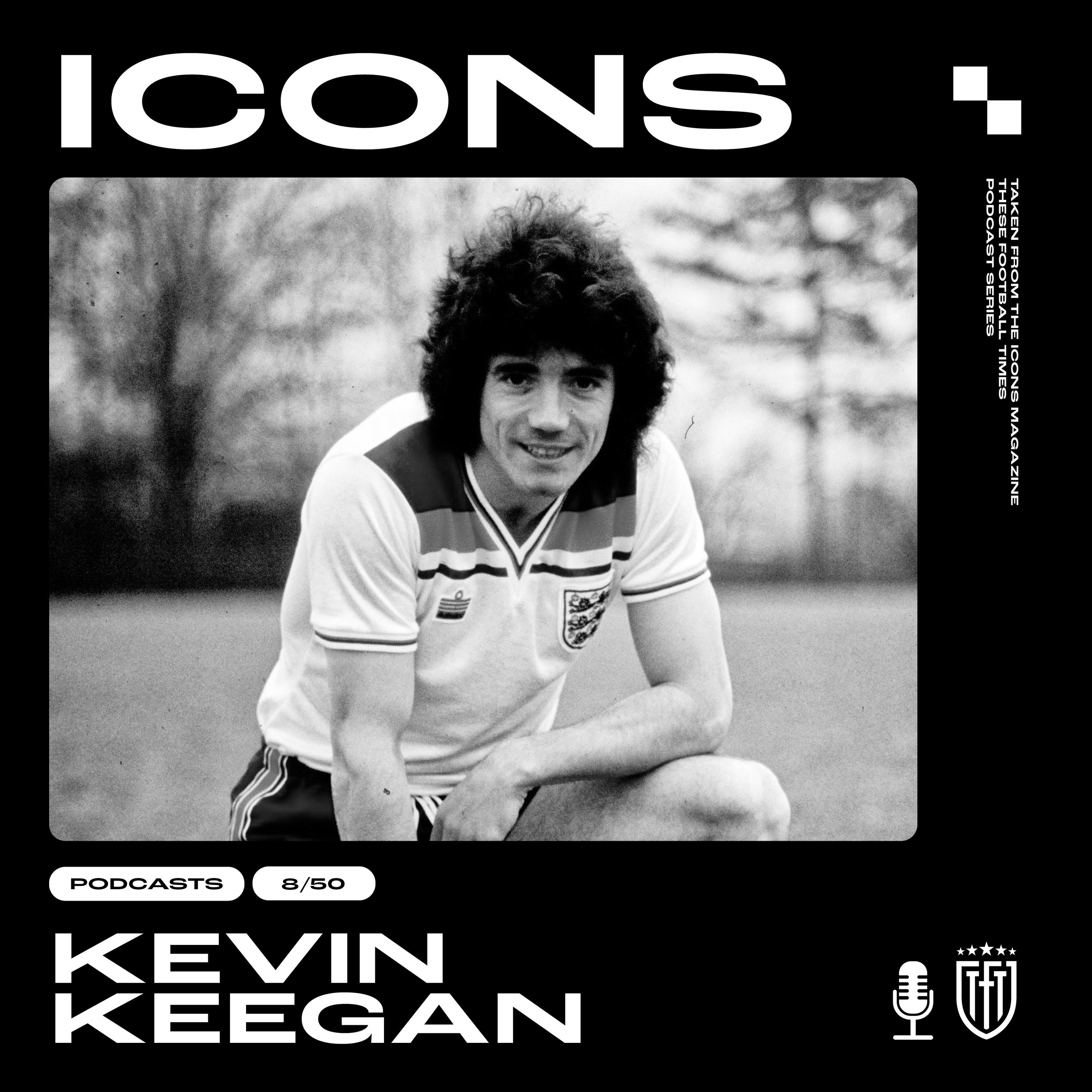
Welcome to The Lobb, your home of in-depth coverage and analysis by These Football Times, a movement of journalism you can trust. Each week, we endeavour to bring you the very best coverage of the game, exploring stories from the past and present with analysis by expert guests from around the world. Find more of our award-winning content online and in print. In the meantime, enjoy the podcast. Hi, and welcome to Lobb Podcasts from These Football Times. And in this mini-series called Icons, a number of teams from TFT Towers will be chatting about players' recent or past who they consider worthy of being described as true icons of the football world.
My name is Gary Thacker and in this episode I'm talking with Steve Scragg about one of his football icons. How are you doing, Stevie? All good. Looking forward to this one. Good, man. The juxtaposition to the one I've already spoken about, I think, in so many ways. Indeed, indeed so. Both wore red, both wore seven. Tell us who you're going to talk about, Stevie. I'm going Kevin Keegan. I think to draw the line between the parallels and the differences between those two iconic Liverpool No. 7s, between the two of them, Kevin Keegan's debut in a Liverpool shirt in August 1971.
to the last game that Kenny Daglish played in the first team Liverpool shirt in May 1990, almost two decades between, you know, first kick of the ball and last kick of the ball between the two, and the baton that was handed between them in the summer of 1977. It does seem a bit unfair that you've got these guys across, as you say, two decades, 20 years, and, you know, two of the most successful, effective, effective forward players, because both could be a bit deeper as well in Liverpool. So, yeah, OK, I guess Keegan had a different relationship with the players on the pitch than Douglas did, but he still had an effective... partnership with Toshek. Toshek and Keegan was probably, you know, almost a classic little man, big man situation. But tell us about that era when they were, Toshek and Keegan, particularly Keegan, was that their prime of Liverpool? Yeah, proper kind of like chalk and cheese, yin and yang effect going on there. You know, Keegan, mighty mouse, short lad, but with, you know, rockets in his boots. You know, the phrase that Shankly used is go out there and drop hand grenades and all of that. You know, that was Kevin Keegan, a ball of energy and, you know, the dynamism, you know, all the way up to that last game he plays in a Liverpool shirt in the 77 European Cup final.
and giving Bertie Vogts the runaround, you know, an opposing marker that he just gives such a torrid night in Rome, such a talented player in Bertie Vogts. And then, you know, Tosjak, that big, you know, the broad shoulders, hunched but broad shoulders, tall target man that could use his feet as well, you know, and two very different players that just connected so well together. It was kind of like a relationship that almost never happened in some respects. Keegan arrives at Liverpool in the summer of, well, just before the 1971 FA Cup final, signed from Scunthorpe United. Several of the First Division clubs had taken a look at him, including Everton and Leeds. They hadn't moved on him, done that classic. He's a bit short, we're not too sure. Shankly, you know, takes a punt. He's already got a talented lad picked up from Scunthorpe in Ray Clemens. And that probably thinks, well, why not? Let's see if Scunthorpe can come up trumps again. And Christ, Christ, they do. So, yeah, you know, he comes in, either the 1971-72 season.
Other people have just reached and lost the 1971 FA Cup final. There's this changing of the guard that's been going on for the previous season and a half now, after the Watford defeat in the FA Cup quarterfinals in February, I think it was, of 1970. The fabled second great Shankly Seidel, there's more levels than that. It's kind of like a third great side, really, of Shankly's, maybe even a fourth. So, yeah, Keegan comes in. Shankly's got an eye on him playing in midfield, but he plays in that classic pre-season Melwood fixture of the first team versus the reserves. The reserves throw the white shirts, the first team play in red.
in this practice match and Keegan just his magnetism playing for the second string in this game that Shankly looks and thinks I can't not put him in and actually thinks I'm going to stick him up front actually because of the chaos that he can cause for defenders because he's just so that dynamism that magnetism that he had and that determination such a hard player to deal with for defenders and yeah he scores on his debut home to Nottingham Forest and he never looks back he's not the most prolific of goal scorers but it's because he plays such a a varied game. Like I say, he drops back into midfield, does play in midfield still sometimes, pushes up front, he's the creator sometimes, he's the beneficiary on other occasions. And the interesting thing about John Toshak is that under Shankly, and I think it's certainly early under Paisley, there's a lack of certainty in Toshak. He plays the big games, but there are times when he's left out. That lack of pace sees Phil Borsman come in sometimes instead, especially away from home. They go for the pace rather than the tall presence of Toshak. So there's a lot of...
alternating that goes on over those years. And within that, Keegan has to cope with that. Different partners. At times, Alan Waddle, you know, uncle of Chris, comes in and plays a fair few games in 73, 74. So there's that little bit of a doubt over Toschak. And because Toschak's involved in the big moments, he plays the 74 Cup final. You know, he plays the 73 UEFA Cup final. And he's so synonymous with many of the big moments. It tends to fall under the radar that he was sometimes dropped out of the team for, you know, other circumstances. The target man's not really going to cut it in this game. We need the pace of someone else. So he was...
sacrificed, you know, on many occasions, John Toshak. It's kind of 75, 76, late 74, 75, 75, 76, the first two thirds of 76, 77, where that partnership is unimpeachable. And, you know, it is very much that partnership. But the two of them are just kind of like, you know, Toshak, Keegan, 1-0, that, that, that. David Coleman, Toshak, Keegan, Suna. You know, the UEFA Cup final first leg, the rearrangement of it, you know, the rain that came down and saturated Anfield that made the game have to be called off after 30 minutes. You know, Toshak's on the bench and Brian Hall is playing that game instead.
Shankly and Paisley see this aerial vulnerability in the glad-back defence. So Toshak starts the following night to such devastation alongside Keegan. And Keegan is such a key part, key component in that second coming of Liverpool under Shankly and winning the league in 72-73 have been denied it in 71-72 by virtue of a disallowed goal, which many people who were there at the time, there's no camera footage of it, will swear blind that it was wrongly called offside. To win that first European trophy for Liverpool in 73, to win the FA Cup, his performance in the 74 FA Cup final, just magnificent. The two goals he scores, that iconic line from, again, David Coleman in goals, pay the rent, and Keegan does his share. This was the Liverpool of Keegan, and Keegan was very much a Shankly man. Shankly adored Keegan. In the same vein that he had so much time for Ellen Hughes, it was that enthusiasm and that unwillingness to stop, that willingness to run through metaphorical brick walls, but to have that talent at their disposal as well. So Keegan was massively influential, and the fact that he would be succeeded by Darglish, and the fact that he would eventually leave by his own volition is another one that kind of soured.
is his legacy for a lot of Liverpool fans for a long time. Because, you know, people shouldn't be choosing to leave Liverpool because we are the pinnacle. As arrogant as that might sound, that's just the way it was. So, yeah, you know, for me, you know, Keegan became, was never quite the property of Liverpool Football Club in the way that Doug Leach was. But that doesn't mean that he shouldn't be reclaimed. And I think there is a bit of a movement now to see that Keegan legacy at Liverpool reclaimed and the Keegan of Liverpool to be celebrated more than it perhaps has been. And rightly so, that it should be.
But yeah, that Keegan of Liverpool was just such a magnificent, such a magnificent component in a team that was Beam. rebuilt, you know, as well. Yeah, I want to touch on his post-Liverpool career afterwards, but just sort of, I always think, focusing on his years, Liverpool, I always think Keegan is a difficult player to pin down for two reasons. The team had two different aspects. Firstly, you mentioned the word chaos and dynamism. That was it. He's almost like, you know, touch on your sort of favourite Hanna-Barbera characters. He was like the Tasmanian devil, sort of everywhere, chaos, everywhere he was going, was sort of enthusiastic and dynamic. And the other thing why you couldn't pin him down is his position, because where did he play? You know, he had that versatility, a little bit like Dalglish as well, as you say, he started from midfield and played. So I think for two different reasons, he was so difficult to pin down, and both of those are massive assets for Liverpool.
Yeah, hugely. I mean, to be part of that Liverpool ethos as well is that some football teams would play likes of UTO teams or table football teams in being rigid to stay in a certain position, to be a certain part of the pitch that you were deployed in and that was your patrol and you stayed there and you didn't move elsewhere. Whereas Liverpool, very continental in their approach. You know all about the Ajax ethos of the interchanging of positions. And that's why Liverpool players being defined in certain positions is so difficult to do. You can't really paint them in that respect. Yes, a player might operate.
predominantly in the final third or the central third of the pitch or the first third of the pitch. But that movement and that freedom of movement is so emblematic of those teams. It was a total football in Scouse terms. So Keegan, he would backtrack. He would chase players down in his own half. He would drop into midfield and pull wide. Look at his goal against Santatien in the quarterfinal of the European Cup that catches Kierkevich out. He hits it from the left wing, basically.
So Keegan wasn't predominantly central. And that's the thing, he pulled his markers. And because so often there would be a marker detailed to follow him. So he pulls central defenders all over the pitch, creating space for others to prosper. And that Liverpool midfield, especially a player like Terry McDermott, that prospered so much from that type of space and those late runs that he would make into the space, into the edge of the area, into the penalty area. So many of those magnificent goals that McDermott scored up to the end of the 76-77 season. And he would score fantastic goals beyond. But you look at some of those goals.
from 70, 76, 77 that the Dermott scored, owes so much to Keegan's movement and his intelligence in dragging players out of position. So there's that selfless aspect to it, which, you know, again ties into, he scored 100 goals all in all for it, which is a lot of goals over, you know, still a lot of goals, but in all competitions. But if you look at his league stats, I think he, you know, we're not talking about 20 a season, you know, but a lot of that was down to his selflessness. And you can look later in his career when he's at Southampton and Newcastle, where maybe he does become a bit more selfish in front of goal, that he goes on to prove that he can be a prolific goal scorer. But that wasn't the job that he was given for Liverpool. He was given a varied, wide remit on what he was to do. And this is what he offered to Liverpool. He was so much more than just a striker, a goal scorer of goals. Just one more thing before we move on to his past Liverpool career. Keegan was also...
a personality off the football field as well. So he did, I think he did a brute advert with Henry Cooper, didn't he? And then he did his pop song, Head Over Heels. Pop career, yeah. Pop career. I mean, I guess, you know, he sort of had that outside football personality as well. And perhaps it was something that his sort of fairly sort of bubbly attitude at that time sort of fed into a little bit as well. Did anything that detracted from his time on his attitude in the game as well?
I don't think so. I think he is the barometer of modern day commercialism, of sports stars, you know, football players, sports stars had previously, you know, they'd had kind of like commercial deals, you know, Fred Perry's own range of sports where, you know, you can look at football players having boot endorsements goes back a long, long way and all that. But the concept of, you know, sports stars tipping up in television adverts and, you know, being, you know... television personalities, you know, his iconic performance on Superstars where he face plants on the bike. You know, all of that, you know, the brute adverts with Tommy Cooper, with Henry Cooper being funny with Tommy Cooper as well. Just like that. Just like that. It really was kind of like a template of what David Beckham would go on and amplify, for instance. Very much kind of like commercially minded, but it would always come back to the football, you know, first and foremost, you know, without a shadow of a doubt. So, yeah, you know, a lightning rod in that respect, you know, for football and, you know, he offers this template for future players too.
to copy, basically, and, you know, to photocopy and say, I'll do this. And, you know, each generation that comes along has benefited from that more and more and more. But, yeah, Keegan was very much, you know, at the forefront of that pioneer in that respect. For rights or wrongs, you know, likes and dislikes of sports stars doing that type of thing. It kind of does, you know, that modern era does start with Keegan. Yeah, yeah. Okay, you mentioned earlier that Liverpool, I mean, very few of, in that era of Liverpool, you know, dominance in Europe.
domestic football and European football as well. Very few players left Liverpool. Well, certainly at their peak, left Liverpool. But Keegan made the decision to de-camp and go and play, not for another club in England, but go and play in Germany for Hamburg. Perhaps for Liverpool fans, it was a sort of difficult to understand, but it also was a brave move as well for a guy who'd only ever played in Swanthorpe, Liverpool, to make that decision to go and play in another country, another language, another league, to test himself out, or was he sort of sided with the success he had at Liverpool? I think, again, it's a multifaceted thing. You know, he's, on one respect, he wants the new challenge, he wants a fresh challenge, playing abroad.
you know, to be that challenge. You know, he's done everything he can in the English game, you know, apart from winning the League Cup, which still at that point in time, you know, isn't the, you know, if you've won the European Cup and league titles and FA Cups, you know, I don't think it's like a problem if you don't win the League Cup as far as Keegan's concerned. So, you know, he wants this challenge, you know, what is he going to do? Go to another English club and try and unseat Liverpool? That's all you can kind of do. So beyond that, it's look into the continent and challenge yourself in a completely different environment. And there was no shortage of interested parties at that point in time. Italian football weren't allowing exports into the Serie A.
So it was always going to be a case of either Spain or Germany. Real Madrid were heavily linked with him. There was a lot of expectation. Bayern Munich were interested. So the great end of the talk is that Bayern Munich side, whose most recent European cup was 1976. So there was a lot of clubs eager to sign him. So yeah, he wanted the challenge. He wanted to do something new. But he would have also had an eye on the extra earning capabilities that going and playing abroad would have compared to English football at that point in time. So there was a lot of reasons for him to go and do that.
You know, all he could do now with Liverpool is repeat the success that he'd already had, which for some personalities is absolutely fine. And that's what they want to do. And for others, once they've done something, then they want to need, have an inbuilt need to move on to the next thing. You know, and Keegan would go on to prove himself to be that type of person. You know, his answer to leaving Hamburg was to tip up at Southampton, which no one expected. So, yeah, you know, and then at Hamburg, you know, he reached another European Cup final.
But they should have won, really, but they didn't. But he won a Bundesliga title, took them to a European Cup final, won two European Football of the Year awards. He just went from strength to strength to strength. And to go and do it in Germany as well, learn a new language and all of that, and to try and fit in and be part of that, you know, was an incredibly... And again, yes, other players have been abroad.
from British football, but not many had prospered. John Charles aside, you know, most were back quite quickly, but Keegan, again, you know, he loved the lifestyle over there and once he felt he'd done all he could, you know, he was a littlest hobo and off down the road again. It's interesting that you mentioned the European Cup final. I mean, he came so close to being one of the very few players who could claim to have won the European Cup with two different clubs. I mean, that would have been a, you know, tell his money thing. And I remember the final, when it played against Forrest and typical, redoubtable Forrest performance on the club. And Keegan was that sort of, I remember this in the second half of his chase in the game. He was going back to...
pick the ball from the goalkeeper, which is that sort of determining, tend to drive this team to save the sort of game, but obviously it wasn't to be. But as you say, two hugely successful seasons with Hamburg, so domestically wouldn't have been played the year twice. And then, as you say, it turned out at Southampton. Not exactly the sort of club you'd expect a player of that success, that sort of standing at the time. But it was also perhaps a little bit typically Keegan-esque as well to do that.
Yeah, totally. Liverpool did have an option on him that had been put into the transfer when Keegan became available at Hamburg again for Liverpool to have first hit. Paisley having signed a young lad by the name of Ian Rush and had opted not to take up that option. Manchester United were sniffing around him. There were other options to continue playing abroad. Italy had opened borders in the summer of 1980 as well. So Serie A was suddenly a proposition as well. But he opted to return to England. He wanted this two-year build-up to the 1982 World Cup. He'd been denied.
participation in the 74 and 78 World Cup by talented collectives poorly organised that failed to qualify for the 1974-1978 World Cup. So, you know, he had that eye on the 1982 World Cup and he wanted to prepare for it by playing first division football and, you know, and that's what he went and did. He, you know, played part of an entertaining Southampton side, you know, without a shadow of a doubt that we're a little bit Harlem Globetrotters in many respects is that, you know, Laurie McNamee had this propensity to pick up star players, star names and put them in the team and, you know, alongside maybe some others that were a bit more pragmatic, shall we say. Alan Ball, you know, had been there, you know, Dave Watson, he would go on to sign Peter Shilton.
He brought Mick Shannon back from Manchester City. Alan Ball, you know, Mick Mills would sign for them eventually. You know, he liked to pick up these big name players. So in many respects, I suppose, it was a surprise, but it maybe shouldn't have been. But the fact that, you know, you're looking at Kevin Keegan, a player who's just been back-to-back European Football of the Year, he's just played in the 1980 European Cup final, just been to the 1980 European Championship finals with England, their first major competition for a decade. And then suddenly he's being unveiled at the Delft to, you know.
you know a press pack and a watching nation that is utterly utterly stunned but you know again he loves life down in Hampshire you know I went to the Dell many times and loved it that kind of such so close to the pitch and you know such a unique atmosphere and stadium that was and he played some great football personally you know played some of the best football of his career in the Southampton shirt scored goals for fun he was top scorer 81-82 possibly but yeah you know couldn't help them to trophies but because of inconsistencies you know collectively But they were in with a shout in 81-82, the league. One of many teams that actually hit the front and gave way. It was an amazing run, 81-82. Liverpool eventually prevailed, thankfully, from my perspective. But Swansea, Manchester City for a while, Southampton, Ipswich. It was this mad title race where one team would hit the front, then stumble. Another team would hit the front, then stumble. And then eventually Liverpool down the back straight, picked up Baton and blasted through the finishing tape. So yeah, what might have been for Southampton in 81-82. But I always remember that game at the Dell when Liverpool went there late in the season.
and 1-3-2 and Ronnie Whelan young Ronnie Whelan was magnificent in that game and Keegan scoring a penalty none of that kind of like you can't celebrate scoring a goal against a former club he was off and away punching the air and all that type of stuff and being part of and again YouTube clacks and go and look it up Southampton's goal that Shannon scores in that game it's just a magnificent game of football if you're allowed to have a favourite goal that your own team has ever conceded that Nick Shannon goal in 81-82 at the Dell it's just unreal go go find him so yeah he should be set up for the 1982 World Cup absolutely perfectly everything has ended It doesn't quite work out. It's interesting. I mean, you look back at Keegan's career and you think Southampton was almost like a summer holiday. You got to play a top club of Liverpool, top club of Hamburg, and pressure to win trophies. Pressure to succeed. At Southampton, the pressure was different. I mean, they had a little bit of a challenge at one time, but no one expected Southampton to win the league, the European Cup. It was almost like a little bit of pressure was off there. But of course, after that then, before we move on to his managerial career, I just want to refer to his time at Newcastle. And it seemed that there was another...
He'd gone back into the expectation thing against Newcastle there. I mean, Newcastle have always been a sort of, I hate the phrase, a club, but a club with expectant fans, shall we say, expect, you know, to do well, even though they haven't had any trophies for success for a while. But he became that talisman that Newcastle did for the last few seasons he was there. He did, you know, post-1982 World Cup. Again, I think he'd probably felt with Southampton that he'd come as close to substantial honours as he could possibly, yeah. And then he's just had that light switch moment. I need to move on. I need to do something else.
And Southampton desperately wanted to keep hold of him. And then he has this bust-up with Bobby Robson being dropped from the England squad and all that type of stuff. But yeah, the Newcastle move. And again, there's plenty of options on the table for him. He could go abroad again. Once again, Manchester United come in for him. And then Newcastle. They kind of plug into that romanticism of Keegan. His grandad had been a huge Newcastle fan. His family had been Newcastle. So although he'd been born away from Newcastle, that was the ancestral home.
And, you know, it felt like a homecoming to him. It felt the most natural thing in the world. And a local brewery, you know, chipped in with his wages, you know, to help pay for his wages. And he just went for it. You know, two years at Newcastle, again, scoring a raft full of goals. Eventually teamed up with Terry McDermott, who had returned to Newcastle before too long as well, to team up with the emergence of Chris Waddle. You know, the arrival of Peter Beard. It all clicked into place, 83-84, to win promotion in style. But, you know, a bit dysfunction at times, but, you know, some wonderful style as well there. And they kind of became everyone's second favourite team because...
This emergence of Beardsley and Waddell was great, but Dermot and Keegan still doing it. Two different pairs at the further end of each other's career spectrum in that respect. They became a joy to watch. They were always here the girls involving Newcastle at the end of the big match. There was plenty of camera footage of them that season. But then within that, the FA Cup tie at Anfield when Newcastle comes to Liverpool, a Friday night fixture. And Keegan knows that he's not got it in his legs to be able to compete at that level anymore, which is the precursor to his eventual retirement, which for many players is still in his relative early 30s.
Many other players will carry on. And for Keegan, it was like, no, if I can't punch my weight, going into the first division at the highest level, he didn't want to tread water. No, he didn't want to be a mid-table water treader in the first division with Newcastle. And he decided, no, I'm bowing out. I've helped you back into the first division. Now I'm off and away. Yeah, OK. I'll tell you Tom Fraser. It'd be funny not to touch on his managerial career. I mean, England perhaps wasn't great. I mean, he said himself that he was a little bit beyond him. But he had relative success as club manager. I'm talking about Fulham. And you mentioned about Newcastle, the Newcastle side of Keegan. His first situation there was...
They were a great entertaining team as well and came so close. It was a classic, a classic Liverpool-Newcastle 4-3 game. I mean, you know, as entertainment, I mean, I just want neither of those teams, but it's a great match to watch. Entertained, pulsating almost. And, you know, and it's the swings backwards and forwards to Liverpool and Newcastle were in front. And the classic, I think, Collingwood last goal, I think, to round out 4-3. And Keegan slumped over the hoardings. And you can see how it sort of, what it meant to him. So, yeah, even as a manager, he had his sort of desire, his drive was perhaps...
greater than his success, than his ability, shall I say, and it's that infusion that's charging down the hill with the flags unfilled, cavalry going down, you know, what's a plan B? I've got a plan B, I've got a plan A, I've got a plan B, which is the same as plan A. Yeah, absolutely, absolutely. I mean, it's that, again, you use the word, you know, juxtaposition between Darglish and Keegan where, you know, Darglish wins the league, clinches the league with a loss at Anfield, you know, the previous season. That 95-96 loss for Keegan, you know, the difference there between the two events. You know, an unlikely manager, I don't think he had any, you know, he quit as a player and said, that's it with me with football.
happy to be kind of talking head for ITV. You know, he was always there as a pundit or a co-commentator to Brian Moore on big games that ITV would cover. You know, and, you know, his agreement to take over at Newcastle, you know, 91, 92, you know, even then within agreeing just a short span to the end of the season to try and help them stay in the second division and then I'm out of the picture because he just seemed the most unlikely of managers because he'd always said it was something he would never do and he had no interest in doing. So when he picked up that and it was because it was Newcastle, you know, that he said yes. And then it opened up a whole new, you know, facet of Keegan's relationship with football.
you know, to go on and, you know, take them into the Premier League, to, you know, set them up to be winners of the Premier League in 95, 96, only to, you know, for it to unravel. So, you know, and again, you know, that Keegan propensity to say, I'm out now, that's it. When he walks away from Newcastle in, what was it, the January 97, the December 96, January 97, not long after the dismantled Manchester United 5-0 at St James Bar. You know, that signing of Alan Shearer and all of that, you know, never a dull moment, you know, with Keegan. And then, yeah, he shouldn't undersell what he did with Fulham.
and reluctantly took on the England job in a similar way that he'd reluctantly initially taken on the Newcastle job. That romanticism that had led to that. He would have been better off served by staying at Fulham and being the man to take them into the Premier League. He was building something with momentum and special at Craven Cottage when he took on the England job. And then that short spell, you know, back in charge of Newcastle, you know, enjoyed his time at Manchester City. And I think the Hallmark, yeah, the trophies alluded him, but, you know, he always set his teams up to play entertaining football. You know, again, that juxtaposition with Darglish. Darglish did create entertaining football teams as a manager as well, but successful ones that won trophies. So, you know, it's always fascinating, this, you know, these differences and similarities between Keegan and Darglish. But yeah, Keegan, flawed in a way that Darglish never was in that respect, but it makes him utterly lovable and human. It's a few years ago now, probably not long before COVID.
go back to that relationship with Liverpool and Liverpool need to reclaim the Keegan of Liverpool because as a player as a personality he belongs to Newcastle he belongs to the nation but he does belong to Liverpool as well and he was at a game at Anfield as a guest and he arrived at Anfield and supporters of a certain age were just delighted to see him and they were getting selfies with him and everything whereas for some players some footballers that's a difficult thing for them to do and they want to be out of there as quick as possible Not Keegan. He signed every single autograph. He took every burr hug, every photo, just with the biggest smile imaginable. And there's a mark of the man as well. Brilliant. That's been a great chat, Steve Lee. So massive thanks to Steve for sharing these thoughts on the icon that is Kevin Keegan. So thanks for listening. Catch you again on the next episode of The Log Podcast from These Football Times. Many thanks for joining us today on The Log at These Football Times production.
For more of our content, check out our award-winning print magazine featuring some of the game's foremost writers, artists and photographers exploring areas of the game rarely covered in high-end print. For now, we look forward to you joining us again soon.