Welcome to The Lobb, your home of in-depth coverage and analysis by These Football Times, a movement of journalism you can trust. Each week, we endeavour to bring you the very best coverage of the game, exploring stories from the past and present with analysis by expert guests from around the world. Find more of our award-winning content online and in print. In the meantime, enjoy the podcast. Hi, and welcome to The Lobb podcast from These Football Times. And in this mini-series called Icons, a member of the team from TFT Towers will be chatting about players recent or past who they consider worthy of being described as the true icons of the football world.
My name's Gary Thacker, and in this episode, I'm chatting with Rob Fletcher about one of his footballing icons. So how you doing, Rob? I'm good, Gary. Thanks. Ready to chat about this play. Good man. Now, you're going to talk about a guy who I've described in the past, and I still hold this to be true. He's probably the best pure striker I've ever seen in my life. Tell me a little bit about who we're going to be chatting about tonight, buddy. I'm going to butcher the Brazilian slash Portuguese pronunciation, but Ronaldo Luiz Nazario de Lima, otherwise known as Ronaldo, or the real Ronaldo, or the Brazilian Ronaldo, whatever you want to call him, R9, whatever.
Probably one of my favourite players of all time, if not my favourite player of all time. What sort of era are we talking about here? Because this is a guy who came to European football as a raw teenager and then played for some of the greatest teams on the continent. So what sort of era are we talking about, Rob? So we're in the 90s, so the early 90s for Ronaldo. You know, as a really, really young kid, I mean, he's playing F. Cruzeiro at sort of 16, 17, coming through then. He comes to Europe at such a young age as well, 18 years old. And I think one of the reasons why, for me, Ronaldo is...
such a hero for me as I was growing up at this time as a kid, watching football eight, nine years old, and you get sort of enraptured by these players who look so different in the style of play, in how they look, in how they move. All of that, I think, plays into that mystique around Ronaldo a little bit. And the fact that he was so young as well. We saw him in England in 1995 at the Umbro Cup when he's still a youngster at PSV. Before he gets his move to Barcelona, he'd already gone to the World Cup. And I remember seeing, and this is kind of World Cup 94, sort of my first World Cup that I see, and in the sunshine at the final.
There's this kid with braces and these, you know, short hair who I thought to myself, I haven't seen him anywhere in any of these games. You know, he's not a competition winner sitting at the end of the bench. You know when you think, why is this young kid part of this Brazil squad who just won the World Cup? And then sort of 12 months later, you go, right, okay, this is why he's here. So even as an 18-year-old, he sort of burst onto that scene. But in this context of the 90s, you've got a boom in everything. Commercialism.
TV footage of football. We've got a Champions League, which is expanding. So when he's at PSV, we're seeing him a lot more. There's booming, whether it's football magazines, football TV programmes. We're starting to see more and more of these players. So Ronaldo is kind of, for the 90s kids, when football was booming, he's a really, really key figure in that part of football history, I suppose. Yeah. It's interesting you mentioned about his youth when he first was seen. I mean, when he went to, his first move was to PSV and apparently it was Romario who recommended him go because Romario used to play there. And so don't go to the big club first, go to.
go in the shower end, as it were, rather than be thrown in the deep end. And so I think he was only 18, 19 when he arrived at PSV. And a couple of years back, or 12 months or so back, we did a magazine on Ronaldo, and I wrote a piece about him. In his early years of PSV, I know you do some research, and I recommend anybody who sort of, you know, get access to YouTube, just type in Ronaldo, PSV. And this is a kid who looks like somebody's dad's turned up to play a 12-year-old's game. Because he's bigger, he's stronger, he's faster, he's better. I just, you know, to call this guy the phenomenon, he's just not exaggerating at all.
He burst onto that scene and I guess he was always going to get a big move eventually. And after two years, it's not as sexy as he had the first of many knee injuries, which would later sort of continue his career. But even then he was still, he almost scored a goal again, I think it was time at PSV. So he was always going to get that big move. And then he went to obviously Barcelona when he made his real name, didn't he? He did. And I think he provided a little bit of a blueprint and Romario before him of that kind of playing for, you know, no disrespect to PSV, but a smaller.
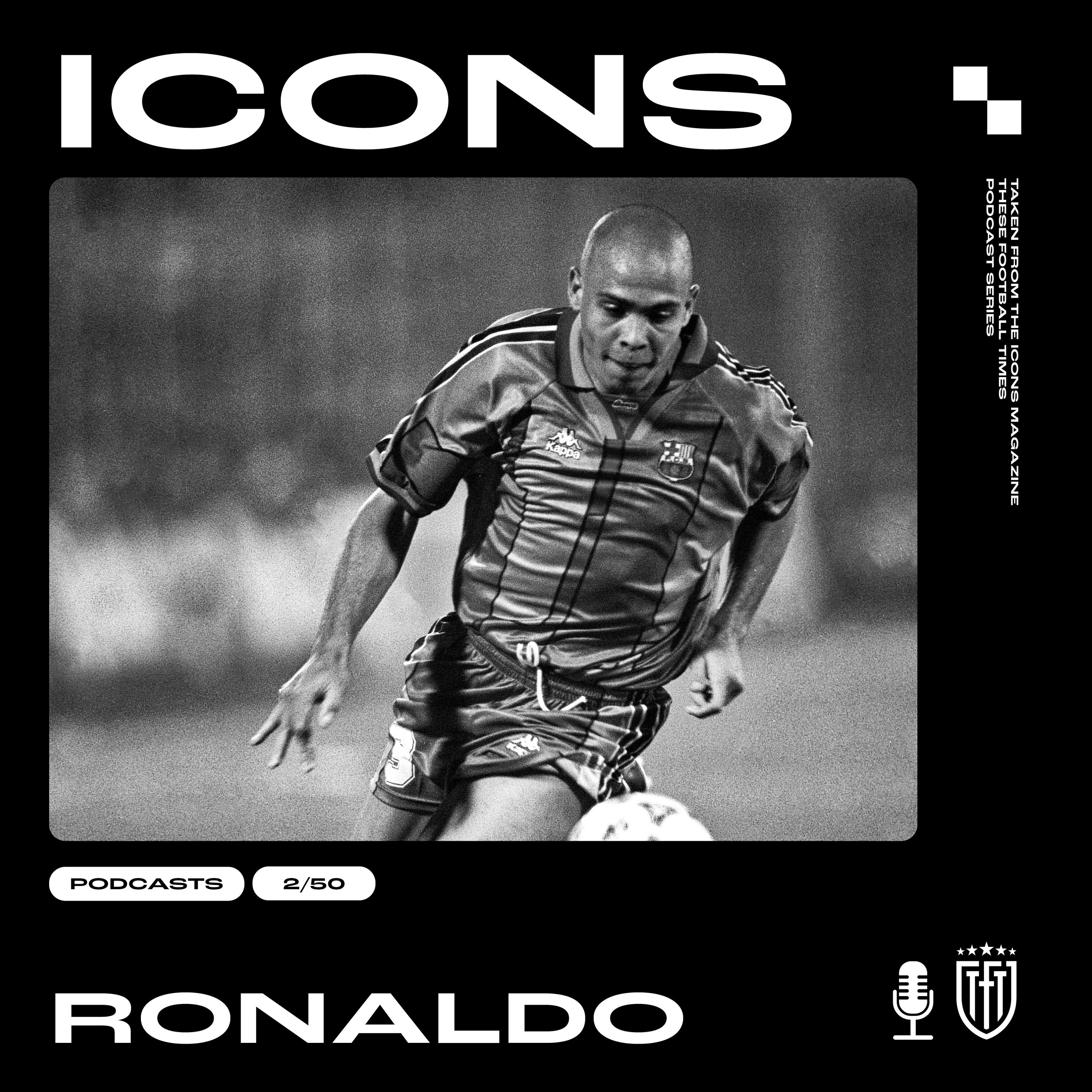
big club, as it were, you know, PSV are still a big club, big name, they won a European Cup, but of the big clubs, they're not a Barcelona, Real Madrid, Juve, Inter, etc. And kind of, they were a bit of a stepping stone and teams in Holland and Belgium, they could get these young players over from South America, they could mould them, they could be successful with them, and then they could sell them on for big fees. So even though PSV had spent quite a bit of money on Ronaldo, you know, for his age and kind of where he come from, they actually made a huge amount of money when they sold them to Barcelona in the summer of 96. And for me, seeing Ronaldo in that capper, Barcelona shirt with Bobby Robson as a manager, as a world record signing. He looks a little bit startled with all the attention that he's getting because it's such a huge moment for such a young, young player. So he signs for them in July 1996. So he's still not 20. You know, he's still not had his 20th birthday. He's only 19. And Bobby Robson said that he'd signed an eight year contract with Barcelona. So obviously the plan for him really was to be their number nine for the foreseeable future and completely sort of transform the club and build it around him. And the fact he went for a world record fee.
at his young age as well. He'd scored 54 goals in 58 games for PSV, which is just frightening. And this is like, he's not even adult at PSV. You know, he's under 18 for quite a lot of the time he's there. So really quite amazing. And the fact that he goes to Barcelona, I think for me, adds to sort of that mystique and that magic about him as a player. You know, he's going to the club that Johan Cruyff had managed so successfully in the late 80s and early 90s. And there was just something about playing for Barcelona at that time.
as a football club, they felt kind of so elevated and the new camp and the stadium and everything that went with that. And the fact that Romario had also played there as well. He'd done the similar route from PSV to Barcelona, just like Romario had. And that season at Barcelona, I mean, wow. It's very difficult, isn't it? When you're on a podcast talking about a player that you want to sort of just give superlatives to, when you also want to tell the audience, press pause, go on YouTube for three hours and then come back and then we'll carry on talking because just some of the way he's playing. I mean, he got described as a PlayStation footballer.
And obviously, you were talking about the context of the 90s. Football computer games were booming. You know, it wasn't sensible soccer anymore of these players moving in straight lines and everything like that. This was someone who looked like he was being controlled by someone because of that close control. In an earlier episode, Gary, you talked about Johan Cruyff gliding across the turf. Now, as a kid, I had Ronaldo's boots. I was a right back or a central defender. So certainly should not have been wearing Ronaldo's boots. But there was amazing adverts and images of Ronaldo's night mercurial boots that almost looked like they're flying or they've got speed.
flowing through them with the shape of the boot and everything like that. And the advertisements that went around him, for me, he's like Michael Jordan of football, where that kind of image is built around his style because it was so unique. You know, his airness was Michael Jordan, but Ronaldo was this phenomenon that we genuinely hadn't seen. And number nines didn't look like Ronaldo. You had your big guy, your big target man, you know, who would beat all the defenders down. And you had the small little poacher that was really quick over five yards, eight yards. And they could, they had such an instinct for goals. You're Gary Lineker's out of the world or whatever. But Ronaldo threw all out the window and just...
just phenomenal in terms of what he could do with the ball, especially in that season at Barcelona. I want to sort of touch on the teams he played for as well before we go on to his style, because there's so much to talk about with this guy. There's one game he played that was on the plane away at Santiago de Compostela in the north of Barcelona, sorry, north of Spain. And he picked the ball up on the halfway line. Guy pulling his shirt, brushed him aside, went plus one, plus two. And he must have been four or five players, not by trickery, but by sheer power.
pace and power away, through, through, roll the ball into the net and Bobby Robson, he's going to hunt in the air, I can't believe I've just seen, that was, as you say, so different for a centre forward at those times. But I said before, we sort of talk a bit more about his attributes and his legacy. This is a guy who played for Barcelona, Inter Milan, Milan, Real Madrid. Did he miss any big club outs? I mean, Middlesbrough, he didn't play Middlesbrough. Well, Gary, you know, we had a couple of Brazilians that we could have played with. One thing that I didn't realise until later in life, you know, as you get older, the more you look back, isn't it, when you're a football fan. And he actually played up front with Giannino in that 1995 Umbro Cup, which was kind of a bit of a dry run for Euro 96. They were testing out stadium security and whatnot. And Brian Robson was the assistant manager to Terry Vanables for England at that time. And he was watching Giannino play with Ronaldo and thought, do you know who he'd be great with? Jan Agafjortovt. Because obviously, Jan Agafjortovt and Ronaldo.
You know, interchangeable, number nine, shall we say. But he, Ronaldo, was part of such an amazing generation in Brazil in the 90s that, you know, it's names that I remember like Bebeto, Romario, you had Rivaldo, you had De Nielsen, Giannino, Edmundo, just from that forward line. And yet, he was better than all of them combined. And I think when he moved to Inter and brought the record again in 97, so he had a year at Barcelona, they kept offering him contracts, basically. He was signing new contracts, they were up in his wages, they were trying to extend how long he was going to be there for because they knew what special player they had. And then it all went wrong.
All the negotiations fall apart. You know, there's disagreements behind the scenes and he breaks the world record again. $27 million at this point in 1997, which if you think in 92, Lentini had gone for 15 million. We've doubled the world record in five years. And actually, he probably could have gone for 40 million, to be honest. And it would have been a bargain still because that season when he started Inter Milan was phenomenal. And I remember watching Gazette Football Italia and, you know, listening to some of his school friends and Italian football is boring. It's too defensive. You know, then Ronaldo goes there. First season, 25 goals. Like it's nothing. And he gets Serie A football of the year and you think, wow.
He's just going to carry on scoring. It's going to be so easy. And almost he was going to be, you hoped he was going to be Van Basten without the injuries. But then injuries come in. You sort of mentioned it before, a little bit guy with a knee injury that got a PSV that meant he didn't get two full seasons really with PSV, kind of one and a half. And it was a real tragedy. Like for me, it's a genuine, genuine tragedy in football that what happened to Ronaldo and his injuries because it totally changed the way he played football. He's still a phenomenal player. When you talk about Real Madrid, wow, Old Trafford, that hat trick when he's clapped off the pitch is amazing. And his goal scoring record.
is still fantastic even at Real Madrid when he can't run he's slightly overweight you know he hasn't got that burst of pace and he changes for me it's interesting I think it all starts probably around the 98 World Cup final when no one still really knows the story of that night I mean I remember that vividly as a kid watching it with my dad because he was like I say my favourite player and I had the Brazil shirt with the Ronaldo 9 on the back and everything like that and it was so confusing that he wasn't playing then he was playing then you know you're hearing these people talking about you know he's had convulsions or whatever in the dressing room has he had a heart attack you know has something happened to him and then from there things start to change quite a bit for him in terms of injuries. And, you know, I feel like it kind of makes him a little bit more iconic because you've always got that imaginary thought. Like, look at Messi and Ronaldo. They've done 20 years of incredible, incredible football. And yet, there's still probably a generation of football fans who say, but they are nowhere near as good as Ronaldo was from that 96 to 99 period. But only three years. You can't, for me, you can't be the best in the world or the best ever, as much as I'd want him to be, with such a short, kind of real, true peak. And I think that's such a shame, isn't it?
I think that's a really good point. I mean, to look back and say he was the best in the world, but as I said earlier, to me, for me, at his peak, when we were talking, we were talking Barcelona season, a little bit of PSV, Barcelona, he was the best striker, pure striker. I mean, you wouldn't say Messi was a striker, perhaps Ronaldo, you wouldn't say Palli was a striker, you wouldn't say Modona was a striker. As a pure striker, he's certainly the best striker I've ever seen in my life, and I'm going back more years than I care to think about. But I guess, you know, and you mentioned, you know, the sort of, the problems he had, and that almost makes him more human. That's, you know, that vulnerability, that weakness that he had, and yet we're still...
Even after those crippling knee injuries, you mentioned the Hattrick at Old Trafford, he was still an exceptional footballer. So he had a number of setbacks to go through in his career, one of which was the recurring knee injury. And then you mentioned about the World Cup thing. And he played in that final eventually, but, well, as he played, he turned up and he was on the pitch. But that was probably very, wasn't it? Yeah, and that, you know, as a 12-year-old football fan I'll have been at the time, that was quite tough to watch, actually, you know, as a young fan, when you kind of want to watch your heroes and you want to enjoy the football that you love. It was such a horrible moment. And how sad that was probably for him, as such a youngster, I mean, still.
sort of 20, 21 years old at that point, and the whole world at your feet. You know, you think you're going to have another 10, 15 years, but it sort of puts into perspective a little bit, doesn't it, when you talk about how football is such a short career for these players? You know, and so much of their worth, their importance, and their sort of legacy is built around their health. And for someone like Ronaldo, from the 98 final, he plays, what, probably about 30 games, maybe? 40 games over the next three seasons?
which again, for someone like him, what I do find, I mean, I'm very much, I like, I'm, you know, born from championship manager, so I look at appearances, goals, assists, that's the bread and butter. And his goal record, even when he wasn't fit, he's still scoring nearly a goal a game, even though he's only playing 10 games, he's scoring eight goals, or he's playing four games, scoring four goals, even with all the problems that he had. And you sort of feel for, for instance, Milan and their fans as well, you know, buying this player from Barcelona, seeing him be absolutely incredible for them. He's brilliant right up until the final of the World Cup, which I, and I still think, still one of my favourite World Cups with a strong Dutch team, a strong Argentinian team, even the English team was strong, French, really competitive tournament. And yet he just has no part to play in that final, which again, you know, it must be so difficult for him, but he gets 2002 and that's the thing. He gets it back and he kind of comes back and he gets himself fit towards the back end of the season. And he has the silliest haircut ever known in modern football. But even so, just for him to have that moment and win that World Cup for me, it's just brilliant. So memorable for him. Yeah, I guess, you know, when we look back at players' careers, you know, iconic players and outstanding stars of the game.
and how they perceived and, you know, you look back at, you mentioned, you know, Messi and Ronaldo never really had that injury crisis time in their careers and, you know, fair play, that's their good fortune. But I guess with Ronaldo, it's almost a case of, you know, look what he could have been, you know, if he hadn't had those injuries. I mean, was being successful so early in his career, did that sort of, you know, the classic overuse injuries when you get a kid growing up and playing so many games and, I mean, what could he have been? What could he have been? I mean, we're talking about, you know, I have no doubt in my seventh grade at his peak, the greatest striker. What could he have been, Rob, without those injuries?
For me, he would be the best player of all time. I genuinely believe that he would have been the best player of all time. Because if you think he would have been, you know, it's time at Real Madrid. He signs for Real Madrid when he's only 25. So imagine if he'd have gone there still having had four good seasons at Inter Milan, maybe. They almost certainly would have won Serie A titles. They would have been competing for the Champions League. Because remember, the Champions League at the back end of the 90s, early 90s, you had sort of Valencia got to a final, Bayern Munich, who, you know, good sides, solid sides, but not that I would say they were spectacular. Real Madrid obviously won with that final at Hampden Park with the famous Zidane goal.
I think he probably would have ended up at Real Madrid anyway, because everybody ends up at Real Madrid, don't they, if they're one of the best players in the world. So I think you're probably looking at, he only ever won two league titles in his career. And one of those, he only actually played three starts. The other one, you know, his first season at Madrid, he played a lot more. But he didn't win a Champions League. He obviously won the UEFA Cup with Inter Milan. Maybe Brazil. Cup in his cup with Barcelona. Yeah, Cup in his cup with Barcelona. Maybe Brazil would have won even more with him there. I mean, could you imagine like a 30-year-old Ronaldo if he'd have still been fitting at his peak? He probably could be looking at 400, 500 career goals, 600 career goals. Who knows? I think the sky, genuinely, I think the sky would have been the limit for a player like Ronaldo. You have to look. I mean, I remember when I was doing the mag on Ronaldo. Look back, he's seized at Barcelona. You're thinking, he left there when he was 20, 19, 20. He got.
at the top, at his peak, seven or eight years ahead of him, at his peak. That's been sort of fairly conservative. If he'd have had that ability to keep playing without those injuries, he would have destroyed all goal-scoring records, wherever he went. I mean, whatever club he played, and in international football, he would have destroyed all goal-scoring records. Because, I mean, logically, it wasn't even at his peak then. He's got another three or four years to sort of fill out, as it were, and mature as a player, which he was denied him. But, you know, the things...
it would have just destroyed the golf game records. And there would be no contest. You can put Pellet, you can put Di Stefano, you can put Maradona, Messi, who you want. If he'd had a chance to play, four things for those years. My word, my word.
Yeah, and I think what people forget is he basically misses one whole season at the turn of the millennium, completely. After that Barcelona season, he starts 32 games in his first season into a 25 goal, so still nearly a goal a game. The following season, he only starts 17, then five, then he misses a season completely, and then nine. So that age 21 to 24, it's just ripped away from him. And that's the sort of time when you're working it out.
Any flaws? I mean, you had very few. Any flaws, any tweaks to your game? Any little tricks that you start to develop or the position that you start to work with? Remember, Intermar at that time, we're constantly signing players. They would have found the right partner for him and he would have just scored so many. And I think, again, it was brilliant to see him back at Real Madrid almost again at a goal a game. But what could have been? I suppose it doesn't even bear thinking about because, I mean, you probably think about it all the time. You know, what could have been if I hadn't had those injuries? But on the flip side, you've got to think he still won the World Cup for Brazil, even after all the injuries and he had a really great goal-scoring record.
was part of that Galacticos squad, who were fun to watch, if maybe not as successful as they probably should have been, especially with him there. So I do think it's not a wasted opportunity because he took every opportunity that he had, but it's just, you know, really difficult and, like I say, tragic circumstances from a football point of view. Looking back, you know, he's probably had a career as successful as 0.0001% of all professional footballs in the history of mankind. But, you know, you still feel a little bit cheated. I mean, he might not be a wasteful involved in football in Spain. He owns, or part owns, real ideal lead in the northern Spain. And so he's still...
involved in football. That's great to have that sort of presence there still. So, final question, Robin. I love this question. I spoke to a few of the guys over the series. If he was playing today, how would he fit into the modern game? However he perishing well wants to, I suppose, would be the answer, wouldn't it?
I think for someone like Ronaldo, I actually think the modern game is even more suited to his capabilities than the 90s when he's around. We've talked a lot in the series about players from different generations and the type of boots they might have had, the ball, the pitch, the stadium, the shirt, the training, the recovery facilities, everything like that. But if you think he was so versatile in what he could do, if you would have said to me, right, Ronaldo's going to play for Man City in a really high-pressing style that's going to press the defenders and the goalkeeper, I would be terrified of that if I was the opposition because he was so quick. He was so sharp and he was so clever with his movement. If you also said to me he was going to play for a Jose Mourinho side, where Mourinho loved to sit a little bit deeper, soak up the pressure, and then spring on a counter-attack, he would be the first person forward, leading the line with speed, with pace. I mean, for me, we talk about Mbappe, we talk about Erling Haaland, but actually, Ronaldo was better than both of them combined. Combined. Because what the flaws in those two players are, Ronaldo actually could cover all of that, so he had the strengths of both of them. If we're sort of classing those two as...
you know, the best forwards in inverted commas, shall we say, or the most modern forwards, if you like, in the current game. If you actually think that sort of uniqueness and the flair and creativity that he has. I was watching, one of the best things about doing these podcasts is you've now got an excuse to go on YouTube and watch these highlights. And there's actually, there's a compilation, I think it's called 59 goals and it's all of his internal angles. And I've seen lots of his Barcelona goals, but not as many of his Inter Milan ones probably, although I saw that at the time. And he just toys with defenders. There could be two, three, four defenders around him. It didn't matter. It's like he had the skill of Messi, the power of a Ronaldo or Haaland, and the pace of a Mbappe all sort of rolled into one. And do you know what? One of the best things about him was he looked like he was having a brilliant time, didn't he? He looked like on that pitch, that whole Joga Benito kind of atmosphere that they created around that 98 squad with the advert in the airport, dribbling the ball at Roberto Carlos. It looked like football is fun. Yeah, it is about winning. We all want to win. But actually, it's about fun.
It's about entertainment. It's about your fans. And also it's about for the players actually loving the game. And for me, when I look at Ronaldo, I think you love the game. You absolutely love the game. And it's funny when you see these legends games, isn't it? You know, you're seeing like they go on tour and he's a big guy. But you see him on the football pitch and he's still smiling and he's still doing tricks and he's still shooting from everywhere. And for me, in the modern game, he would be sort of like the ultimate kind of icon for people to look up to because he loved the game. He loved playing football. He always played with that joy and that freedom that we could probably argue is missing a little bit from some of the modern superstars. You know, are they actually having fun?
or is the pressure of being a big player in a big team so much? But for me, one of the reasons why he's such an icon is just the joy he brought to a football pitch. Great way to finish it, Rob. Great way to finish it. So that was Ronaldo, the icon. Yeah, great, great chat. So a massive thanks to Rob for sharing his thoughts on the real Ronaldo, the real Ronaldo. And thanks for listening. Catch us again on the next episode of the Log Podcast from These Football Times. And we'll be talking about another football night. Many thanks for joining us today on The Log, a These Football Times production.
For more of our content, check out our award-winning print magazine featuring some of the game's foremost writers, artists and photographers exploring areas of the game rarely covered in high-end print. For now, we look forward to you joining us again soon.