
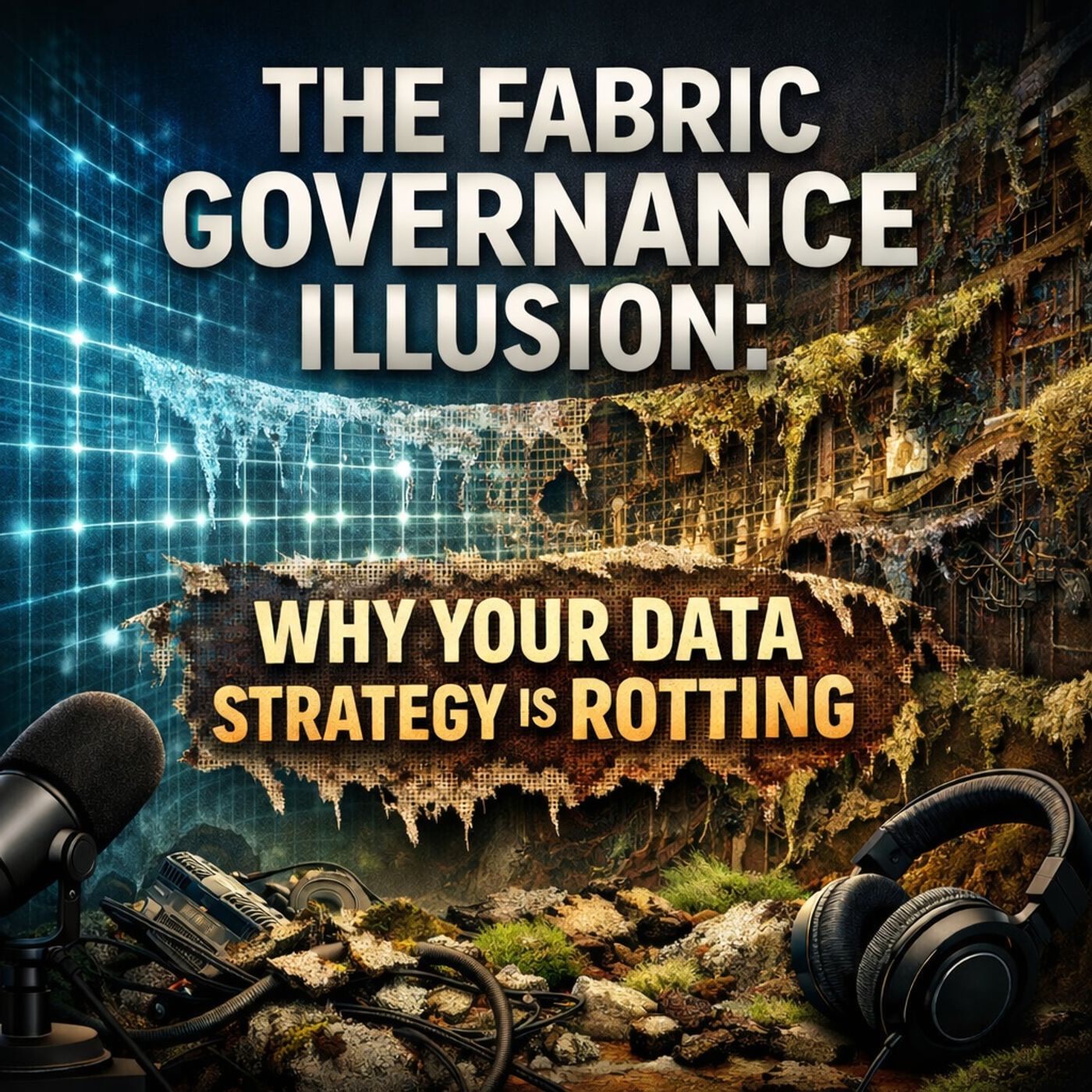
EPISODE · Feb 7, 2026 · 1H 20M
icrosoft Fabric Governance: Why Your Data Strategy Is Failing Even When the Platform Works
from M365.FM - Modern work, security, and productivity with Microsoft 365 · host Mirko Peters - Founder of m365.fm, m365.show and m365con.net
In this episode of m365.fm, Mirko Peters exposes one of the most expensive illusions in enterprise data architecture: the belief that adopting Microsoft Fabric solves your governance problem. One tenant, one bill, one security model, one platform — that is the pitch. And it is wrong in every way that matters when data quality, trust, and accountability are actually on the line.Microsoft Fabric is not a platform. It is a shared decision engine. And if you do not enforce intent through system constraints — through Microsoft Purview, through OneLake governance, through defined data ownership, through Entra ID access control, and through structured data contracts between producers and consumers — the platform will happily monetize your confusion. Usage metrics will look healthy. Dashboards will render. Reports will be produced. And the data underneath will be rotting.This episode breaks down exactly why Microsoft Fabric governance fails by default, how well-intentioned governance programs turn into theater, and what it actually takes to build a data strategy inside Microsoft Fabric that survives cost pressure, audit scrutiny, and AI integration at enterprise scale.WHAT YOU WILL LEARNWhy Microsoft Fabric governance fails by default even when the platform is fully deployed and actively usedWhat the Fabric Governance Illusion is and how it disguises data rot as platform success in Microsoft 365How Microsoft Purview, OneLake, and Entra ID must work together to enforce real data governance in Microsoft FabricWhy data ownership, data contracts, and lineage tracking are non-negotiable in a Microsoft Fabric enterprise architectureHow to distinguish between governance theater and real governance inside Microsoft Fabric and Microsoft 365What the hidden cost of ungoverned Microsoft Fabric data is when Copilot and AI agents start reasoning over itHow to design a Microsoft Fabric data strategy that survives audit, cost review, and AI integration pressureWhy Microsoft Fabric governance is not a technical problem — it is an organizational design and accountability problemTHE CORE INSIGHTMicrosoft Fabric governance fails not because the technology is wrong, but because organizations treat governance as a configuration task rather than a design discipline. They turn on Microsoft Purview sensitivity labels. They configure OneLake access policies. They assign workspace admins. And then they conclude that governance is in place. It is not. What they have is governance theater — the appearance of control without the accountability structure that makes control real.Real Microsoft Fabric governance means every dataset has a defined owner who is accountable for its accuracy and freshness. It means every consumer of that data has a defined contract with the producer — explicit about what is guaranteed, what is estimated, and what is raw. It means Microsoft Purview is not just labeling content, but enforcing data lifecycle policies that determine when data expires, who can extend it, and what audit trail exists when AI systems like Microsoft Copilot reason over it. Without that structure, your Microsoft Fabric environment is not a governed data platform. It is a very expensive shared drive with better dashboards.WHY MICROSOFT FABRIC GOVERNANCE FAILS IN PRACTICEData ownership is assigned on paper but never enforced through system constraints or accountability mechanismsMicrosoft Purview is configured for labeling but not for lifecycle management, lineage enforcement, or AI readinessOneLake access policies are set at the workspace level but not at the semantic layer where AI actually reasonsThere are no data contracts between producers and consumers, so quality expectations are implicit and unenforceableMicrosoft Fabric usage metrics create the illusion of health while underlying data quality silently degradesEntra ID permissions in Microsoft Fabric are not aligned with data ownership or consumption accountability modelsCopilot and AI agents are given access to Microsoft Fabric data before governance structures are in place to support itKEY TAKEAWAYSMicrosoft Fabric does not solve governance — it makes ungoverned data faster, more accessible, and more expensive to fixReal Microsoft Fabric governance requires data ownership, data contracts, and enforced lifecycle policies through Microsoft PurviewOneLake, Entra ID, and Microsoft Purview must be designed together as a unified governance architecture, not configured separatelyGovernance theater is the most dangerous state in Microsoft Fabric — it creates confidence without accountabilityAI integration with Microsoft Fabric data requires governance-first design, or Copilot will reason over rotting data at enterprise scaleMicrosoft Fabric governance is an organizational design problem, not a platform configuration problemWHO THIS EPISODE IS FORData architects and Microsoft Fabric platform owners responsible for enterprise data governance and strategyIT leaders and CIOs evaluating Microsoft Fabric for AI-ready data platforms in Microsoft 365 environmentsMicrosoft Purview and data governance teams designing lifecycle policies, lineage tracking, and access control for FabricPower BI and analytics engineers who need to understand why their Microsoft Fabric data quality is degrading under scaleEnterprise architects connecting Microsoft Fabric to Microsoft Copilot, AI agents, and Microsoft 365 intelligence workloadsAnyone responsible for data strategy, data ownership, or AI readiness inside a Microsoft Fabric or Microsoft 365 environmentTOPICS COVEREDMicrosoft Fabric Governance Architecture & Data Strategy DesignMicrosoft Purview Integration for OneLake Lifecycle Management & Data LineageEntra ID Access Control & Data Ownership in Microsoft FabricData Contracts, Producer-Consumer Accountability & OneLake GovernanceMicrosoft Fabric AI Readiness for Microsoft Copilot & Autonomous Agent IntegrationGovernance Theater vs. Real Governance in Microsoft Fabric and Microsoft 365Microsoft Fabric Cost Management & Audit Readiness for Enterprise Data PlatformsABOUT THE HOSTMirko Peters is a Microsoft 365 expert, architect, and host of m365.fm. He works with organizations from small businesses to large enterprise environments, focusing on Microsoft 365 architecture, Microsoft Fabric data governance, AI integration, Copilot deployment, Power Platform governance, Entra ID design, and enterprise system architecture. His work centers on designing context-driven systems that reduce complexity, enable autonomous execution, and create scalable AI performance across modern enterprises.Become a supporter of this podcast: https://www.spreaker.com/podcast/m365-fm-modern-work-security-and-productivity-with-microsoft-365--6704921/support.
Embed this episode
What this episode covers
In this episode of m365.fm, Mirko Peters exposes one of the most expensive illusions in enterprise data architecture: the belief that adopting Microsoft Fabric solves your governance problem. One tenant, one bill, one security model, one platform — that is the pitch. And it is wrong in every way that matters when data quality, trust, and accountability are actually on the line. Microsoft Fabric is not a platform. It is a shared decision engine. And if you do not enforce intent through system constraints — through Microsoft Purview, through OneLake governance, through defined data ownership, through Entra ID access control, and through structured data contracts between producers and consumers — the platform will happily monetize your confusion. Usage metrics will look healthy. Dashboards will render. Reports will be produced. And the data underneath will be rotting. This episode breaks down exactly why Microsoft Fabric governance fails by default, how well-intentioned governance programs turn into theater, and what it actually takes to build a data strategy inside Microsoft Fabric that survives cost pressure, audit scrutiny, and AI integration at enterprise scale. WHAT YOU WILL LEARN Why Microsoft Fabric governance fails by default even when the platform is fully deployed and actively used What the Fabric Governance Illusion is and how it disguises data rot as platform success in Microsoft 365 How Microsoft Purview, OneLake, and Entra ID must work together to enforce real data governance in Microsoft Fabric Why data ownership, data contracts, and lineage tracking are non-negotiable in a Microsoft Fabric enterprise architecture How to distinguish between governance theater and real governance inside Microsoft Fabric and Microsoft 365 What the hidden cost of ungoverned Microsoft Fabric data is when Copilot and AI agents start reasoning over it How to design a Microsoft Fabric data strategy that survives audit, cost review, and AI integration pressure Why Microsoft Fabric governance is not a technical problem — it is an organizational design and accountability problem THE CORE INSIGHT Microsoft Fabric governance fails not because the technology is wrong, but because organizations treat governance as a configuration task rather than a design discipline. They turn on Microsoft Purview sensitivity labels. They configure OneLake access policies. They assign workspace admins. And then they conclude that governance is in place. It is not. What they have is governance theater — the appearance of control without the accountability structure that makes control real. Real Microsoft Fabric governance means every dataset has a defined owner who is accountable for its accuracy and freshness. It means every consumer of that data has a defined contract with the producer — explicit about what is guaranteed, what is estimated, and what is raw. It means Microsoft Purview is not just labeling content, but enforcing data lifecycle policies that determine when data expires, who can extend it, and what audit trail exists when AI systems like Microsoft Copilot reason over it. Without that structure, your Microsoft Fabric environment is not a governed data platform. It is a very expensive shared drive with better dashboards. WHY MICROSOFT FABRIC GOVERNANCE FAILS IN PRACTICE Data ownership is assigned on paper but never enforced through system constraints or accountability mechanisms Microsoft Purview is configured for labeling but not for lifecycle management, lineage enforcement, or AI readiness OneLake access policies are set at the workspace level but not at the semantic layer where AI actually reasons There are no data contracts between producers and consumers, so quality expectations are implicit and unenforceable Microsoft Fabric usage metrics create...
NOW PLAYING
icrosoft Fabric Governance: Why Your Data Strategy Is Failing Even When the Platform Works
No transcript for this episode yet
Similar Episodes
No similar episodes found.
Similar Podcasts
No similar podcasts found.