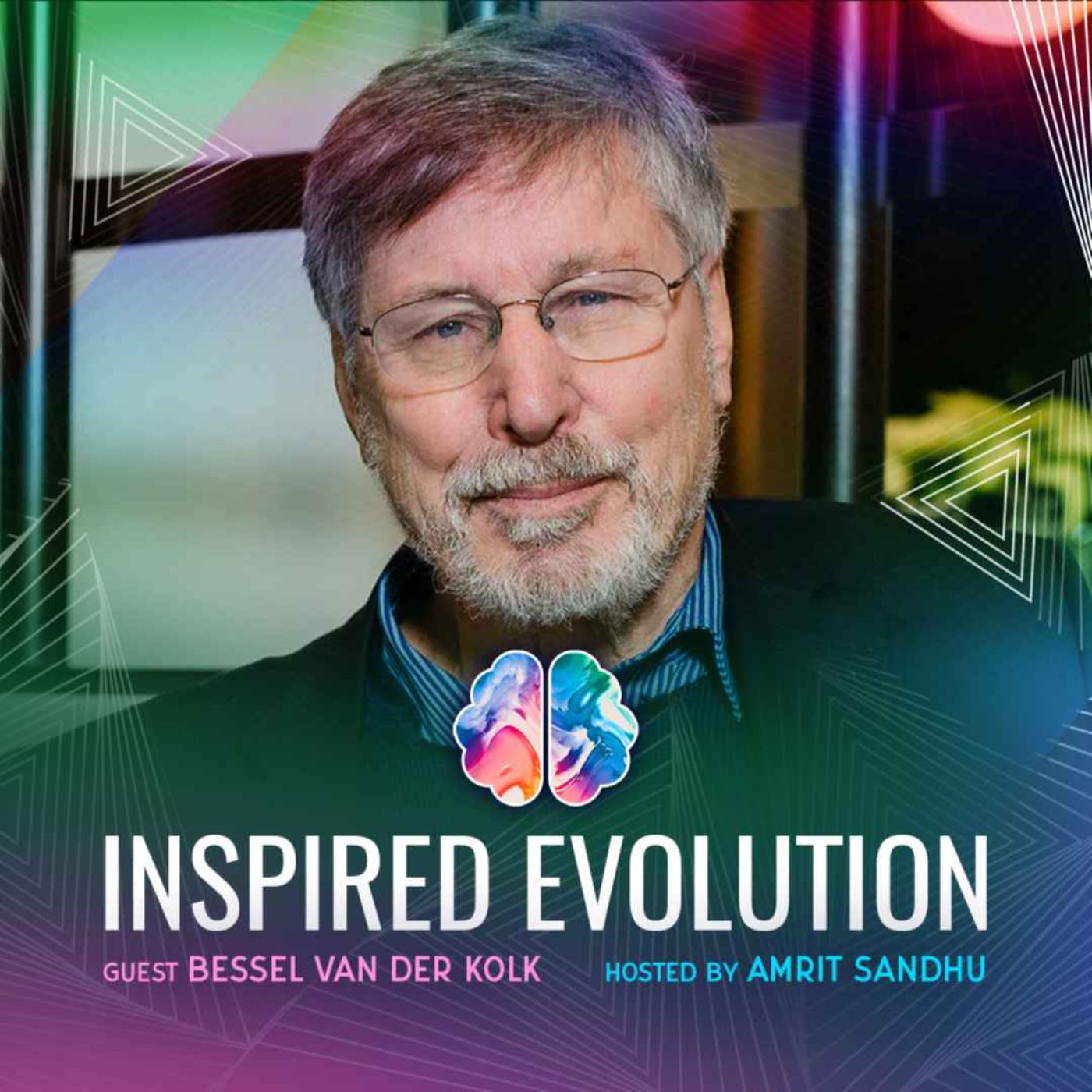
IE162 Dr. Bessel van der Kolk: Transforming Trauma: How to Heal the Body that Keeps The Score episode artwork

EPISODE · Feb 14, 2021 · 51 MIN

IE162 Dr. Bessel van der Kolk: Transforming Trauma: How to Heal the Body that Keeps The Score

from Inspired Evolution with Amrit Sandhu 🙏🏻

In this week’s episode, Amrit interviews Dr. Bessel van der Kolk, a psychiatrist, author, researcher and educator based in Boston, USA. He was previously the president for the International Society for Traumatic stress Studies, former co-director of the National Child Traumatic Stress Network, professor of Psychiatry at Boston University School of Medicine and president of the Trauma Research Foundation in Brookline, Massachusetts.Dr. Bessel has published over 150 peer reviewed scientific articles on trauma and how to heal from trauma. He is the author of “Post-traumatic Stress Disorder”, “Psychological Trauma”, Traumatic Stress with Alexander C. McFarlane and Lars Weisæth, and the New York Times best seller, The Body Keeps the Score. In this episode, Amrit and Dr. Bessel have a profound conversation about trauma and healing. They dive deep into what causes trauma, how and why it gets stored in the body, and effective healing modalities to recover from it.If you would like to have access to Dr. Bessel’s best seller “The Body Keeps the Score” and learn more about how to heal a body that stores trauma, please go to:  https://amz.run/4I8M   In the first part of this chapter, Amrit and Dr. Bessel talk about what is trauma, what goes on in our brain when we hold on to things that we can't let go of, how we navigate the world with stored traumatic experiences, experiences that can prevent you from living a life and the importance of having people around you when feeling overwhelmed. They converse about the changes in your brain when you go through a dramatic experience, different parts of the body related to traumatic experiences, the role of helplessness when trying to get out of a traumatic experience we can’t get out of and the role of our nervous system when processing trauma.They cave into a dialogue around the link between our rational mind and the trauma we experience and where the trauma is stored. In regards to this modern society in which people have in their heads what their bodies should look like; they talk about whether this is potentially creating more of a disconnection rather than a connection to their bodies.Furthermore, in the second half of the episode, they dive deep into healing with a short parable of the raft and how once helpful things can become a burden instead. They talk about how to begin with healing, how every culture has their own indigenous ways of dealing with trauma, the importance of some modalities of healing having someone around, modalities for healing with no one around, different healing therapies, western culture’s therapies, and promising neurofeedback and psychedelic therapy with it’s different perspectives.In this chapter you will discover what trauma is, how it makes you feel, how it is formed and created, how it changes your brain, why people experiencing trauma keep behaving and reacting as if they were stuck in that experience, why you get stuck in a state of hyper alertness and why your body, mind and entire system gets frozen or stuck in “fight or flight” mode.You will understand why people try to shut the feeling down and end up shutting down their ability to feel turning to drugs, alcohol, pharmaceuticals and compulsive behaviour. You also will have access to different modalities and therapies for healing trauma, promising research around psychotropics and psychedelic therapy and neurofeedback.You will learn the importance of taking care of your body, feeling safe and being surrounded by your loved ones.You will master the most effective healing modalities to recover from trauma!“Take care of your body”“Develop a loving relationship to take care of your body”About Dr. Bessel van der Kolk:Bessel van der Kolk MD spends his career studying how children and adults adapt to traumatic experiences, and has translated emerging findings from neuroscience and attachment research to develop and study a range of treatments for traumatic stress in children and adults.In 1984, he set up one of the first clinical/research centers in the US dedicated to study and treatment of traumatic stress in civilian populations, which has trained numerous researchers and clinicians specializing in the study and treatment of traumatic stress, and which has been continually funded to research the impact of traumatic stress and effective treatment interventions. He did the first studies on the effects of SSRIs on PTSD; was a member of the first neuroimaging team to investigate how trauma changes brain processes, and did the first research linking BPD and deliberate self-injury to trauma and neglect in early childhood.Much of his research has focused on how trauma has a different impact at different stages of development, and that disruptions in care-giving systems have additional deleterious effects that need to be addressed for effective intervention. In order to promote a deeper understanding of the impact of childhood trauma and to foster the development and execution of effective treatment interventions, he initiated the process that led to the establishment of the National Child Traumatic Stress Network (NCTSN), a Congressionally mandated initiative that now funds approximately 150 centers specializing in developing effective treatment interventions, and implementing them in a wide array of settings, from juvenile detention centers to tribal agencies, nationwide.He has focused on studying treatments that stabilize physiology, increase executive functioning and help traumatized individuals to feel fully alert to the present. This has included an NIMH funded study on EMDR and NCCAM funded study of yoga, and, in recent years, the study of neurofeedback to investigate whether attentional and perceptual systems (and the neural tracks responsible for them) can be altered by changing EEG patterns.​His efforts resulted in the establishment of Trauma Center (now the Trauma Research Foundation) that consisted of a well-trained clinical team specializing in the treatment of children and adults with histories of child maltreatment, that applied treatment models that are widely taught and implemented nationwide, a research lab that studied the effects of neurofeedback and MDMA on behavior, mood, and executive functioning, and numerous trainings nationwide to a variety of mental health professional, educators, parent groups, policy makers, and law enforcement personnel.Tune In: Welcome Dr. Bessel van der Kolk to the Inspired Evolution!: (00:00)How Dr. Bessel defines Trauma: (02:59)“Trauma is an experience that overwhelms your system”Process in the brain when holding onto things and not letting go: (04:10) “We have systems in the brain that create the map of where we need to go”Navigating the world with traumatic experiences that drop in: (07:44)“What originally was protecting you becomes a deferment and prevents you from living”Traumatic experiences have to be extreme or can they be everyday experiences?: (08:41) “Humans need each other to make themselves feel safe”Community as an instrumental part of the coping system: (11:27)“The deepest hurt is to be brutalized by the people we love”About the brain having gone through a traumatic experience: (12:27)“If you cannot fight or flee, your system may get stuck and keep on producing stress hormones”Different parts of the body related to different traumatic experiences?: (13:55)The role of helplessness when trying to get out of traumatic experiences you can't get out of: (15:24)The role of the nervous system in processing trauma: (16:32)“The function of the brain is to have a functioning body”“Your body sends signals that need to be attended”The link between a rational mind and a traumatic experience. Is trauma rational: (19:27)“A rational brain explains things, your body speaks the truth”Parts of the head connected to the body responsible for storing trauma: (22:22) “You have to love the relationship to your body”Does worrying about the way we must look create more of a disconnection than a connection to our body?:(25:40)About a raft parable referring to the things we hold on to: (27:15)“People have been very ingenious in being able to survive horrendous situations but they have their draft on their shoulders”From trauma to healing: (31:06) “Healing trauma becomes helping people be insync with people around them”Research uncovering indigenous modalities for healing?: (37:46)“Research can do only what is socially acceptable”About collective trauma in modern society: (39:02)“You can make misery anywhere and you can make happiness anywhere, it all depends on how respectful, insync and how open people are to each other”Self healing modalities where others don't need to be involved: (40:58)“None of us do things by ourselves”About Psychedelic Therapy and it’s different perspective: (45:23)“You transport into a different reality where you see yourself in a much larger perspective”Dr. Bessel van der Kolk’s books and articles:“The body keeps the score: Brain, mind, and body in the healing of trauma” by Dr. Bessel van der Kolk: https://amz.run/4I8M  “Traumatic Stress: The Effects of Overwhelming Experience on Mind, Body, and Society” by Dr. Bessel van der Kolk & Alexander C. McFarlane and Lars Weisaeth: https://amz.run/4I8O “Psychological Trauma” by Dr. Bessel van der Kolk: https://amz.run/4I8Q “Post-Traumatic Stress Disorder: Psychological and Biological Sequelae” (Clinical Insights) by Dr. Bessel van der KolkDr. van der Kolk’s Google Scholar: https://scholar.google.com/citations?user=1oHBFlMAAAAJ&hl=en Mentioned resources:Dave Asprey: https://www.youtube.com/watch?v=cS9MBM2rvA8&t=115s Connect with Dr. Bessel van der Kolk:Website: https://www.besselvanderkolk.com/ Facebook The Body Keeps The Score: https://www.facebook.com/thebodykeepsthescore/ Instagram: https://www.instagram.com/bessel_van/ Instagram The Body Keeps The Score: https://www.instagram.com/thebodykeepsthescore/ Wiki page: https://en.wikipedia.org/wiki/Bessel_van_der_Kolk Join the Inspired Evolution Community:Facebook: https://www.facebook.com/InspiredEvolution/    Instagram: https://www.instagram.com/InspiredEvo/ YouTube: https://www.youtube.com/InspiredEvolution/  Website: https://inspiredevolution.com/ Support this show http://supporter.acast.com/inspiredevolution. Hosted on Acast. See acast.com/privacy for more information.

In this week’s episode, Amrit interviews Dr. Bessel van der Kolk, a psychiatrist, author, researcher and educator based in Boston, USA. He was previously the president for the International Society for Traumatic stress Studies, former co-director of the National Child Traumatic Stress Network, professor of Psychiatry at Boston University School of Medicine and president of the Trauma Research Foundation in Brookline, Massachusetts.Dr. Bessel has published over 150 peer reviewed scientific articles on trauma and how to heal from trauma. He is the author of “Post-traumatic Stress Disorder”, “Psychological Trauma”, Traumatic Stress with Alexander C. McFarlane and Lars Weisæth, and the New York Times best seller, The Body Keeps the Score. In this episode, Amrit and Dr. Bessel have a profound conversation about trauma and healing. They dive deep into what causes trauma, how and why it gets stored in the body, and effective healing modalities to recover from it.If you would like to have access to Dr. Bessel’s best seller “The Body Keeps the Score” and learn more about how to heal a body that stores trauma, please go to:  https://amz.run/4I8M   In the first part of this chapter, Amrit and Dr. Bessel talk about what is trauma, what goes on in our brain when we hold on to things that we can't let go of, how we navigate the world with stored traumatic experiences, experiences that can prevent you from living a life and the importance of having people around you when feeling overwhelmed. They converse about the changes in your brain when you go through a dramatic experience, different parts of the body related to traumatic experiences, the role of helplessness when trying to get out of a traumatic experience we can’t get out of and the role of our nervous system when processing trauma.They cave into a dialogue around the link between our rational mind and the trauma we experience and where the trauma is stored. In regards to this modern society in which people have in their heads what their bodies should look like; they talk about whether this is potentially creating more of a disconnection rather than a connection to their bodies.Furthermore, in the second half of the episode, they dive deep into healing with a short parable of the raft and how once helpful things can become a burden instead. They talk about how to begin with healing, how every culture has their own indigenous ways of dealing with trauma, the importance of some modalities of healing having someone around, modalities for healing with no one around, different healing therapies, western culture’s therapies, and promising neurofeedback and psychedelic therapy with it’s different perspectives.In this chapter you will discover what trauma is, how it makes you feel, how it is formed and created, how it changes your brain, why people experiencing trauma keep behaving and reacting as if they were stuck in that experience, why you get stuck in a state of hyper alertness and why your body, mind and entire system gets frozen or stuck in “fight or flight” mode.You will understand why people try to shut the feeling down and end up shutting down their ability to feel turning to drugs, alcohol, pharmaceuticals and compulsive behaviour. You also will have access to different modalities and therapies for healing trauma, promising research around psychotropics and psychedelic therapy and neurofeedback.You will learn the importance of taking care of your body, feeling safe and being surrounded by your loved ones.You will master the most effective healing modalities to recover from trauma!“Take care of your body”“Develop a loving relationship to take care of your body”About Dr. Bessel van der Kolk:Bessel van der Kolk MD spends his career studying how children and adults adapt to traumatic experiences, and has translated emerging findings from neuroscience and attachment research to develop and study a range of treatments for traumatic stress in children and adults.In 1984, he set up one of the first clinical/research centers in the US dedicated to study and treatment of traumatic stress in civilian populations, which has trained numerous researchers and clinicians specializing in the study and treatment of traumatic stress, and which has been continually funded to research the impact of traumatic stress and effective treatment interventions. He did the first studies on the effects of SSRIs on PTSD; was a member of the first neuroimaging team to investigate how trauma changes brain processes, and did the first research linking BPD and deliberate self-injury to trauma and neglect in early childhood.Much of his research has focused on how trauma has a different impact at different stages of development, and that disruptions in care-giving systems have additional deleterious effects that need to be addressed for effective intervention. In order to promote a deeper understanding of the impact of childhood trauma and to foster the development and execution of effective treatment interventions, he initiated the process that led to the establishment of the National Child Traumatic Stress Network (NCTSN), a Congressionally mandated initiative that now funds approximately 150 centers specializing in developing effective treatment interventions, and implementing them in a wide array of settings, from juvenile detention centers to tribal agencies, nationwide.He has focused on studying treatments that stabilize physiology, increase executive functioning and help traumatized individuals to feel fully alert to the present. This has included an NIMH funded study on EMDR and NCCAM funded study of yoga, and, in recent years, the study of neurofeedback to investigate whether attentional and perceptual systems (and the neural tracks responsible for them) can be altered by changing EEG patterns.​His efforts resulted in the establishment of Trauma Center (now the Trauma Research Foundation) that consisted of a well-trained clinical team specializing in the treatment of children and adults with histories of child maltreatment, that applied treatment models that are widely taught and implemented nationwide, a research lab that studied the effects of neurofeedback and MDMA on behavior, mood, and executive functioning, and numerous trainings nationwide to a variety of mental health professional, educators, parent groups, policy makers, and law enforcement personnel.Tune In: Welcome Dr. Bessel van der Kolk to the Inspired Evolution!: (00:00)How Dr. Bessel defines Trauma: (02:59)“Trauma is an experience that overwhelms your system”Process in the brain when holding onto things and not letting go: (04:10) “We have systems in the brain that create the map of where we need to go”Navigating the world with traumatic experiences that drop in: (07:44)“What originally was protecting you becomes a deferment and prevents you from living”Traumatic experiences have to be extreme or can they be everyday experiences?: (08:41) “Humans need each other to make themselves feel safe”Community as an instrumental part of the coping system: (11:27)“The deepest hurt is to be brutalized by the people we love”About the brain having gone through a traumatic experience: (12:27)“If you cannot fight or flee, your system may get stuck and keep on producing stress hormones”Different parts of the body related to different traumatic experiences?: (13:55)The role of helplessness when trying to get out of traumatic experiences you can't get out of: (15:24)The role of the nervous system in processing trauma: (16:32)“The function of the brain is to have a functioning body”“Your body sends signals that need to be attended”The link between a rational mind and a traumatic experience. Is trauma rational: (19:27)“A rational brain explains things, your body speaks the truth”Parts of the head connected to the body responsible for storing trauma: (22:22) “You have to love the relationship to your body”Does worrying about the way we must look create more of a disconnection than a connection to our body?:(25:40)About a raft parable referring to the things we hold on to: (27:15)“People have been very ingenious in being able to survive horrendous situations but they have their draft on their shoulders”From trauma to healing: (31:06) “Healing trauma becomes helping people be insync with people around them”Research uncovering indigenous modalities for healing?: (37:46)“Research can do only what is socially acceptable”About collective trauma in modern society: (39:02)“You can make misery anywhere and you can make happiness anywhere, it all depends on how respectful, insync and how open people are to each other”Self healing modalities where others don't need to be involved: (40:58)“None of us do things by ourselves”About Psychedelic Therapy and it’s different perspective: (45:23)“You transport into a different reality where you see yourself in a much larger perspective”Dr. Bessel van der Kolk’s books and articles:“The body keeps the score: Brain, mind, and body in the healing of trauma” by Dr. Bessel van der Kolk: https://amz.run/4I8M  “Traumatic Stress: The Effects of Overwhelming Experience on Mind, Body, and Society” by Dr. Bessel van der Kolk & Alexander C. McFarlane and Lars Weisaeth: https://amz.run/4I8O “Psychological Trauma” by Dr. Bessel van der Kolk: https://amz.run/4I8Q “Post-Traumatic Stress Disorder: Psychological and Biological Sequelae” (Clinical Insights) by Dr. Bessel van der KolkDr. van der Kolk’s Google Scholar: https://scholar.google.com/citations?user=1oHBFlMAAAAJ&hl=en Mentioned resources:Dave Asprey: https://www.youtube.com/watch?v=cS9MBM2rvA8&t=115s Connect with Dr. Bessel van der Kolk:Website: https://www.besselvanderkolk.com/ Facebook The Body Keeps The Score: https://www.facebook.com/thebodykeepsthescore/ Instagram: https://www.instagram.com/bessel_van/ Instagram The Body Keeps The Score: https://www.instagram.com/thebodykeepsthescore/ Wiki page: https://en.wikipedia.org/wiki/Bessel_van_der_Kolk Join the Inspired Evolution Community:Facebook: https://www.facebook.com/InspiredEvolution/    Instagram: https://www.instagram.com/InspiredEvo/ YouTube: https://www.youtube.com/InspiredEvolution/  Website: https://inspiredevolution.com/ Support this show http://supporter.acast.com/inspiredevolution. Hosted on Acast. See acast.com/privacy for more information.

NOW PLAYING

IE162 Dr. Bessel van der Kolk: Transforming Trauma: How to Heal the Body that Keeps The Score

0:00 51:05

No transcript for this episode yet

We transcribe on demand. Request one and we'll notify you when it's ready — usually under 10 minutes.

MG Show MG Show The MG Show, hosted by Jeffrey Pedersen and Shannon Townsend, is a leading alternative media platform dedicated to uncovering the truth behind today’s most pressing political issues. Launched in 2019, the show has grown exponentially, offering unfiltered insights, comprehensive research, and real-time analysis. With a commitment to independent journalism and factual integrity, the MG Show empowers its audience with knowledge and encourages active participation in the political discourse. French Your Way Jessica: Native French teacher founder of French Your Way Boost your French listening skills and test your comprehension with this one of a kind series of podcasts. Get the chance to listen to a real conversation between native speakers talking at normal speed AND customise your learning experience through carefully designed sets of questions (2 levels of difficulty) available for download at www.frenchvoicespodcast.com. All interviews also come with the transcript. French teacher Jessica interviews native speakers of French from around the world who share a bit of their life and passion. Where else would you meet in one same place a French yoga teacher based in Melbourne, a soap manufacturer from Provence, or a couple cycling around the world? That Hoarder: Overcome Compulsive Hoarding That Hoarder Hoarding disorder is stigmatised and people who hoard feel vast amounts of shame. This podcast began life as an audio diary, an anonymous outlet for somebody with this weird condition. That Hoarder speaks about her experiences living with compulsive hoarding, she interviews therapists, academics, researchers, children of hoarders, professional organisers and influencers, and she shares insight and tips for others with the problem. Listened to by people who hoard as well as those who love them and those who work with them, Overcome Compulsive Hoarding with That Hoarder aims to shatter the stigma, share the truth and speak openly and honestly to improve lives. The Small Business Startup School – Business Notes | Financial Literacy | Retail Psychology – For Professionals & Entrepreneurs The Small Business Startup School Inc. Starting or buying a small business? While personal circumstances may vary, business patterns remain timeless. On The Small Business Startup School, we explore strategies, insights, and practical solutions to help entrepreneurs confidently navigate their journey.Hosted by Ola Williams—a retail entrepreneur, fintech founder, and financial coach with over two decades of experience—this podcast marries financial awareness and retail psychology with optimism to deliver actionable takeaways.Join us to learn, grow, and connect as we uncover the keys to business success.Let’s continue to learn together and be encouraged to keep on connecting!

Frequently Asked Questions

How long is this episode of Inspired Evolution with Amrit Sandhu 🙏🏻?

This episode is 51 minutes long.

When was this Inspired Evolution with Amrit Sandhu 🙏🏻 episode published?

This episode was published on February 14, 2021.

What is this episode about?

In this week’s episode, Amrit interviews Dr. Bessel van der Kolk, a psychiatrist, author, researcher and educator based in Boston, USA. He was previously the president for the International Society for Traumatic stress Studies, former co-director of...

Can I download this Inspired Evolution with Amrit Sandhu 🙏🏻 episode?

Yes, you can download this episode by clicking the download button on the episode player, or subscribe to the podcast in your preferred podcast app for automatic downloads.
URL copied to clipboard!