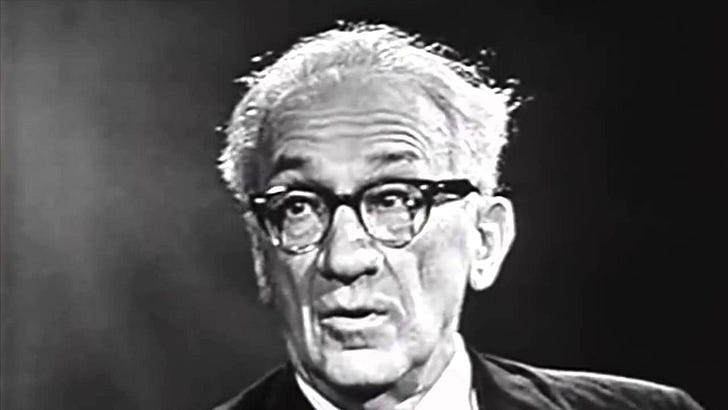
Immanuel Velikovsky
from The Duke Report Podcast Hosted by The Duke Report™️
Immanuel Velikovsky’s talk at Eastern Baptist College in Wayne, Pennsylvania, from the 1974 American Association for the Advancement of Science Symposium. Velikovsky speaks for about fifty minutes, compressing his whole theory across psychology, the Old Testament, geology, paleontology, ocean science, archaeology, and astronomy before he opens the floor to questions. He frames the talk as an attempt to plant skepticism in young listeners. Every figure, date, and claim below belongs to Velikovsky as he delivered it. Opening: planting a seed (00:10) Velikovsky greets the audience, glad to see so many young faces, and notes that someone has already laid out his theory in a shorter span. He recalls the gentile who asked Rabbi Hillel to teach the wisdom of Judaism in the time a man could stand on one leg. Rabbi Shammai, stern and severe, drove the man from the premises; Hillel answered in a single sentence — love thy neighbor as yourself — and the gentile converted. Velikovsky sets a smaller goal for himself. He hopes to leave behind some seeds of skepticism and a fresh look at the universe and what fills it. Where the work began (02:09) Velikovsky tells the audience he will cross many fields of science in forty-five minutes, with questions to follow. He began with the Old Testament, and he credits his years in psychoanalysis for sharpening his eye. In his consulting room, he often heard a patient describe a situation so obvious in its meaning that only the patient stayed blind to it. He reads the Exodus the same way. The plagues, the passages in Numbers, the Psalms, the words of the prophets — Velikovsky argues that the Old Testament turns on a few catastrophic events, events a whole nation witnessed, with the population of Egypt caught up in them. A global event, read across nations (04:00) From the start, Velikovsky presses one point: people across the world witnessed these events. The long day in the Book of Joshua, with sun and moon halted, could not have hung over the valley of Ajalon alone. Wherever the sun still shone, the day would have stretched; wherever night had fallen, the night would have run long. He travels in imagination from book to book — which is to say from land to land — and finds the Mexicans, the Babylonians, the Persians, and the Chinese reporting the same occurrences. He lingers on a detail. Joshua describes stones falling from the sky two verses before the sun stands still. Joshua could not have known the link between the Earth’s rotation and its passage through a cloud of meteorites. Native peoples on the American continent could not have known why the sun would climb, drop, climb again, and drop while the land burst into flame. Velikovsky argues that people who could not grasp the mechanism could not invent the story. Something happened. In China, at the same moment, the records describe disturbances of atmosphere and water — the consequences he expects when the earth’s rotation falters. The seas, the prophets, and the Egyptian eyewitness (07:09) Velikovsky turns to the seas. He cites accounts of gigantic tides and an ocean torn apart, and points to the Talmud’s claim that the seas of the world split together, the Sea of Passage among them. Read on these terms, he argues, the words of the prophets make plain sense — mountains skip like rams, hills melt like wax, the earth trembles, coals and dust fall from the sky, and rivers and seas turn red — language that means nothing if the days stay calm. If those things happened, Velikovsky reasons, an Egyptian record should exist. He found one: a papyrus held for more than a century at the University of Leiden Museum in Holland, translated by Gardiner in 1909. The verses Gardiner rendered into modern English match the plague narrative in the King James Version, yet Gardiner did not notice. Velikovsky calls this scotoma, a blind spot, and finds it shared across centuries of readers and commentators who saw stone for stone and fire for fire and registered none of it. Scotoma and overturned mountains (09:46) He widens the blind spot to all of us. Readers translated a book into scores of languages and pored over it for generations, and still passed over its central drama. Even fundamentalists declined to picture a mountain turning over as a mountain turning over. Velikovsky says the mountains did turn over and moved from their roots. The Rocky Mountains shifted scores of miles. The Alps moved from northern Italy toward present-day Switzerland. The Matterhorn lies overturned, its younger formations and fossils at the bottom and the older above. Young mountains (11:32) Now, in geology, Velikovsky takes on the age of mountains. Geologists had placed their building in the Tertiary, sixty million to one million years ago. Investigators who climbed the Andes, the Alps, and the Himalayas returned with one verdict: the mountains are young. The Himalayas rose in the age of Neolithic and even Bronze Age people. Tilted ancient lake shores still hold the vestiges of historical men. Velikovsky points to a city high in the Andes, above twelve thousand feet, where no grain grows and no great population could have lived, its agricultural terraces climbing into permanent snow above fifteen thousand feet. The mass death of animals (14:00) The whole antiplano around Lake Titicaca, Velikovsky says, rose thousands of feet at once. He recalls Darwin at Valparaiso, puzzled by decayed shells thousands of feet above the sea and by the bones of vanished giant animals, writing in his diary that the entire frame of the globe must have shaken to destroy so many creatures from Tierra del Fuego to the Bering Strait. Velikovsky reports the same wholesale destruction on all five continents. Gold-digging machines in Alaska slice through muck packed with animals torn limb from limb. Islands north of Siberia stand built of splintered trees and the bones of mammoths, horses, buffaloes, and rhinoceroses. He asks how hippopotami reached England, how corals once grew off Spitsbergen and Greenland, and how ostriches, crocodiles, polar bears, seals, and arctic foxes came to lie buried together, animals that could never have shared a habitat. Origin of species, fossils, and shifting ground (17:02) From destruction Velikovsky moves to origin. He doubts that competition alone, working on one simple ancestral form, can explain how a crocodile, a bird, a worm, a man, and a many-legged insect all came to be, or how so many species vanished without descendants. He presses the puzzle of fossilization: the textbook account asks animals to die in shallow water and lie covered before predators reach them, in a process so slow it runs across tens of thousands of years as the land subsides, and he asks who has ever seen a cat wading in the shallows. A faster process did the work. The sea erupted; sea and land traded places. Velikovsky says the fixed outline of continents and oceans, a dogma in geology, has no basis in fact. Ancient climates and two dated catastrophes (19:35) Velikovsky turns at once to climate. Ancient climates differed sharply from today’s. Corals could not have grown where he found their traces unless the earth once traveled a different orbit on a differently tilted axis — try raising corals at the North Pole, he says. He notes that the climate changed hard around 1500 BC and again in the eighth century BC, a finding Scandinavian researchers established before he took up the problem. Those two windows frame his first book, Worlds in Collision: the catastrophe of the Exodus, the catastrophe in the time of Joshua fifty-two years later, and a second series in the days of the prophets Isaiah, Amos, and Hosea. He points the audience to that week’s issue of Time magazine, where oceanographers report that the volcanic island of Thera, north of Crete, erupted with terrific force around 1500 BC and again about fifty years on — the same interval he had assigned to the Exodus and Joshua, and the same interval recorded in Mesoamerican sources from the … This is a public episode. If you'd like to discuss this with other subscribers or get access to bonus episodes, visit thedukereport.substack.com/subscribe
Embed this episode
No transcript yet.