
EPISODE · Aug 9, 2025 · 49 MIN
Imposing Climate Law onto Governments (WHY2025)
from Chaos Computer Club - recent audio-only feed · host Rick van Rein
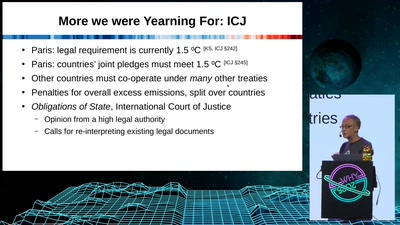
This talk is a roller-coaster ride through a few years of experience in teaching the government about their obligations w.r.t. climate change. It details the procedural hacks they use, and ways to evade them. It also gives examples of elegantly designed cases with a potential of very high impact. Climate law is a domain of logic, language and social ethics, all available in the average hacker's toolbox. I'd argue the world needs our minds to lap up the debris left behind by our governments. At [MCH2022](https://mch2022.org/#/) I ran into skilled, intelligent young people who were numb about climate change. This is trending, and it broke my reliance on governments to fix this huge problem. It is, after all, a [tragedy of the commons](https://en.wikipedia.org/wiki/Tragedy_of_the_commons) so by default everyone waits for others to make the first move. I adopted a grassroots approach and started taking government to court, alone or as part of [Scientist Rebellion](https://www.scientistrebellion.nl/). Because it really is politics that is failing us. Court cases help executive government to do their jobs, by forcing them to stick to climate laws in spite of politicians without vision, heart or spine. Climate law is mostly international law, which means that it trumps national law, even including anything that a national Supreme Court says. But courts are not the problem, they are well-versed in the travesty of what governments are _not_ doing. They need to be asked to rule on a case though, before they can take a decision. And it takes some work before you get to that point. I am not saying that government is evil. I am saying it is stifled in its ways, it cannot progress because it is obstructed by the past, present, procedures and politics. The everyday working space for civil servants is one of national or even local law. They have insufficient focus on international (climate) law or rely on other parties to remedy it. Also, they cannot always move freely, caught up between their oath of faith and a lack of mandate to interpret laws. With low court fees and no lawyer requirement, administrative law is the cheapest way to go about correcting government, but it takes a fair amount of skill to navigate. I'm still learning, but I can share from experience the most important pitfalls to prepare for. Most of this has parallels in countries outside the Netherlands. What remains is logic, language and ethics. Oh, and some perseverance and creativity. All these skills are native to hackers, and often abundantly so. It can take some designer skill to construct a case that has a chance of making it. And looking at things from different perspectives, while still sticking to concrete goals. During this talk, I will give a few examples. If you want to read up on things, have a look at my [Draaiboek Klimaatzaak](http://klimaatzaak.groengemak.nl/) (in Dutch) or similar resources by others. Finally, it can feel abrasive to step out and impose demands on local government, a national ministry or a central bank. At least, I usually think shyly of what I am doing. But abresiveness is not among my submission filters; I care for being reasonable and having a right to what I'm demanding. And as long as I remain respectful towards the humans on the other side of a case, it is quite simply a democratic right to take corrective or coercive action if the government fails so utterly as it is doing w.r.t. climate change. **IANAL** but what I am is _seriously pissed_ with irresponsible governments around the globe. It is their job to protect our future survival, the evidence and urgency is overwhelmingly clear, but still they leave the free market to corporations with short-term profit as their essential goal. Corporations will bend when curtailed, provided it is done equally to all, and there is only one party with the power of doing that. But government is treating a life-threatening condition as yet another management problem to fit into a 9-to-5 job. So much is done wrong that I find it unethical to sit and wait for a rare breed of climate lawyers to stand up to government mismanagement. Not if all it takes is a few hundred Euros, strict logical reasoning, a few letters full of detailed knowledge in a design with components from a couple of data sheets (a.k.a. climate laws) and perhaps the mentality of living in a makable world (a.k.a. democracy). Licensed to the public under https://creativecommons.org/licenses/by/4.0/ about this event: https://program.why2025.org/why2025/talk/FYX8FV/
What this episode covers
This talk is a roller-coaster ride through a few years of experience in teaching the government about their obligations w.r.t. climate change. It details the procedural hacks they use, and ways to evade them. It also gives examples of elegantly designed cases with a potential of very high impact. Climate law is a domain of logic, language and social ethics, all available in the average hacker's toolbox. I'd argue the world needs our minds to lap up the debris left behind by our governments. At [MCH2022](https://mch2022.org/#/) I ran into skilled, intelligent young people who were numb about climate change. This is trending, and it broke my reliance on governments to fix this huge problem. It is, after all, a [tragedy of the commons](https://en.wikipedia.org/wiki/Tragedy_of_the_commons) so by default everyone waits for others to make the first move. I adopted a grassroots approach and started taking government to court, alone or as part of [Scientist Rebellion](https://www.scientistrebellion.nl/). Because it really is politics that is failing us. Court cases help executive government to do their jobs, by forcing them to stick to climate laws in spite of politicians without vision, heart or spine. Climate law is mostly international law, which means that it trumps national law, even including anything that a national Supreme Court says. But courts are not the problem, they are well-versed in the travesty of what governments are _not_ doing. They need to be asked to rule on a case though, before they can take a decision. And it takes some work before you get to that point. I am not saying that government is evil. I am saying it is stifled in its ways, it cannot progress because it is obstructed by the past, present, procedures and politics. The everyday working space for civil servants is one of national or even local law. They have insufficient focus on international (climate) law or rely on other parties to remedy it. Also, they cannot always move freely, caught up between their oath of faith and a lack of mandate to interpret laws. With low court fees and no lawyer requirement, administrative law is the cheapest way to go about correcting government, but it takes a fair amount of skill to navigate. I'm still learning, but I can share from experience the most important pitfalls to prepare for. Most of this has parallels in countries outside the Netherlands. What remains is logic, language and ethics. Oh, and some perseverance and creativity. All these skills are native to hackers, and often abundantly so. It can take some designer skill to construct a case that has a chance of making it. And looking at things from different perspectives, while still sticking to concrete goals. During this talk, I will give a few examples. If you want to read up on things, have a look at my [Draaiboek Klimaatzaak](http://klimaatzaak.groengemak.nl/) (in Dutch) or similar resources by others. Finally, it can feel abrasive to step out and impose demands on local government, a national ministry or a central bank. At least, I usually think shyly of what I am doing. But abresiveness is not among my submission filters; I care for being reasonable and having a right to what I'm demanding. And as long as I remain respectful towards the humans on the other side of a case, it is quite simply a democratic right to take corrective or coercive action if the government fails so utterly as it is doing w.r.t. climate change. **IANAL** but what I am is _seriously pissed_ with irresponsible governments around the globe. It is their job to protect our future survival, the evidence and urgency is overwhelmingly clear, but still they leave the free market to corporations with short-term profit as their essential goal. Corporations will bend when curtailed, provided it is done equally to all, and there is only one party with the power of doing that. But government is treating a life-threatening condition as yet another management problem to fit into a 9-to-5 job. So much is done wrong that I find it unethical to sit and wait for a rare breed of climate lawyers to stand up to government mismanagement. Not if all it takes is a few hundred Euros, strict logical reasoning, a few letters full of detailed knowledge in a design with components from a couple of data sheets (a.k.a. climate laws) and perhaps the mentality of living in a makable world (a.k.a. democracy). Licensed to the public under https://creativecommons.org/licenses/by/4.0/ about this event: https://program.why2025.org/why2025/talk/FYX8FV/
NOW PLAYING
Imposing Climate Law onto Governments (WHY2025)
No transcript for this episode yet
Similar Episodes
Mar 26, 2026 ·1m
Feb 8, 2026 ·4m
Jan 30, 2026 ·6m
Jan 2, 2026 ·47m