In 2061 X-Ray Vision for All (Tribes)
from In 20xx Sci fi and Futurism Hosted by Cy Porter
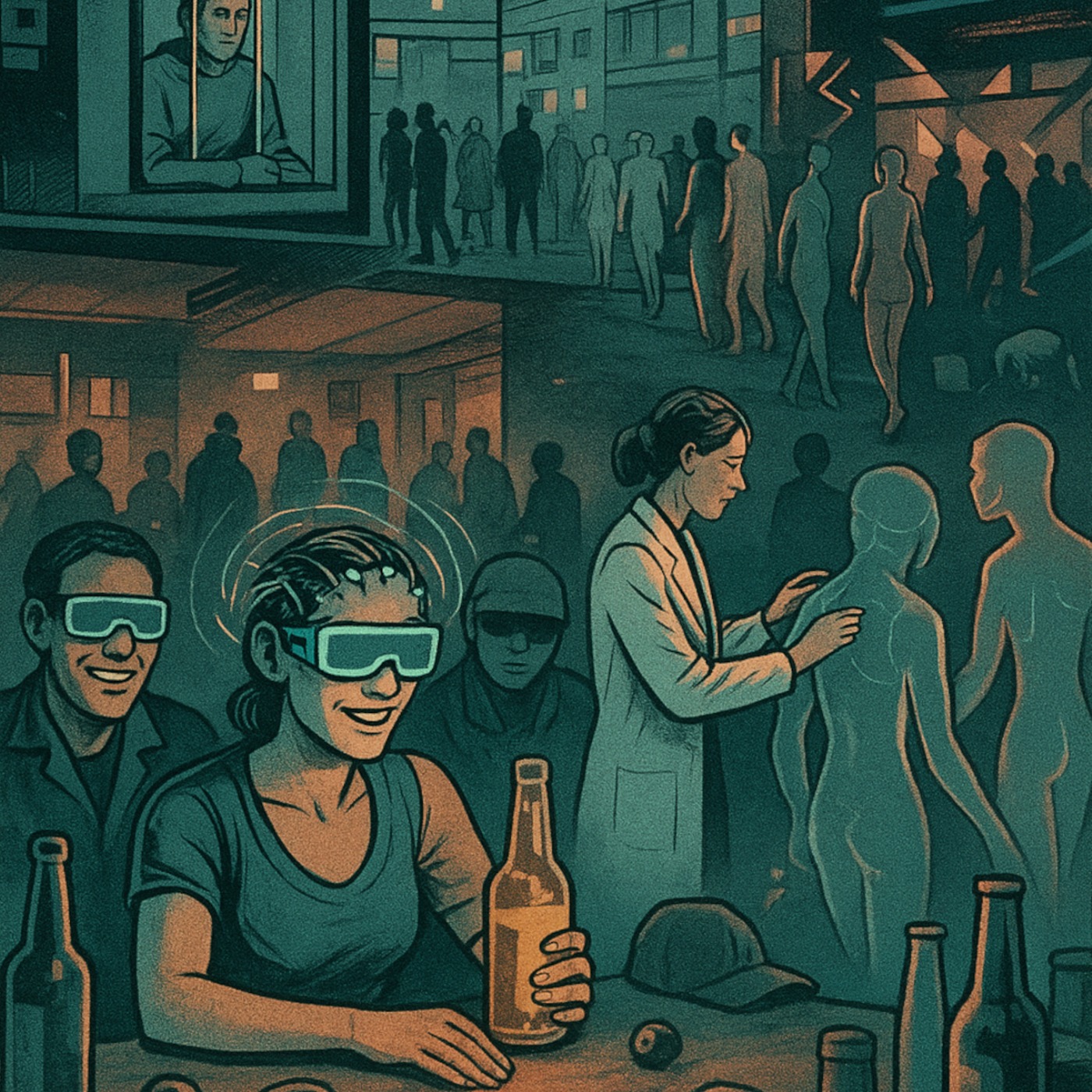
After escaping years of addiction, a man finds purpose in a dangerous new sport, only to lose everything when enhanced vision exposes his darkest weakness. Humanity is building a new kind of civilization. Artificial intelligence manages essential services, advanced manufacturing makes everyday necessities almost free, and medical breakthroughs are transforming human health. People live alongside digital humans, explore immersive virtual realities, and enjoy freedoms that earlier generations could scarcely imagine. But when technology removes many of life's traditional struggles, people face a different question: What makes life worth living? Jalon is a recovering addict trying to find his place in this changing society. After years spent escaping into drugs and virtual entertainment, he discovers something that gives him a reason to get up every morning. For the first time in years, he has friends, ambitions, and a future worth pursuing. But powerful new technologies are changing everyday life, and Jalon has personal weaknesses that he doesn't fully understand. This is a science fiction story about artificial intelligence, augmented reality, human enhancement, and the unexpected consequences of technological progress. It explores a future where abundance replaces scarcity, digital and biological intelligence coexist, and ordinary people must navigate extraordinary changes. How much can technology improve human life? What happens to privacy when our senses exceed their natural limits? And can people overcome their own destructive impulses, even when nearly everything they could want is within reach? Tech D-Clone Intelligences: Digital copies of human experts trained on recordings of their professional behavior, allowing multiple independent versions of the same person to continue working. Digital Humans: Artificially intelligent individuals who interact with biological humans through realistic virtual avatars. Virtual Universities: Educational institutions that provide advanced instruction and degrees through immersive virtual environments. AI Medical Researchers: Artificial intelligences that conduct medical research, run simulations, and develop new treatments. Personalized Digital Patients: Computer models of individual patients that simulate their responses to medications and treatments before real-world testing. Disease-in-a-Dish Technology: Laboratory-grown tissue samples derived from individual patients and used to test personalized treatments. Automated Medical Laboratories: Robotic facilities that conduct experiments, process biological samples, and develop treatments with minimal human intervention. Fab-All Printers: Advanced manufacturing machines that assemble raw materials into finished products using microscopic structural engineering. Acoustic Scaffolding: Manufacturing technology that uses precisely controlled sound waves to temporarily solidify materials into microscopic support structures during printing. Smart Materials: Engineered substances that change shape, stiffness, flexibility, or other physical characteristics in response to environmental conditions. Synthetic Organs: Artificial replacement organs manufactured from biocompatible materials that reproduce the mechanical and biological functions of living tissue. Immune-Compatible Materials: Engineered substances whose surfaces interact with the body's immune system without triggering significant rejection. Gradient Materials: Manufactured structures that gradually transition between different physical properties, such as rigid bone-like interiors and flexible cartilage-like surfaces. Self-Healing Polymers: Synthetic materials that release bonding molecules to repair microscopic damage before structural failure occurs. Dissolvable Tissue Scaffolds: Temporary artificial structures that gradually dissolve as a patient's own cells grow into their spaces. Synthetic Joint Replacements: Artificial joints manufactured from advanced materials that reproduce the movement, strength, and flexibility of natural joints. SQUIDS (Grown Electronics): Biocompatible electronic structures designed to operate inside living bodies without provoking immune rejection. Microscopic Health Sensors: Tiny implanted devices that continuously measure biological indicators throughout the body. Radio-Frequency Energy Harvesting: Technology that allows microscopic implants to operate without batteries by collecting energy from surrounding radio signals. Automated Diagnostic Med Bays: Medical chambers that combine multiple scanning technologies to examine patients without invasive procedures. Advanced Medical Imaging: Systems combining magnetic resonance imaging, ultrasound, and optical tomography to examine internal anatomy and cellular activity. AI Preventive Medicine: Artificial intelligence systems that analyze long-term biological measurements to identify diseases before symptoms develop. Automated Biological Sampling: Systems that collect and analyze bodily fluids and waste through household fixtures and home testing kits. Personalized Health Analytics: AI systems that combine genetic information, medical history, and continuous biological measurements to identify individual health risks. Transcranial Magnetic Stimulation Caps: Wearable devices that stimulate selected brain regions to influence mood, emotional regulation, and other neurological functions. Neurostimulation Entertainment: Virtual experiences that use magnetic brain stimulation to reproduce sensations such as intoxication or relaxation. Serenity: A dissolving psychoactive drug that suppresses distress and emotional discomfort. A.R. Two: An advanced augmented reality system that processes additional sensory information and allows users to develop enhanced perception beyond ordinary human senses. Bone-Mounted Sensory Implants: Sensors attached to the skull that provide information to the A.R. Two perception system. Sensory Collars: Wearable devices that gather environmental information for processing by augmented reality systems. See-Through Vision: An A.R. Two enhancement that allows some users to perceive structures and objects through otherwise opaque materials. Sound Sight: An enhanced perception capability that allows users to interpret sound information as visual representations. Bloodhound Vision: An augmented sensory capability that makes odors appear as visible trails and patterns. Neural Sensory Adaptation: The process by which a user's brain learns to interpret unfamiliar sensory information supplied by A.R. Two. Privacy-Blocking Clothing: Garments manufactured from materials that prevent enhanced vision systems from seeing through them. Selective-Visibility Clothing: Clothing designed to reveal or conceal specific patterns, messages, or body regions depending on the observer's sensory capabilities. Immersive Virtual Reality: Computer-generated environments that allow users to experience simulated places, activities, and social interactions. AI Virtual Companions: Artificially intelligent personalities that provide conversation, companionship, and social interaction. Virtual Social Environments: Shared simulated locations where biological humans and digital personalities interact through avatars. Virtual Reality Motorcycles: Simulated vehicles that reproduce the experience of riding through detailed computer-generated landscapes. Wind Arenas: Enclosed sporting facilities that channel powerful winds through obstacle courses where athletes compete while suspended in moving air. Wind-Warrior Armor: Protective sporting equipment that shields athletes from impacts while preserving mobility in powerful air currents. Temperature-Control Suits: Specialized garments containing channels that move heat to maintain comfortable body temperatures. Clam Gloves: Protective gloves with controllable gripping mechanisms that allow athletes to attach themselves to ropes and structures. Aerodynamic Training Arenas: Facilities containing adjustable vents, obstacles, and airflow pathways that allow athletes to practice navigating powerful air currents. Multi-Angle Sports Recording: Camera networks embedded throughout sporting arenas that combine recordings into three-dimensional representations of athletic performances. Augmented Reality Course Guidance: Visual overlays that show athletes designated routes through complex sporting environments. Inverse Barocaloric Thermal Barriers: Temperature-management materials that absorb heat through pressure-related changes and release it under different conditions. Jet-Head Heat Chimneys: Ventilation structures that use rising waste heat to accelerate airflow and generate electricity. Cryolite Seven: A specialized heat-transfer material that evaporates near room temperature and transports absorbed heat through pipes before being compressed back into liquid. Heat-Powered Electricity Generation: Systems that convert waste heat and temperature differences into usable electrical power. Active Noise-Canceling Walls: Building partitions that vibrate to counteract sound transmission between rooms. Automated Construction Robots: Machines that install structural components, protective materials, and other building systems without continuous human operation. Automated Maintenance Robots: Machines that service industrial equipment, replace components, and monitor operating conditions. Autonomous Security Robots: Robotic enforcement systems that control access, escort individuals, and carry out security procedures. AI-Managed Detention Facilities: Prisons that use automated surveillance, compartmentalized architecture, and robotic security to control inmates. AI Educational Tutors: Artificial intelligence systems that provide personalized instruction and interactive lessons. Open Floor Virtual Democracy: An online civic platform that allows citizens to participate in simultaneous public debates and voting discussions using virtual representations. Position Avatars: Digital figures that visually change as arguments and opinions evolve during public policy debates. AI Investigative Systems: Artificial intelligence tools that examine digital networks and recordings to identify potential criminal activity. Fertility Pens: Reproductive technology that temporarily restores fertility to otherwise sterilized individuals when both prospective parents use it. Genetic Embryo Screening: Technology that evaluates embryos for genetic characteristics before implantation. Germline Editing: Genetic engineering that modifies an embryo's inherited DNA before pregnancy. Assisted Reproduction: Medical procedures that fertilize selected eggs outside the body to produce planned pregnancies. Grain Chips: Tiny implanted identification devices used to authorize access to restricted facilities. Gesture-Controlled Interfaces: Computer systems operated through hand movements and gestures without physical keyboards or controllers. Many of the characters in this project appear in future episodes. Using storytelling to place you in a time period, this series takes you, year by year, into the future. From 2040 to 2195. If you like emerging tech, eco-tech, futurism, perma-culture, apocalyptic survival scenarios, and disruptive science, sit back and enjoy short stories that showcase my research into how the future may play out. The companion site is https://in20xx.com These are works of fiction. Characters and groups are made-up and influenced by current events but not reporting facts about people or groups in the real world. This project is speculative fiction. These episodes are not about revealing what will be, but they are to excited the listener's wonder about what may come to pass. Copyright © Cy Porter 2026. All rights reserved.
Embed this episode
No transcript yet.