PodParley PodParley

In Bloom

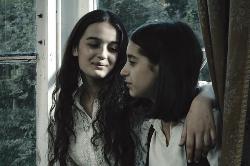
A little miracle has come out of Georgia, the former Soviet republic. It’s a film called In Bloom, written by Nana Ekvtimishvili, and directed by her and Simon Gross. It tells of two 14-year-old girls living in the Georgian capital of Tbilisi, in a time of poverty and great unrest. You’d have to know about the history of the region to pick up, from occasional conversations and snatches of TV news in the film, that it’s 1992, right after the collapse of the Soviet Union, when Georgia suffered through a coup and a civil war. But if you don’t know about any of that, it doesn’t really matter, because the film’s depiction of the struggles of adolescent girls is strong and forceful and universally relevant in many ways. Diminutive, sad-eyed Eka, played by Lika Babluani, is best friends with Natia, played by Mariam Bokeria. Natia looks a little older than Eka, and her beauty is already attracting attention from boys, mostly unwanted. We are first gradually immersed in the daily lives of these girls—Eka’s household is shadowed by the absence of a father, unexplained until later in the film; whereas Natia’s father is an abusive drunk. There are breadlines in which people push and shove and swear at each other in order to get to the bread first, and the situation at school is chaotic, where the kids openly defy their bullying teacher. There’s really no melodrama here, or at least not much—the directors manage to evoke the tenderness and some of the joy of companionship, especially among the girls of the town, so that much of all this seems like normal teen misbehavior and rebellion, but exacerbated by social collapse and oppressive patriarchal culture. A young man who flirts with Natia presents her with an unusual gift—a gun to defend herself, and as the film goes on, this gun symbolizes the frustrated desire of the girls for some power over their own lives. One of the threats the gun is supposedly meant to ward off is “brideknapping”—a custom of kidnapping young girls and forcing them to get married. I hear this is not as prevalent in Georgia as it used to be, but it’s a sign of how deeply sexist the culture really is. The two lead actresses are girls that the filmmakers discovered in Tbilisi, not professionals, and they’re wonderful. Sometimes a director can access the greatest truths from the natural behavior of amateurs like this, and that’s what happens here. The style employs a lot of long takes with a moving camera, and this lends the film a gentle rhythm. Two sequences I would go so far as to call tours de force. One early scene shows a large group of girls gathered at Eka’s house when her mother’s out, smoking, talking, singing when someone plays the piano, all done without cuts, the camera roaming through the rooms. The second great scene shows Eka enjoying a moment in the spotlight, when she mesmerizes a wedding party with a spontaneous dance. In Bloom presents the richness of life and the sadness of how easily it can be wasted.

An episode of the Flicks with The Film Snob podcast, hosted by Chris Dashiell, titled "In Bloom" was published on April 24, 2014.

April 24, 2014 · Flicks with The Film Snob

0:00 / 0:00

A little miracle has come out of Georgia, the former Soviet republic. It’s a film called In Bloom, written by Nana Ekvtimishvili, and directed by her and Simon Gross. It tells of two 14-year-old girls living in the Georgian capital of Tbilisi, in a time of poverty and great unrest. You’d have to know about the history of the region to pick up, from occasional conversations and snatches of TV news in the film, that it’s 1992, right after the collapse of the Soviet Union, when Georgia suffered through a coup and a civil war. But if you don’t know about any of that, it doesn’t really matter, because the film’s depiction of the struggles of adolescent girls is strong and forceful and universally relevant in many ways. Diminutive, sad-eyed Eka, played by Lika Babluani, is best friends with Natia, played by Mariam Bokeria. Natia looks a little older than Eka, and her beauty is already attracting attention from boys, mostly unwanted. We are first gradually immersed in the daily lives of these girls—Eka’s household is shadowed by the absence of a father, unexplained until later in the film; whereas Natia’s father is an abusive drunk. There are breadlines in which people push and shove and swear at each other in order to get to the bread first, and the situation at school is chaotic, where the kids openly defy their bullying teacher. There’s really no melodrama here, or at least not much—the directors manage to evoke the tenderness and some of the joy of companionship, especially among the girls of the town, so that much of all this seems like normal teen misbehavior and rebellion, but exacerbated by social collapse and oppressive patriarchal culture. A young man who flirts with Natia presents her with an unusual gift—a gun to defend herself, and as the film goes on, this gun symbolizes the frustrated desire of the girls for some power over their own lives. One of the threats the gun is supposedly meant to ward off is “brideknapping”—a custom of kidnapping young girls and forcing them to get married. I hear this is not as prevalent in Georgia as it used to be, but it’s a sign of how deeply sexist the culture really is. The two lead actresses are girls that the filmmakers discovered in Tbilisi, not professionals, and they’re wonderful. Sometimes a director can access the greatest truths from the natural behavior of amateurs like this, and that’s what happens here. The style employs a lot of long takes with a moving camera, and this lends the film a gentle rhythm. Two sequences I would go so far as to call tours de force. One early scene shows a large group of girls gathered at Eka’s house when her mother’s out, smoking, talking, singing when someone plays the piano, all done without cuts, the camera roaming through the rooms. The second great scene shows Eka enjoying a moment in the spotlight, when she mesmerizes a wedding party with a spontaneous dance. In Bloom presents the richness of life and the sadness of how easily it can be wasted.

inbloom A little miracle has come out of Georgia, the former Soviet republic. It’s a film called In Bloom, written by Nana Ekvtimishvili, and directed by her and Simon Gross. It tells of two 14-year-old girls living in the Georgian capital of Tbilisi, in a time of poverty and great unrest. You’d have to know about the history of the region to pick up, from occasional conversations and snatches of TV news in the film, that it’s 1992, right after the collapse of the Soviet Union, when Georgia suffered through a coup and a civil war. But if you don’t know about any of that, it doesn’t really matter, because the film’s depiction of the struggles of adolescent girls is strong and forceful and universally relevant in many ways.

Diminutive, sad-eyed Eka, played by Lika Babluani, is best friends with Natia, played by Mariam Bokeria. Natia looks a little older than Eka, and her beauty is already attracting attention from boys, mostly unwanted. We are first gradually immersed in the daily lives of these girls—Eka’s household is shadowed by the absence of a father, unexplained until later in the film; whereas Natia’s father is an abusive drunk. There are breadlines in which people push and shove and swear at each other in order to get to the bread first, and the situation at school is chaotic, where the kids openly defy their bullying teacher.

There’s really no melodrama here, or at least not much—the directors manage to evoke the tenderness and some of the joy of companionship, especially among the girls of the town, so that much of all this seems like normal teen misbehavior and rebellion, but exacerbated by social collapse and oppressive patriarchal culture.

A young man who flirts with Natia presents her with an unusual gift—a gun to defend herself, and as the film goes on, this gun symbolizes the frustrated desire of the girls for some power over their own lives. One of the threats the gun is supposedly meant to ward off is “brideknapping”—a custom of kidnapping young girls and forcing them to get married. I hear this is not as prevalent in Georgia as it used to be, but it’s a sign of how deeply sexist the culture really is.

The two lead actresses are girls that the filmmakers discovered in Tbilisi, not professionals, and they’re wonderful. Sometimes a director can access the greatest truths from the natural behavior of amateurs like this, and that’s what happens here. The style employs a lot of long takes with a moving camera, and this lends the film a gentle rhythm. Two sequences I would go so far as to call tours de force. One early scene shows a large group of girls gathered at Eka’s house when her mother’s out, smoking, talking, singing when someone plays the piano, all done without cuts, the camera roaming through the rooms. The second great scene shows Eka enjoying a moment in the spotlight, when she mesmerizes a wedding party with a spontaneous dance. In Bloom presents the richness of life and the sadness of how easily it can be wasted.

Future Flicks with Billiam The SomewhatNerdy Podcast Network Future Flicks is a podcast about flicks that come out, wait for it, in the future! In this podcast your host Billiam from SomewhatNerdy.com will go over all the movies coming out during the week, tell you his pick, and throw in his thoughts and occasionally trivia and news. He’ll also throw in a movie review every podcast or two for a suggestion on what to watch during a night in. So check out Future Flicks because why use Google to tell you what movies are coming out when you can have an opinionated Nerd do it for you. Box Office Premiere Podcasts Box Office is a weekly film show on Virgin Media Two, which takes a look at the pick of the flicks in cinemas, along with a host of fun film features. Flick Switch Flickswitch Flick Switch is far more than a rigging rental company. We have built our business on delivering high quality solutions with years of experience in a wide variety of markets, including film, television, live events, international touring and theatre.With our years of experience in audio, lighting, screens, sets, (and the list goes on) we can go further than just the support rigging. We are also able to rig the equipment too. Planning and installing the power and data distribution, fixtures, fly systems and other equipment, fine tuning, focusing and operating.When you engage Flick Switch yo Mark Fricks - The Road Less Traveled Mark Fricks Federal Employees - The Retirement Road Less Traveled with Financial Adviser and Federal Employee Advocate Mark Fricks. Mark Shares the mission behind the 2nd edition of The Book "The Road Less Traveled." This is a Financial Roadmap for Federal Employees seeking a secure retirement.
URL copied to clipboard!