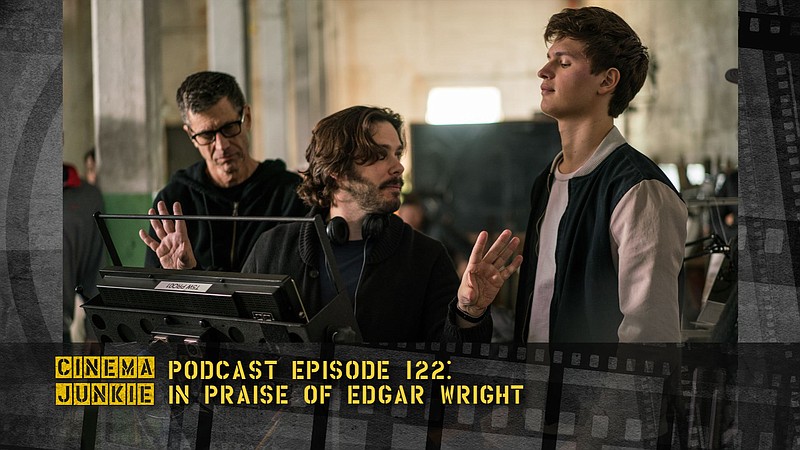
KPBS On Demand is supported by UC San Diego's Art Power, presenting Latin Grammy-winning ensemble, Las Migas, performing from their new album, Flamencas, on November 13th at UC San Diego's Epstein Family Amphitheater. Tickets at artpower.ucsd.edu. Welcome to another edition of listener-supported KPBS Cinema Junkie Podcast. I'm Beth Accomando. Edgar Wright has a new film out, and that's cause for celebration. I fell in love with his work back in 2004, just before Shaun of the Dead came out. I had a friend who worked in a store that sold British import DVDs, and he told me to buy a British TV series called Spaced. It was directed by Wright and co-written with its stars Simon Pegg and Jessica Stevenson. The show was brilliant. Not only was it funny, but it was insanely clever and rich with pop culture references. Brian, did you notice that everything that transpired in those three films, and I mean everything, can be attributed to the actions of one very minor character? Who? The gunner on the Star Destroyer at the beginning of the first film.
How come? Well, because if the gunner had shot the pod that C3PO and R2 were in, they wouldn't have got to Tatooine, they wouldn't have met Luke, Luke wouldn't have met Ben, they wouldn't have met Han and Chewie, they wouldn't have rescued Princess Leia. None of it would have happened. Chaos theory. I fell in love with the show, and then when I saw Shaun of the Dead, I knew I had found a new director to cherish. Any zombies out there? Don't say that. What? That. What? That. The dead word. Don't say it. Why not? Because it's ridiculous. All right. Are there any out there, though? Can't say any. Maybe it's not as bad as all that.
I got to interview Wright and Pegg at Comic-Con in 2004. I remember they weren't that well known back then, and the studio hadn't set up a room to do interviews, so I ended up speaking to them in a stairwell at Comic-Con. Shaun of the Dead showed how to construct the perfect movie. It showed how to use opening scenes, that are usually just padding in a horror film, to genuinely make you care for the characters, and to set up things that will pay off later.
The way films are focus groups and screened is that people kind of like, and even with our kind of film, we occasionally get some kind of pressure to say, get to the first zombie killing, get to the first death. That's when the audience really like it. And you have to make the point, yeah, but the audience really like it because they're with the characters at that point. They've watched half an hour of people that they kind of like sympathize with. And then when they have to become killers, it's a much more shocking thing. So that's why it gets bigger laughs is because we've had that slow burn build up to it. The film also used sound effectively to help reveal what waking up to the zombie apocalypse might be like. It did that by contrasting the buzz and noise of normal life with the quiet of a zombified populace.
How many times do you sit at home and the police go by and you don't even look out the window? Do you know what I mean? So it's that kind of thing that you can hear sirens and sirens and sirens, but never stop to think, I wonder what's going on? And so it was something that we thought was both funny and scary at the same time. It's that idea of just car alarms and police sirens. And then when it gets to the Sunday, when the zombies, when it finally happens, it goes deathly quiet for a bit. So we wanted to have a film where the first half an hour of the film has got some kind of emergency siren going on in every single scene. And then on Sunday morning, nothing.
Wright and Peg then delivered Hot Fuzz, which revealed their love for 80s action bromances, and World's End, where they ventured into sci-fi territory. In between those films, Wright adapted the comic book Scott Pilgrim vs. the World. Scott Pilgrim? Hi, I was thinking about asking you out, but then I realized how stupid that would be. That's okay, you should just sign for this, all right? So do you want to go out sometime? I say yes, will you sign for your damn package? So yeah, 8 o'clock? What I love about Wright's films is that he pays meticulous attention to every detail. Music, sound, editing, casting, cinematography, everything works together in perfect harmony. And everything is in there for a purpose, and generally pays off by the end of the film.
Like Quentin Tarantino, he makes films that reflect his own love of cinema. But he doesn't have Tarantino's brash ego that can sometimes get in the way of his films. Wright doesn't call attention to himself, and the stylish flourishes that fill his films all seem to come organically from the material so that we aren't ever pulled out of the movie to marvel at what he's done. He makes it all look so easy that we may actually overlook how truly skilled and meticulous he is as a director. I recently had the chance to do a short phone interview with Wright about Baby Driver.
I may have gotten the interview in part because I saw him at the TCM Classic Film Festival where he introduced Kentucky Fried Movie. I gave him a button I had made for the film for the segment called Catholic High School Girls in Trouble. He posted a picture of it on his Instagram account and said it was a great takeaway from the festival. So maybe that's what helped me get one of those limited time slots for an interview. And that's another thing about Wright. He's a genuinely nice guy and a true film geek. I had the pleasure of attending a film series he did at the New Bev. It was films that he hadn't seen but should have.
I went when he was screening The Adventures of Buckaroo Banzai, and he had made a special printout packet of information about the film. Then he introduced it and sat in the front row to watch the movie with the audience. And after the film, he hung out to talk about it. That was an amazing screening. Baby Driver is his latest film, and I've already seen it twice. Here's a trailer to give you a taste of what it's like.
One more job and I'm done. One more job and we're straight. Now, I don't think I need to give you the speech about what happens when you say no, how I can break your legs and tell everyone you love. Because you already know that, don't you? Yeah. Because my interview time was so short, I didn't get to ask all the questions I wanted to. So I'm going to play one soundbite from the studio-provided press kit in which Edgar Wright talks about directing. I want to play this because it goes to my point of how meticulous he is when he's directing. Here he talks about choreographing scenes and action to the music.
Sometimes in action scenes you would occasionally be able to play the music out loud. So in that opening sequence when he's walking down the street and getting the coffees, that song was playing, Harlem Shuffle was playing out loud in the street. Other scenes it's only in Ansel's ears and maybe Ansel has it in his ears, I can hear it on my headphones and the camera operator can hear it, but nobody else. And then other times... we had to play a clip track or something because sometimes when there's guns firing, nobody can hear anything. So in those cases, then a really amazing thing happens is the choreographer, Ryan Hefferton, who is an amazing genius, he would get the actors to think in counts. So say, for example, a scene where people are shooting in time in the music, he would get them to memorize this part of the rhythm. So it'd be a thing like Ryan going up to Jon Hamm and saying, this next bit is you going...
And here's my interview with Edgar Wright. I apologize for the sound quality, but sometimes the studios set up interviews where they insist on staying on the line or keeping the talent on a speakerphone so they can listen in. Anyway, I started my interview with Wright by asking which came first, the playlist or the script for Baby Driver.
So how did the finished film, the car chases and the car scenes, live up to the dreams you had when you were in your 20s? You have this real passion for cinema and for film. So how does that love for cinema kind of play out in your career choices and the kind of things that you want to do?
But what you do so well is that you, even though a lot of your films or all of your films seem inspired by movies you love, you make each of these films completely your own without making them seem like they're just imitations. What did you feel that you were kind of refracting in this one?
The target is an armored truck at Perimeter Trust in Dunwoody, 10 a.m. sharp. We have the details of the route because someone at the depot has a nasal problem. The bank itself is right near the Buford Highway, so we should be able to hit the ramp within 60 seconds of getting out. We also have a diversion crew. They're going to blow up a bread truck a ways away, keep the fuzz busy. The dress code is the Michael Myers Halloween mask, but don't all buy your mask at the same time. It looks suspicious. The switch car is ready, but you want me to hit the long-stay parking structure at Hartsfield Jackson to get a heist vehicle that stays colder longer? Loose to a commuter car, a family car, something that blends in well with morning traffic. Something on the heavy side, in case we need to rent the cops off the road to Escalade, Yukon, Havalanche, whatever. He needs to be ready for an 8.30 start in the a.m
I'll let y'all keep, that's my baby. And so within a gang, wants to be a gangster. The NFL is already like a veteran driver and actually wants to kind of get out of it. I think it's a thing about like grown-up decisions or like trying to leave the life of his life's first adult decision. I guess obviously you think through the eyes of this young character, but also you're experiencing it through his life that he is hearing and that, you know, he's kind of like... What's he listening to? Oh, let me say. Tequila. This shit is bananas, dog. Tequila.
Well, you always use sound really well in your films, especially Shaun of the Dead, just the kind of soundscape you create to let you know when the world has totally gone to hell. And so how do you approach sound when you're making a film? Because it seems like such an important part and you use it in ways that other filmmakers seem to ignore. I think the sound effects and how combined together with the visual, you're using the sound to conjure up. To me, it's how you can utilize sound. And you also have him playing with sound, too, creating his little kind of songs and raps that he does at home.
Yeah, absolutely. That was something I thought would be a fun idea. I like when there's artists... In fact, the person who actually made the song does songs like that. It's a Montreal DJ called Kim Koala. He actually did that track.
You know, I always like people that make music out of sound or audio recording, so I thought it was an interesting thing for him to be doing. And in terms of the character, it's like he's mythologizing himself, which I think in turn is his way of compartmentalizing the guilt that he's fooling himself that he's not a criminal at the start of the movie. And I think creating this somewhat romantic persona of this daredevil getaway driver is actually distancing himself from the real repercussions of the crime. But then the movie sort of becomes about having to take responsibility for your actions because maybe he can keep on driving, but at some point he has to face the music.
Well, there also seems to be a sense about him that he is sort of different from the other characters. And there's this feeling, it's almost like his innocence almost protects him. Because, you know, there's a lot that goes on and there's a lot of violence and there's a lot of action. And yet he seems sort of removed from it. It reminded me a little bit of in Raising Arizona, how the baby never gets hurt, no matter how outrageous everything is around him. I love that movie. I guess it's a very millennial thing, but reminding them that it's not a game.
Well, it had a bit of a tone of, like, it felt like someone who as a kid watched these movies like Dirty Mary, Crazy Larry, and admired these characters that were breaking the law and kind of breaking out of conventional roles. But deep down, the person who loved those films also had kind of an innate sense of morality, too, that kind of had to get balanced with it. Yeah, and I think that would give away the ending, but if they just clean got away with it at the end, I would feel on that side. And I think sometimes in those movies, movies that just usually end in one or two ways, you know, I can really condone an entire film of May.
You've mentioned a lot of films that have car chases and a lot of action and heists in them, but one thing that I was thinking of when I was watching the film is it also seems influenced by Hong Kong movies in the sense of action defines characters in a way that isn't used as often in American films. Yeah, no, I think it's a very formative age. I think the character doesn't talk to you. The way he handles the car, because there is not a lot of dialogue in it, and there is a lot of action, but how did you want kind of the car scenes to kind of define who the different characters were? Because there's other people who drive also. Well, I think one of the things in the movie is the cars are kind of somewhat disposable to him.
So it's actually sort of like, you know, an action film linked to any one particular character. Okay, well, thank you very much for your time. And I just want to say, I met you briefly at the TCM Film Festival, and I'm the one who gave you the Catholic School Girls button. Oh, I love it. I just saw my Instagram. I took a photo of it. I love it dearly. Well, I'm very happy that I was able to give that to you because you gave a great introduction for that film. Oh, what a blast that was. Can you introduce those four? It was amazing. It was. It was a lot of fun. It was funny about that night. Yeah. I think they didn't realize it was at midnight, and they were like, oh, are we going to be too tired? And I'm up to top secret. And then as soon as they got on there, they're like sort of just the funniest interviewees. It was amazing.
Oh, it was great. And you handled it all well, keeping them all kind of on topic. Thank you. Thank you. Bye-bye. Thank you, sir. Bye. That was director Edgar Wright. His new film Baby Driver is out in theaters now, and you need to see it, and see it on the big screen in a cinema with great sound. Next week, I'll be talking about Hitchcock and the new TCM online class about the master of suspense. Thanks for listening to another episode of listener-supported KPBS Cinema Junkie podcast. Till our next film fix, I'm Beth Accomando, your resident cinema junkie.
KPBS On Demand is supported by Bill Howe Plumbing, Heating, and Air Flood and Restoration Services. Family owned and operated for over 46 years, Bill Howe has been serving San Diego homeowners with home services since 1980. Bill Howe's full service team offers heating and air solutions along with dedicated flood and restoration services and an expert plumbing team. Their trained professionals are available 24 hours a day, 7 days a week to respond to both routine needs and unexpected emergencies. Bill Howe is committed to providing excellent communication, transparent pricing, and quality workmanship on every job. Appointments can be scheduled by phone, online, or through live chat at their website. Call 1-800-BILL-HOWE or visit billhowe.com because we know how.