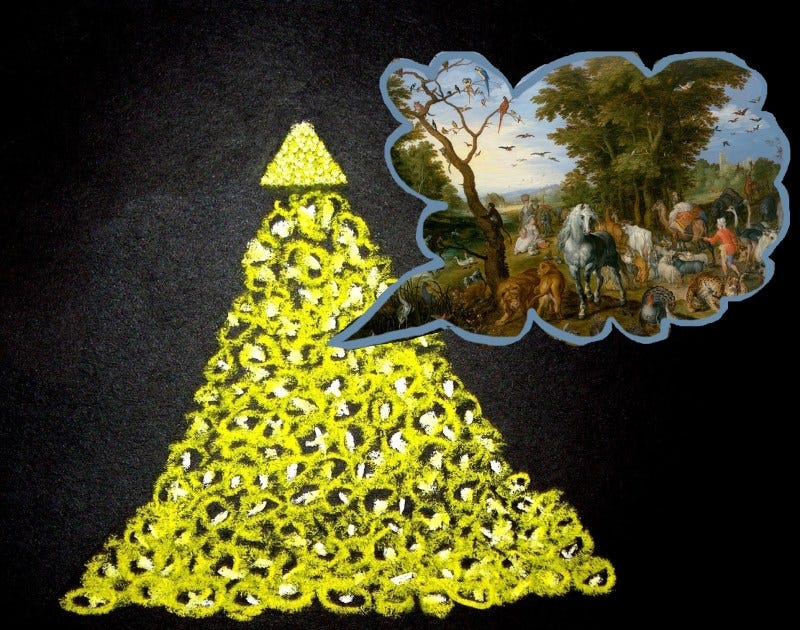
In the Origin was Logos
from Gnostic Reformation, Clear and Simple Hosted by Cyd Ropp
I imagine that some people who tune into this broadcast or read my writing, when they see the word Gnostic, they’re hoping it’s going to be more exotic than it turns out to be, because there are many ancient myths and stories that are labeled as Gnostic and Gnostic scriptures that don’t much resemble what is taught in the Judeo-Christian line of religions. But when you read the New Testament afresh with this new translation by David Bentley Hart, you see that many of the phrases and concepts that we’ve become accustomed to in the standard translations of the Bible are not entirely accurate to the original ancient Greek writing. The New Testament as recently translated by David Bentley Hart sounds very much like the Tripartite Tractate in its speech and in its allegories. Hart has translated the New Testament afresh from the ancient Greek without reference to what we have come to believe the words mean—doctrinal expectations, you could say. Quoting from his preface, he says, “The relation between Christian theology and scriptural translation has a long and complicated history; theology has not only influenced translation, but particular translations have had enormous consequences for the development of theology (it would be almost impossible, for instance, to exaggerate how consequential the Latin Vulgate’s inept rendering of a single verse, Romans 5:12, proved for the development of the Western Christian understanding of original sin).” He says that, “In the end, even the most conscientious translations tend at certain crucial junctures to use language determined as much by theological and dogmatic tradition as by the plain meaning of the words on the page.” He says that what happens as a consequence often verges on a kind of “pious fraudulence.” So, in this translation, he has elected to produce an “almost pitilessly literal translation.” Many of his departures from received practices are Hart’s efforts to “make the original text as visible as possible, through the palimpsest of its translation.” Palimpsest? I paused a moment to look up palimpsest, and it means something reused or altered, but still bearing visible traces of its earlier form. This morning I want to share with you some important passages out of the New Testament from Hart’s translation, which demonstrates the compatibility between this Gnostic Christianity that I talk about, and more conventional Christianity, although few people have noticed or care to draw these similarities. So let’s begin with a passage from John, chapter one, verses 1-6. And, it’s a very familiar passage for us. It usually reads, “In the beginning was the Word, and the Word was with God, and the Word was God.” Well, the actual Word is Logos, and we talk about Logos a lot here. And so it reads like this: “In the origin, there was the Logos and the Logos was present with GOD.” And, by the way, when Hart is referring to the highest character of God—The God Above All Gods, as we would say—he uses GOD in all capital letters. And when he refers to God in the more usual way that we refer to God—the God that is involving itself in our human existence—it’s god or God. And those differences are all indicated in the original Greek, but they don’t ever translate through into our modern Bibles. So, “In the origin there was the Logos and the Logos was present with GOD (the God Above All Gods) and the Logos was god.” God meaning, then, that the Logos incorporated all of the attributes of the God Above All Gods, but in a place in a particularity. Going on, “This one was present with GOD (the God Above All Gods) in the origin. All things came to be through him (Logos) and without him came not a single thing that has come to be. In him was life and this life was the light of men. And the light shines in the darkness, and the darkness did not conquer it.” Carrying on, “It was the true light which illuminates everyone, that was coming into the cosmos. He was in the cosmos, and through him the cosmos came to be. And the cosmos did not recognize him. He came to those that were his own, and they who were his own did not accept him. But as many as did accept him, to them, he gave the power to become GOD’s children (the God Above All Gods’ children)—to those having faith in his name. Those born not from blood, nor from a man’s desire, but of GOD. And the Logos became flesh and pitched a tent among us, and we saw his glory, glory as of the Father’s only one, full of grace and truth.” (John 1:9-14.) Now, of course, this is usually meant to refer to Jesus Christ coming to Earth in fleshly form. And that “he came to those who were his own” is usually thought to mean to the Jews, but the Jews did not recognize him as the Messiah and did not accept him. And, in conventional Christianity, “but as many of the Jews that did accept him, he gave the power to become the originating source’s children, (the God Above All God’s children), to those having faith in his name.” That name generally is considered to be Jesus. “Logos became flesh” (that is being born into the human body) “and pitched a tent among us.” (He came to dwell with us, but not permanently, so he didn’t build a cathedral; he didn’t build a synagogue, but rather he just pitched a tent because he wasn’t going to be here that long.) “And we saw his glory, glory as of the Father’s only one, full of grace and truth.” Now, in the sense that we often talk about here, all of these truths that we speak are fractals, and they all begin above in the ethereal realm. That’s where the grand fractals, the archetypal stories, are written and dreamed of by the Aeons. And they are played out over and over again, down here on Earth. So we can take the story that comes to Earth—the story of Jesus coming to his own and his own not knowing him—but we can also back that story back up. We can go upstream with it, back into the Fullness. So let’s look at this John 1:9-14 again in that sense. Logos was the true light which illuminates everyone that was coming into the cosmos. Well, we realize from our Gnostic myth, that Logos fell out of the Fullness and it was the falling out that traversed into a new dimension, this material dimension. And so he came into the cosmos, and the cosmos is down here. The cosmos is what was formed after the Fall. So, Logos was in the cosmos and through Logos, the Cosmos came to be. And we call that the result of the Fall. “But the Cosmos did not recognize him.” So here is that familiar story where Logos falls, he breaks open, and this material cosmos rolls out of them and does not recognize that it came from Logos. The Tripartite Tractate says that Logos was horrified at the things that came out of him and they refused to recognize him. They did not see him. They went their own way. So that’s a description of the Fall—that was his own that did not accept him. So, what was existent just immediately prior to the Fall? This is where I’ve put together, so forgive me if I am taking license here, but I’ve put together that Logos, who was himself a fractal of the Fullness of God, remember, was sitting right up there on top of the hierarchy of God (so he is a small hierarchy consisting of fractals of all the originating Aeons). What existed then, just prior to his overreach, prior to the Fall? Well, there’s Logos. There’s his fractals. OK, those are those of his own. They are part of his sub- selves. And then he also had his name, Logos. He had his position at the top of the hierarchy—his place. He had his duty, which was to replicate the Fullness as a Whole. And his job was to be the head, the capstone, of the Fullness of God. So tha… This is a public episode. If you'd like to discuss this with other subscribers or get access to bonus episodes, visit cydropp.substack.com/subscribe
Embed this episode
No transcript yet.