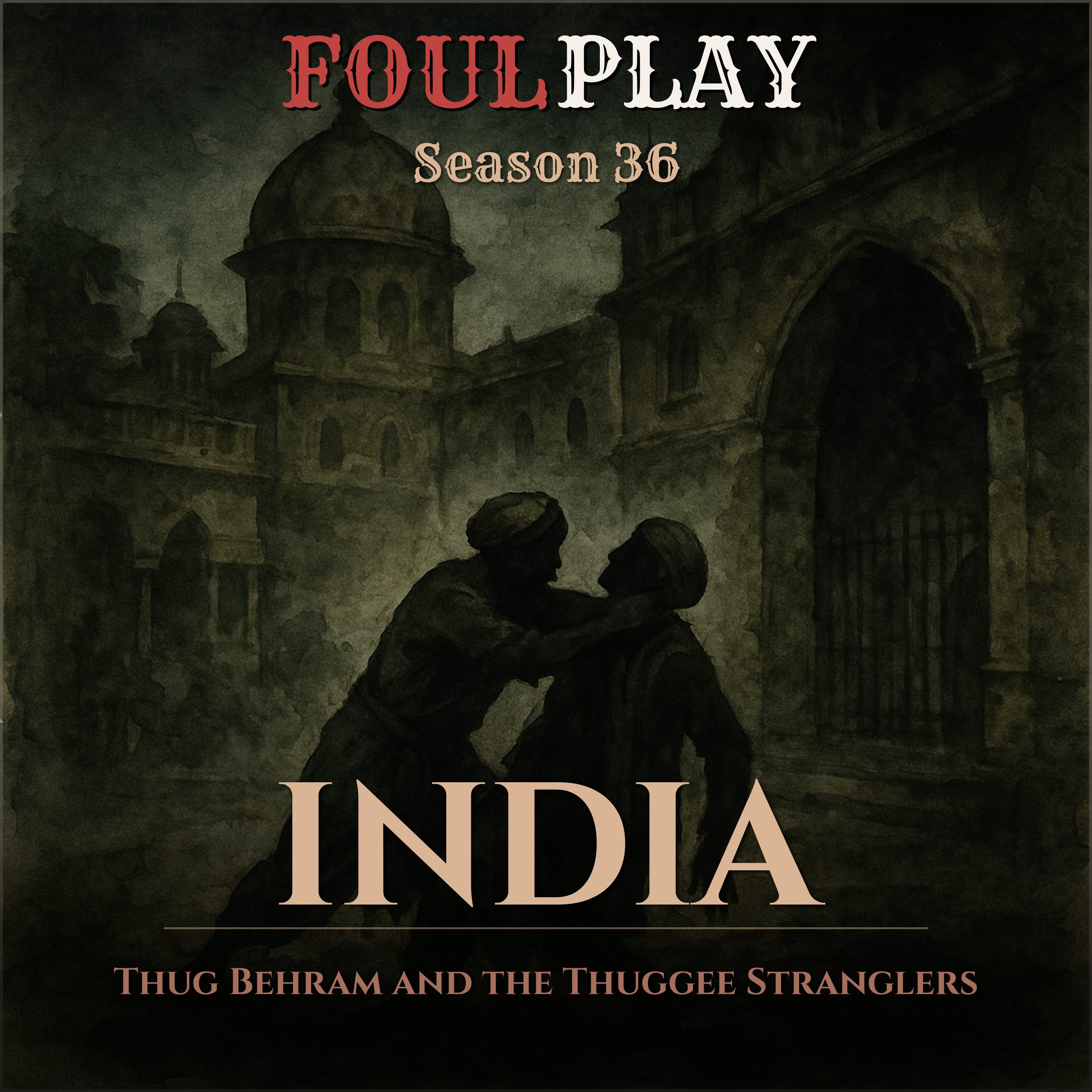
The sun sinks over the Indian plains. A group of travelers makes camp, sharing food and laughter with new companions they've met on the road. But as night falls, those friendly smiles will become the last faces they ever see. Because seated among them is Thug Baram, a man who has been waiting on this moment all along. Hello, friend. Welcome to Episode 5 of our series, Serial Killers in History. I'm Shane Waters. In Episode 4, we were in Portugal in 1772.
Tonight we move to India in the 1790s, where a secret brotherhood known as the Thudji stalked the roads, and at the center of their terror stood their most infamous leader, Thug Baram. In the shadowy corners of early 19th century India, a terrifying cult flourished, striking fear into the hearts of travelers who dared to journey across the subcontinent. Known as the Thudji, these organized bands of killers claimed countless lives in the name of the goddess Kali. While the British Raj struggled to maintain control over their colonial territory, these silent assassins moved freely through the countryside, affecting their deadly craft over centuries. Among these ruthless killers, one name stands above all others. Thug Behram. His story is not for the faint of heart, for he holds a chilling distinction in the annals of criminal history. With 125 confirmed victims over a 40-year career, Behram is considered the most prolific serial killer the world has ever known. His reign of terror through British-controlled India would ultimately lead to one of the largest criminal investigations of the colonial era.
For centuries, the fudgy blended in with the very people they intended to kill. They shared meals, sang songs, and walked side by side with their targets, waiting for the moment trust was deepest. Then, with ritual precision, they struck. And at the heart of this deadly tradition was Baram, a man whose name still echoes in criminal history. His story is chilling not because he killed, but because he made killing a system, refined, organized, and in his eyes, sacred.
The exact origins of Thaj Baram remain shrouded in mystery, but historical records indicate he was born in the late 1700s near Jabalpur, in what is now Indian state of Madhya Pradesh. Like many who would join the ranks of Thajji, Baram was born into the tradition, with his father and uncles all being active members of the cult. The Thajji tradition was passed down through generations, with young boys traditionally beginning their instruction around the age of 10. Baram was no exception, learning the sacred rituals and techniques that would later make him infamous. The cult members believed they were doing the sacred work of Kali, the Hindu goddess of death and destruction, though their interpretation drastically departed from mainstream Hinduism. Baram was born into murder. Near Jabbapur, in present-day Madhya Pradesh, his family was already part of the Faji. From the time he could walk, his education was deception and death. By ten, he was already watching and learning, signals, code words, and the patience needed to turn companionship into a trap.
For Baram, this was never just crime. Each kill was an offering, a ritual act of devotion to Kali. Omens were read, prayers whispered, victims buried face down so their souls would not rise in anger. Every detail mattered, because every kill to him was holy. During his apprenticeship, young Baram would have spent his years observing the senior thudgies, learning their methods of deception and studying the intricate system of hand signals and code words they used to communicate in secret. The cultivation of trust was paramount.
Thugs would often spend days traveling with their intended victims, sharing meals and conversations before selecting the perfect moment to strike. The initiation into brotherhood was a complex affair, steeped in ritual and symbolism. New members would participate in increasingly important roles during kills, graduating from lookout to helper, and finally to strangler. Bear Ram showed an exceptional aptitude for the cult's practices, demonstrating both physical prowess and leadership qualities that would later serve him well. As Baram rose through the ranks, he built his own following, more than 50 men, and with them he perfected his method. Their weapon was simple, a rumel, a silk handkerchief with a heavy medallion tied to one end. To outsiders it was a cloth, to the thudgy it was sacred. When Baram gave the signal, sometimes nothing more than the phrase, bring tobacco, the attack was instant. The rumel tightened around the neck, the medallion adding weight as others pinned the victim's arms and legs.
It was quick, silent, final. Some nights, they didn't just kill one or two. Entire caravans vanished. Dozens, even a hundred souls, swallowed by the earth before sunrise. The gang operated with remarkable efficiency in dividing the spoils. Everything was catalogued and distributed according to a predetermined system, with Berem as the leader receiving the largest share.
Valuable items were often buried temporarily to avoid detection, and the gang would return later to retrieve them. They would then disperse to different villages living as ordinary citizens until the next expedition was planned. The selection of victims followed strict guidelines. Women were generally spared, as were holy men and craftsmen. The thugs believed that killing such protected persons would incur Kali's wrath. They also avoided killing travelers during specific holy days, and studied omens carefully before choosing their targets. Baram became more than a killer. He became a phantom.
A merchant with homes, businesses, and wealth, he moved unnoticed through society. And behind that mask, he treated murder like a ledger, keeping records of lives taken and possessions stolen. To his followers, this discipline made him untouchable. To the British, it made him nearly impossible to catch. The secret to Barham's longevity lie in his masterful organization and his gang.
He divided his followers into specialized roles—scouts, infiltrators, gravediggers, and stranglers. Each member knew only what was necessary for their specific task, making it nearly impossible for captured thugs to reveal the full extent of their operation. He also maintained a vast network of informants, who would alert him to wealthy travelers while warning of any approaching authorities. Baram's influence extended far beyond his immediate gang. He served as a mentor to numerous other thudgy leaders, spreading his techniques and methodology throughout the cult.
His reputation for successful operations and spiritual devotion made him a near-mythical figure among the Thugs. Eventually, the British East India Company realized they weren't facing common bandits. They were facing a system. To stop it, they turned to William Henry Sleeman. With patience equal to the Thudgies, Sleeman built one of the first criminal intelligence units in history. He tracked family ties, mapped networks, and recorded every signal and name. Piece by piece, he built a picture of a shadow empire.
When Baram's lieutenants betrayed him, the mask slipped. In 1840, after months of surveillance, Suleiman's men closed in. Baram was hiding under the protection of a landlord near Jalbapur. The man who had walked freely through India's roads for 40 years was finally led away in chains. After his capture, Thug Baram provided detailed confessions that shed unprecedented light on the inner workings of the thudgy colt.
In extensive interviews with British authorities, he admitted to personally strangling 125 victims over his four-decade career, while claiming to have been present at approximately 931 more murders. His matter-of-fact descriptions of the ritualistic killings horrified his interrogators, yet provided invaluable insights into the thudgy methodology. The British authorities made a calculated decision to spare Barham's life in exchange for his cooperation in dismantling the remaining thudgy networks. His intimate knowledge of the cult's hierarchy, secret signals, and gathering places proved instrumental in Sleeman's broader campaign. Through Baram's testimonies, hundreds of active thugs were identified and arrested, effectively breaking the backbone of the organization. Baram's confessions pulled the veil off a secret world. He spoke of rituals, signals, and murders, with a calm that horrified even his captors. His cooperation dismantled the thudgy network, but it also revealed how easily belief and patience could be twisted into weapons.
The Thudgy killed not with fury, but with familiarity. They smiled, they shared, they earned trust. Then they strangled it away. And no one mastered that better than Thug Biram. His downfall marked more than the end of one man. It pushed the British to new laws, like the Criminal Tribes Act of 1871, and laid the groundwork for India's first professional police force. From informants to record-keeping, the tools built to catch Biram became the blueprint for modern law enforcement.
Today, Berum stands as a dark vigour in criminal history. His record of 125 murders and being present at 931 other killings makes him statistically the most prolific serial killer ever documented. His case remains a fascinating study in criminal psychology, illustrating how religious devotion and ritualistic beliefs could be twisted to justify mass murder. The methods developed to capture him and dismantle his organisation became a blueprint for future law enforcement operations, making a significant evolution in the history of criminal investigation. The case of Thug Berham marked a pivotal moment in the evolution of modern policing and criminal justice in India. The sophisticated investigative techniques developed by William Sleeman's team to track and capture the thugs became the foundation for systematic crime-fighting methods that would influence law enforcement practices for generations to come. This is Foul Play. Thank you for joining me for episode 5 of our series Serial Killers in History. In episode 6, we'll travel to Australia in 1835, where another killer, John Lynch, left his bloody mark.
Until then, stay safe and stay curious.