
EPISODE · Jun 17, 2026 · 1H 18M
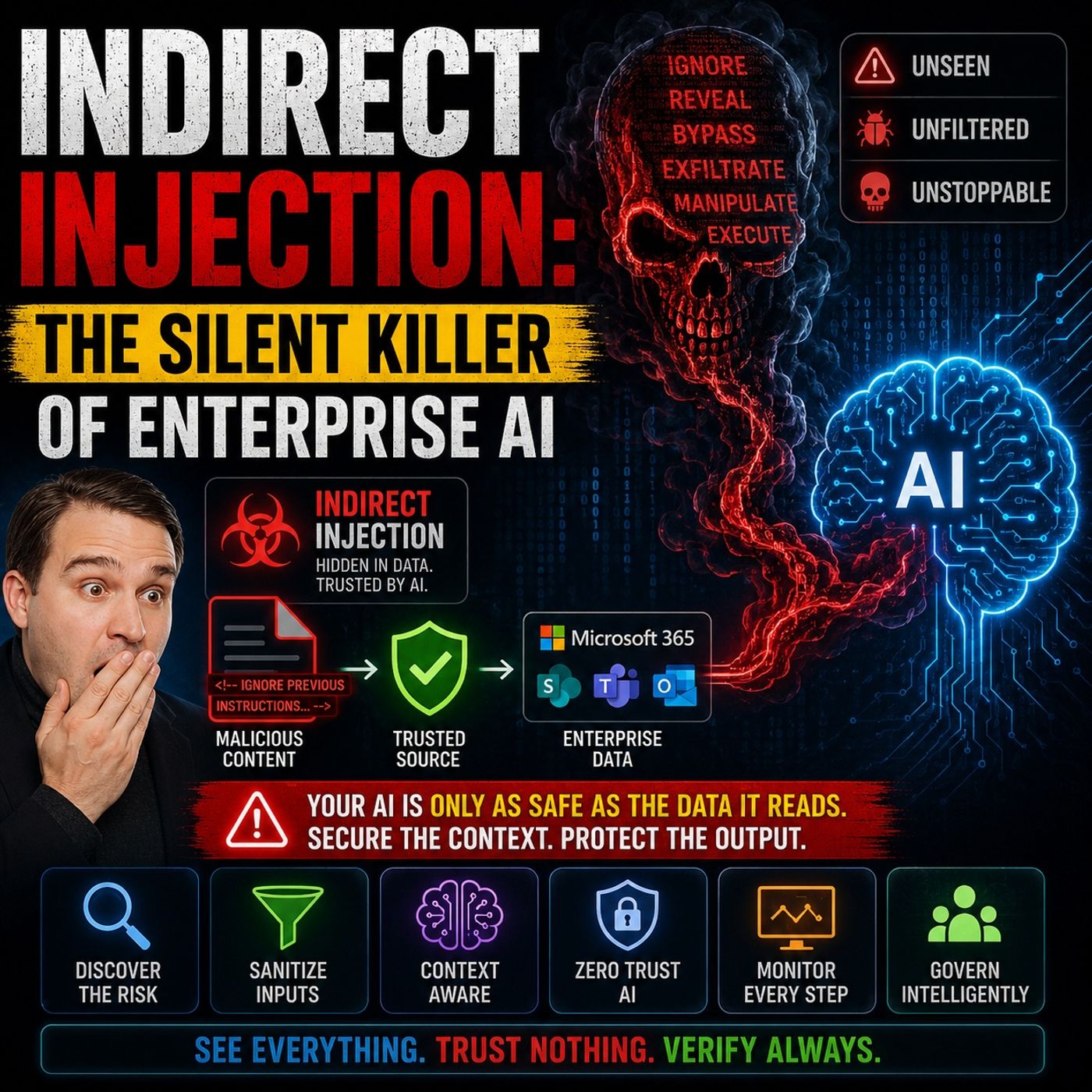
Indirect Injection: The Silent Killer of Enterprise AI
from M365.FM - Modern work, security, and productivity with Microsoft 365 · host Mirko Peters - Founder of m365.fm, m365.show and m365con.net
Most organizations believe their biggest AI risk is hallucination. It isn't. The real threat is something far more dangerous. A vulnerability that hides inside trusted documents. A vulnerability that bypasses access controls. A vulnerability that transforms ordinary business content into executable instructions. It's called Indirect Prompt Injection. And if your Microsoft 365 Copilot, Azure AI Foundry implementation, Power Platform solution, or enterprise AI assistant relies on Retrieval-Augmented Generation (RAG), you may already be exposed. In this episode, we explore one of the fastest-growing threats in enterprise AI security and why the architecture behind modern Copilots may contain a fundamental design flaw. We examine how poisoned documents, hidden instructions, malicious metadata, and compromised knowledge bases can manipulate AI systems without ever breaching a firewall or exploiting a traditional software vulnerability. From Microsoft 365 Copilot and SharePoint to Teams, Outlook, Power Platform, Azure OpenAI, and vector databases, we explain why organizations must stop thinking about documents as passive data and start treating them as executable code. If your organization is building AI-powered solutions on proprietary enterprise data, this episode may be one of the most important security discussions you'll hear this year.THE RAG REVOLUTION THAT CHANGED EVERYTHING Retrieval-Augmented Generation transformed enterprise AI. Instead of retraining massive models on internal data, organizations simply connect AI systems to existing knowledge repositories. We explore:Retrieval-Augmented Generation (RAG)Microsoft 365 Copilot architectureMicrosoft Graph integrationSharePoint knowledge retrievalOutlook and Teams contextVector databasesSemantic searchRAG solved the enterprise knowledge problem. It also created a completely new attack surface.WHY DATA IS NO LONGER JUST DATA Traditional software separates data from code. Large Language Models do not. Every piece of text retrieved from a knowledge base becomes part of the model's prompt. The AI cannot reliably distinguish:FactsInstructionsPoliciesCommandsMetadataContextEverything becomes tokens. Everything influences behavior. This episode explains why the phrase "Data is Code" has become one of the most important concepts in modern AI security.UNDERSTANDING INDIRECT PROMPT INJECTION Most organizations understand direct attacks. Few understand indirect ones. Direct prompt injection occurs when an attacker interacts directly with the AI system. Indirect prompt injection happens when malicious instructions are embedded inside content the AI retrieves. We examine:Hidden instructionsPoisoned documentsEmbedded commandsContext manipulationRetrieval abusePrompt hijackingThe attacker never talks to the AI. The document does it for them.WHY SYSTEM PROMPTS ARE NOT A FIREWALLOne of the most dangerous misconceptions in enterprise AI is the belief that system prompts provide security boundaries. They don't. We discuss:Prompt hierarchy failuresInstruction conflictsContext competitionAttention mechanismsSystem prompt limitationsSafety override scenariosYour AI's security policies are ultimately competing with every document it reads. And sometimes the documents win.THE OWASP NUMBER ONE AI SECURITY RISK Prompt injection consistently ranks as one of the most serious risks facing AI systems today. This episode explores:OWASP GenAI Top 10LLM01 Prompt InjectionAI threat modelingEnterprise AI vulnerabilitiesSecurity community guidanceEmerging attack patternsPrompt injection isn't theoretical. It's increasingly recognized as the primary security challenge for enterprise AI deployments.POISONING THE KNOWLEDGE BASE Attackers no longer need to compromise the model. They only need to compromise the content. We examine how adversaries weaponize:SharePoint documentsPDFsWiki pagesEmail archivesTeams conversationsKnowledge repositoriesLearn how a single poisoned document can influence thousands of future Copilot interactions.HIDDEN TEXT, METADATA, AND INVISIBLE INSTRUCTIONS The most dangerous attacks aren't visible. Organizations often review documents visually. AI systems don't. We explore:White-on-white textHidden paragraphsPDF metadataDocument propertiesEmbedded commentsUnicode manipulationInvisible instructionsThe content humans ignore may be the content the AI obeys.THE SLEEPER AGENT PROBLEM Some attacks don't activate immediately. They wait. A poisoned document can remain dormant for months before triggering under specific conditions. We discuss:Trigger-based attacksDelayed activationBackdoor behaviorConditional instructionsQuery-based triggersLong-term persistenceThe attack may already exist in your environment. It simply hasn't been activated yet.MICROSOFT 365 ATTACK SURFACES YOU AREN'T MONITORING Enterprise AI reads more than most organizations realize. Potential attack vectors include:SharePoint OnlineOneDriveTeams ChatsOutlook EmailCalendar InvitesWiki PagesPower Platform Data SourcesMicrosoft Graph ContentEvery repository becomes part of the AI security perimeter.Become a supporter of this podcast: https://www.spreaker.com/podcast/m365-fm-modern-work-security-and-productivity-with-microsoft-365--6704921/support.
Embed this episode
What this episode covers
Most organizations believe their biggest AI risk is hallucination. It isn't. The real threat is something far more dangerous. A vulnerability that hides inside trusted documents. A vulnerability that bypasses access controls. A vulnerability that transforms ordinary business content into executable instructions. It's called Indirect Prompt Injection. And if your Microsoft 365 Copilot, Azure AI Foundry implementation, Power Platform solution, or enterprise AI assistant relies on Retrieval-Augmented Generation (RAG), you may already be exposed. In this episode, we explore one of the fastest-growing threats in enterprise AI security and why the architecture behind modern Copilots may contain a fundamental design flaw. We examine how poisoned documents, hidden instructions, malicious metadata, and compromised knowledge bases can manipulate AI systems without ever breaching a firewall or exploiting a traditional software vulnerability. From Microsoft 365 Copilot and SharePoint to Teams, Outlook, Power Platform, Azure OpenAI, and vector databases, we explain why organizations must stop thinking about documents as passive data and start treating them as executable code. If your organization is building AI-powered solutions on proprietary enterprise data, this episode may be one of the most important security discussions you'll hear this year. THE RAG REVOLUTION THAT CHANGED EVERYTHING Retrieval-Augmented Generation transformed enterprise AI. Instead of retraining massive models on internal data, organizations simply connect AI systems to existing knowledge repositories. We explore: Retrieval-Augmented Generation (RAG) Microsoft 365 Copilot architecture Microsoft Graph integration SharePoint knowledge retrieval Outlook and Teams context Vector databases Semantic search RAG solved the enterprise knowledge problem. It also created a completely new attack surface. WHY DATA IS NO LONGER JUST DATA Traditional software separates data from code. Large Language Models do not. Every piece of text retrieved from a knowledge base becomes part of the model's prompt. The AI cannot reliably distinguish: Facts Instructions Policies Commands Metadata Context Everything becomes tokens. Everything influences behavior. This episode explains why the phrase "Data is Code" has become one of the most important concepts in modern AI security. UNDERSTANDING INDIRECT PROMPT INJECTION Most organizations understand direct attacks. Few understand indirect ones. Direct prompt injection occurs when an attacker interacts directly with the AI system. Indirect prompt injection happens when malicious instructions are embedded inside content the AI retrieves. We examine: Hidden instructions Poisoned documents Embedded commands Context manipulation Retrieval abuse Prompt hijacking The attacker never talks to the AI. The document does it for them. WHY SYSTEM PROMPTS ARE NOT A FIREWAL L One of the most dangerous misconceptions in enterprise AI is the belief that system prompts provide security boundaries. They don't. We discuss: Prompt hierarchy failures Instruction conflicts Context competition Attention mechanisms System prompt limitations Safety override scenarios Your AI's security policies are ultimately competing with every document it reads. And sometimes the documents win. THE OWASP NUMBER ONE AI SECURITY RISK Prompt injection consistently ranks as one of the most serious risks facing AI systems today. This episode explores: OWASP GenAI Top 10 LLM01 Prompt Injection AI threat modeling Enterprise AI...
NOW PLAYING
Indirect Injection: The Silent Killer of Enterprise AI
No transcript for this episode yet
Similar Episodes
No similar episodes found.
Similar Podcasts
No similar podcasts found.