INSECURITY IN NIGERIA
from Ideas Untrapped Hosted by Tobi Lawson
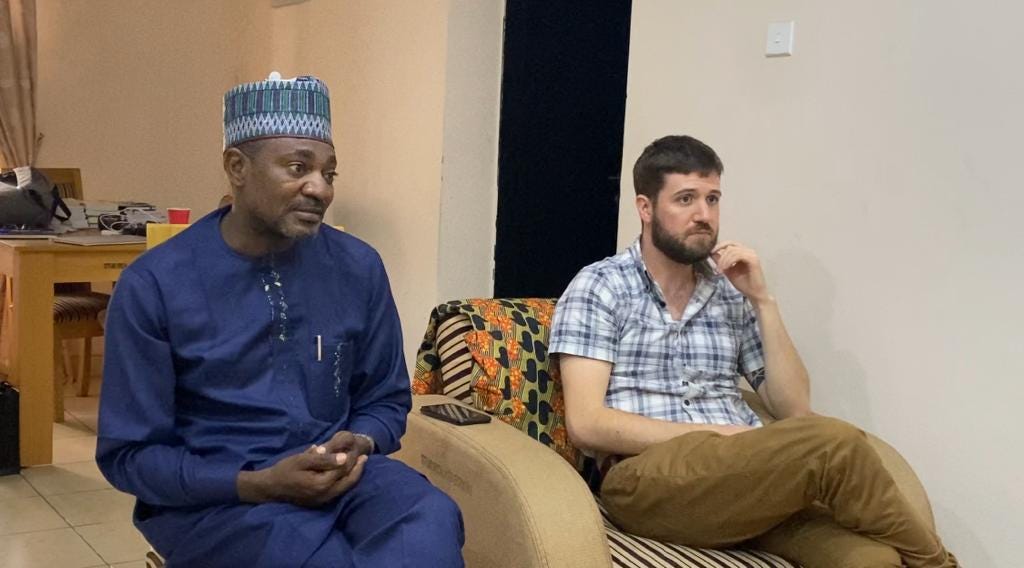
If you ask any Nigerian today what the number one problem that they think political leadership should tackle - I am fairly certain security will be the overwhelming answer. In the last week alone there have been two deadly attacks in the Ondo state and Kaduna state with scores of people murdered in their homes and places of worship. Go back a week further, and the number of such murderous attacks would have risen to six. What many Nigerians depressing is that the problem is worsening and spreading to all parts of the country without any sign that it might abate anytime soon. Politicians seeking elective positions in next year's elections are making promises to end the crisis, but given how much it has gotten worse under the current administration despite similar promises leaves very little room for optimism. It is in the light of this that I speak to my guests on the podcast today James Barnett and Dr. Muritala Rufai. Our conversation is about what is now known as banditry in the Northwest of Nigeria. We talked about the origins of banditry, the nuances of the many factors at play, corruption, and the failure of local governance. Dr. Murtala Rufai is a professor of history at Usman Danfodiyo University in Sokoto. TRANSCRIPT Tobi; So I'll start right at the end, which is not the most recent attack, but the Kaduna train attack was heavy in people's memory, and mentality, and maybe because of the status of some of the people that were involved. And in the weeks after there has been suggestions that the banditry issue is sort of evolving into something rather different. Maybe something akin to Boko Haram or ISWAP tactics. And some have even suggested that there are some evidence that both groups are now working together. So I like to take it from there because in both your paper your article on this, you suggested that this is a problem that has the potential to evolve even more dangerously. So is this part of that evolution? And if so, what can you tell us about the background to that and where it's likely to go next? James; ...In terms of the kind of the relationship between the bandits and Boko Haram, you know, the term that we talk more generally about jihadist because, really, there're kind of at least three different primary factions of what was once Boko Haram in Nigeria, today. There's ISWAP, there's the original Boko Haram, which we use the acronym JAS, which was led by Abubakar Shekau until May of last year when he was killed. And then there's also the Ansaru splinter faction of Boko Haram. So when looking at relationships between bandits and jihadists, I think if anything, our study was maybe a bit more skeptical of some of the claims that, you know, by 2021 (by last year) there was already more speculation. You had more comments from government officials, commentators, journalists saying, you know, the bandits, they are being recruited by Boko Haram, they're working together. I think our study was, in some ways, a bit more skeptical of the degree of, I would say, co-optation. You know, we kind of pushed back to some extent against this idea that the jihadists were coming in and recruiting all the bandits and that they were kind of transforming the conflict. I think our argument was that the conflict in the Northwest for now is very much still one being driven by the bandits rather than by Boko Haram or the jihadists. We do note, as you say, I think there's definitely room for closer potential cooperation. I think that from what we're beginning to see of the Kaduna train attack, the evidence so far, the details I've heard so far, there are kind of concerning issues there. But I think that for now, you know, even recognizing that the Kaduna train attack is a notable attack, a very serious one and obviously, the situation is still ongoing in terms of the the situation with the hostages, negotiations. So I think it's good to kind of avoid commenting too much right now as the situation is rather uncertain. But I think my view is still that one of the impediments that has, kind of, historically prevented the jihadists from getting closer to the bandits is that the bandits, for the most part, they really prized their autonomy. It's very much part of their modus operandi to operate very independently, they will cooperate with, you know, different gangs, will cooperate with each other, but banditry is definitely an activity that in some ways, kind of rewards autonomy. You know, the groups are not as rigidly structured as a jihadist organizations. It's an area where many people today if they want to get rich, they can take up arms and become a bandit. And so I think, because the bandits kind of value their autonomy, and also just given the fact that they've become, frankly, so powerful in recent years, they are not necessarily in such desperate need to kind of be recruited or trained or equipped or supported by jihadist. So I think my view is that there are opportunities from the perspective of Jihadist to work with bandits in certain instances, you know, to cooperate on certain operations. But I think, as we've seen with for example, especially the group Ansaru, which has tried in the past several years to recruit bandits to say, 'you should stop acting like bandits, you should join our group. Your fight is not with Muslim people. It's with the Nigerian government.' They go on this preaching tours and their efforts have really fallen flat. The bandits have not been interested in joining Ansaru. And so there have actually been many clashes. And recently, I think, as recently as a week ago, was the last one. And so, you know, the situation in Northwest is very volatile, many different militants, many different gangs, and sometimes they work together, sometimes they fight together, but I think for the foreseeable future, that the jihadist element to the northwest - this Boko Haram, this Ansaru...it's a problem, it's a challenge and makes things more complicated for sure. But I think that, in my view, the primary challenge in the Northwest is still bandits. It's not Boko Haram. Dr Rufai; I should just continue from where he stopped. You see, the fundamental problem is that the bandits are not in any way a monolithic criminal formation. There are quite a number of bandit gangs and also bandit groups operating separately and individually. Now having the unity of the bandits into a one united organization, for instance, is indeed a very difficult exercise. Because when we talk about a bandit group or a bandit gang, we've seen cases and instances where three, four, five people, for instance, form up a gang. And they have their own independent and absolute autonomy. They could actually do and undo, they may decide to go on attack, they may decide to carry out abduction, they may decide to do whatever they feel like doing. So now, putting all these bandits together into a one single platform - it is indeed a very difficult exercise. And there are also quite a number of them that consider this jihadist group including Boko Haram, Ansaru and ISWAP that he pointed out clearly, as their traditional enemies, and on several locations attempts by these groups to bring to the fore the members of the bandits, for instance, became so much challenging to the extent that some of the bandit groups and also bandit leaders were making it very clear to them that our problem as you were arguing is not with the Nigerian state - that is what we fail to understand. The problem of banditry is basically and fundamentally local. Until probably recently, that the whole conflict is now taking a more national dimension. You go to the rural areas, you interact with the pundits, they will tell you that their problem is local and solution to their problem also remain local. Local in the sense that they more or less have problem with the an sake - with the vigilante - and other local authorities than even with their state governors. So now, my argument has always been: bringing this bandits… This is a public episode. If you would like to discuss this with other subscribers or get access to bonus episodes, visit www.ideasuntrapped.com
Embed this episode
No transcript yet.