
EPISODE · May 3, 2019 · 15 MIN
International LCIL Workshop: The Future of Multilateralism: Panel I - Dr Michael Waibel
from LCIL International Law Centre Podcast
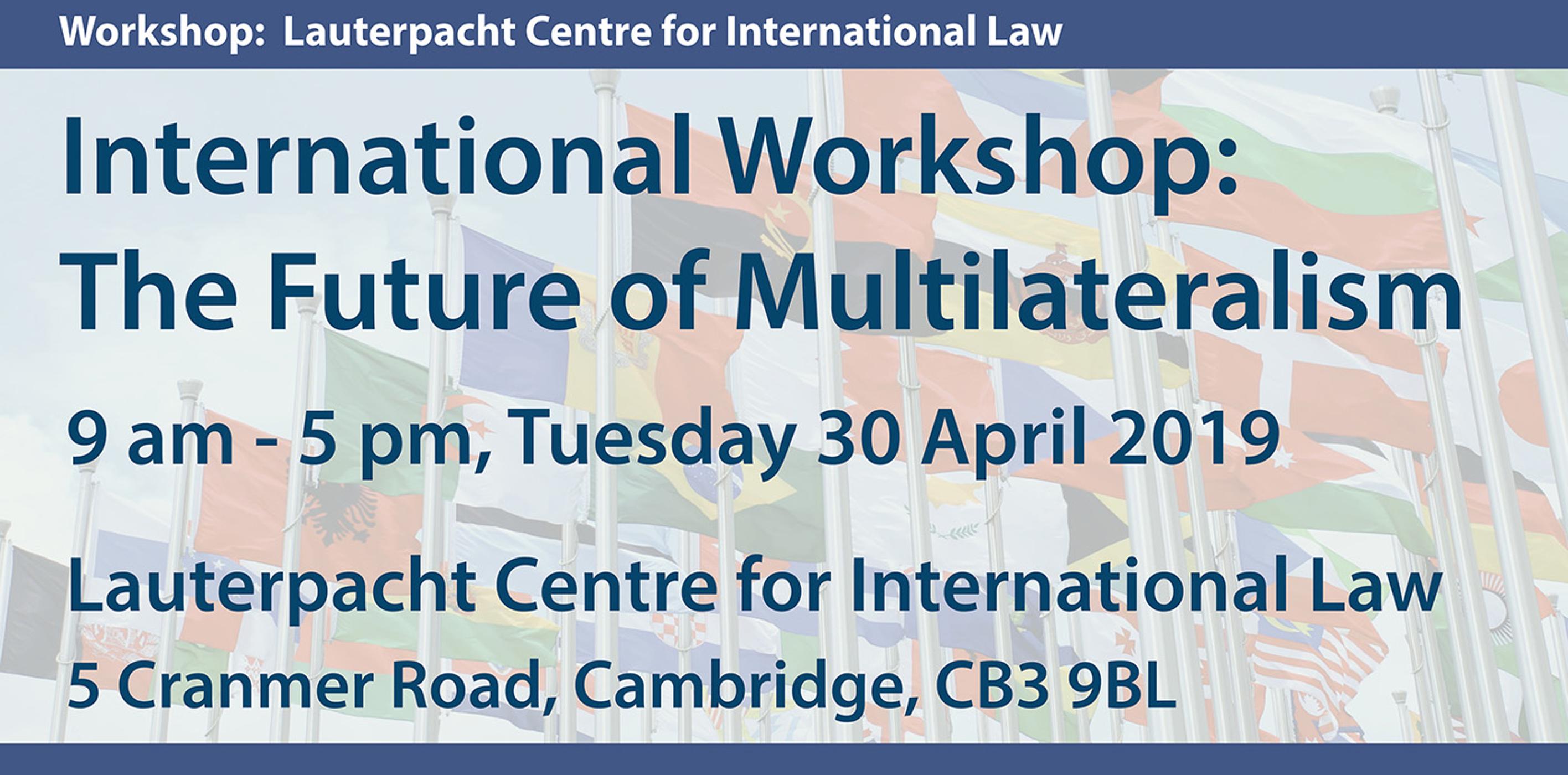
Tuesday, 30 April 2019 - 9.00am Location: Lauterpacht Centre for International Law, Finley Library All-day workshop: 09:00 - 17:00 hrs Conveners: Eyal Benvenisti, Harold Hongju Koh, and Tomohiro Mikanagi In 2019 three major treaty withdrawals will reach important watersheds. Sometime in spring, the United Kingdom is scheduled to withdraw from the European Union under the withdrawal notice it gave under Article 50 of the Treaty of Lisbon. On November 4, 2019, the United States (under the administration of Donald Trump) is set to give notice that it will withdraw from the Paris Climate Change Accord one year later. In November 2019 the dispute resolution mechanism of the WTO will terminate effectively unless the US agrees to re-appoint a judge of the Appellate Body. These events may be seen as signaling a decline in leading states’ commitment to multilateralism and a growing preference to bilateralism. The Trump administration has clearly asserted its preference for bilateral deals while dismissing international organisations as taking advantage of US generosity. China also seems to prefer alternative groupings outside existing multilateral organisations. In October 2007, during its ascent to global power, China declared FTAs to be its basic international economic strategy. America’s disengagement from multilateralism did not prompt China to fill the void by reinforcing existing multilateral bodies with global reach. Instead, its Belt and Road Initiative (BRI) and its regional security arrangements are modelled on the “hub and spokes” pattern, an architecture that allows it to tightly control its numerous partners and limit the application of existing standards and mechanisms. Famously, it ignored the UNCLOS arbitral award on the South China Sea in 2016. Perhaps to confront the risk of two superpowers busy dividing and ruling the rest, other countries have sought to preserve the minilateral institutions (eg the CPTPP) and utilise existing multilateral mechanisms (WTO reforms, UNCLOS conciliation and arbitration, OPCW attribution mechanism, etc.). In this workshop we wish to address the uncertain future of multilateralism in light of the prospective withdrawals and resurgence of bilateralism. We wish to discuss motivations, prospects, and implications for domestic and international law. This one day workshop seeks to reflect on the questions. In particular we wish to address the following questions: Panel I: The Domestic and International Legal Issues Surrounding US withdrawal from the Paris Climate Accord and Revising the WTO Since 2017, the Trump Administration has announced its withdrawal from a host of bilateral and multilateral arrangements, including the Paris Climate Agreement; the Joint Comprehensive Plan of Action (JCPOA or Iran Nuclear Deal); the U.N. Educational, Scientific, and Cultural Organization; the Global Compact on Migration; the U.N. Human Rights Council; the Trans-Pacific Partnership (TPP); the 1955 Treaty of Amity, Economic Relations and Consular Relations with Iran; the 1961 Optional Protocol to the Vienna Convention for Diplomatic Relations on Dispute Settlement; the Universal Postal Union Treaty; and the Intermediate Nuclear Forces Treaty. This panel will address the following questions, among others – Is the Trump Administration aberrational, or are we witnessing the culmination of a long-term trend of U.S. withdrawal from multilateralist institutions? To what extent has the Trump Administration applied tactics first adopted by prior administrations: e.g., blocking reappointment of members of the WTO Appellate Body? What constraints do U.S. and international law place upon blanket unilateral presidential withdrawal from all disfavored organizations? Panel II: The Domestic and International Legal Issues Surrounding China’s “Hub and Spoke” Strategy This panel will address the following questions, among others – Is China accepting the existing multilateral legal rules and mechanisms in economic and non-economic areas? Is China deviating from international standards (including with respect to ISDS) in its various legal arrangements under BRI? Is China deviating from UNCLOS in the South China Sea, including through bilateral COC negotiation? Panel III: The Future of Rule-Based Global Governance through International Institutions: Limits and Potential What are the prospects for international institutions to reclaim multilateralism through concerted action, or through insistence on multilaterally binding norms? To what extent can the UN Security Council, the International Court of Justice, or other international organisations and tribunals can contribute to maintaining and developing further globally-binding norms? To what extent can international process enhance the rule-based global governance through the clarification of law and facts? The UK and the Changing Legal Landscape: The Way Forward from Here
Embed this episode
NOW PLAYING
International LCIL Workshop: The Future of Multilateralism: Panel I - Dr Michael Waibel
No transcript for this episode yet
Similar Episodes
No similar episodes found.
Similar Podcasts
No similar podcasts found.