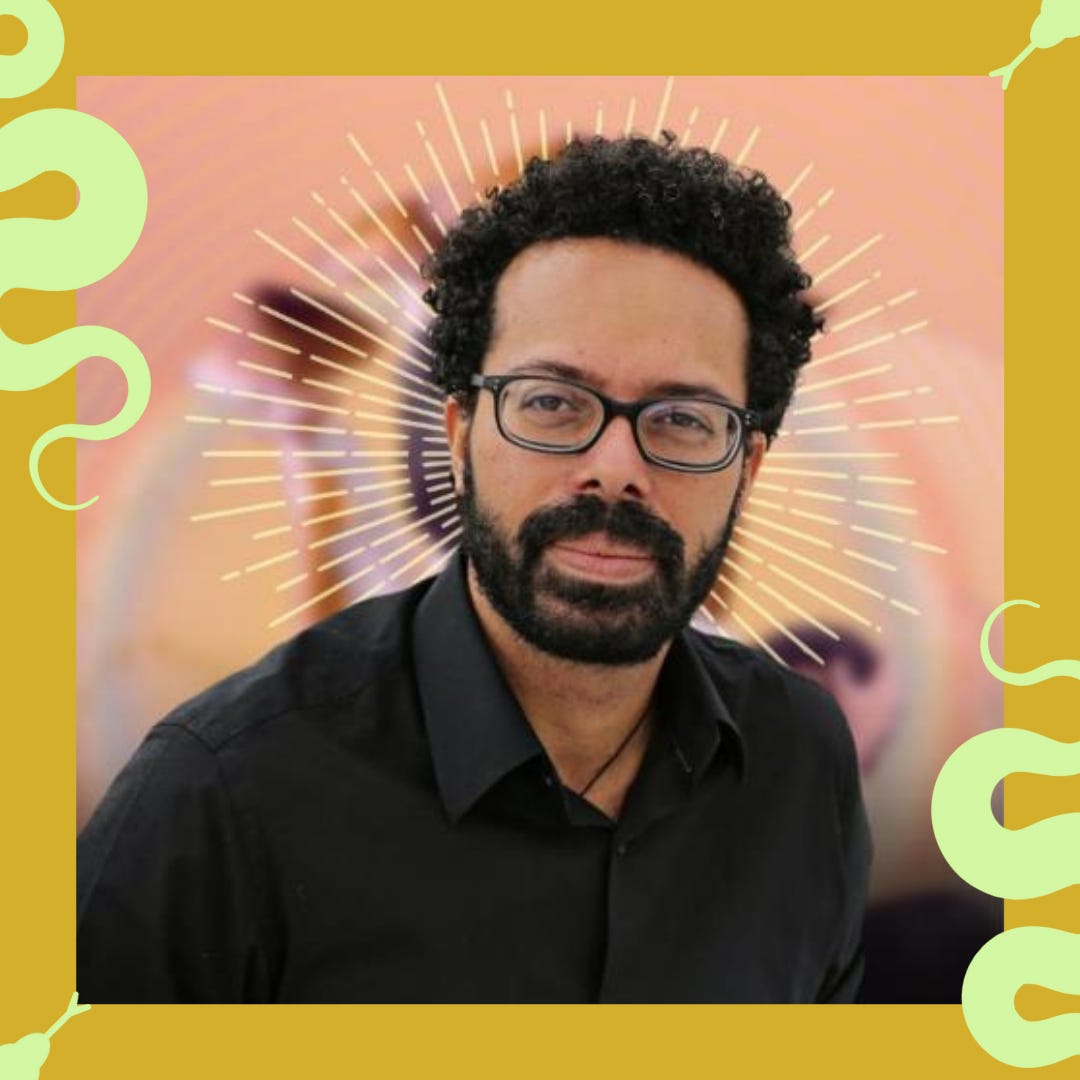
Interview with a Vampire Author and Psychedelic Activist: Nicholas Powers
from Charlotte Dune's Lagoon Hosted by Charlotte Dune
Nicholas Powers, author, teacher, and psychedelic activist, discusses the future of psychedelic therapy, his release from PTSD, and his vampire political novel, Thirst: The Rich are Vampires. Read the interview below, or if you prefer to watch the interviews, please subscribe to my new YouTube channel! Thanks for splashing in Charlotte Dune's Lagoon! Subscribe for free to receive new posts about mind expansion, hot topics, psychedelics, ethical quandaries, and self-experiments, or share this episode with a friend. The following transcription is auto-generated and lightly edited. Interview Transcription: Charlotte: Welcome to Charlotte Dunes Lagoon, where we talk about whatever we want. Nick: I love swimming in the lagoon. I feel like the creature from the Lagoon, so thank you yay! Charlotte: I'm going to let you introduce yourself because I'm sure you can describe your bio better than I can, but I'll just say that you're the author of Thirst, Nicholas Powers. This is an amazing book with incredible writing, a crazy story, and stunning illustrations. I was very impressed. Professional Daydreamer Nick: Thank you! My name is Nick Powers. I'm a professional Daydreamer, and that's my side gig. The way I keep the lights on and food on the table and to make sure child protective services don't take my kid away for starving is I'm a professor of literature at a State University, Old Westbury, which is in Long Island. I live in Brooklyn, and I take the train out to Long Island and teach. The teaching is going very well. I've been doing it for about 16-17 years, and so I think I've got it down to a well-oiled machine, but the students always change, and so the way that you teach changes. This semester, we're doing Caribbean literature. We just finished Daniel Defoe's Journal of the Plague in London during 1665. Now, we're doing Albert Camus Le Pest, which in English is The Plague. In my other class, they’re getting ready to write their senior thesis, which is a 25-page critical essay. So, that's my professor gig. On the side, I advocate for psychedelic therapy. I give a lot of talks, and some of them are paid, and some of them are not. It's more of a passion project, and the goal with that is hopefully to get the Department of Mental Health in New York City and hopefully the surrounding Tri-State areas to follow like a domino effect offering mental health psychedelic therapy as an advanced mental health technique to working-class people and poor people who really need it. Because oftentimes, they face intergenerational trauma, life in the streets, and I think they could benefit from this new high-tech medical technology. Lastly, I'm a father, and I would say probably the most powerful psychedelic I've ever taken is my son. I love him; he brings me incredible amounts of joy and grief all at the same time, sometimes within the space of one minute. Charlotte: How old is your son? Nick: He's four. Charlotte: Oh, wow, that is a joy and terror all at the same time. I have a 15-year-old, so I'm a little ahead of you. My daughter has Asperger, well what they used to call Asperger's or high-functioning autism, so it's a very different experience, I think, for me. But it's a beautiful time. All the times are beautiful, but I like that she and I can have intellectual conversations. We watched Romeo and Juliet, the Baz Luhrmann version, the other night, and her takes on it were so hilarious because they're reading Romeo and Juliet in school, and she was like, "This is giving call the police; this is giving underage date rape; this is like…and on and on” And I’m like, I did not know these words when I was your age, and I'm so glad that this generation exists. I have a lot of hope in Gen Z. People will knock on them, but I'm like, these guys are smart. Yes they're addicted to their phones, but aren't we all at this point? You must have a really interesting perspective teaching young people and seeing firsthand how technology is changing everything, and especially reading about the plague. That must feel really timely. Nick: I taught the literature of the plague in 2021, and you know, that was kind of like at the climax and we were starting to kind of see the light at the end of the tunnel with the vaccines starting to roll out. It became a form of book therapy because the plot reflects or parallels their real life, and so the emotions that the characters feel are emotions that the reader has felt. By expressing what the character is feeling, the reader can then ride along and some of their anxieties can get expressed out through the characters. Some of the depths that they've had to witness and endure - the near-life fatalities, the paranoia about the quarantine, the insecurity about the future that kind of just went up in smoke - all of these emotions are reflected in the text. So, the book, in a sense, allows them to express themselves through reading the book. They actually massage stuck emotions out through their consciousness via the book, and so it becomes a kind of an odd form of psychodynamic therapy where emotions that are stuck start flowing again. I found that it is not surprising because I've seen it before in other courses, but for the students, they're surprised because they remember what literature and art can do as a form of kind of therapeutic expression. Generational Distraction Overall, I've seen the students become dramatically less homophobic, less sexist, and less racist. I started in 2006, or seven, that their attention span decreased. They're more knowledgeable, but they have a hard time judging the quality of the knowledge they acquire. They're more knowledgeable, but they have a hard time judging the quality of the knowledge they acquire. The internet is a great relativizer; you can see anything there, and it all becomes a soup. Without a kind of hierarchical sense of pedigree or quality, or at least gatekeeping, everything can just collide together. The students sometimes have a hard time knowing what's a good argument and what's not a good argument. Finally, I realize that they're such visual thinkers that there's a difference when you think primarily in visuals. It can be very kind of mushy-headed, but when you're reading, reading tightens up the brain. The last thing I've noticed is that as a generation, they're a lot more anxious. I think it's because they're exposed to the judgment of their peers through social media in a dramatic way that those of us who are Gen X and older just weren't. For GenX, we're addicted now, but our deep brain settings were without media. So, if I don't have my phone, I actually feel fine. I feel great. But when they don't have their phone they feel anxious. For us and for people who are older, there's like a federal quality to us. We like being out in the moment, like wild animals and just figuring it out. And if we bite someone or get bitten, that's kind of part of the price of being a feral wolf. For them, they're not feral at all. They're very domesticated. They like to stay inside. Charlotte: They’re house cats. Nick: They hear these 40-year-old parents screaming outside the window and they're like, 'what are you guys doing?' Charlotte: I know. My daughter doesn't want to get her learner's permit to drive because she's like, ‘where would I go? Everything I have is right here inside the computer.' And I'm like, 'oh honey.' You can try to fight it as a parent, but it's very challenging. Both you and I have spent time in countries that were less developed. She grew up in the beginning of her childhood in Cameroon, and I'm glad that she at least had that little bubble of nature and that little bubble of experiencing the world without all of this before she got thrown back into, well, first we moved to Canada and then America, but before she g… This is a public episode. If you would like to discuss this with other subscribers or get access to bonus episodes, visit charlottedune.substack.com
Embed this episode
No transcript yet.