
EPISODE · Apr 22, 2026 · 21 MIN
IPv4 Subnetting - Part 1
from Mapped Learning Podcast · host Jonathan Lincoln
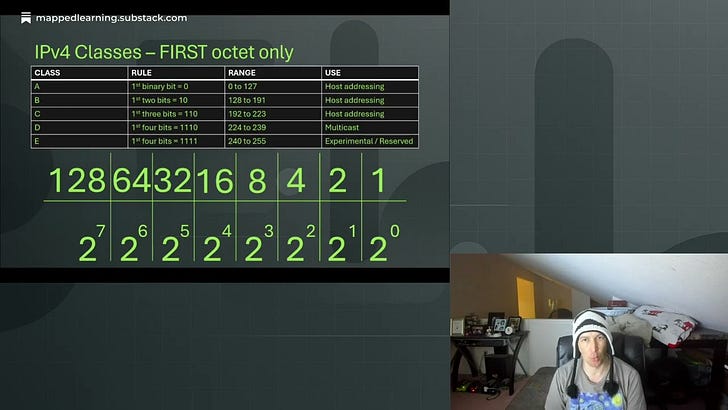
Subnetting has a reputation for being one of the most confusing topics in networking — but that’s usually because people jump straight into the math without understanding the ideas underneath it. In Mapped Learning, we do things differently. Before we calculate anything, we build the mental tools that make subnetting make sense.Today’s lesson is IPv4 Subnetting, Part 1, and it focuses entirely on the foundations:* What CIDR notation really means* How subnet masks are built* What “borrowing bits” actually does* How devices determine their network using AND‑ingThese concepts are the backbone of every subnetting problem you’ll ever solve.⭐ Why start here?Subnetting isn’t just a math exercise — it’s a way of thinking about networks. If you understand why subnetting works, the calculations become predictable instead of intimidating.This lesson gives you that foundation.We slow down, look at the structure of IPv4 addresses, and build the intuition you need before touching formulas or tables.By the end of Part 1, you’ll understand:CIDR NotationHow the /24, /25, /28, etc., define the boundary between network bits and host bits — and how that boundary shapes the entire network.Borrowing BitsHow subnetting creates more networks by shifting bits from the host side to the network side, and why that changes the number of available hosts.Binary MasksHow subnet masks look in binary, and how that binary pattern defines the network.AND‑ingHow devices determine whether two IP addresses are on the same network by performing a simple logical operation.These aren’t tricks — they’re the rules that every router and host follows.⭐ What’s inside the lessonIn the video and slides, we walk through:* A clear explanation of CIDR notation* A breakdown of the CIDR acronym* A visual demonstration of borrowing bits* Binary subnet masks and what they represent* A real AND‑ing example showing two devices on different networksEverything is designed to be simple, visual, and calm — the mapped‑learning way.If you’re new to networking, this will make subnetting feel far less mysterious.If you’re experienced, this will reinforce the fundamentals that make advanced topics easier.⭐ What’s coming nextIn IPv4 Subnetting, Part 2, we’ll take these concepts and turn them into practical skills:* The subnet mask table* The “magic number”* How to calculate networks quickly* Practice exercises to build confidencePart 1 gives you the understanding.Part 2 gives you the speed.⭐ Thanks for being hereEverything I make is free, and it’s built to help you learn clearly and without noise. If this lesson helped you, share it with someone who’s learning too — it makes a real difference.See you in Part 2.Subnetting Part 1 slides with notes:⭐ Watch the lesson (IPv4)🎥 YouTube Video: 📝 Slides + Notes for IPv4: Get full access to Jonathan Lincoln at mappedlearning.substack.com/subscribe
Embed this episode
Ready to play
IPv4 Subnetting - Part 1
No transcript for this episode yet
Similar Episodes
No similar episodes found.