The following podcast is part of the mindbodyspirit.fm podcast network. Let's play Burlington's Guess That Price. Back to school means back to saving. We're bringing you kids jeans starting at, hold on a minute, just $11.99. Burlington's acing this test. What about character backpacks? We've got them starting at $12.99. Burlington's done it again. How about sneakers for the kids? A-plus brands and right on trend starting at $11.99. Saving is now in session. Burlington, deals, brands, wow. Styles and selections vary by location.
Lowe's knows tough jobs call for tougher tools. The new DeWalt Elite Series power tool accessories are built to last for the pro who doesn't stop. With precision fitment, durability, and impact resistance, finishing jobs faster has never been easier. Shop the new DeWalt Elite Series at an everyday low price exclusively at Lowe's. We help. You save.
Are you old enough for this episode? Do you remember when coming out was a big deal in mainstream society and culture? Do you remember hearing the sound of dial-up internet? In this episode, we share our coming out stories, having been raised in evangelical Christian and Catholic households, and we reflect on how the meaning of coming out has changed over the decades. Lots more detailed show notes on the blog, and you should find a link for that in the show notes. But for now, welcome to this episode.
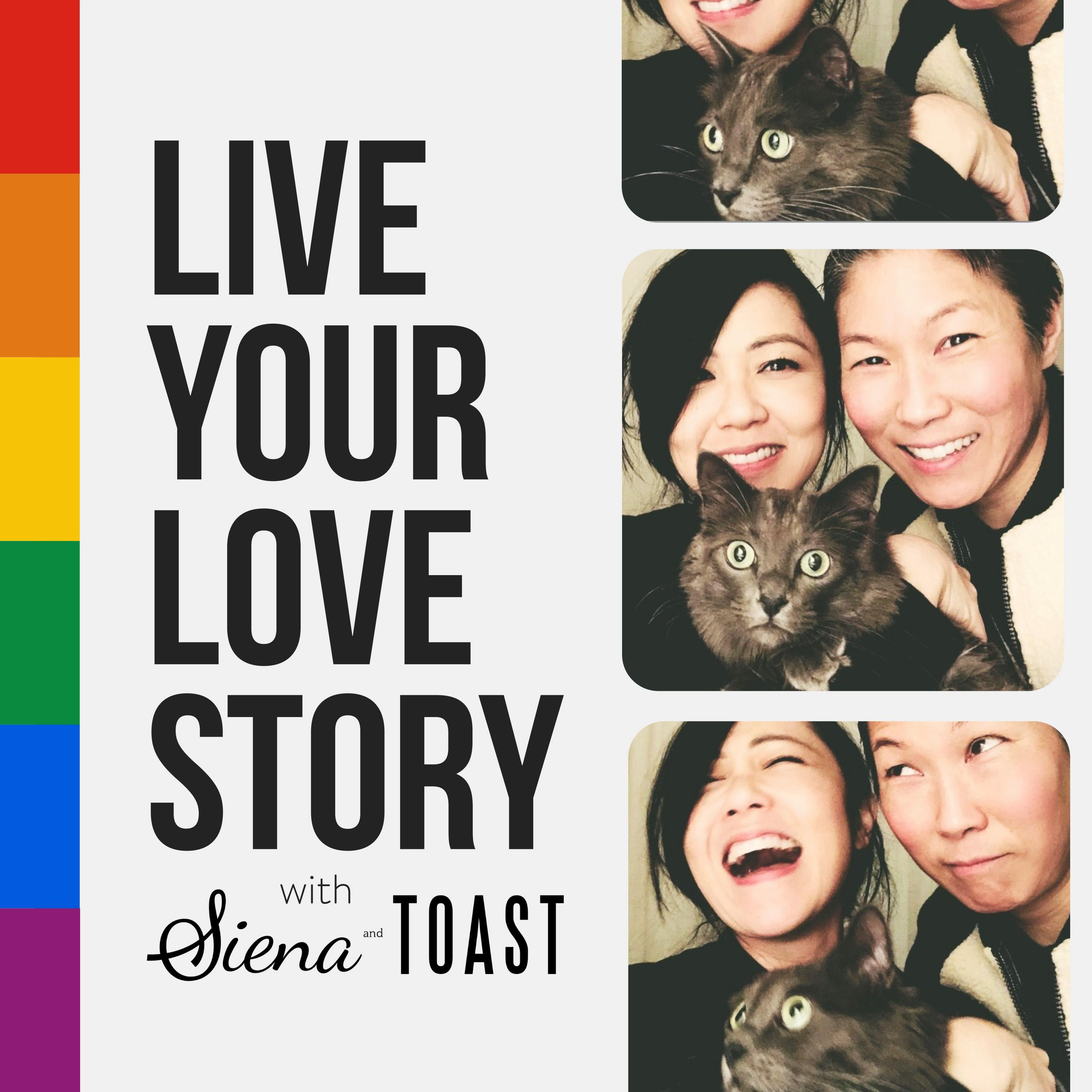
Welcome to the podcast where it's all about living your love story and making your life a story where love wins. My name is Sienna. And my name is Toast. We're married and we've been partners in life, love, and music since 2001, over 20 years. On this show, we share our life as an Asian American lesbian couple. Some of our favorite topics are positive spirituality, holistic health, sometimes cats, lesbian alerts, and other things we hope are entertaining, uplifting, and helpful for living your love story. So here we go. Welcome to our home studio in the Pacific Northwest. Welcome in.
And if you listened to the previous episode, I know we've been gone for a while, a few weeks, have gone by without any new episodes, but we are happy to report the garage is finished with the painting. The lesbians finished painting the garage. Yes, we did. And I'm so excited because the carpet that we have purchased for the garage has also arrived, as well as the carpet non-slip pad. So everything is ready. And our string lights have arrived. So all of these elements are ready to go. We will just add labor. Just add labor. We will share photos of the finished. Well, I think it'll never really be finished, right? Nothing is ever finished. It's only abandoned where we've left off. And I'm excited to have this nice, fresh room. And Bear, our cat, has really been enjoying the...
Galloping the space in that wide open spaces. So we will keep you updated. All right. But. We are planning to release this episode in the week of National Coming Out Day, which we just found out from Wikipedia. It started in 1988, is that what you said? 1988, yes. And I'm going to read a little segment here. The initial idea was grounded in the feminist and gay liberation spirit of the personal being political and the emphasis on the most basic form of activism being coming out to family, friends, and colleagues and living life as an openly lesbian or gay person. The founder's belief was that homophobia thrives in an atmosphere of silence and ignorance and that once people know...
that they have loved ones who are lesbian or gay, they are far less likely to maintain homophobic or oppressive ways. Yay. Yay. So anyways, that's a fancy way of saying it's hard to be prejudiced against people when you actually know those people and realize they're not a-holes or, you know, so effed up, right? They're normal people. It's harder to be prejudiced. What were you going to say? You were going to say something? Well, I was going to say that, so that was National Coming Out Day, originated in 1988.
and so that was back in our day so we are just we are old school lesbians here old school lesbians and in preparing this podcast because we thought okay it's national coming out week so let's let's talk about our coming out stories uh And we've had conversations about this before, how the temperature, the climate seems more welcoming of those growing up gay now than it was during our time. At least in that it's more spoken about gay and lesbians. And I know things are still more challenging for transgendered individuals. And things have gotten crazier again in the past few years, as we all know. But I think that's a backlash. But I do get the sense that people coming out now, people in high school or even earlier.
There is more room to be who you are, who you know you are. Especially, you know, since I see more and more in just forms that you fill out, whether it's an online form or an in-person form, there is a space for your pronouns. And even though that doesn't necessarily mean you're gay or anything like that, it is an openness and an acceptance or maybe not an acceptance, but an acknowledgement. Yes. That, you know, like we're at least talking about it right here. Because when I was growing up in the 70s and 80s.
In the 90s? In the 90s. And I'm still growing up. We're all still growing up. We never finished growing up. But I grew up in an atmosphere where I didn't even realize...
That being gay was a thing. I thought it meant happy. And that's it. That's so funny to me. I did not even know of the concept of anything other than heterosexuality. And that's why I was internally, I think, pretty shaken and traumatized when I realized my own feelings. I'm like, well, I am really weird. Because I didn't know anybody else in the world. But let's tell people, because they may not know, that you were born and raised in a small town in Hawaii. You were raised in Hilo on the Big Island.
And that's a whole different world. It's a country living. Well, it was the 70s and 80s. And I was also raised an evangelical Christian. Well, there we go. Now that changes the whole thing too. Sunday school and five-day club, vacation Bible school. Those of you who are fellow evangelical raised people, you know what I'm talking about. Yeah, the whole thing. So, yeah. So I'm going to take a quick sidebar and bring up this quote that I think most people have heard.
And I don't know who really said it. There's two versions of it. Here's the first one. First, they ignore you. Then they laugh at you. Then they attack you. Then you win. And I've heard it attributed to Gandhi and stuff, but I think it's kind of one of those. I'm not sure exactly who said it. But another version of that is attributed to a philosopher named Arthur Schopenhauer, who said, all truth passes through three stages. First, it is ridiculed. Second, it is violently opposed. Third, it is accepted as being self-evident. And both of those, you know, they kind of overlap. But I like this idea, this concept of first they ignore you, then they laugh at you, then they attack you, then you win. That came to mind as we were preparing for this episode, because I do feel like...
Personally, that was my experience because they ignored homosexual people. That was my experience. That's why I had no clue. You mean the church, your church? Yeah, just the culture at large. It's like, no, we don't talk about that. We just don't talk about it. So it's invisible. But then when it's no longer able to be invisible, when you have to acknowledge it, then they make fun of you. You fag. In Hawaii, the word is mahu. That's the Hawaiian word that people would use to ridicule people. Do you remember what that translates as? Well.
In our day, it translated as fag. No, but literally what the word means. It's literally a Hawaiian word. I don't know the deep, you know, cultural. I'm going to do a quick Google. Go ahead. Okay. And then when laughing, you know, at us past then, then it was like, whoa, whoa, now you want rights. No, we're going to fight against your rights. And back, I think it was in the 90s. Yeah, it was in the 90s. Oh, it's interesting. Can I just say? You're going to share. So mahu is.
means the in-between, the in-between. This Hawaiian term is used to characterize someone who embodies both male and female spirit, like the two spirits. See, that doesn't sound so derogatory, but I know it's all about how you use it, right? Growing up, it was, yeah. But yeah, and then they attacked us, and I remember being involved in Hawaii. There was Prop 8, right? Wasn't it Prop 8, if I remember correctly, where it was one of the first legal challenges to try and get marriage equality. Yeah, and we lost.
But you fought. You were there. Yeah. And you got to fight and be active and you're going to lose some battles on the way to winning because eventually we won. And now it is kind of a legitimate question. It's like, is coming out even still a thing? Right. It's not what it used to be. It used to be a big deal. In fact, I remember. Ooh, this sounds juicy. Again, it was the 90s. And Ellen DeGeneres.
It was on the cover of some national magazine. Probably Time. Time, right? Oh. Was it Yep, She's Gay? Yep, I'm gay. Yep, I'm gay. It was a big, huge deal. It was like, oh, my God. Oh, my God, she's gay. And then I remember, too, there was like some show where there was like, oh, my God, they're going to show a gay kiss. You know, and now it's like, whatever. Yeah. Do you remember the Ellen DeGeneres thing being a big deal? Yep. Yep, I do. Did you guys talk about it with all of your friends and everything? Or did your family say anything about it? You know, no.
Why don't you share your growing up experience compared to mine? Well, first of all, just to tie the loop on the Ellen thing, it was a big deal to me. I felt like, oh, wow. But it wasn't a topic of conversation because I had a lot of gay friends growing up. But more than that, I grew up with gay family members.
You know, so I wonder, I wonder, too, like, how was it for them growing up, you know, kind of paving the way. But I will say that still growing up in Hawaii and being. you know, being Asian, having that cultural piece too. Yeah. You don't talk about it. No one talks about it. No one talks about it at all. It's just more, Oh, bring your friend, you know, bring your friend, my gay aunt, your girlfriend, right. Bring your friend. And then my gay aunties and my gay uncles. Yes. Plural. You know, they would, their partners would be introduced to me as another auntie or another uncle, but in Hawaii.
Whoops. Did you hear that? I did. Okay, I'm going to stop recording. We'll come back. We'll be back. I think the cat knocked something over. I'm Chris Hadfield. I'm an astronaut, an author, a citizen of planet Earth. Join me for a six-part journey into the systems that power the world. Real conversations with real people who are shaping the future of energy. No politics, no empty talk, just solutions-focused conversations on the challenges we must overcome and the possibilities that lie ahead. This is On Energy. Listen wherever you get your podcasts.
At Blinds.com, it's not just about window treatments. It's about you, your style, your space, your way. Whether you DIY or want the pros to handle it all, you'll have the confidence of knowing it's done right. From free expert design help to our 100% satisfaction guarantee, everything we do is made to fit your life and your windows. Because at Blinds.com, the only thing we treat better than windows is you. Visit Blinds.com now for up to 40% off site-wide, plus a professional measure at no cost. Rules and restrictions apply.
All right. All is well. Bear was just knocking down some cans of soup that we had on the counter. So anyways, everything's fine. A can of soup. Fed the cat. Fed him. He's good. We're all good. We can continue on. All right. I forget what you were saying. I don't even know. So, well, so I had gay family members growing up.
And I'm sorry, I interrupted because I just wanted to clarify and get more understanding here because in Hawaii, the culture is very much one where any friend of the family is welcome. And you call them auntie or uncle, any friend of the family. So when you said, oh, but when your uncle's friend comes over, did you feel like it was a different kind of, oh, that's also uncle. I felt growing up, I felt like something was different. I didn't feel an aversion or anything like it was weird.
You know, I didn't feel like other people thought it was weird. It just felt really normal to me growing up. That's so amazing. I mean, but again, no one talked about it, you know, so it wasn't exactly, oh, it's just so accepted. Be gay and be proud. Like no one was talking about it. Okay. But it wasn't, it did not seem like something negative. No one was, you know, so, so that.
And you grew up in a Catholic family. I sure did. I still feel guilty. I mean, yeah, my family was very Catholic, especially my grandma who raised me. And so there's that. But I think the difference between you and me in our coming out, what is it, story or realizations of being gay, I feel like I was a late bloomer in a lot of ways because I didn't have the experience of...
feeling like, oh, I'm gay. Like even as a young, young, young kid. Okay. You know, I went through my whole like early childhood, not having it be a thought. In fact, I was probably more like what they would say, boy crazy, like, you know, with my friends and, and all the, you know, the boys and all that stuff, but it wasn't, I'm sorry. Can I, can I just put a little sparkly fun fact right in right here? Go ahead. With your boy crazy phase here, because I was experimenting. It was a phase. It was a phase. Yep.
Straight face. Because Sienna got to spend a day with Ricky Martin and Menudo. Who ended up being gay. You guys were so, oh my God. There was a picture of Sienna and Ricky Martin together. I did really love him. Well, he was the best looking, cutest little guy. But anyways, yes. Okay, that's true. So I was never feeling like, gosh, I feel different. And then.
Until? Until I went to an all-girls school, which is true, actually. So I went to a Catholic all-girls school from seventh grade up until all the way through when I graduated. And in seventh grade, I met someone who became my best friend. And I was like, huh, this is a different feeling. Like, it was just a different closeness.
I remember when she she tried to kiss me and then I freaked out like I freaked out. I'm like, no, it's not that. Yes, we're close, but it's not that it is not that. And then it was awkward. Right. As you would imagine. Yes. But then there was another person in school and people were kind of teasing this person and me like, oh, that person likes you, you know, when you're a kid. Right.
And I was just like, oh, it's just so stupid, right? This is so stupid. But then I was like, huh, I think I kind of like that person. So after having that other experience with a best friend, and I'm like, no, I'm not. No, I'm not. Maybe it was just not the right person. Because then when the other person came along. Because that doesn't matter. Just to correct my perception, it's not like you just need the body parts. Right, if you're the same sex, oh, look out. Right, and I think that's a misconception.
Right. Yes. No, but people think like we'll need to talk about like our own internal homophobic kind of things, you know, later in another episode. But so anyways, then that's when I went, oh, no, I think I'm gay. And I would pray and pray about it. And just because I felt like I felt like I felt really confused. I think bisexual wasn't even.
And that is what didn't seem like an option to me because I didn't know anyone that was bisexual. I knew either straight people or gay people in my family. So I was like, wait, I couldn't understand why I liked boys. And then all of a sudden, here comes this girl. And then I'm going, wait, what? And I thought you had to be one or the other. Got it. And so I would pray and pray. And I felt like I would pray to God that if this is wrong, then just make me stop feeling this way. That's what I would pray for. And then God didn't change that for me. So then I would just go away.
So then I just kind of went with it. And then I was lucky because in my high school growing up, there were a lot of gay people in my high school. In the all-girls Catholic school, there were a lot of gay people. Yes, that is correct. And so it didn't feel so abnormal. You know, you didn't feel like the only one. So in that way, I...
feel like I was very lucky. How ironic is that, right? Right. And then it wasn't until I went to, it wasn't until I went to college that I experienced some hate crimes and stuff, but which is, which also you would think you'd be fine after you make it through these formative years, you would think, okay, you're good. You're good to go. But no, it's not, it wasn't. It was worse outside of the all girls Catholic school. Yes. And the nuns and bother and all the churchy church, you know, uniforms, but why don't you tell people about.
Oh, and so I'll just tie a loop on this part too and say, so as far as the actual like coming out, I didn't feel the need to come out. You know, the way you came out in my family was just you started bringing your girlfriend around. You started bringing your partner around. And nobody asked any questions. No one said, oh, is that your girlfriend? Nope. You just didn't really talk about it. But there was acceptance by family saying, oh, invite so-and-so to the Christmas party. And then so-and-so would have a Christmas present under the tree. You know, so that's how they showed acceptance. But you didn't talk about it. There wasn't a need to sit down and prepare a talk. Like, okay, I just need to tell you, you know.
And I probably have my great aunt and uncle to thank for that because they had laid the foundation of that this was normal. But maybe before them, it was more difficult. It makes me wonder if they ever had a coming out combo. I never thought of that before. But why don't we move on to your coming out story because it was really different from mine. Yeah. Okay. So here in evangelical Christian world, when I realized, oh, wow, feelings inside of me. And it was early too.
Yeah, I didn't feel like it. Looking back on it, I do recall being in elementary school even and kind of just being aware of regarding other girls in a different way than I regarded other boys. You know what I'm saying? Like really young, really young though. No, I'm making a point because I didn't feel that at all. Like when you say really young, I guess I'm thinking it was probably maybe as young as six, seven. I was going to say third grade, fourth grade. That's ish kind of around that time maybe.
But anyway, OK, so that's in hindsight kind of thing. But I didn't actually deal with that the way I was feeling until I was in college, I would say. Wow. So you just like skipped over. Yeah. In terms of like coming to terms with it and being like, OK, this is a thing. And it calls into question the basis of reality that I have been taught about life. And, you know, through the evangelical Christian teachings. Got it. Yes.
And what made it really exciting was that at this time in my life, I was super involved with church organizations. Like I, you know, was a part of InterVarsity Christian Fellowship. And I flew with my group of fellow Christian people all the way to someplace in Chicago, Champaign-Urbana. They had some international convention with this arena full of other Christian college students just praising Jesus. And, you know, so I was like full on.
into that stuff a jesus lover yes yeah yeah yeah you know um having been taught about all the stuff you know winning all kinds of bible drills and i mean i was into it and then also i'm having feelings and and so the nerdy part of me is like yeah okay You've got to research this. Let me study this on my own because I know what the organization and the institution says about it. They don't say much because they just think it's horrible and awful and you just don't go there. So I needed to study on my own and thank God I did. And that's just when the internet started to become accessible. And I used, probably I used AOL or something like that. Some of you might not know what we just did, but anyways.
And I found, what is it called? Metropolitan, jeez, I forget, community church or something like that. And they were an inclusive Christian church. And I was like, all kinds of materials. And I went to the library to research the original, you know, meaning of certain words in certain books of the Bible that supposedly were condemning, you know, gay people and stuff like that. And I learned a whole bunch such as...
uh, the, the account in the gospels where the centurion, the Roman centurion comes to Jesus and asks Jesus to heal his servant, that, that particular type of servant, that the word that he used for that particular servant was commonly understood to mean that's my young male lover. That was just the culture in that time and place, you know, in the Roman culture. And those of you who are familiar with this story, perhaps you are also a fellow. evangelical Christian history, have a history of that, you'll know that in this particular account, Jesus heals the centurion's servant, quote-unquote servant, and then says about... You're talking like a boy toy. I mean, that's the closest equivalent, I guess, of what we would say. Like not a partner. That's why they were saying a servant, right? Yes. Younger, you know. Other cultures have this around the world, too. Like in Japan, the samurai, they would often have a young lover. Anyway.
The whole point is that this Roman centurion in the Gospels is held up by Jesus himself as having more faith than anyone Jesus has seen in all of Israel. So when you add on this other information about the young lover being loved by the centurion, asking Jesus to heal him, yada, yada, it's like, oh, they don't tell you about this in Sunday school. And there's so many other things like this, and David and Jonathan, and all kinds of stuff. And just learning, too, about history, just the history of civil rights and how... Like women used to be regarded in a certain way. Right. And that was just how it was. And they were second class citizens. Same thing with people who happen to be of African descent, yada, yada. Just just a whole history of how culture changes and what's accepted as normal changes. And I just went through this big, long learning curve just on my own. And so it was a years, years long process. And I would say it took about like 10 years or so, maybe, maybe, maybe longer. You know, there's no firm start point and end point. But I do feel like going through that whole thing kind of.
took up at least a decade or two of my life where it's like I couldn't really do much else almost it's almost I almost feel like my growth as a person or adult in the world got kind of put on hold a little bit yeah you know what i mean it's like oh yeah you grow up and you go to college and then it's like i have to whoa i have to stop because the whole way that you were raised the whole the way that reality works and the world is is not what i thought it was so i have to relearn life like i have to relearn the world um so anyway that's my coming out story well no but what so but then like you had and the whole time you're doing music you realized oh katie lang oh my god she's gay indigo girls right so that was a whole other like wow and you respected you respect their music and all of that so that was a part of it yes and then what about your actual you did come out yes okay to your parents yes so actually i came out to friends here and there one throughout right like as i felt safe yeah and you came out to gay people didn't you yes yes so during that time in my life i was reacquainted with some early early childhood friends we had lost touch you know um for a number of years but then
we saw each other again and we're like okay cool we got to know each other and they happened to be gay so that helped and when you looked back were you like oh yeah see I thought they were oh no because you didn't think that was an option no yeah okay um but I do remember one friend at that time she's not gay but she was a good friend at the time and When I was trying to come out to her, the biggest response I remember from her is, are you sure? Are you sure you're going to live your life this way? Because she was concerned about it being hard. Legitimate concern at that time. And I know you have friends, Sienna, who decided, no, I know that I have gay feelings, but I'm not going to choose that.
It's not a choice, but it's a choice, right? Your feelings are not a choice. Your feelings are not a choice, but what you do with it is a choice. Right. Yeah. So I do. I do have friends who decided to choose a straight life, marry a guy, have children, and live that way. Yeah, I do.
But yes, I did eventually come out to my parents through an email, which felt the safest for me and for them too. They could read it privately, have a reaction, talk about it with each other. And what was their response? Well, thankfully, I don't have a memory of exactly if the response was a phone call or an email. I think it was just an email back. I think it was an email back that basically said, we love you no matter what. You know what I think is so funny? I remember that period for you. And I think...
I think that the really funny part to me is that I believe your email opened up the conversation for your dad to feel safe now questioning all the friends he knew of yours and going, oh, what about this person? What about that person? What about them? How about this person? Asking if all these people were gay or not because he had suspected. I think most of them he said were. Anyways, I thought it was pretty funny. I do remember that. He embraced it, right? Well, I don't know. Embrace is a strong word, but he felt free to ask about my circle of friends.
So now you know our coming out stories in general. Yep. And just to kind of wrap up, as Sien and I were preparing for this topic and this week of National Coming Out Day and all that stuff, it's been really gratifying to realize that over time, I think in general, this is a very generalized statement, but in our culture, coming out used to be, the main focus of coming out used to be like, it's a big deal. yeah, you're going to be on the cover of a magazine. It's going to cause controversy. You're going to stir up all kinds of things in your family. And oh my gosh, huge, huge, huge. And so that was kind of, that felt like the focus of coming out day, you know, like it's scary and serious and there's trepidation there. Yeah. And over time, I mean, it's taken decades, but now when I think of the idea of coming out day, it feels like the focus is different and the focus feels more in general in our society.
Like there's room for having the focus be on gratitude and appreciation that more of us can just be out. Yeah. Like we're out and it's okay. And it's not that big of a deal in general. Yeah. Very generalized statement. Yeah. Because I do, because I think we opened this up by saying like, do we still even need to come out anymore? Like, is that even a thing? And I do believe that there will always be a place for it. Absolutely. You know, there will always be people.
Who are trying to come out. It so depends on what culture you're in. Where you live. What small town you might be from. All of that. And the way that we're going to continue as a society. To keep coming out. Being not that big of a dangerous deal. As it used to be. I understand it is still dangerous for some people. That should definitely be a consideration. For people who are considering to come out. But the way it's going to continue to progress. Is if more of us are out.
Yeah, that's true. Like how you first read in the Wikipedia entry. So people who know you know you and know a gay person, know gay people. They're not scary. We're not trying to convert people and brainwash people. And I think the same is true for transgender folks. It's that whole thing of like you do know a gay person. You just don't know that they're gay. And I think the same is true for transgender people. It's like a lot of times, yes, you have interacted with a transgender person. You just don't realize it. So it's like if we can be out, yes, that helps other people.
Okay. We're going to wrap it up. That's it. Thanks for joining us. That was our coming out episode for now. We'll probably do a whole bunch more adjacent to the whole idea of coming out and all that. I feel like, oh, can I still say something? I don't know. Can you? I think I can. Okay. I feel like because we're old school, like we're older, I feel like the whole pronoun thing really was difficult for me. And it still is in a way. Okay. That's a whole other episode. It is a whole other episode, but I feel like as an older person that I feel like now it's tricky terrain. So we need to do a podcast. The pronoun thing? Well, just.
There are so, it feels like there are so many options, you know, available in terms of how people express themselves, who they know to be in that moment, how safe they feel being, you know, to what extent they're really going to be who they know they are. And so when you see someone, that's what you have to judge them by, right? You don't know them, you see them. Like say, like I'm thinking about someone at the plant store that we go to that's very, um, friendly. And I saw a person there and, um, he was just beautiful.
but he was wearing, right. But I don't know the pronouns. Yeah. Is that what you're kind of talking about? It's difficult. Right. And, but it was, um, it, the person looked male.
Okay. See, I feel like, oh my God, I'm going to say it all wrong. The person looked male, but the person was wearing a dress and had a little bit of makeup on. But does that make them transgender? It doesn't. So you can't, and does that make the person a they? The person could be a she. Right. So you just don't know. And that for me as an older lesbian person, that's where I feel like, oh my God, it's tricky. Help me, help me. Yes. And then I don't say anything with a pronoun that might offend. And it's more just, hi.
You know, let me look closer at your name tag in case there are pronouns there. Yeah. Yeah. It's tricky. It's an exciting time. Some things I feel like have gotten more difficult, I think. Yeah. Relative. Relative. The area of difficulty has shifted. Shifted. Yeah. All right. That's all I wanted to add. Okay. That's good. Oh, my gosh. So many good things to talk about. Okay. Look us up on Instagram. We are Sienna and Toast. That's it. All one word. Sienna is spelled with one N.
Sienna and Toast on Instagram. And that's pretty much like where we are. That's where we are. If we do any social media stuff, that's where it is. We have accounts from other places also as Sienna and Toast. But you are Instagram. That's where we are. Okay. And that's also our website, SiennaandToast.com. So thanks for listening. Happy coming out to you. Bye. Live your love story and all that good stuff.