Is Somalia ready for E-Visa?
from Somali Waa kuma Podcast Hosted by MI
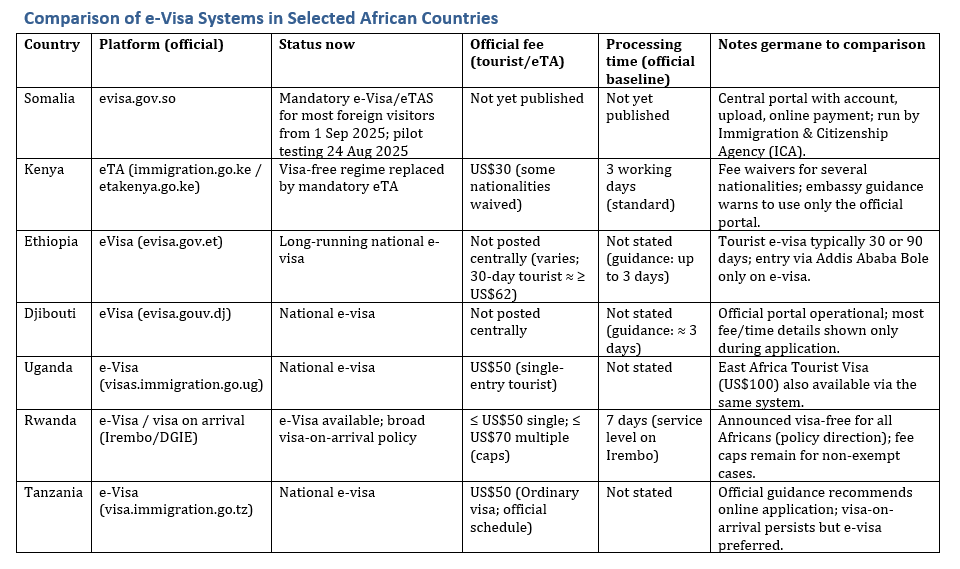
This is MI’s 5 Minutes of Fame for Week 36 of 2025, written from Perth, Australia. Somalia’s launch of a fully digital e-Visa system is undeniably good news, signaling progress in governance and mobility. Yet, as aggregated by my AI-enabled analytic tools from the online Somali discourse, the questions are less about the technology itself and more about institutional credibility. Can this reform be sustained beyond short-term visibility? Will regulation keep pace with the promises of digital transformation to turn this encouraging step into lasting progress? Somalis online are asking: Can the country’s institutions deliver beyond symbolism? Will government shortcuts erode public trust? Is fragile governance strong enough to sustain e-Visa reform? Somalia and the Promise of E-Visa Reform Electronic visa platforms have become a defining feature of contemporary mobility governance. More than 130 states now operate such systems, which collectively process over half of global visa applications. Their advantages are well documented: they reduce administrative burdens, eliminate the need for physical visits to embassies, and allow applicants to retain their passports during processing. By digitizing applications, governments strengthen fiscal oversight, expand pre-arrival screening capacity, and improve the scalability of decision-making. In Africa, regional experiments such as the East Africa Tourist Visa illustrate how digital authorizations can foster integration and stimulate tourism. These benefits are tempered by persistent challenges. Inconsistent fee structures, opaque use of intermediaries, and variable processing times undermine accessibility and trust. Nigeria processes applications within 16–48 hours, whereas South Africa ranges from five to thirty-five days. Intermediaries such as VFS Global have faced repeated criticism over inflated costs and data security breaches. Furthermore, the absence of widespread reciprocal agreements highlights Africa’s fragmented approach to digital visas and constrains their broader economic potential. Against this backdrop, Somalia’s launch of a fully digital e-Visa and electronic travel authorization system in September 2025 is a notable institutional milestone. Managed by the Immigration and Citizenship Agency through a centralized online portal, the system allows applicants to create accounts, upload documents, and process payments electronically. The reform enhances transparency by directing revenues to the Ministry of Finance and strengthens border security through systematic pre-arrival screening. Exemptions are reserved for diplomats, residents, and nationals covered by free-movement agreements, while most travelers are required to comply with the new system. Somalia’s initiative aligns it with regional peers such as Kenya, Rwanda, and Uganda, where digital visa systems are now firmly established (See table above, am using data publicly published). Yet important gaps remain. Somalia has not published its fee structures or processing timelines, in contrast to Kenya and Rwanda, which provide clear benchmarks on both costs and expected turnaround. Such omissions risk eroding traveler confidence and reducing the competitiveness of Somalia’s system. Experience across Africa also suggests that where third-party intermediaries dominate, risks of fraud and inequitable access increase. Direct government communication and regulation will therefore be critical. What is the problem with Somali E-Visa system? As hinted in the introduction my AI-enabled analytic tools from the online Somali discourse, the questions are less about the technology itself and more about institutional credibility and a user of the new e-visa system wrote about serious flaws in Somalia’s new online visa system. I have applied and will write more on this soon. Let me share the experience of one user summarized here who can be searched via google if one is interested. He wrote that although he obtained and paid for a $64 visa, upon arrival in Garowe immigration demanded another $60, forcing passengers including a mother of three who had already spent $496, to pay twice. He framed this as a wider problem rooted in the political dispute between the Federal Government of Somalia (FGS) and Puntland, where ordinary citizens suffer the consequences of institutional fragmentation and predatory practices. He stressed that immigration is constitutionally a federal mandate and condemns the double-charging as exploitative, harmful, and undermining of social trust. I partially agree with this person on the urgent need for action, urging federal and state leaders to resolve the issue immediately, prioritize citizens’ dignity, and end practices that burden ordinary Somalis with additional costs and uncertainty. The controversy surrounding Somalia’s newly introduced e-Visa system underscores a deeper structural problem within the country’s governance framework: the incomplete and poorly implemented federal system. Although immigration is constitutionally defined as a federal mandate, practical enforcement remains fragmented. The episode reported in Garowe, where travelers were compelled to pay twice despite holding valid visas, illustrates how state authorities often act autonomously, disregarding federal protocols. This reflects a persistent contestation of authority in Somalia, where the federal government’s institutional weakness permits regional administrations to exert parallel or conflicting powers. Such practices not only erode policy coherence but also undermine the credibility of reforms intended to modernize public administration and facilitate mobility. The e-Visa case thus cannot be viewed simply as a technical failure of digital service delivery; rather, it reveals the contested sovereignty between federal and state entities. In contexts such as Puntland, local authorities often perceive themselves as equal to, rather than subordinate to, the federal government, and act accordingly in matters of revenue collection and regulatory enforcement. The result is a fragmented governance environment in which citizens and travelers bear the costs of political competition through duplicative fees and institutional inconsistency. Unless Somalia resolves these fundamental questions of federal authority and implements clear mechanisms of intergovernmental coordination, even well-designed digital reforms will remain vulnerable to local capture, undermining both public trust and the broader state-building project. Somalia’s e-Visa initiative is thus a welcome development, even if the concept is not entirely new. Earlier attempts at digital visa reform faltered due to institutional weakness, but the current system reflects a stronger commitment to modern governance. Its long-term success will depend on embedding transparency, accountability, and reciprocity within a coherent regulatory framework that supports both national state-building objectives and continental mobility aspirations. Somalia’s introduction of a fully digital e-Visa/eTAS system in September 2025 marks a significant institutional milestone in its efforts to modernize border management and align with global digital governance practices. Administered by the Immigration and Citizenship Agency (ICA) through a centralized portal, the system enables applicants to create accounts, submit documents, and process payments online, thereby reducing reliance on paper-based procedures and embassy visits. The reform also embeds fiscal transparency by directing visa revenues directly to the Ministry of Finance and bolsters security through enhanced pre-arrival screening. While exemptions apply to diplomats, residents, and nationals under bilateral free-movement agreements, the new system is mandatory for most travelers, signifying a decisive shift toward structured border regulation. In comparative region… This is a public episode. If you would like to discuss this with other subscribers or get access to bonus episodes, visit somalia.substack.com
Embed this episode
No transcript yet.