
EPISODE · May 20, 2026 · 5 MIN
Is the ‘Yellow Envelope’ act behind unions’ emboldened bonus push?
from Korea JoongAng Daily - Daily News from Korea · host KIM YEON-JOO
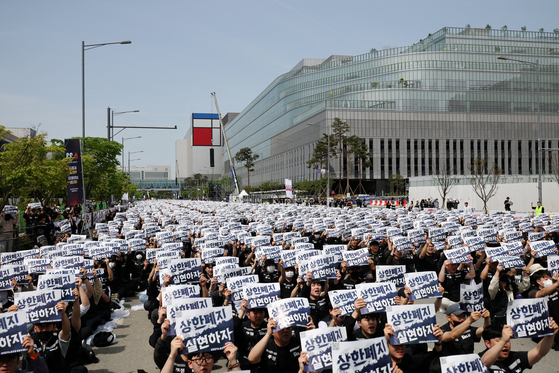
This article is by Kim Yeon-joo and read by an artificial voice. Profit-sharing demands are sweeping Korea's biggest conglomerates. Unions at Samsung Electronics, LG U+, Kakao and HD Hyundai Heavy Industries have all pressed this year for a fixed share of operating profits as bonus pay. While unions secured stronger legal protections when the "Yellow Envelope" law took effect in March, the latest demands can't be entirely pinned on the legislation. But some labor lawyers say the law has made it easier for unions to escalate such demands into legal strike action, raising concerns that a measure originally pitched as protection for subcontractor workers is being put to use by big-company unions. The law's original aim was to widen the legal definition of "employer" under the Trade Union and Labor Relations Adjustment Act. The change was meant to give subcontractor unions a real bargaining counterpart and ease the Korean labor market's dual structure, where workers at large conglomerates enjoy strong union protections and stable employment while those at subcontractors and smaller firms have far fewer rights and little bargaining power. But the amendment also added "management decisions that affect working conditions" as a legitimate cause of labor disputes, and major company unions have been quick to use it. "In the past, there were different views on whether performance bonuses should be classified as part of working conditions or as a management decision," said Lee Kwang-sun, an attorney at Yulchon law firm. "But now that the Yellow Envelope act has expanded the scope of labor disputes, performance bonuses are also more likely to become legitimate subjects of collective action. We're already seeing various management-related demands appear on union agendas," Lee explained. Korean labor law distinguishes between two categories in labor-management negotiations. One covers issues that can lawfully trigger a strike if negotiations break down, while the other concerns issues that can be discussed in talks but are not legitimate grounds for a strike. Whether performance bonuses count as wages and working conditions or as a matter of management's authority has been contested in practice. If classified as the former, a standoff on bonuses can legally result in a strike. If treated as the latter, they sit closer to the issues that may be open to a legal challenge over a strike. As the Yellow Envelope law broadens the definition of labor disputes, experts say not just performance bonuses but matters that touch on management decisions can now form the basis for a legitimate protest. "In the past, there was room to challenge the legitimacy of a strike based on a management decision like performance bonuses," said Park Ji-soon, a professor at Korea University School of Law. "But with the Yellow Envelope law in place, industrial action that used to be limited to improving working conditions is now being expanded to cover the distribution of excess corporate profits and even areas of management judgment." The demands have been concentrated at conglomerates with strong recent earnings, which makes it difficult to directly blame the Yellow Envelope law, but the legislation has played a significant role in pushing those demands to the brink of strikes, Park said. The union at Samsung Biologics has asked the company to set up a joint labor-management council and proposed a collective agreement that would require the council's approval on matters such as introducing new machinery and technology as well as changes to work processes. Hyundai Motor's union has included guarantees on employment and working conditions after AI-based production lines are introduced as part of this year's wage and collective bargaining demands. The HMM union is raising the possibility of invoking the law in the planned relocation of the shipping line's headquarters, arguing that the move has a big impact on working conditions. Not every legal expert agrees that pe...
Embed this episode
NOW PLAYING
Is the ‘Yellow Envelope’ act behind unions’ emboldened bonus push?
No transcript for this episode yet
Similar Episodes
No similar episodes found.
Similar Podcasts
No similar podcasts found.